Thank you for visiting SNEWPapers!
Sign up free
Editorial
June 15, 1862
Sunday Dispatch
New York, New York County, New York
What is this article about?
Editorial criticizes North Carolina Military Governor Stanley for exiling a loyal citizen due to his brother's anti-slavery book, deeming it a graver offense than closing colored schools; argues against abuse of martial law and calls for tolerating opinion to reform the South amid Civil War.
Clipping
OCR Quality
95%
Excellent
Full Text
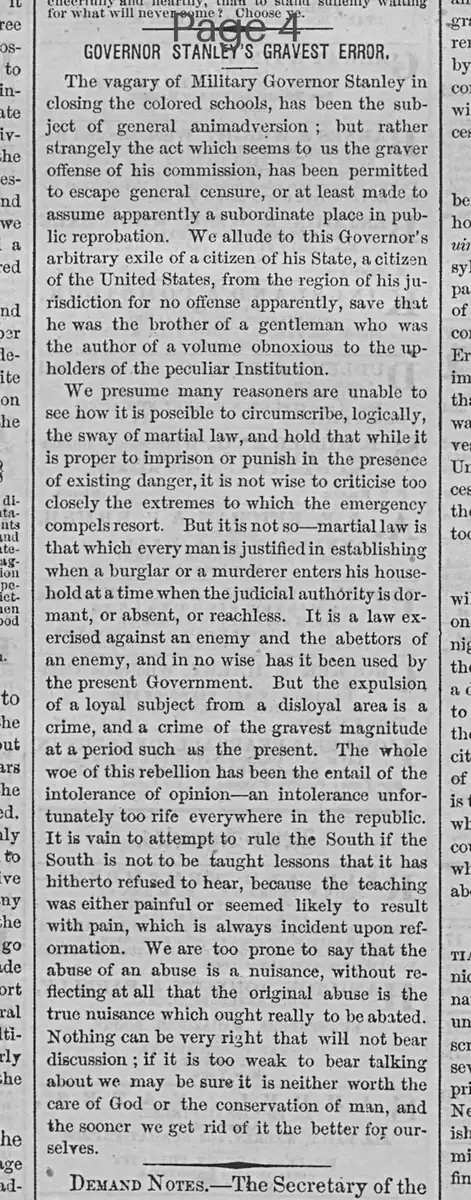
Governor Stanley's Gravest Error.
The vagary of Military Governor Stanley in closing the colored schools, has been the subject of general animadversion; but rather strangely the act which seems to us the graver offense of his commission, has been permitted to escape general censure, or at least made to assume apparently a subordinate place in public reprobation. We allude to this Governor's arbitrary exile of a citizen of his State, a citizen of the United States, from the region of his jurisdiction for no offense apparently, save that he was the brother of a gentleman who was the author of a volume obnoxious to the upholders of the peculiar Institution.
We presume many reasoners are unable to see how it is possible to circumscribe, logically, the sway of martial law, and hold that while it is proper to imprison or punish in the presence of existing danger, it is not wise to criticise too closely the extremes to which the emergency compels resort. But it is not so—martial law is that which every man is justified in establishing when a burglar or a murderer enters his household at a time when the judicial authority is dormant, or absent, or reachless. It is a law exercised against an enemy and the abettors of an enemy, and in no wise has it been used by the present Government. But the expulsion of a loyal subject from a disloyal area is a crime, and a crime of the gravest magnitude at a period such as the present. The whole woe of this rebellion has been the entail of the intolerance of opinion—an intolerance unfortunately too rife everywhere in the republic.
It is vain to attempt to rule the South if the South is not to be taught lessons that it has hitherto refused to hear, because the teaching was either painful or seemed likely to result with pain, which is always incident upon reformation. We are too prone to say that the abuse of an abuse is a nuisance, without reflecting at all that the original abuse is the true nuisance which ought really to be abated.
Nothing can be very right that will not bear discussion; if it is too weak to bear talking about we may be sure it is neither worth the care of God or the conservation of man, and the sooner we get rid of it the better for ourselves.
The vagary of Military Governor Stanley in closing the colored schools, has been the subject of general animadversion; but rather strangely the act which seems to us the graver offense of his commission, has been permitted to escape general censure, or at least made to assume apparently a subordinate place in public reprobation. We allude to this Governor's arbitrary exile of a citizen of his State, a citizen of the United States, from the region of his jurisdiction for no offense apparently, save that he was the brother of a gentleman who was the author of a volume obnoxious to the upholders of the peculiar Institution.
We presume many reasoners are unable to see how it is possible to circumscribe, logically, the sway of martial law, and hold that while it is proper to imprison or punish in the presence of existing danger, it is not wise to criticise too closely the extremes to which the emergency compels resort. But it is not so—martial law is that which every man is justified in establishing when a burglar or a murderer enters his household at a time when the judicial authority is dormant, or absent, or reachless. It is a law exercised against an enemy and the abettors of an enemy, and in no wise has it been used by the present Government. But the expulsion of a loyal subject from a disloyal area is a crime, and a crime of the gravest magnitude at a period such as the present. The whole woe of this rebellion has been the entail of the intolerance of opinion—an intolerance unfortunately too rife everywhere in the republic.
It is vain to attempt to rule the South if the South is not to be taught lessons that it has hitherto refused to hear, because the teaching was either painful or seemed likely to result with pain, which is always incident upon reformation. We are too prone to say that the abuse of an abuse is a nuisance, without reflecting at all that the original abuse is the true nuisance which ought really to be abated.
Nothing can be very right that will not bear discussion; if it is too weak to bear talking about we may be sure it is neither worth the care of God or the conservation of man, and the sooner we get rid of it the better for ourselves.
What sub-type of article is it?
Constitutional
Slavery Abolition
Moral Or Religious
What keywords are associated?
Governor Stanley
Martial Law
Citizen Exile
Colored Schools
Peculiar Institution
Intolerance Of Opinion
Southern Reformation
What entities or persons were involved?
Governor Stanley
Editorial Details
Primary Topic
Criticism Of Governor Stanley's Arbitrary Exile Of A Citizen
Stance / Tone
Strongly Critical Of Arbitrary Martial Law Abuse And Intolerance Of Anti Slavery Opinion
Key Figures
Governor Stanley
Key Arguments
Exile Of A Loyal Citizen For His Brother's Anti Slavery Book Is A Grave Crime
Martial Law Applies Only To Enemies, Not Loyal Subjects
Intolerance Of Opinion Caused The Rebellion
South Must Be Taught Painful Lessons For Reformation
Nothing Right Can Avoid Discussion