Thank you for visiting SNEWPapers!
Sign up free
The Liberator
Boston, Suffolk County, Massachusetts
What is this article about?
In a letter from Boston dated March 28, 1853, a correspondent critiques Wendell Phillips while defending other Garrisonian abolitionists against Horace Mann's arguments. The writer praises Mann's rebuttals, seeks constitutional clarification on fugitive slave rendition, and expresses willingness to engage in political office if scruples are resolved, emphasizing shared patriotism among abolitionists and Free Soilers.
Clipping
OCR Quality
Full Text
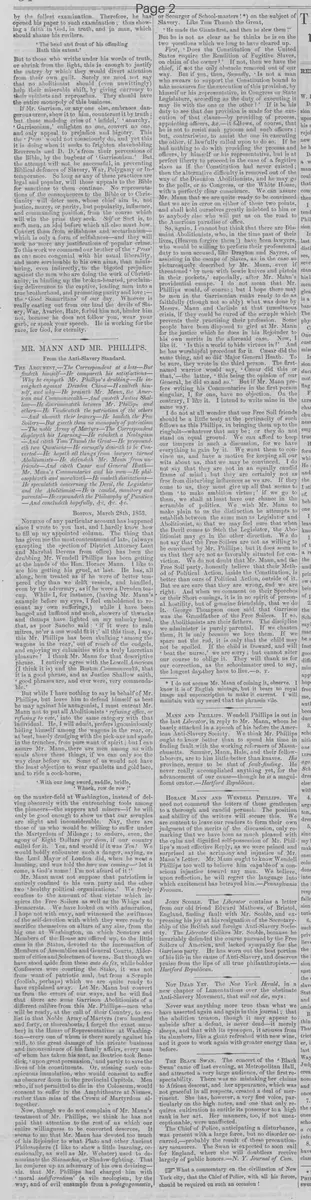
From the Anti-Slavery Standard.
The Argument.—The Correspondent at a loss—But findeth himself—He compareth his satisfactions—Why he enjoyeth Mr. Phillips's drubbing—He inveigheth against Dresden China—Exalteth himself, and why—He praiseth Mr. Mann, the American and Commonwealth—And quoteth Justice Shallow—He discriminateth between Mr. Phillips and others—He vindicateth the patriotism of the others—And showeth their bravery—He laudeth the Free Soilers—But giveth them no monopoly of patriotism—The noble Army of Martyrs—The Correspondent displayeth his Learning—He rebuketh a Neologism And citeth Tom Thumb the Great—He propoundeth two Questions—He earnestly desireth to be Converted—He hopeth all things from lawyers turned Abolitionists—He defendeth Mr. Mann from un-friends—And citeth Cæsar and General Heath—Mr. Mann's Commentaries and his own—He philosophizeth and moralizeth—He maketh distinctions—He speculateth concerning the Devil, the Legislator and the Abolitionist—He is candid, monitory and parental—He expoundeth the Philosophy of Punition—And concludeth hopefully, &c. &c. &c.
BOSTON, March 28th, 1853.
Nothing of any particular account has happened since I wrote to you last, and I hardly know how to fill up my appointed column. The thing that has given me the most contentment of late, (always excepting the ejection of District Attorney Lunt and Marshal Devens from office) has been the drubbing Mr. Wendell Phillips has been getting at the hands of the Hon. Horace Mann. I like to see him getting his gruel, at last. He has, all along, been treated as if he were of better tempered clay than we deft vessels, and handled, even by the adversary, as if he were a Dresden tea-cup. While I, for instance, (having Mr. Mann's example before my eyes, I feel emboldened to recount my own sufferings,) while I have been banged and buffeted and such, showers of thwacks and thumps have lighted on my unlucky head, that, as poor Sancho said: if it were to rain mitres, ne'er a one would fit it;' all this time, I say, this Mr. Phillips has been skulking 'among the wagons in the rear,' out of reach of the cudgels, and enjoying my calamities with a truly Lucretian pleasure! I thank Mr. Mann for that descriptive phrase. I entirely agree with the Lowell American (I think it is) and the Boston Commonwealth, that it is a good phrase, and as Justice Shallow saith, 'good phrases are, and ever were, very commendable.'
But while I have nothing to say in behalf of Mr. Phillips, but leave him to defend himself as best he may against his antagonist, I must entreat Mr. Mann not to put all Abolitionists 'refusing office, or refusing to vote,' into the same category with that individual. He, I will admit, prefers ignominiously hiding himself among the wagons in the rear, or, at best, basely drudging with the pick-axe and spade in the trenches, from pure want of spirit; but I can assure Mr. Mann, there are men among us with souls above these things, if we can only see the way clear before us. Some of us would not have the least objection to wear epauletts and gold lace, and to ride a cock-horse,
With our long sword, saddle, bridle,
Whack, row de row !'
on the muster-field at Washington, instead of delving obscurely with the entrenching tools among the pioneers—the sappers and miners—if he will only be good enough to show us that our scruples are slight and inconsiderable. Nay, there are those of us who would be willing to suffer under the Martyrdom of Mileage; to endure, even, the agony of Eight Dollars per diem, if our country called for it. Yea, and would if it was Ten! We would boldly encounter such a danger, saying, as the Lord Mayor of London did, when he went a hunting, and was told the hare was coming—' let it come, a God's name! I'm not afeard of it!'
Mr. Mann must not suppose that patriotism is entirely confined to his own party and the other two 'healthy political organizations.' We freely confess to the amount of that virtue which inspires the Free Soilers as well as the Whigs and Democrats. We have looked on with admiration, I hope not with envy, and witnessed the swiftness of the self-devotion with which they were ready to sacrifice themselves on altars of any size, from the big one at Washington, on which Senators and Members of the House are offered up, to the little ones in the States, devoted to the cremation of Members of Assemblies and General Courts, Aldermen of cities and Selectmen of towns. But though we have stood aside from these auto da fé, while bolder Confessors were courting the Stake, it was not from want of patriotic zeal, but from a Scruple (foolish, perhaps) which we are quite ready to have explained away. Let Mr. Mann but convert us from the errors of our ways, and he will find that there are some Garrison Abolitionists of a different calibre from this Mr. Phillips—men who will be ready, at the call of their Country, to enlist in that Noble Army of Martyrs (two hundred and forty, or thereabouts, I forget the exact number) in the House of Representatives at Washington—every one of whom is there sorely against his will, to the great damage of his private business and inconvenience of his family affairs, every man of whom has taken his seat, as Beatrice took Benedick, 'upon great persuasion,' and partly to save the lives of his constituents. Or, missing such conspicuous immolation, who would consent to suffer an obscurer doom in the provincial Capitols. Men who, if not permitted to die in the Colosseum, would consent to suffer in the Amphitheatre at Nismes, rather than miss of the Crown of Martyrdom altogether.
Now, though we do not complain of Mr. Mann's treatment of Mr. Phillips, we think he has not paid that attention to the rest of us which our entire willingness to be converted deserves. It seems to me that Mr. Mann has devoted too much of his Rejoinder to what Plato and other Ancient Philosophers (I like to show a little learning, occasionally, as well as Mr. Webster) used to denominate the Skiomachia, or Shadow-fighting. That he conjures up an adversary of his own devising, viz. that Mr. Phillips had charged him with 'moral indifferentism' (a vile neologism, by the way, and of evil ensample from a pedagogomastix, or Scourger of School-masters! *) on the subject of Slavery. Like Tom Thumb the Great,
He made the Giants first, and then he slew them!'
But he is not as clear as he thinks he is on the two questions which we long to have cleared up.
First, Does the Constitution of the United States require the Rendition of Fugitive Slaves, on claim of the owner?' If not, then we have the chief, if not the only obstacle removed out of our way. But if yea, then, Secondly, Is not a man who swears to support the Constitution bound to take measures for the execution of this provision, by himself or his representative, in Congress or State Legislature, according as the duty of executing it may lie with the one or the other?' If it be his duty to see that due provision is made for the execution of that clause—by providing of process, appointing officers, &c.—it follows, of course, that he is not to resist such process and such officers; but, contrariwise, to assist the one in executing the other, if lawfully called upon to do so. If he had nothing to do with providing the process and officers, by himself or his representative, but is at perfect liberty to proceed in the case of a fugitive slave as if the Constitution had never existed; then the alternative difficulty is removed out of the way of the Disunion Abolitionists, and he may go to the polls, or to Congress, or the White House, with a perfectly clear conscience. We can assure Mr. Mann that we are quite ready to be convinced that we are in error on either of these two points, and shall hold ourselves greatly indebted to him or to anybody else who will put us on the road to the American paradise of office.
So, again, I cannot but think that there are Disunion Abolitionists, who, in the time past of their lives, (Heaven forgive them!) have been lawyers, who would be willing to perform their professional duty to men accused, like Drayton and Sayres, of assisting in the escape of Slaves, as in the case so picturesquely described by Mr. Mann, even if threatened by men with bowie knives and pistols in their pockets,' especially, after Mr. Mann's providential escape. I do not mean that Mr. Phillips would, of course; but I hope there may be men in the Garrisonian ranks ready to do as faithfully (though not so ably) what was done by Messrs. Mann and Carlisle at that tumultuous crisis, if they could be cured of the scruple which prevents their practising their profession. Some people have been disposed to gird at Mr. Mann for the justice which he does in his Rejoinder to his own merits in the aforesaid case. Now, I like it. 'Is this a world to hide virtues in?' And he has worshipful precedent for it. Cæsar did the same thing, and so did Major General Heath. To be sure, they wrote in the third person. The first-named warrior would say, 'Cæsar did this or that,'—the latter, 'this being the opinion of our General, he did so and so.' But if Mr. Mann prefers writing his Commentaries in the first person singular, I, for one, have no objection. On the contrary, I like it. I intend to write mine in the same way.
I do not at all wonder that our Free Soil friends should be a little testy at the pertinacity of such fellows as this Phillips, in bringing them up to the ringbolt—whatever that may be; or they do not stand on equal ground. We can afford to keep our tempers in such a discussion, for we have everything to gain by it. We want them to convince us, and have a motive for keeping all our wits about us, that we may be convinced. I do not say that they are not in an equally candid frame of mind: but they are certainly not as free from disturbing influences as we are. If they come to us, they must give up all that seems to them 'to make ambition virtue;' if we go to them, we shall at least have our chance in the scramble of politics. We wish Mr. Mann to make plain to us the distinction he attempts to establish between the same man as Legislator and Abolitionist, so that we may feel sure that when the Devil comes to fetch the Legislator, the Abolitionist may go in the other direction. We do not say that the Free Soilers are not as willing to be convinced by Mr. Phillips; but it does seem to us that they are not as favorably situated for conviction. We do not doubt that Mr. Mann, and the Free Soil party, honestly believe that their Method of Political Action, inside the Constitution, is better than ours of Political Action, outside of it. But we are sure that they are wrong, and we are right. And when we comment on their Speeches or their Short comings, it is in no spirit of personal hostility, but of genuine friendship, that we do it. George Thompson once said that Garrison was the Grandfather of the Free Soilers. If so, the Abolitionists are their fathers. The discipline we administer is purely parental. If we chasten them, it is only because we love them. If we spare not the rod, it is only that the child may not be spoiled. If the child is froward, and will 'beat the nurse,' we are sorry; but cannot alter our course to oblige it. They will thank us for our correction, as the schoolmaster used to say, the longest day they have to live.—D. Y.
* I do not accuse Mr. Mann of coining it, observe. I know it is of English mintage, but it bears no royal image and superscription to make it current. I will maintain with my sword that the phrase is vile.
What sub-type of article is it?
What themes does it cover?
What keywords are associated?
What entities or persons were involved?
Letter to Editor Details
Author
D. Y.
Recipient
Mr. Mann And Mr. Phillips
Main Argument
the writer distinguishes garrisonian abolitionists from wendell phillips, asserting their patriotism and willingness to participate in political office if convinced that the constitution does not require supporting fugitive slave rendition or that such support is not obligatory for officeholders.
Notable Details