Thank you for visiting SNEWPapers!
Sign up free
Story
December 30, 1919
East St. Louis Daily Journal
East Saint Louis, Saint Clair County, Illinois
What is this article about?
Historical account of stately ceremonies for English judges at county assizes, representing the king, with a detailed example from Chester 60 years ago involving the high sheriff's elaborate escort.
Clipping
OCR Quality
95%
Excellent
Full Text
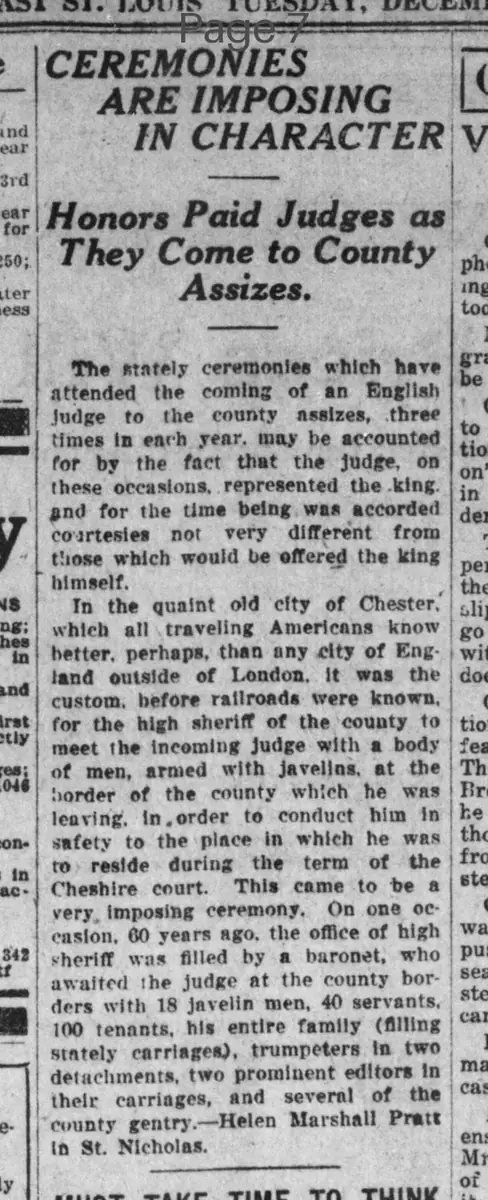
CEREMONIES ARE IMPOSING IN CHARACTER
Honors Paid Judges as They Come to County Assizes.
The stately ceremonies which have attended the coming of an English judge to the county assizes, three times in each year, may be accounted for by the fact that the judge, on these occasions, represented the king. and for the time being was accorded courtesies not very different from those which would be offered the king himself.
In the quaint old city of Chester, which all traveling Americans know better. perhaps, than any city of England outside of London. it was the custom. before railroads were known. for the high sheriff of the county to meet the incoming judge with a body of men. armed with javelins. at the border of the county which he was leaving. in order to conduct him in safety to the place in which he was to reside during the term of the Cheshire court. This came to be a very, imposing ceremony. On one occasion, 60 years ago. the office of high sheriff was filled by a baronet, who awaited the judge at the county borders with 18 javelin men, 40 servants. 100 tenants, his entire family (filling stately carriages), trumpeters in two detachments, two prominent editors in their carriages, and several of the county gentry.—Helen Marshall Pratt In St. Nicholas.
Honors Paid Judges as They Come to County Assizes.
The stately ceremonies which have attended the coming of an English judge to the county assizes, three times in each year, may be accounted for by the fact that the judge, on these occasions, represented the king. and for the time being was accorded courtesies not very different from those which would be offered the king himself.
In the quaint old city of Chester, which all traveling Americans know better. perhaps, than any city of England outside of London. it was the custom. before railroads were known. for the high sheriff of the county to meet the incoming judge with a body of men. armed with javelins. at the border of the county which he was leaving. in order to conduct him in safety to the place in which he was to reside during the term of the Cheshire court. This came to be a very, imposing ceremony. On one occasion, 60 years ago. the office of high sheriff was filled by a baronet, who awaited the judge at the county borders with 18 javelin men, 40 servants. 100 tenants, his entire family (filling stately carriages), trumpeters in two detachments, two prominent editors in their carriages, and several of the county gentry.—Helen Marshall Pratt In St. Nicholas.
What sub-type of article is it?
Historical Event
Curiosity
What themes does it cover?
Social Manners
What keywords are associated?
Judicial Ceremonies
County Assizes
High Sheriff
Chester Customs
English Traditions
What entities or persons were involved?
Helen Marshall Pratt
Where did it happen?
Chester, England
Story Details
Key Persons
Helen Marshall Pratt
Location
Chester, England
Event Date
60 Years Ago
Story Details
Stately ceremonies for English judges at county assizes, representing the king; in Chester, high sheriff met judge with armed men before railroads; one occasion featured baronet sheriff with 18 javelin men, 40 servants, 100 tenants, family, trumpeters, editors, and gentry.