Thank you for visiting SNEWPapers!
Sign up free
Arkansas State Gazette And Democrat
Little Rock, Pulaski County, Arkansas
What is this article about?
In March 1851, the Ohio Legislature debates and passes resolutions urging Congress to amend the Fugitive Slave Law to protect free persons' rights or repeal it if unamendable, with votes in Senate and House.
Clipping
OCR Quality
Full Text
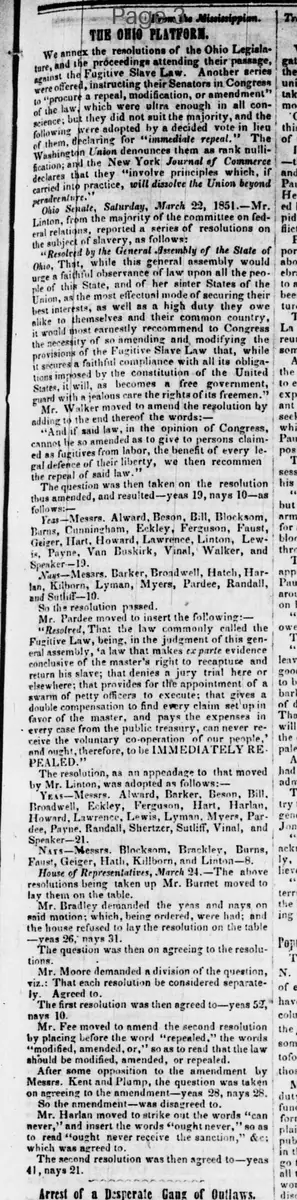
We annex the resolutions of the Ohio Legislature against the Fugitive Slave Law. Another series offered to "procure a repeal, modification, or amendment" instructing their Senators in Congress. Of the law which were ultra enough in all conscience; but they did not suit the majority, and the majority of them, declaring for "immediate repeal." The following were adopted by a decided vote in lieu of modification; and the New York Journal of Commerce and Washington Union denounces them as rank nullification; declares that they "involve principles which, if carried into practice, will dissolve the Union beyond peradventure."
Ohio Senate, Saturday, March 22, 1851.—Mr. Linton from the majority of the committee on federal relations, reported a series of resolutions on the subject of slavery, as follows:
Resolved by the General Assembly of the State of Ohio, That, while this general assembly would urge a faithful observance of law upon all the people of this State and her sister States of the Union, as the most effectual mode of securing their best interests as well alike to themselves and their common country.
It would most earnestly recommend to Congress to so amend the provisions of the Fugitive Slave Law that, while the necessity of amending and modifying the law secures faithful compliance with all its obligations, the States will guard with a jealous care the rights of its freemen."
Mr. Walker moved to amend the resolution by adding to the end thereof the words;—
"And if said law, in the opinion of Congress, cannot be so amended as to give to persons claimed as fugitives from labor, the benefit of every legal defence of their liberty, we then recommend the repeal of said law."
The resolution thus amended, and resulted—yeas 19, nays 10—as follows:
Yeas—Messrs. Alward, Beson, Bill, Blocksom, Burns, Cunningham, Eckley, Ferguson, Faust, Geiger, Hart, Howard, Lawrence, Linton, Lewis, Payne, Van Buskirk, Vinal, Walker, and Speaker—19.
Nays—Messrs. Barker, Broadwell, Hatch, Harlan, Kilborn, Lyman, Myers, Pardee, Randall, and Suthir—10.
So the resolution passed.
Mr. Pardee moved to insert the following:——
"Resolved, That the law commonly called the Fugitive Law, being, in the judgment of this general assembly, 'a law that makes ex parte evidence conclusive of the master's right to recapture and return his slave; that denies a jury trial here or elsewhere; that provides for the appointment of a swarm of petty officers to execute; that gives a double compensation to find every claim set up in favor of the master, and pays the expenses in every case from the public treasury, can never receive the voluntary co-operation of our people, and ought, therefore, to be IMMEDIATELY REPEALED.'"
The resolution, as an appendage to that moved by Mr. Linton, was adopted as follows:——
Yeas—Messrs. Alward, Barker, Beson, Bill, Broadwell, Eckley, Ferguson, Hart, Harlan, Howard, Lawrence, Lewis, Lyman, Myers, Pardee, Payne, Randall, Shertzer, Sutliff, Vinal, and Speaker—21.
Nays—Messrs. Blocksom, Brackley, Burns, Faust, Geiger, Hatch, Kilborn, and Linton—8.
House of Representatives, March 24.—The above resolutions being taken up Mr. Burnet moved to lay them on the table.
Mr. Bradley demanded the yeas and nays on said motion; which, being ordered, were had; and the house refused to lay the resolution on the table—yeas 26, nays 31.
The question was then on agreeing to the resolutions.
Mr. Moore demanded a division of the question, viz.: That each resolution be considered separately. Agreed to.
The first resolution was then agreed to—yeas 52, nays 10.
Mr. Fee moved to amend the second resolution by placing before the word "repealed," the words "modified, amended, or," so as to read that the law should be modified, amended, or repealed.
After some opposition to the amendment by Messrs. Kent and Plump, the question was taken on agreeing to the amendment—yeas 28, nays 28.
So the amendment was disagreed to.
Mr. Harlan moved to strike out the words "can never," and insert the words "ought never," so as to read "ought never receive the sanction," &c.; which was agreed to.
The second resolution was then agreed to—yeas 41, nays 21.
What sub-type of article is it?
What keywords are associated?
What entities or persons were involved?
Where did it happen?
Domestic News Details
Primary Location
Ohio
Event Date
March 22 24, 1851
Key Persons
Outcome
resolutions passed in senate (yeas 19-21, nays 8-10) and house (yeas 41-52, nays 10-21), calling for amendment or immediate repeal of the fugitive slave law.
Event Details
The Ohio Senate and House debate and adopt resolutions recommending Congress amend the Fugitive Slave Law to allow legal defenses for claimed fugitives or repeal it if unamendable, criticizing its provisions denying jury trials and favoring masters.