Thank you for visiting SNEWPapers!
Sign up free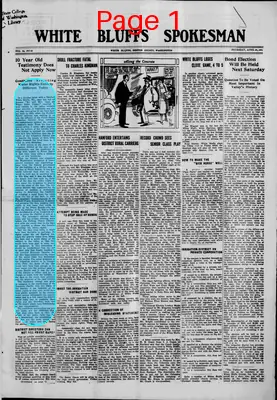
White Bluffs Spokesman
White Bluffs, Benton County, Washington
What is this article about?
Article counters misleading circular quoting 1921 court testimony to oppose Priest Rapids Irrigation District bond issue. Explains district's original plans for gravity irrigation from proposed dam, secured water rights protections, and how conditions have changed since, with dam unlikely and liens determined.
Clipping

OCR Quality
Full Text
In a circular letter with a Hanford-White Bluffs, Wn., date line and addressed "Mr. and Mrs. Land and Water Right Owner," received by land owners in the valley recently, some excerpts of testimony are quoted, that were given in the court hearing back in 1921, when the Northern Pacific railroad was seeking to enjoin the officers of the Priest Rapids Irrigation District from collecting the assessments against the railroad company's lands. From the few quotations given, it seems quite apparent that the writers of the circular letter were hoping to mislead the residents here now into believing that the directors of the irrigation district plan to deprive the people of their water rights through the bond issue to be voted on next Saturday.
A brief review of the plans of the irrigation district at the time of its organization, and the conditions existing with regard to Priest Rapids at that time, casts quite a different light on this testimony.
When the district was organized, the Washington Irrigation & Development company was negotiating a lease from the federal government for the building of a 96-foot dam at the foot of Priest Rapids. It was generally believed then that the dam would be built and in operation prior to this time and it was the hope of the people here that with the building of the dam the valley might secure water for irrigation by gravity from the crest of the dam. The irrigation district was organized for the purpose of making a preliminary survey to determine the feasibility of bringing a canal down the valley from the top of the dam; to make the necessary representations to the Federal Power Commission to protect and preserve the then existing water rights in any lease that might be given on the Priest Rapids site, and upon the building of the dam to begin the development of an irrigation system to cover the district, a unit at a time. The necessary surveys were made and the proper showing made before the Federal Power Commission with the result that in the lease later granted, a clause was inserted protecting the water rights.
Had the dam been built, it might have been desirable to exchange the rights under the old Hanford contracts for gravity water from behind the dam and a great many of the settlers in the valley at that time would have been glad to make such an exchange. In this connection it should be remembered that the suit to quiet title that finally resulted in the so-called Bourquin decision had not then been initiated nor the extent of the water right lien determined by the courts. The canal proposed by the irrigation district to be brought down from the crest of the dam would have been high enough to deliver water into the present canal at Coyote Rapids and it was the plan of the district to effect such an exchange or trade with the builders of the dam in the event such proposal met the approval of the land owners.
The testimony quoted was given in response to the questioning of the Northern Pacific into the plans of the district. A big majority of the water rights at that time would have been gladly assigned by the owners, under proper safeguards, for gravity water and in a few cases the district would have had to condemn these rights and pay therefor such sum as the courts might have determined as just compensation.
The conditions surrounding the project today are far different from what they were back in 1921. The extent of the water right lien has been determined, the possibilities of the dam are far more remote and there is an entire new deal facing the settlers today.
What sub-type of article is it?
What themes does it cover?
What keywords are associated?
Where did it happen?
Story Details
Location
Hanford White Bluffs, Washington; Priest Rapids
Event Date
1921
Story Details
The Priest Rapids Irrigation District was organized to survey and protect water rights in anticipation of a dam at Priest Rapids. In 1921, Northern Pacific Railroad challenged assessments, with testimony suggesting potential exchange of rights for gravity water. Today, conditions differ: dam unlikely, liens settled, facing new challenges with bond issue vote.