Thank you for visiting SNEWPapers!
Sign up free
National Republican (Washington City
Washington, District Of Columbia
What is this article about?
The Keifer-Boynton committee hears testimonies in a case where Mr. Boynton accuses Charles Garfield of burglary, counterfeiting, and criminal ties; Speaker Keifer denies statements, witnesses affirm Garfield's reputation, and procedural matters are discussed. (1883)
Clipping
OCR Quality
Full Text
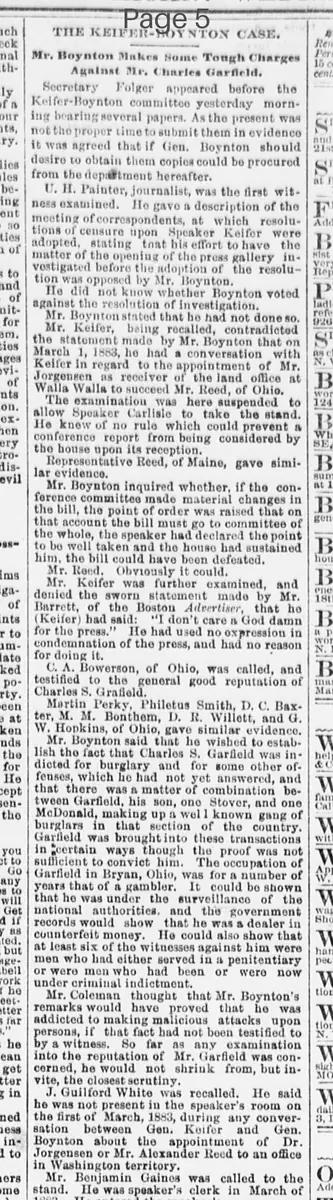
Mr. Boynton Makes Some Tough Charges
Against Mr. Charles Garfield.
Secretary Folger appeared before the
Keifer-Boynton committee yesterday morning
bearing several papers. As this was not the
proper time to submit them in evidence
it was agreed that if Gen. Boynton should
desire to obtain them copies could be procured
from the department hereafter.
U. H. Painter, journalist, was the first witness
examined. He gave a description of the
meeting of correspondents, at which resolutions
of censure upon Speaker Keifer were
adopted, stating that his effort to have the
matter of the opening of the press gallery investigated
before the adoption of the resolution
was opposed by Mr. Boynton.
He did not know whether Boynton voted
against the resolution of investigation.
Mr. Boynton stated that he had not done so.
Mr. Keifer, being recalled, contradicted
the statement made by Mr. Boynton that on
March 1, 1883, he had a conversation with
Keifer in regard to the appointment of Mr.
Jorgensen as receiver of the land office at
Walla Walla to succeed Mr. Reed, of Ohio.
The examination was here suspended to
allow Speaker Carlisle to take the stand.
He knew of no rule which could prevent a
conference report from being considered by
the house upon its reception.
Representative Reed, of Maine,
gave similar evidence.
Mr. Boynton inquired whether, if the conference
committee made material changes in
the bill, the point of order was raised that on
that account the bill must go to committee of
the whole, the speaker had declared the point
to be well taken and the house had sustained
him, the bill could have been defeated.
Mr. Reed: Obviously it could.
Mr. Keifer was further examined, and
denied the sworn statement made by Mr.
Barrett, of the Boston Advertiser, that he
(Keifer) had said: I don't care a God damn
for the press. He had used no expression in
condemnation of the press, and had no reason
for doing it.
C. A. Bowerson, of Ohio, was called, and
testified to the general good reputation of
Charles S. Garfield.
Martin Perky, Philetus Smith, D. C. Baxter,
M. M. Bonthem, D. R. Willett, and G.
W. Hopkins, of Ohio, gave similar evidence.
Mr. Boynton said that he wished to establish
the fact that Charles S. Garfield was indicted
for burglary and for some other offenses,
which he had not yet answered, and
that there was a matter of combination between
Garfield, his son, one Stover, and one
McDonald, making up a well known gang of
burglars in that section of the country.
Garfield was brought into these transactions
in certain ways though the proof was not
sufficient to convict him. The occupation of
Garfield in Bryan, Ohio, was for a number of
years that of a gambler. It could be shown
that he was under the surveillance of the
national authorities, and the government
records would show that he was a dealer in
counterfeit money. He could also show that
at least six of the witnesses against him were
men who had either served in a penitentiary
or were men who had been or were now
under criminal indictment.
Mr. Coleman thought that Mr. Boynton's
remarks would have proved that he was
addicted to making malicious attacks upon
persons, if that fact had not been testified to
by a witness. So far as any examination
into the reputation of Mr. Garfield was concerned,
he would not shrink from, but invite,
the closest scrutiny.
J. Guilford White was recalled. He said
he was not present in the speaker's room on
the first of March, 1883, during any conversation
between Gen. Keifer and Gen.
Boynton about the appointment of Dr.
Jorgensen or Mr. Alexander Reed to an office
in Washington territory.
Mr. Benjamin Gaines was called to the
stand. He was speaker's clerk in March of
1883. He entered the speaker's room on one
occasion when Gen. Boynton was in conversation
with the speaker, but was in great
haste and remained but a moment. He heard
nothing of the conversation. Mr. White was
in the room.
The committee, at 2 o'clock, adjourned
until 11 o'clock this morning.
What sub-type of article is it?
What themes does it cover?
What keywords are associated?
What entities or persons were involved?
Where did it happen?
Story Details
Key Persons
Location
Keifer Boynton Committee (U.S. House Of Representatives)
Event Date
March 1, 1883
Story Details
During the Keifer-Boynton committee hearing, Mr. Boynton levels serious charges against Charles S. Garfield, alleging involvement in burglary, counterfeiting, and associations with criminals; witnesses including journalists, representatives, and Ohio residents testify on reputations, past conversations, and procedural rules, with contradictions from Speaker Keifer.