Thank you for visiting SNEWPapers!
Sign up free
Daily National Intelligencer
Washington, District Of Columbia
What is this article about?
Opinion piece from the Boston Patriot criticizing a Massachusetts House committee report on British impressment of seamen, arguing against using French examples as justification, defending the law of nations on naturalization and expatriation, and refuting claims about the Monroe-Pinkney treaty's handling of impressment.
Clipping
OCR Quality
Full Text
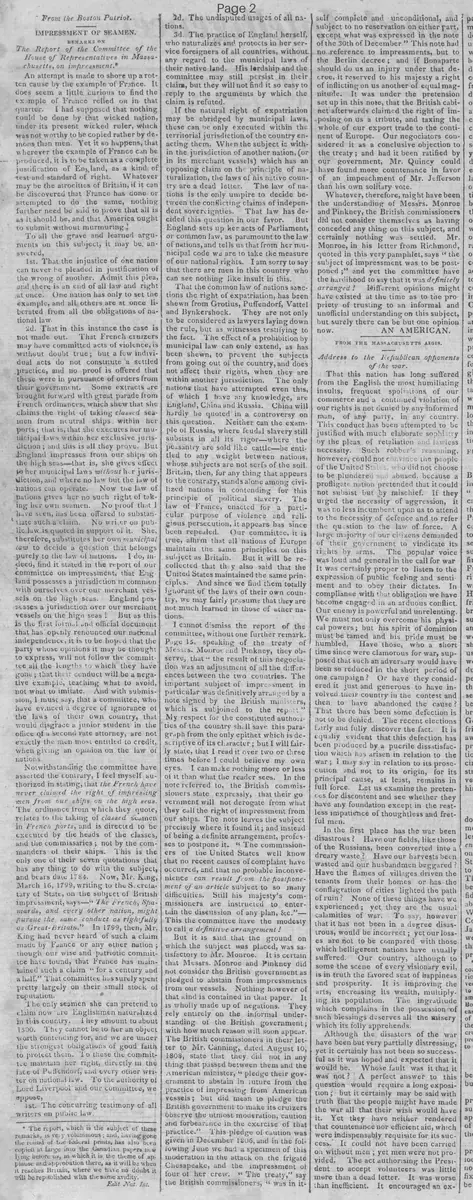
IMPRESSMENT OF SEAMEN.
REMARKS ON
The Report of the Committee of the House of Representatives in Massachusetts, on impressment.*
An attempt is made to shore up a rotten Cause by the example of France. It does seem a little curious to find the example of France relied on in that quarter. I had supposed that nothing could be done by that wicked nation, under its present wicked ruler, which was not worthy to be copied rather by demons than men. Yet it so happens, that wherever the example of France can be produced, it is to be taken as a complete justification of England, as a kind of test and standard of right. Whatever may be the atrocities of Britain, if it can be discovered that France has done or attempted to do the same, nothing further need be said to prove that all is as it should be, and that America ought to submit without murmuring!
To all the grave and learned arguments on this subject, it may be answered,
1st. That the injustice of one nation can never be pleaded in justification of the wrong of another. Admit this plea, and there is an end of all law and right at once. One nation has only to set the example, and all others are at once liberated from all the obligations of national law.
2d. That in this instance the case is not made out. That French cruizers may have committed acts of violence, is without doubt true; but a few individual acts do not constitute a settled practice, and no proof is offered that these were in pursuance of orders from their government. Some extracts are brought forward with great parade from French ordinances, which shew that she claims the right of taking classed seamen from neutral ships within her ports; that is, that she executes her municipal laws within her exclusive jurisdiction: and this is all they prove. But England impresses from our ships on the high seas--that is, she gives effect to her municipal laws without her jurisdiction, and where no law but the law of nations can operate. Now the law of nations gives her no such right of taking her own seamen. No proof that I have seen, has been offered to substantiate such a claim. No writer on public law is quoted in support of it. She, therefore, substitutes her own municipal law to decide a question that belongs purely to the law of nations. I do, indeed, find it stated in the report of our committee on impressment, that England possesses a jurisdiction in common with ourselves over our merchant vessels on the high seas. England possesses a jurisdiction over our merchant vessels on the high seas! But as this is the first formal and official document that has openly renounced our national independence, it is to be hoped that the party whose opinions it may be thought to express, will not follow the committee all the lengths to which they have gone; that their conduct will be a negative example, teaching what to avoid, not what to imitate. And with submission, I must say, that a committee, who have evinced a degree of ignorance of the laws of their own country, that would disgrace a junior student in the office of a second rate attorney, are not exactly the men most entitled to credit, when giving an opinion on the law of nations.
Notwithstanding the committee have asserted the contrary, I feel myself authorized in stating, that the French have never claimed the right of impressing men from our ships on the high seas. The ordinance from which they quote, relates to the taking of classed seamen in French ports, and is directed to be executed by the heads of the classes, and the commissaries; not by the commanders of their ships. This is the only one of their seven quotations that has any thing to do with the subject, and bears date 1784. Now, Mr. King, March 16, 1799, writing to the Secretary of State, on the subject of British impressment, Says--"The French, Spaniards, and every other nation, might pursue the same conduct as rightfully as Great-Britain." In 1799, then, Mr. King had never heard of such a claim made by France or any other nation; though our wise and patriotic committee have found, that France has maintained such a claim "for a century and a half." That committee has surely spent pretty largely on their small stock of reputation.
The only seamen she can pretend to claim now are Englishmen naturalized in this country. They amount to about 1500. They cannot be to her an object worth contending for, and we are under the strongest obligations of good faith to protect them. To these the committee maintain her right, directly in the face of Puffendorf, and every other writer on national law. To the authority of Lord Liverpool and our committee, we oppose,
1st. The concurring testimony of all writers on public law.
* The report, which is the subject of these remarks, is very voluminous; and, having gone the round of the federal prints, has also been copied at large into the Canadian papers now lying before us, in which it is the theme of applause and approbation there, as it will be when it reaches Britain, where we have no doubt it will be republished with the same avidity.
2d. The undisputed usages of all nations.
3d. The practice of England herself, who naturalizes and protects in her service foreigners of all countries, without any regard to the municipal laws of their native land. His lordship and the committee may still persist in their claim, but they will not find it so easy to reply to the arguments by which the claim is refuted.
If the natural right of expatriation may be abridged by municipal laws, these can be only executed within the territorial jurisdiction of the country enacting them. When the subject is within the jurisdiction of another nation, (or in its merchant vessels) which has an opposing claim on the principle of naturalization, the laws of his native country are a dead letter. The law of nations is the only umpire to decide between the conflicting claims of independent sovereignties. That law has decided this question in our favor. But England sets up her acts of Parliament, or common law, as paramount to the law of nations, and tells us that from her municipal code we are to take the measure of our national rights. I am sorry to say that there are men in this country who can see nothing like insult in this. That the common law of nations sanctions the right of expatriation, has been shewn from Grotius, Puffendorf, Vattel and Bynkershock. They are not only to be considered as lawyers laying down the rule, but as witnesses testifying to the fact. The effect of a prohibition by municipal law can only extend, as has been shewn, to prevent the subjects from going out of the country, and does not affect their rights, when they are within another jurisdiction. The only nations that have attempted even this, of which I have any knowledge, are England, China and Russia. China will hardly be quoted in a controversy on this question. Neither can the example of Russia, where feudal slavery still subsits in all its rigor--where the peasantry are sold like cattle--be entitled to any weight between nations, whose subjects are not serfs of the soil. Britain, then, for any thing that appears to the contrary, stands alone among civilized nations in contending for this principle of political slavery. The law of France, enacted for a particular purpose of violence and religious persecution, it appears has since been repealed. Our committee, it is true, affirm that all nations of Europe maintain the same principles on this subject as Britain. But it will be recollected that they also said that the United States maintained the same principles. And since we find them totally ignorant of the laws of their own country, we may fairly presume that they are not much learned in those of other nations.
I cannot dismiss the report of the committee, without one further remark. Page 15, speaking of the treaty of Messrs. Monroe and Pinkney, they observe, that "the result of this negotiation was an adjustment of all the differences between the two countries. The important subject of impressment in particular was definitively arranged by a note signed by the British ministers, which is subjoined to the report"
My respect for the constituted authorities of the country shall save this paragraph from the only epithet which is descriptive of its character; but I will fairly state, that I read it over two or three times before I could believe my own eyes. I can make nothing more or less of it than what the reader sees. In the note referred to, the British commissioners state expressly, that their government will not derogate from what they call the right of impressment from our ships. The note leaves the subject precisely where it found it; and instead of being a definite arrangement, professes to postpone it. "The commissioners of the United States well know that no recent causes of complaint have occurred, and that no probable inconvenience can result from the postponement of an article subject to so many difficulties. Still his majesty's commissioners are instructed to entertain the discussion of any plan, &c." This the committee have the modesty to call a definitive arrangement!
But it is said that the ground on which the subject was placed, was satisfactory to Mr. Monroe. It is certain that Messrs. Monroe and Pinkney did not consider the British government as pledged to abstain from impressments from our vessels. Nothing however of that kind is contained in that paper. It is wholly made up of negations. They rely entirely on the informal understanding of the British government; with how much reason will soon appear. The British commissioners in their letter to Mr. Canning, dated August 10, 1808, state that they did not in any thing that passed between them and the American minister, "pledge their government to abstain in future from the practice of impressing from American vessels; but did mean to pledge the British government to make its cruizers observe the utmost moderation, caution and forbearance in the exercise of that practice." This pledge of caution was given in December 1806, and in the following June we had a specimen of this moderation in the attack on the frigate Chesapeake, and the impressment of four of her crew. "The treaty," say the British commissioners, "was in itself complete and unconditional, and
self complete and unconditional, and subject to no reservation on either part, except what was expressed in the note of the 30th of December." This note had no reference to impressments, but to the Berlin decree; and if Bonaparte should do us an injury under that decree, it reserved to his majesty a right of inflicting on us another of equal magnitude. It was under the pretension set up in this note, that the British cabinet afterwards claimed the right of imposing on us a tribute, and taxing the whole of our export trade to the continent of Europe. Our negociators considered it as a conclusive objection to the treaty; and had it been ratified by our government, Mr. Quincy could have found more countenance in favor of an impeachment of Mr. Jefferson than his own solitary vote.
Whatever, therefore, might have been the understanding of Messrs. Monroe and Pinkney, the British commissioners did not consider themselves as having conceded any thing on this subject, and certainly nothing was settled. Mr. Monroe, in his letter from Richmond, quoted in this very pamphlet, says "the subject of impressment was to be postponed;" and yet the committee have the hardihood to say that it was definitely arranged! Different opinions might have existed at the time as to the propriety of trusting to an informal and unofficial understanding on this subject, but surely there can be but one opinion now.
AN AMERICAN.
What sub-type of article is it?
What keywords are associated?
What entities or persons were involved?
Where did it happen?
Foreign News Details
Primary Location
High Seas
Key Persons
Outcome
impressment of about 1500 naturalized english seamen claimed by britain; attack on uss chesapeake with four crew impressed; monroe-pinkney treaty failed to settle impressment, leading to ongoing tensions.
Event Details
Critique of Massachusetts committee report justifying British impressment by citing French practices; argues injustice cannot justify injustice, France only claims within ports not high seas, defends naturalization rights under law of nations citing Grotius, Puffendorf, Vattel, Bynkershock; refutes committee's claim on Monroe-Pinkney treaty as not definitively arranging impressment but postponing it, with British commissioners denying any pledge to abstain.