Thank you for visiting SNEWPapers!
Sign up free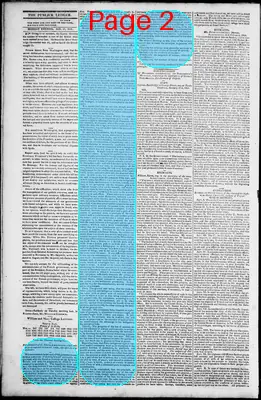
Foreign News
January 27, 1806
Norfolk Gazette And Publick Ledger
Norfolk, Virginia
What is this article about?
Excerpt from a pamphlet in the National Intelligencer critiquing Britain's doctrine allowing capture of neutral trade not open in peacetime, arguing it violates international law and neutral rights, with implications for US commerce.
Clipping
OCR Quality
98%
Excellent
Full Text
From the National Intelligencer.
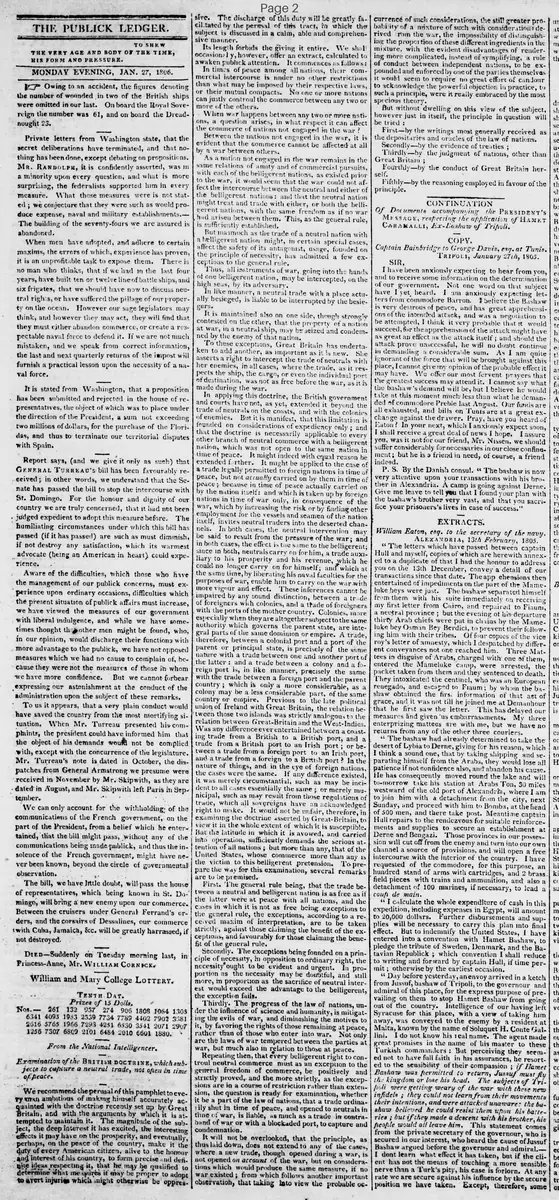
Examination of the British doctrine, which subjects to capture a neutral trade, not open in time of peace.
We recommend the perusal of this pamphlet to every man ambitious of making himself accurately acquainted with the doctrine recently set up by Great Britain, and with the arguments by which it is attempted to maintain it. The magnitude of the subject, the deep interest it has excited, the interesting effects it may have on the prosperity, and eventually, perhaps, on the peace of the country, make it the duty of every American citizen, alive to the honour and interest of his country, to form precise and definite ideas respecting it, that he may be qualified to determine what measures it may be proper to adopt to avert injuries which might otherwise be oppressive. The discharge of this duty will be greatly facilitated by the perusal of this tract, in which the subject is discussed in a calm, able and comprehensive manner.
Its length forbids the giving it entire. We shall occasionally, however, offer an extract, calculated to awaken publick attention. It commences as follows:
In times of peace among all nations, their commercial intercourse is under no other restrictions than what may be imposed by their respective laws, or their mutual compacts. No one or more nations can justly controul the commerce between any two or more of the others.
When war happens between any two or more nations, a question arises, in what respect it can affect the commerce of nations not engaged in the war? Between the nations not engaged in the war, it is evident that the commerce cannot be affected at all by a war between others.
As a nation not engaged in the war remains in the same relations of amity and of commercial pursuits, with each of the belligerent nations, as existed prior to the war, it would seem that the war could not affect the intercourse between the neutral and either of the belligerent nations: and that the neutral nation might treat and trade with either, or both the belligerent nations, with the same freedom as if no war had arisen between them. This, as the general rule, is sufficiently established.
But inasmuch as the trade of a neutral nation with a belligerent nation might, in certain special cases, affect the safety of its antagonist, usage, founded on the principle of necessity, has admitted a few exceptions to the general rule.
Thus, all instruments of war, going into the hands of one belligerent nation, may be intercepted, on the high seas, by its adversary.
In like manner, a neutral trade with a place actually besieged, is liable to be interrupted by the besiegers.
It is maintained also on one side, though strongly contested on the other, that the property of a nation at war, in a neutral ship, may be seized and condemned by the enemy of that nation.
To these exceptions, Great Britain has undertaken to add another, as important as it is new. She asserts a right to intercept the trade of neutrals with her enemies, in all cases, where the trade, as it respects the ship, the cargo, or even the individual port of destination, was not as free before the war, as it is made during the war.
In applying this doctrine, the British government and courts have not, as yet, extended it beyond the trade of neutrals on the coasts, and with the colonies of enemies. But it is manifest, that this limitation is founded on considerations of expediency only; and that the doctrine is necessarily applicable to every other branch of neutral commerce with a belligerent nation, which was not open to the same nation in time of peace. It might indeed with equal reason be extended further. It might be applied to the case of a trade legally permitted to foreign nations in time of peace, but not actually carried on by them in time of peace; because in time of peace actually carried on by the nation itself: and which is taken up by foreign nations in time of war only, in consequence of the war, which by increasing the risk or by finding other employment for the vessels and seamen of the nation itself, invites neutral traders into the deserted channels. In both cases, the neutral intervention may be said to result from the pressure of the war; and in both cases, the effect is the same to the belligerent; since in both, neutrals carry on for him, a trade auxiliary to his prosperity and his revenue, which he could no longer carry on for himself; and which at the same time, by liberating his naval faculties for the purposes of war, enable him to carry on the war with more vigour and effect. These inferences cannot be impaired by any sound distinction, between a trade of foreigners with colonies, and a trade of foreigners with the ports of the mother country. Colonies, more especially when they are altogether subject to the same authority which governs the parent state, are integral parts of the same dominion or empire. A trade, therefore, between a colonial port and a port of the parent or principal state, is precisely of the same nature with a trade between one and another port of the latter: and a trade between a colony and a foreign port is, in like manner, precisely the same with the trade between a foreign port and the parent country; which is only a more considerable, as a colony may be a less considerable part, of the same country or empire. Previous to the late political union of Ireland with Great Britain, the relation between those two islands was strictly analogous to the relation between Great-Britain and the West-Indies. Was any difference ever entertained between a coasting trade from a British to a British port, and a trade from a British port to an Irish port; or between a trade from a foreign port to an Irish port, and a trade from a foreign to a British port? In the nature of things, and in the eye of foreign nations, the cases were the same. If any difference existed, it was merely circumstantial, such as may be incident to all cases essentially the same; or merely municipal, such as may result from those regulations of trade, which all sovereigns have an acknowledged right to make. It would not be unfair, therefore, in examining the doctrine asserted by Great-Britain, to view it in the whole extent of which it is susceptible.
But the latitude in which it is avowed, and carried into operation, sufficiently demands the serious attention of all nations; but more than any, that of the United States, whose commerce more than any is the victim to this belligerent pretension. To prepare the way for this examination, several remarks are to be premised.
First. The general rule being, that the trade between a neutral and belligerent nation is as free as if the latter were at peace with all nations, and the cases in which it is not as free being exceptions to the general rule, the exceptions, according to a received maxim of interpretation, are to be taken strictly, against those claiming the benefit of the exceptions, and favourably for those claiming the benefit of the general rule.
Secondly. The exceptions being founded on a principle of necessity, in opposition to ordinary right, the necessity ought to be evident and urgent. In proportion as the necessity may be doubtful, and still more, in proportion as the sacrifice of neutral interest would exceed the advantage to the belligerent, the exception fails.
Thirdly. The progress of the law of nations, under the influence of science and humanity, is mitigating the evils of war, and diminishing the motives to it, by favoring the rights of those remaining at peace, rather than of those who enter into war. Not only are the laws of war tempered between the parties at war, but much also in relation to those at peace.
Repeating then, that every belligerent right to controul neutral commerce must as an exception to the general freedom of commerce, be positively and strictly proved,-- and the more strictly, as the exceptions are in a course of restriction rather than extension, the question is ready for examination, whether it be a part of the law of nations, that a trade ordinarily shut in time of peace, and opened to neutrals in time of war, is liable, as much as a trade in contraband of war or with a blockaded port, to capture and condemnation.
It will not be overlooked, that the principle, as thus laid down, does not extend to any of the cases, where a new trade, though opened during a war, is not opened on account of the war, but on considerations which would produce the same measure, if no war existed; from which follows another important observation, that taking into view the probable occurrence of such considerations, the still greater probability of a mixture of such with considerations derived from the war, the impossibility of distinguishing the proportion of these different ingredients in the mixture, with the evident disadvantages of rendering more complicated, instead of simplifying, a rule of conduct between independent nations, to be expounded and enforced by one of the parties themselves it would seem to require no great effort of candour to acknowledge the powerful objection in practice, to such a principle, were it really embraced by the most specious theory.
But without dwelling on this view of the subject, however just in itself, the principle in question will be tried:
First--by the writings most generally received as the depositaries and oracles of the law of nations.
Secondly--by the evidence of treaties;
Thirdly--by the judgment of nations, other than Great Britain;
Fourthly--by the conduct of Great Britain herself.
Fifthly--by the reasoning employed in favour of the principle.
Examination of the British doctrine, which subjects to capture a neutral trade, not open in time of peace.
We recommend the perusal of this pamphlet to every man ambitious of making himself accurately acquainted with the doctrine recently set up by Great Britain, and with the arguments by which it is attempted to maintain it. The magnitude of the subject, the deep interest it has excited, the interesting effects it may have on the prosperity, and eventually, perhaps, on the peace of the country, make it the duty of every American citizen, alive to the honour and interest of his country, to form precise and definite ideas respecting it, that he may be qualified to determine what measures it may be proper to adopt to avert injuries which might otherwise be oppressive. The discharge of this duty will be greatly facilitated by the perusal of this tract, in which the subject is discussed in a calm, able and comprehensive manner.
Its length forbids the giving it entire. We shall occasionally, however, offer an extract, calculated to awaken publick attention. It commences as follows:
In times of peace among all nations, their commercial intercourse is under no other restrictions than what may be imposed by their respective laws, or their mutual compacts. No one or more nations can justly controul the commerce between any two or more of the others.
When war happens between any two or more nations, a question arises, in what respect it can affect the commerce of nations not engaged in the war? Between the nations not engaged in the war, it is evident that the commerce cannot be affected at all by a war between others.
As a nation not engaged in the war remains in the same relations of amity and of commercial pursuits, with each of the belligerent nations, as existed prior to the war, it would seem that the war could not affect the intercourse between the neutral and either of the belligerent nations: and that the neutral nation might treat and trade with either, or both the belligerent nations, with the same freedom as if no war had arisen between them. This, as the general rule, is sufficiently established.
But inasmuch as the trade of a neutral nation with a belligerent nation might, in certain special cases, affect the safety of its antagonist, usage, founded on the principle of necessity, has admitted a few exceptions to the general rule.
Thus, all instruments of war, going into the hands of one belligerent nation, may be intercepted, on the high seas, by its adversary.
In like manner, a neutral trade with a place actually besieged, is liable to be interrupted by the besiegers.
It is maintained also on one side, though strongly contested on the other, that the property of a nation at war, in a neutral ship, may be seized and condemned by the enemy of that nation.
To these exceptions, Great Britain has undertaken to add another, as important as it is new. She asserts a right to intercept the trade of neutrals with her enemies, in all cases, where the trade, as it respects the ship, the cargo, or even the individual port of destination, was not as free before the war, as it is made during the war.
In applying this doctrine, the British government and courts have not, as yet, extended it beyond the trade of neutrals on the coasts, and with the colonies of enemies. But it is manifest, that this limitation is founded on considerations of expediency only; and that the doctrine is necessarily applicable to every other branch of neutral commerce with a belligerent nation, which was not open to the same nation in time of peace. It might indeed with equal reason be extended further. It might be applied to the case of a trade legally permitted to foreign nations in time of peace, but not actually carried on by them in time of peace; because in time of peace actually carried on by the nation itself: and which is taken up by foreign nations in time of war only, in consequence of the war, which by increasing the risk or by finding other employment for the vessels and seamen of the nation itself, invites neutral traders into the deserted channels. In both cases, the neutral intervention may be said to result from the pressure of the war; and in both cases, the effect is the same to the belligerent; since in both, neutrals carry on for him, a trade auxiliary to his prosperity and his revenue, which he could no longer carry on for himself; and which at the same time, by liberating his naval faculties for the purposes of war, enable him to carry on the war with more vigour and effect. These inferences cannot be impaired by any sound distinction, between a trade of foreigners with colonies, and a trade of foreigners with the ports of the mother country. Colonies, more especially when they are altogether subject to the same authority which governs the parent state, are integral parts of the same dominion or empire. A trade, therefore, between a colonial port and a port of the parent or principal state, is precisely of the same nature with a trade between one and another port of the latter: and a trade between a colony and a foreign port is, in like manner, precisely the same with the trade between a foreign port and the parent country; which is only a more considerable, as a colony may be a less considerable part, of the same country or empire. Previous to the late political union of Ireland with Great Britain, the relation between those two islands was strictly analogous to the relation between Great-Britain and the West-Indies. Was any difference ever entertained between a coasting trade from a British to a British port, and a trade from a British port to an Irish port; or between a trade from a foreign port to an Irish port, and a trade from a foreign to a British port? In the nature of things, and in the eye of foreign nations, the cases were the same. If any difference existed, it was merely circumstantial, such as may be incident to all cases essentially the same; or merely municipal, such as may result from those regulations of trade, which all sovereigns have an acknowledged right to make. It would not be unfair, therefore, in examining the doctrine asserted by Great-Britain, to view it in the whole extent of which it is susceptible.
But the latitude in which it is avowed, and carried into operation, sufficiently demands the serious attention of all nations; but more than any, that of the United States, whose commerce more than any is the victim to this belligerent pretension. To prepare the way for this examination, several remarks are to be premised.
First. The general rule being, that the trade between a neutral and belligerent nation is as free as if the latter were at peace with all nations, and the cases in which it is not as free being exceptions to the general rule, the exceptions, according to a received maxim of interpretation, are to be taken strictly, against those claiming the benefit of the exceptions, and favourably for those claiming the benefit of the general rule.
Secondly. The exceptions being founded on a principle of necessity, in opposition to ordinary right, the necessity ought to be evident and urgent. In proportion as the necessity may be doubtful, and still more, in proportion as the sacrifice of neutral interest would exceed the advantage to the belligerent, the exception fails.
Thirdly. The progress of the law of nations, under the influence of science and humanity, is mitigating the evils of war, and diminishing the motives to it, by favoring the rights of those remaining at peace, rather than of those who enter into war. Not only are the laws of war tempered between the parties at war, but much also in relation to those at peace.
Repeating then, that every belligerent right to controul neutral commerce must as an exception to the general freedom of commerce, be positively and strictly proved,-- and the more strictly, as the exceptions are in a course of restriction rather than extension, the question is ready for examination, whether it be a part of the law of nations, that a trade ordinarily shut in time of peace, and opened to neutrals in time of war, is liable, as much as a trade in contraband of war or with a blockaded port, to capture and condemnation.
It will not be overlooked, that the principle, as thus laid down, does not extend to any of the cases, where a new trade, though opened during a war, is not opened on account of the war, but on considerations which would produce the same measure, if no war existed; from which follows another important observation, that taking into view the probable occurrence of such considerations, the still greater probability of a mixture of such with considerations derived from the war, the impossibility of distinguishing the proportion of these different ingredients in the mixture, with the evident disadvantages of rendering more complicated, instead of simplifying, a rule of conduct between independent nations, to be expounded and enforced by one of the parties themselves it would seem to require no great effort of candour to acknowledge the powerful objection in practice, to such a principle, were it really embraced by the most specious theory.
But without dwelling on this view of the subject, however just in itself, the principle in question will be tried:
First--by the writings most generally received as the depositaries and oracles of the law of nations.
Secondly--by the evidence of treaties;
Thirdly--by the judgment of nations, other than Great Britain;
Fourthly--by the conduct of Great Britain herself.
Fifthly--by the reasoning employed in favour of the principle.
What sub-type of article is it?
Diplomatic
Trade Or Commerce
What keywords are associated?
Neutral Trade
British Doctrine
Law Of Nations
Commerce Capture
Belligerent Rights
Colonial Trade
Where did it happen?
Great Britain
Foreign News Details
Primary Location
Great Britain
Event Details
Pamphlet excerpt discusses and critiques the British doctrine permitting capture of neutral trade not permitted in peacetime, arguing it as an unjust exception to neutral rights under the law of nations, with applications to colonial and coastal trade, and implications for US commerce.