Thank you for visiting SNEWPapers!
Sign up free
Southern Christian Advocate
Charleston, Charleston County, South Carolina
What is this article about?
A letter titled 'A SIGN' copies and critiques an article from Zion's Herald on the proposed Methodist Theological Seminary, questioning its character, control by conferences, and implying it's a cunning front for abolitionist secession within the church, dated November 29, 1839.
Merged-components note: Continuation of letter on Methodist Theological Seminary across pages, based on sequential reading_order and text continuity; retains letter_to_editor label.
Clippings
1 of 2
OCR Quality
Full Text
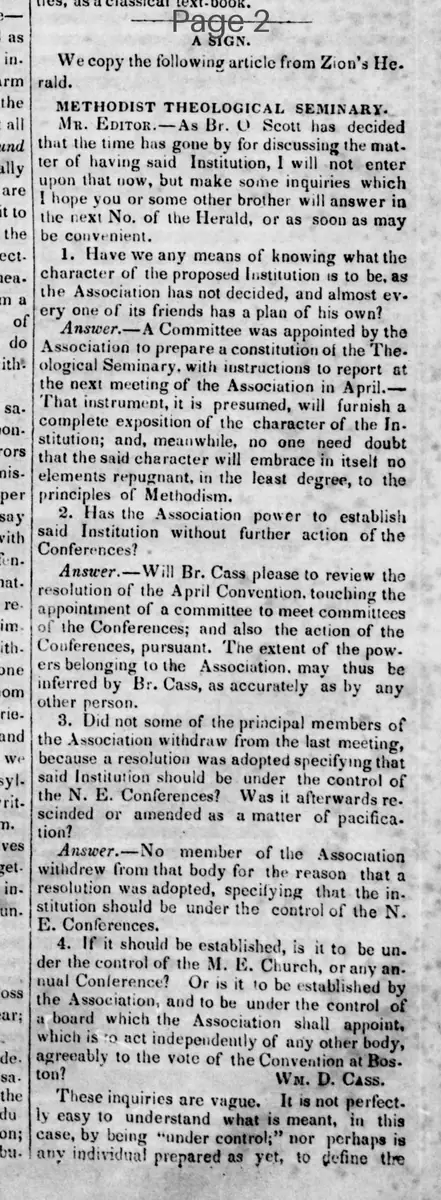
We copy the following article from Zion's Herald.
METHODIST THEOLOGICAL SEMINARY.
Mr. Editor.—As Br. O. Scott has decided that the time has gone by for discussing the matter of having said Institution, I will not enter upon that now, but make some inquiries which I hope you or some other brother will answer in the next No. of the Herald, or as soon as may be convenient.
1. Have we any means of knowing what the character of the proposed Institution is to be, as the Association has not decided, and almost every one of its friends has a plan of his own?
Answer.—A Committee was appointed by the Association to prepare a constitution of the Theological Seminary, with instructions to report at the next meeting of the Association in April.—That instrument, it is presumed, will furnish a complete exposition of the character of the Institution; and, meanwhile, no one need doubt that the said character will embrace in itself no elements repugnant, in the least degree, to the principles of Methodism.
2. Has the Association power to establish said Institution without further action of the Conferences?
Answer.—Will Br. Cass please to review the resolution of the April Convention, touching the appointment of a committee to meet committees of the Conferences; and also the action of the Conferences, pursuant. The extent of the powers belonging to the Association, may thus be inferred by Br. Cass, as accurately as by any other person.
3. Did not some of the principal members of the Association withdraw from the last meeting, because a resolution was adopted specifying that said Institution should be under the control of the N. E. Conferences? Was it afterwards rescinded or amended as a matter of pacification?
Answer.—No member of the Association withdrew from that body for the reason that a resolution was adopted, specifying that the institution should be under the control of the N. E. Conferences.
4. If it should be established, is it to be under the control of the M. E. Church, or any annual Conference? Or is it to be established by the Association, and to be under the control of a board which the Association shall appoint, which is to act independently of any other body, agreeably to the vote of the Convention at Boston?
These inquiries are vague. It is not perfectly easy to understand what is meant, in this case, by being "under control;" nor perhaps is any individual prepared as yet, to define the extent of that control.
NOVEMBER 29, 1839.
precise degree of power which those Conferences, patronizing the institution, will exercise in controlling its affairs. If it is meant to be asked whether the institution is to stand completely independent of the influence of the Conferences, while they have no participation in giving it direction and influence, we have no faith in such a doctrine. It is difficult to see how such an institution could be entitled to be called a Methodist Theological Seminary.
One may see without glasses how thoroughly the editor of the Herald felt the posing force of his correspondent's inquiries. He says the inquiries are vague; what are some of his answers? Is it not a flat contradiction of all we have heard about the shrewdness of the Yankees, that they should have pushed so hard and fast after this said Theological Seminary, without having settled what is to be its character, what control the conferences are to have over it, or any single thing concerning its foundation? Or is it rather an exemplification of that very shrewdness, in the lower form of cunning? The knowing ones having got so far ahead in a fog to gain a power of bringing to pass something, which, in clear weather, and every thing open, they might not have been able to effect—a Grand Lodge, under another name, for the passing of true and accepted Abolitionists of the Scott and Storrs stamp.
What makes such an inference more likely, is, that immediately following this article, there appears a very favorable notice of the specimen paper of Messrs. Horton and Scott, to be published for six months only from the 1st of January next; and which is generally understood to mean a bold signal for a new secession, after the fashion of the Springfield District troubles; in which Abolition is to be proclaimed outright as the sole divinity, and no meetings of the church but abolition meetings, to be allowed.
What sub-type of article is it?
What themes does it cover?
What keywords are associated?
What entities or persons were involved?
Letter to Editor Details
Author
A Sign
Recipient
Mr. Editor
Main Argument
the proposed methodist theological seminary is being advanced without clear definition of its character or control, likely as a cunning ploy by abolitionists like scott and storrs to establish an independent organization promoting secession and abolitionism within the church.
Notable Details