Thank you for visiting SNEWPapers!
Sign up free
Editorial
January 12, 1769
The Virginia Gazette
Richmond, Williamsburg, Richmond County, Virginia
What is this article about?
An analysis of Great Britain's post-war economic challenges, including rising prices due to increased revenue extraction, diminishing trade balance, and foreign debt interest, urging Parliament to implement reforms for national recovery and prosperity.
Clipping
OCR Quality
98%
Excellent
Full Text
Extract from the Present State of the Nation, &c.
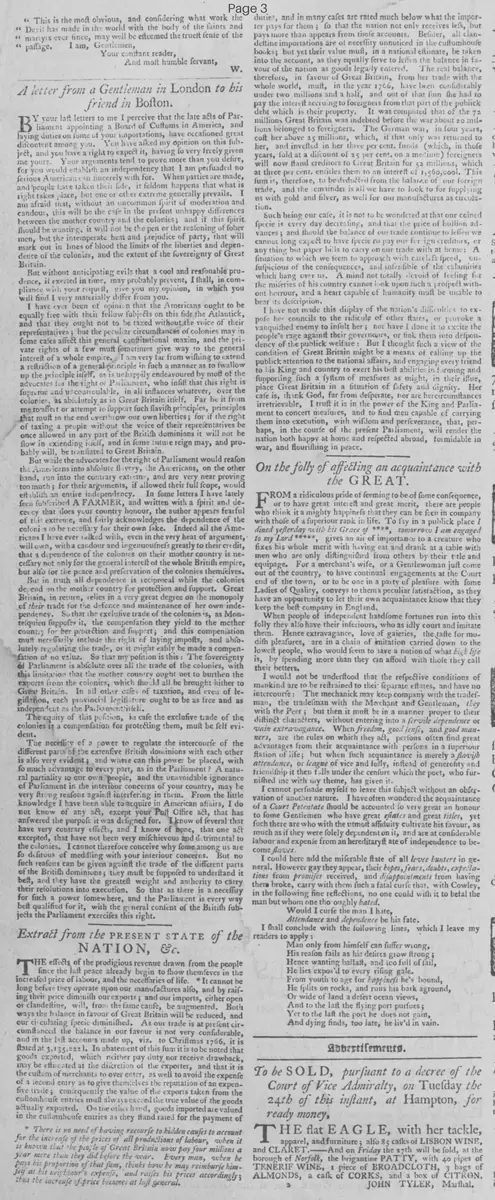
The effects of the prodigious revenue drawn from the people since the last peace already begin to show themselves in the increased price of labour, and the necessaries of life. It cannot be long before they operate upon our manufactures also, and by raising their price diminish our exports; and our imports, either open or clandestine, will, from the same cause, be augmented. Both ways the balance in favour of Great Britain will be reduced, and our circulating specie diminished. As our trade is at present circumstanced the balance in our favour is not very considerable, and in the last accounts made up, viz. to Christmas 1766, it is stated at 3,135,221 l. In abatement of this sum it is to be noted that goods exported, which neither pay duty nor receive drawback, may be estimated at the discretion of the exporter, and that it is the custom of merchants to over enter, as well to avoid the expense of a second entry as to give themselves the reputation of an extensive trade; consequently the value of the exports taken from the customhouse entries must always exceed the true value of the goods actually exported. On the other hand, goods imported are valued in the customhouse entries as they stand rated for the payment of duties, and in many cases are rated much below what the importer pays for them; so that the nation not only receives less, but pays more than appears from those accounts. Besides, all clandestine importations are of necessity unnoticed in the customhouse books; but yet their value must, in a national estimate, be taken into the account, as they equally serve to lessen the balance in favour of the nation as goods legally entered. The real balance, therefore, in favour of Great Britain, from her trade with the whole world, must, in the year 1766, have been considerably under two millions and a half, and out of that sum she had to pay the interest accruing to foreigners from that part of the publick debt which is their property. It was computed that of the 72 millions Great Britain was indebted before the war about 20 mil. lions belonged to foreigners. The German war, in four years, cost her above 25 millions, which, if that only was returned to her, and invested in her three per cent. funds (which, in those years, sold at a discount of 25 per cent. on a medium) foreigners will now stand creditors to Great Britain for 52 millions, which at three per cent. entitles them to an interest of 1,560,000 l. This sum is, therefore, to be deducted from the balance of our foreign trade, and the remainder is all we have to look to for supplying us with gold and silver, as well for our manufactures as circulation.
Such being our case, it is not to be wondered at that our coined specie is every day decreasing, and that the price of bullion advances; and should the balance of our trade continue to lessen we cannot long expect to have specie to pay our foreign creditors, or any thing but paper bills to carry on our trade with at home: A situation to which we seem to approach with careless speed, unsuspicious of the consequences, and insensible of the calamities which hang over us. A mind not totally devoid of feeling for the miseries of his country cannot look upon such a prospect without horror, and a heart capable of humanity must be unable to bear its description.
I have not made this display of the nation's difficulties to expose her councils to the ridicule of other states, or provoke a vanquished enemy to insult her; nor have I done it to excite the people's rage against their governors, or sink them into despondency of the publick welfare: But I thought such a view of the condition of Great Britain might be a means of calling up the publick attention to the national affairs, and engaging every friend to his King and country to exert his best abilities in forming and supporting such a system of measures as might, in their issue, place Great Britain in a situation of safety and dignity. Her case is, thank God, far from desperate, nor are her circumstances irretrievable, I trust it is in the power of the King and Parliament to concert measures, and to find men capable of carrying them into execution, with wisdom and perseverance, that, perhaps, in the course of the present Parliament, will render the nation both happy at home and respected abroad, formidable in war, and flourishing in peace.
There is no need of having recourse to hidden causes to account for the increase of the prices of all productions of labour, when it is known that the people of Great Britain now pay four millions a year more than they did before the war. Every man, when he pays his proportion of that sum, thinks how he may reimburse himself at his neighbour's expense, and raises his prices accordingly; thus the increased price becomes at last general.
The effects of the prodigious revenue drawn from the people since the last peace already begin to show themselves in the increased price of labour, and the necessaries of life. It cannot be long before they operate upon our manufactures also, and by raising their price diminish our exports; and our imports, either open or clandestine, will, from the same cause, be augmented. Both ways the balance in favour of Great Britain will be reduced, and our circulating specie diminished. As our trade is at present circumstanced the balance in our favour is not very considerable, and in the last accounts made up, viz. to Christmas 1766, it is stated at 3,135,221 l. In abatement of this sum it is to be noted that goods exported, which neither pay duty nor receive drawback, may be estimated at the discretion of the exporter, and that it is the custom of merchants to over enter, as well to avoid the expense of a second entry as to give themselves the reputation of an extensive trade; consequently the value of the exports taken from the customhouse entries must always exceed the true value of the goods actually exported. On the other hand, goods imported are valued in the customhouse entries as they stand rated for the payment of duties, and in many cases are rated much below what the importer pays for them; so that the nation not only receives less, but pays more than appears from those accounts. Besides, all clandestine importations are of necessity unnoticed in the customhouse books; but yet their value must, in a national estimate, be taken into the account, as they equally serve to lessen the balance in favour of the nation as goods legally entered. The real balance, therefore, in favour of Great Britain, from her trade with the whole world, must, in the year 1766, have been considerably under two millions and a half, and out of that sum she had to pay the interest accruing to foreigners from that part of the publick debt which is their property. It was computed that of the 72 millions Great Britain was indebted before the war about 20 mil. lions belonged to foreigners. The German war, in four years, cost her above 25 millions, which, if that only was returned to her, and invested in her three per cent. funds (which, in those years, sold at a discount of 25 per cent. on a medium) foreigners will now stand creditors to Great Britain for 52 millions, which at three per cent. entitles them to an interest of 1,560,000 l. This sum is, therefore, to be deducted from the balance of our foreign trade, and the remainder is all we have to look to for supplying us with gold and silver, as well for our manufactures as circulation.
Such being our case, it is not to be wondered at that our coined specie is every day decreasing, and that the price of bullion advances; and should the balance of our trade continue to lessen we cannot long expect to have specie to pay our foreign creditors, or any thing but paper bills to carry on our trade with at home: A situation to which we seem to approach with careless speed, unsuspicious of the consequences, and insensible of the calamities which hang over us. A mind not totally devoid of feeling for the miseries of his country cannot look upon such a prospect without horror, and a heart capable of humanity must be unable to bear its description.
I have not made this display of the nation's difficulties to expose her councils to the ridicule of other states, or provoke a vanquished enemy to insult her; nor have I done it to excite the people's rage against their governors, or sink them into despondency of the publick welfare: But I thought such a view of the condition of Great Britain might be a means of calling up the publick attention to the national affairs, and engaging every friend to his King and country to exert his best abilities in forming and supporting such a system of measures as might, in their issue, place Great Britain in a situation of safety and dignity. Her case is, thank God, far from desperate, nor are her circumstances irretrievable, I trust it is in the power of the King and Parliament to concert measures, and to find men capable of carrying them into execution, with wisdom and perseverance, that, perhaps, in the course of the present Parliament, will render the nation both happy at home and respected abroad, formidable in war, and flourishing in peace.
There is no need of having recourse to hidden causes to account for the increase of the prices of all productions of labour, when it is known that the people of Great Britain now pay four millions a year more than they did before the war. Every man, when he pays his proportion of that sum, thinks how he may reimburse himself at his neighbour's expense, and raises his prices accordingly; thus the increased price becomes at last general.
What sub-type of article is it?
Economic Policy
Trade Or Commerce
Taxation
What keywords are associated?
Trade Balance
Post War Revenue
Increased Prices
National Debt
Foreign Creditors
Economic Reform
What entities or persons were involved?
Great Britain
King And Parliament
Foreigners
Editorial Details
Primary Topic
Post War Economic Difficulties And Trade Balance In Great Britain
Stance / Tone
Warning Of Economic Decline With Call For Parliamentary Reform
Key Figures
Great Britain
King And Parliament
Foreigners
Key Arguments
Increased Revenue Since Last Peace Raises Prices Of Labor And Necessities
Rising Prices Will Diminish Exports And Augment Imports, Reducing Trade Balance
Actual Trade Balance In 1766 Under 2.5 Million Pounds After Adjustments
Foreign Debt Interest Of 1,560,000 Pounds Deducts From Trade Balance
Decreasing Specie And Advancing Bullion Prices Signal Economic Peril
Situation Not Desperate; King And Parliament Can Implement Measures For Recovery