Thank you for visiting SNEWPapers!
Sign up free
Story
August 2, 1856
American Union
Morgantown, Monongalia County, West Virginia
What is this article about?
A Philadelphia News article refutes claims by the Buchanan-supporting Pennsylvanian that accusations of Buchanan favoring low wages are false, by quoting his 1840 congressional speech advocating reduction of U.S. prices to match European standards for manufacturing competitiveness.
Clipping
OCR Quality
95%
Excellent
Full Text
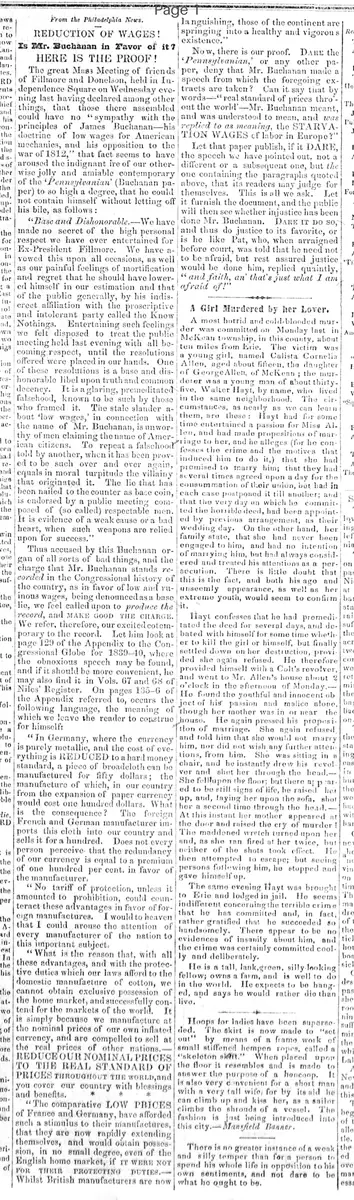
From the Philadelphia News.
REDUCTION OF WAGES!
Is Mr. Buchanan in Favor of it?
HERE IS THE PROOF!
The great Mass Meeting of friends of Fillmore and Donelson, held in Independence Square on Wednesday evening last having declared among other things, that those there assembled could have no "sympathy with the principles of James Buchanan--his doctrine of low wages for American mechanics, and his opposition to the war of 1812," that fact seems to have aroused the indignant ire of our otherwise jolly and amiable contemporary of the 'Pennsylvanian' (Buchanan paper) to so high a degree, that he could not contain himself without letting off his bile, as follows:
"Base and Dishonorable.--We have made no secret of the high personal respect we have ever entertained for Ex-President Fillmore. We have avowed this upon all occasions, as well as our painful feelings of mortification and regret that he should have lowered himself in our estimation and that of the public generally, by his indiscreet affiliation with the proscriptive and intolerant party called the Know Nothings. Entertaining such feelings we felt disposed to treat the public meeting held last evening with all becoming respect, until the resolutions offered were placed in our hands. One of these resolutions is a base and dishonorable libel upon truth and common decency. It is a glaring, premeditated falsehood, known to be such by those who framed it. The stale slander about 'low wages,' in connection with the name of Mr. Buchanan, is unworthy of men claiming the name of American citizens. To repeat a falsehood told by another, when it has been proved to be such over and over again, equals in moral turpitude the villainy that originated it. The lie that has been nailed to the counter as base coin, is endorsed by a public meeting composed of (so called) respectable men. It is evidence of a weak cause or a bad heart, when such weapons are relied upon for success."
Thus accused by this Buchanan organ of all sorts of bad things, and the charge that Mr. Buchanan stands recorded in the Congressional history of the country, as in favor of low and ruinous wages, being denounced as a base lie, we feel called upon to produce the record, and MAKE GOOD THE CHARGE.
We refer, therefore, our excited contemporary to the record. Let him look at page 129 of the Appendix to the Congressional Globe for 1839-40, where the obnoxious speech may be found, and if it should be more convenient, he may also find it in Vols. 67 and 68 of Niles' Register. On pages 135-6 of the Appendix referred to, occurs the following language, the meaning of which we leave the reader to construe for himself:
" In Germany, where the currency is purely metallic, and the cost of everything is REDUCED to a hard money standard, a piece of broadcloth can be manufactured for fifty dollars: the manufacture of which, in our country from the expansion of paper currency would cost one hundred dollars. What is the consequence? The foreign French and German manufacturer imports this cloth into our country and sells it for a hundred. Does not every person perceive that the redundancy of our currency is equal to a premium of one hundred per cent. in favor of the manufacturer.
" No tariff of protection, unless it amounted to prohibition, could counteract these advantages in favor of foreign manufactures. I would to heaven that I could arouse the attention of every manufacturer of the nation to this important subject.
" What is the reason that, with all these advantages, and with the protective duties which our laws afford to the domestic manufacture of cotton, we cannot obtain exclusive possession of the home market, and successfully contend for the markets of the world. It is simply because we manufacture at the nominal prices of our own inflated currency, and are compelled to sell at the real prices of other nations.-- REDUCE OUR NOMINAL PRICES TO THE REAL STANDARD OF PRICES THROUGHOUT THE WORLD, AND you cover our country with blessings and benefits.
" The comparative LOW PRICES of France and Germany, have afforded such a stimulus to their manufactures, that they are now rapidly extending themselves, and would obtain possession, in no small degree, even of the English home market, if it were not FOR THEIR PROTECTING DUTIES.-- Whilst British manufacturers are now languishing, those of the continent are springing into a healthy and vigorous existence.'
Now, there is our proof. Dare the 'Pennsylvanian,' or any other paper, deny that Mr. Buchanan made a speech from which the foregoing extracts are taken? Can it say that by words--"real standard of prices throughout the world'--Mr. Buchanan meant, and was understood to mean, and was replied to as meaning, the STARVATION WAGES of labor in Europe?
Let that paper publish, if it DARE, the speech we have pointed out, not a different or a subsequent one, but the one containing the paragraphs quoted above, that its readers may judge for themselves. This is all we ask. Let it furnish the document, and the public will then see whether injustice has been done Mr. Buchanan. DARE IT DO SO, and thus do justice to its favorite, or is he like Pat, who, when arraigned before court, was told that he need not be afraid, but rest assured justice would be done him, replied quaintly, " and faith, an'that's just what I am afraid of!"
REDUCTION OF WAGES!
Is Mr. Buchanan in Favor of it?
HERE IS THE PROOF!
The great Mass Meeting of friends of Fillmore and Donelson, held in Independence Square on Wednesday evening last having declared among other things, that those there assembled could have no "sympathy with the principles of James Buchanan--his doctrine of low wages for American mechanics, and his opposition to the war of 1812," that fact seems to have aroused the indignant ire of our otherwise jolly and amiable contemporary of the 'Pennsylvanian' (Buchanan paper) to so high a degree, that he could not contain himself without letting off his bile, as follows:
"Base and Dishonorable.--We have made no secret of the high personal respect we have ever entertained for Ex-President Fillmore. We have avowed this upon all occasions, as well as our painful feelings of mortification and regret that he should have lowered himself in our estimation and that of the public generally, by his indiscreet affiliation with the proscriptive and intolerant party called the Know Nothings. Entertaining such feelings we felt disposed to treat the public meeting held last evening with all becoming respect, until the resolutions offered were placed in our hands. One of these resolutions is a base and dishonorable libel upon truth and common decency. It is a glaring, premeditated falsehood, known to be such by those who framed it. The stale slander about 'low wages,' in connection with the name of Mr. Buchanan, is unworthy of men claiming the name of American citizens. To repeat a falsehood told by another, when it has been proved to be such over and over again, equals in moral turpitude the villainy that originated it. The lie that has been nailed to the counter as base coin, is endorsed by a public meeting composed of (so called) respectable men. It is evidence of a weak cause or a bad heart, when such weapons are relied upon for success."
Thus accused by this Buchanan organ of all sorts of bad things, and the charge that Mr. Buchanan stands recorded in the Congressional history of the country, as in favor of low and ruinous wages, being denounced as a base lie, we feel called upon to produce the record, and MAKE GOOD THE CHARGE.
We refer, therefore, our excited contemporary to the record. Let him look at page 129 of the Appendix to the Congressional Globe for 1839-40, where the obnoxious speech may be found, and if it should be more convenient, he may also find it in Vols. 67 and 68 of Niles' Register. On pages 135-6 of the Appendix referred to, occurs the following language, the meaning of which we leave the reader to construe for himself:
" In Germany, where the currency is purely metallic, and the cost of everything is REDUCED to a hard money standard, a piece of broadcloth can be manufactured for fifty dollars: the manufacture of which, in our country from the expansion of paper currency would cost one hundred dollars. What is the consequence? The foreign French and German manufacturer imports this cloth into our country and sells it for a hundred. Does not every person perceive that the redundancy of our currency is equal to a premium of one hundred per cent. in favor of the manufacturer.
" No tariff of protection, unless it amounted to prohibition, could counteract these advantages in favor of foreign manufactures. I would to heaven that I could arouse the attention of every manufacturer of the nation to this important subject.
" What is the reason that, with all these advantages, and with the protective duties which our laws afford to the domestic manufacture of cotton, we cannot obtain exclusive possession of the home market, and successfully contend for the markets of the world. It is simply because we manufacture at the nominal prices of our own inflated currency, and are compelled to sell at the real prices of other nations.-- REDUCE OUR NOMINAL PRICES TO THE REAL STANDARD OF PRICES THROUGHOUT THE WORLD, AND you cover our country with blessings and benefits.
" The comparative LOW PRICES of France and Germany, have afforded such a stimulus to their manufactures, that they are now rapidly extending themselves, and would obtain possession, in no small degree, even of the English home market, if it were not FOR THEIR PROTECTING DUTIES.-- Whilst British manufacturers are now languishing, those of the continent are springing into a healthy and vigorous existence.'
Now, there is our proof. Dare the 'Pennsylvanian,' or any other paper, deny that Mr. Buchanan made a speech from which the foregoing extracts are taken? Can it say that by words--"real standard of prices throughout the world'--Mr. Buchanan meant, and was understood to mean, and was replied to as meaning, the STARVATION WAGES of labor in Europe?
Let that paper publish, if it DARE, the speech we have pointed out, not a different or a subsequent one, but the one containing the paragraphs quoted above, that its readers may judge for themselves. This is all we ask. Let it furnish the document, and the public will then see whether injustice has been done Mr. Buchanan. DARE IT DO SO, and thus do justice to its favorite, or is he like Pat, who, when arraigned before court, was told that he need not be afraid, but rest assured justice would be done him, replied quaintly, " and faith, an'that's just what I am afraid of!"
What sub-type of article is it?
Historical Event
Deception Fraud
What themes does it cover?
Deception
Justice
What keywords are associated?
Buchanan Wages
Political Slander
Congressional Speech
Low Prices
Manufacturing Competition
Know Nothings
Fillmore Donelson
What entities or persons were involved?
James Buchanan
Fillmore
Donelson
Pennsylvanian
Where did it happen?
Philadelphia, Independence Square
Story Details
Key Persons
James Buchanan
Fillmore
Donelson
Pennsylvanian
Location
Philadelphia, Independence Square
Event Date
1839 40
Story Details
A mass meeting criticizes Buchanan's principles on low wages; the Pennsylvanian calls it a falsehood; the article quotes Buchanan's 1840 speech advocating price reduction to world standards, implying support for lower wages to compete with Europe.