Thank you for visiting SNEWPapers!
Sign up free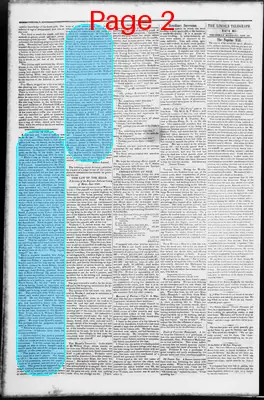
Editorial
November 19, 1840
Lincoln Telegraph
Bath, Sagadahoc County, Maine
What is this article about?
This editorial reviews historical English cases of illegal paper seizures, including Algernon Sidney's arrest and John Wilkes' case, quoting Lord Camden's judgment against arbitrary searches. It argues such practices violate liberties and questions their legality in America.
Clipping
OCR Quality
98%
Excellent
Full Text
SEIZURE OF PAPERS.
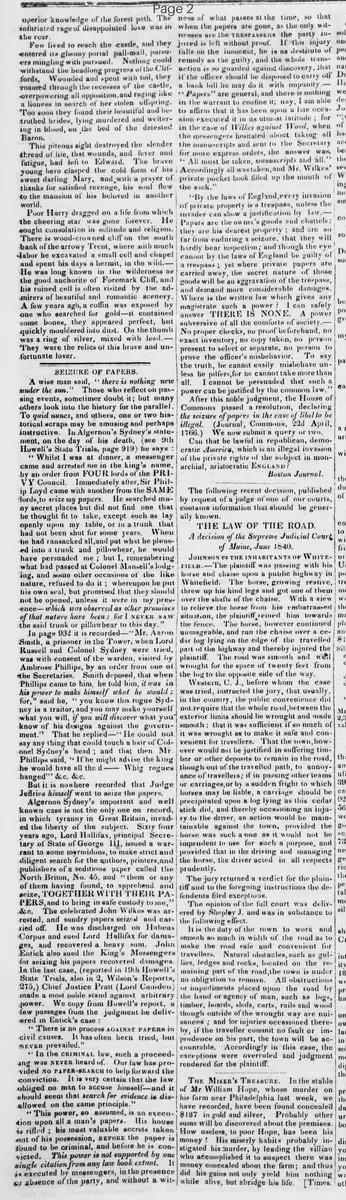
A wise man said, 'there is nothing new under the sun.' Those who reflect on passing events, sometimes doubt it; but many others look into the history for the parallel. To quid nuncs, and others, one or two historical scraps may be amusing and perhaps instructive. In Algernon Sydney's statement, on the day of his death, (see 9th Howell's State Trials, page 919) he says: 'Whilst I was at dinner, a messenger came and arrested me in the king's name, by an order from four lords of the PRIVY Council. Immediately after, Sir Philip Loyd came with another from the SAME Lords, to seize my papers. He searched in many secret places but did not find one that he thought fit to take, except such as lay openly upon my table, or in a trunk that had not been shut for some years. When he had ransacked all, and put what he pleased into a trunk and pillowbear, he would have persuaded me; but I, remembering what had passed at Colonel Mansell's lodging, and some other occasions of the like nature, refused to do it; whereupon he put his own seal, but promised that they should not be opened, unless it were in my presence'—which was observed as other promises of that nature have been: for I never saw the said trunk or pillowbear to this day.' In page 932 it is recorded—'Mr. Aaron Smith, a prisoner in the Tower, when Lord Russell and Colonel Sydney were tried, was with consent of the warden, visited by Ambrose Phillips, by an order from one of the Secretaries. Smith deposed, that when Phillips came to him, he told him, it was in his power to make himself what he would; for,' said he, 'you know this rogue Sydney is a traitor, and you may make yourself what you will, if you will discover what you know of his designs against the government.' That he replied—'He could not say anything that could touch a hair of Colonel Sydney's head; and that then Mr. Phillips said, "If he might advise the king he would have all the d--- Whig rogues hanged" &c. &c.' But it is nowhere recorded that Judge Jeffries himself went to seize the papers. Algernon Sydney's important and well known case is not the only one on record, in which tyranny in Great Britain, invaded the liberty of the subject. Sixty four years ago, Lord Halifax, principal Secretary of State of George III, issued a warrant to some myrmidons, to make strict and diligent search for the authors, printers, and publishers of a seditious paper called the North Briton, No. 45. and 'them or any of them having found, to apprehend and seize, TOGETHER WITH THEIR PAPERS, and to bring in safe custody to me,' &c. The celebrated John Wilkes was arrested, and sundry papers seized and carried off. He was discharged on Habeas Corpus and sued Lord Halifax for damages, and recovered a heavy sum. John Entick also sued the King's Messengers for seizing his papers recovered damages. In the last case, (reported in 19th Howell's State Trials, also in 2, Wilson's Reports, 275,) Chief Justice Pratt (Lord Camden) made a most noble stand against arbitrary power. We copy from Howell's report, a few passages from the judgment he delivered in Entick's case: 'There is no process AGAINST PAPERS in civil causes. It has often been tried, but NEVER prevailed.' 'In the criminal law, such a proceeding was Never heard of. Our law has provided No PAPER-SEARCH to help forward the conviction. It is very certain that the law obliged no man to accuse himself—and it should seem that search for evidence is disallowed on the same principle.' 'This power, so assumed, is an execution upon all a man's papers. His house is rifled; his most valuable secrets taken out of his possession, Before the paper is found to be criminal, and before he is convicted. This power is not supported by one single citation from any law book extant. It is executed by messengers, in the presence or absence of the party, and without a witness of what passes at the time, so that when the papers are gone, as the only witnesses are the TRESPASSERS the party injured is left without proof. If this injury falls on the innocent, he is as destitute of remedy as the guilty, and the whole transaction is so guarded against discovery, that if the officer should be disposed to carry off a bank bill he may do it with impunity. "Papers" are general, and there is nothing in the warrant to confine it; nay, I am able to affirm that it has been upon a late occasion executed it in its utmost latitude; for in the case of Wilkes against Wood, when the messengers hesitated about taking all the manuscripts and sent to the Secretary for more express orders, the answer was, "All must be taken, manuscripts and all." Accordingly all was taken, and Mr. Wilkes private pocket book filled up the mouth of the sack.' 'By the laws of England, every invasion of private property is a trespass, unless the invader can show a justification by law. Papers are the owner's goods and chattels: they are his dearest property; and are so far from enduring a seizure, that they will hardly bear inspection; and though the eye cannot by the laws of England be guilty of a trespass; yet where private papers are carried away, the secret nature of those goods will be an aggravation of the trespass, and demand more considerable damages. Where is the written law which gives any magistrate such a power? I can safely answer THERE IS NONE. A power subversive of all the comforts of society. No proper checks, no proof beforehand, no exact inventory, no copy taken, no person present to select or separate, no person to prove the officer's misbehavior. To say the truth, he cannot easily misbehave unless he pilfers, for he cannot take more than all. I cannot be persuaded that such a power can be justified by the common law.' After this noble judgment, the House of Commons passed a resolution, declaring the seizure of papers in the case of libel to be illegal. (Journal, Commons, 22d April, 1766.) We now submit a query or two. Can that be lawful in republican, democratic America, which is an illegal invasion of the private rights of the subject in monarchical, aristocratic ENGLAND?
A wise man said, 'there is nothing new under the sun.' Those who reflect on passing events, sometimes doubt it; but many others look into the history for the parallel. To quid nuncs, and others, one or two historical scraps may be amusing and perhaps instructive. In Algernon Sydney's statement, on the day of his death, (see 9th Howell's State Trials, page 919) he says: 'Whilst I was at dinner, a messenger came and arrested me in the king's name, by an order from four lords of the PRIVY Council. Immediately after, Sir Philip Loyd came with another from the SAME Lords, to seize my papers. He searched in many secret places but did not find one that he thought fit to take, except such as lay openly upon my table, or in a trunk that had not been shut for some years. When he had ransacked all, and put what he pleased into a trunk and pillowbear, he would have persuaded me; but I, remembering what had passed at Colonel Mansell's lodging, and some other occasions of the like nature, refused to do it; whereupon he put his own seal, but promised that they should not be opened, unless it were in my presence'—which was observed as other promises of that nature have been: for I never saw the said trunk or pillowbear to this day.' In page 932 it is recorded—'Mr. Aaron Smith, a prisoner in the Tower, when Lord Russell and Colonel Sydney were tried, was with consent of the warden, visited by Ambrose Phillips, by an order from one of the Secretaries. Smith deposed, that when Phillips came to him, he told him, it was in his power to make himself what he would; for,' said he, 'you know this rogue Sydney is a traitor, and you may make yourself what you will, if you will discover what you know of his designs against the government.' That he replied—'He could not say anything that could touch a hair of Colonel Sydney's head; and that then Mr. Phillips said, "If he might advise the king he would have all the d--- Whig rogues hanged" &c. &c.' But it is nowhere recorded that Judge Jeffries himself went to seize the papers. Algernon Sydney's important and well known case is not the only one on record, in which tyranny in Great Britain, invaded the liberty of the subject. Sixty four years ago, Lord Halifax, principal Secretary of State of George III, issued a warrant to some myrmidons, to make strict and diligent search for the authors, printers, and publishers of a seditious paper called the North Briton, No. 45. and 'them or any of them having found, to apprehend and seize, TOGETHER WITH THEIR PAPERS, and to bring in safe custody to me,' &c. The celebrated John Wilkes was arrested, and sundry papers seized and carried off. He was discharged on Habeas Corpus and sued Lord Halifax for damages, and recovered a heavy sum. John Entick also sued the King's Messengers for seizing his papers recovered damages. In the last case, (reported in 19th Howell's State Trials, also in 2, Wilson's Reports, 275,) Chief Justice Pratt (Lord Camden) made a most noble stand against arbitrary power. We copy from Howell's report, a few passages from the judgment he delivered in Entick's case: 'There is no process AGAINST PAPERS in civil causes. It has often been tried, but NEVER prevailed.' 'In the criminal law, such a proceeding was Never heard of. Our law has provided No PAPER-SEARCH to help forward the conviction. It is very certain that the law obliged no man to accuse himself—and it should seem that search for evidence is disallowed on the same principle.' 'This power, so assumed, is an execution upon all a man's papers. His house is rifled; his most valuable secrets taken out of his possession, Before the paper is found to be criminal, and before he is convicted. This power is not supported by one single citation from any law book extant. It is executed by messengers, in the presence or absence of the party, and without a witness of what passes at the time, so that when the papers are gone, as the only witnesses are the TRESPASSERS the party injured is left without proof. If this injury falls on the innocent, he is as destitute of remedy as the guilty, and the whole transaction is so guarded against discovery, that if the officer should be disposed to carry off a bank bill he may do it with impunity. "Papers" are general, and there is nothing in the warrant to confine it; nay, I am able to affirm that it has been upon a late occasion executed it in its utmost latitude; for in the case of Wilkes against Wood, when the messengers hesitated about taking all the manuscripts and sent to the Secretary for more express orders, the answer was, "All must be taken, manuscripts and all." Accordingly all was taken, and Mr. Wilkes private pocket book filled up the mouth of the sack.' 'By the laws of England, every invasion of private property is a trespass, unless the invader can show a justification by law. Papers are the owner's goods and chattels: they are his dearest property; and are so far from enduring a seizure, that they will hardly bear inspection; and though the eye cannot by the laws of England be guilty of a trespass; yet where private papers are carried away, the secret nature of those goods will be an aggravation of the trespass, and demand more considerable damages. Where is the written law which gives any magistrate such a power? I can safely answer THERE IS NONE. A power subversive of all the comforts of society. No proper checks, no proof beforehand, no exact inventory, no copy taken, no person present to select or separate, no person to prove the officer's misbehavior. To say the truth, he cannot easily misbehave unless he pilfers, for he cannot take more than all. I cannot be persuaded that such a power can be justified by the common law.' After this noble judgment, the House of Commons passed a resolution, declaring the seizure of papers in the case of libel to be illegal. (Journal, Commons, 22d April, 1766.) We now submit a query or two. Can that be lawful in republican, democratic America, which is an illegal invasion of the private rights of the subject in monarchical, aristocratic ENGLAND?
What sub-type of article is it?
Press Freedom
Constitutional
Legal Reform
What keywords are associated?
Seizure Of Papers
Civil Liberties
Historical Precedents
John Wilkes
Lord Camden
General Warrants
Press Freedom
Legal Tyranny
What entities or persons were involved?
Algernon Sydney
John Wilkes
Lord Halifax
Chief Justice Pratt (Lord Camden)
Judge Jeffries
John Entick
Editorial Details
Primary Topic
Opposition To Arbitrary Seizure Of Papers
Stance / Tone
Strongly Against Illegal Searches And Seizures, Defending Civil Liberties
Key Figures
Algernon Sydney
John Wilkes
Lord Halifax
Chief Justice Pratt (Lord Camden)
Judge Jeffries
John Entick
Key Arguments
Historical Seizures In England Violated Liberties, As In Algernon Sydney's Case Where Papers Were Taken Despite Promises.
John Wilkes Was Arrested And Papers Seized Under A General Warrant For The North Briton No. 45, Later Ruled Illegal.
Lord Camden's Judgment In Entick's Case Declared No Legal Basis For Paper Searches Without Specific Process.
Such Powers Allow Trespass, Rifling Of Homes, And Seizure Without Proof Or Witnesses, Leaving Innocents Remediless.
House Of Commons Resolved Paper Seizures In Libel Cases Illegal In 1766.
Questions Legality Of Such Practices In America Given Their Illegality In England.