Thank you for visiting SNEWPapers!
Sign up free
Editorial
December 29, 1804
The Enquirer
Richmond, Henrico County, Virginia
What is this article about?
Editor of the Richmond Enquirer reflects on a prior article about Judge Chase's impeachment, regrets linking it to Marshal Randolph's conduct in the 1800 Callender trial, responds to Randolph's denial, and examines evidence of alleged jury manipulation favoring Federalists over Democrats.
Clipping
OCR Quality
95%
Excellent
Full Text
ENQUIRER
RICHMOND:
SATURDAY, DECEMBER 29, 1804.
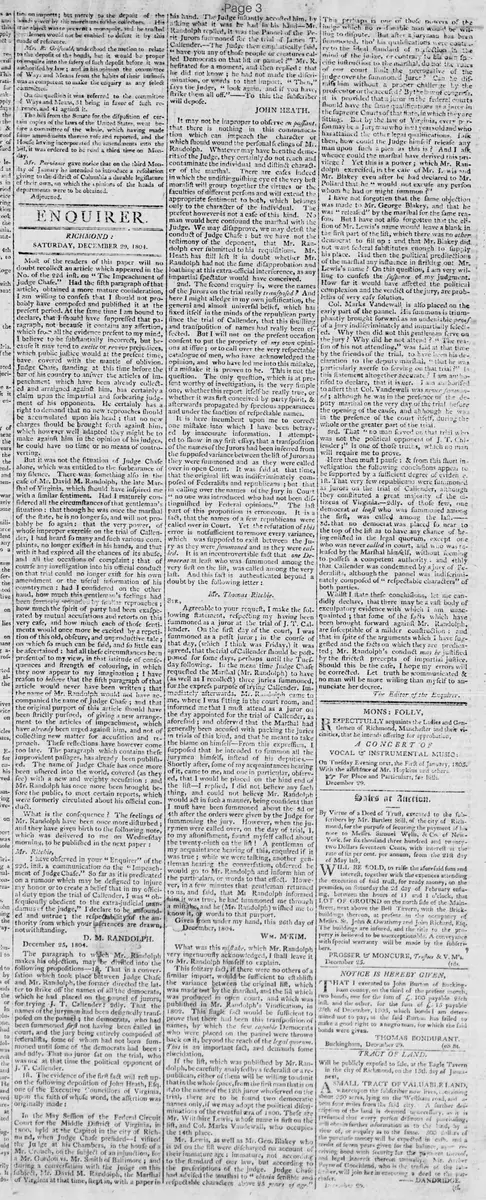
Most of the readers of this paper will no doubt recollect an article which appeared in the No. of the 22d inst. on "The Impeachment of Judge Chase." Had the fifth paragraph of that article, obtained a more mature consideration, I am willing to confess that I should not probably have composed and published it at the present period. At the same time I am bound to declare, that I should have suppressed that paragraph, not because it contains any assertion, which from all the evidence present to my mind, I believe to be substantially incorrect, but because it may tend to excite or revive prejudices, which public justice would at the present time, have, covered with the mantle of oblivion.
Judge Chase, standing at this time before the bar of his country to answer the articles of impeachment which have been already collected and arraigned against him, has certainly a claim upon the impartial and forbearing judgment of his opponents. He certainly has a right to demand that no new reproaches should be accumulated upon his head; that no new charges should be brought forth against him, which however well adapted they might be to make against him in the opinion of his judges, he could have no time or no means of controverting.
But it was not the situation of Judge Chase alone, which was entitled to the forbearance of my silence. There was something also in the case of Mr. David M. Randolph, the late Marshal of Virginia, which should have inspired me with a similar sentiment. Had I maturely considered all the circumstances of that gentleman's situation: that though he was once the marshal of the state, he is no longer so, and will not probably be so again: that the very power, of whose improper exercise on the trial of Callender, I had heard so many and such various complaints, no longer existed in his hands, and that with it had expired all the chances of its abuse, and all the occasions of complaint; that of course any investigation into his official conduct on that trial could no longer exist for his own amendment or the useful information of his countrymen: had I considered on the other hand, how much this gentleman's feelings had formerly been wounded by similar reproaches; how much the spirit of party had been exasperated by mutual accusations and retorts on this very case, and how much each of those sentiments would once more be excited by a repetition of this old, obscure, and unproductive tale; on which so much can be said, and so little can be ascertained: had all these circumstances been presented to my view, in that latitude of consequences and strength of colouring, in which they now appear to my imagination; I have reason to believe that the fifth paragraph of that article would never have been written; that the name of Mr. Randolph would not have accompanied the name of Judge Chase; and that the original purport of this article should have been strictly pursued, of giving a new arrangement to the articles of impeachment, which have already been urged against him, and not of collecting new matter for accusation and reproach. These reflections have however come too late. The paragraph which contains these improvident passages, has already been published. The name of Judge Chase has once more been ushered into the world, covered (as they see) with a new and weighty accusation: and Mr. Randolph has once more been brought before the public, to meet certain reports, which were formerly circulated about his official conduct.
What is the consequence? The feelings of Mr. Randolph have been once more disturbed; and they have given birth to the following note, which was delivered to me on Wednesday morning, to be published in the next paper:
Mr. Ritchie.
I have observed in your "Enquirer" of the 22d. inst. a communication on the "Impeachment of Judge Chase." So far as it is predicated on a rumour which may be designed to injure my honor or to create a belief that in my official duty upon the trial of Callender, I was "obsequiously obedient to the extra-judicial mandamus of the judge," I declare to be unfounded and untrue; the respectability of the authority from which your inferences are drawn, notwithstanding
D. M. RANDOLPH.
December 25, 1804.
The paragraph to which Mr. Randolph makes his objection, may be divided into the following propositions--1st. That in a conversation which took place between Judge Chase and Mr. Randolph, the former directed the latter to strike off the names of all the democrats, which he had placed on the panel of jurors, for trying J. T. Callender: 2dly. That the names of the jurymen had been designedly transposed on the panel; the democrats, who had been summoned first not having been called in court, and the jury being entirely composed of federalists, some of whom had not been summoned until some of the democrats had been: and 3dly. That no juror sat on the trial, who was not at that time the political opponent of J. T. Callender.
1st. The evidence of the first fact will rest upon the following deposition of John Heath, Esq. one of the Executive Councillors of Virginia, upon the faith of whose word, the assertion was originally made:
In the May Session of the Federal Circuit Court for the Middle District of Virginia, in 1800, held at the Capitol in the city of Richmond, when Judge Chase presided--I visited the Judge at his Chambers, in the house of a Mr. Crouch, on the subject of an injunction, for a Mr. Gordon vs. Mr. Smith of Baltimore; and during a conversation with the Judge on this subject, Mr. David M. Randolph, the Marshal of Virginia at that time, stept in, with a paper in his hand. The Judge instantly accosted him, by asking what it was he had in his hand--Mr. Randolph replied, it was the Panel of the Petit Jurors summoned for the trial of James T. Callender.--The Judge then emphatically said, "have you any of those people or creatures called Democrats on that list or panel?" Mr. R. hesitated for a moment, and then replied: that he did not know: he had not made the discrimination, or words to that import. "The n," says the Judge, "look again, and if you have, Strike them all off."--To this the subscriber will depose.
JOHN HEATH.
It may not be improper to observe en passant, that there is nothing in this communication which can impeach the character or which should wound the personal feelings of Mr. Randolph. Whatever may have been the demerits of the Judge, they certainly do not reach and contaminate the individual and distinct character of the marshal. There are cases indeed in which the undistinguishing eye of the very best moralist will group together the virtues or the faculties of different persons and will extend the appropriate epithet to both, which belongs only to the character of the individual. The present however is not a case of this kind. No man would here confound the marshal with the Judge. We may disapprove, we may detest the conduct of Judge Chase: but we have not the testimony of the deponent, that Mr. Randolph ever submitted to his requisitions. Mr. Heath has still left it in doubt whether Mr. Randolph had not the same disapprobation and loathing at this extra-official interference, as any impartial spectator would have conceived.
2nd. The second enquiry is, were the names of the Jurors on the trial really transposed? And here I might allege in my own justification, the general and almost universal belief, which has fixed itself in the minds of the republican party since the trial of Callender. that this shuffling and transposition of names had really been effected. But I will not on the present occasion consent to put the propriety of my former opinions at issue; or to call over the very respectable catalogue of men, who have acknowledged the opinion, and who have led me into this mistake, if a mistake it is proven to be. This is not the question. The only question, which is at present worthy of investigation, is the very simple one, whether this report itself be really true, or whether it was first conceived by party spirit, & afterwards propagated by specious appearances and under the sanction of respectable names.
It is here incumbent upon me to correct one mistake into which I have been betrayed by inaccurate information. I attempted to show in my first essay, that a transposition of the names of the Jurors had been inferred from the supposed variance between the list of Jurors as they were summoned and as they were called over in open Court. It was said at that time, that the original list was indiscriminately composed of Federalists and republicans: but that in calling over the names of the Jury in Court "no one was introduced who had not been distinguished by Federal opinions." The last part of this proposition is erroneous. It is a fact, that the names of a few republicans were called over in Court. Yet the refutation of this error is not sufficient to remove every variance, which was supposed to exist between the Jury as they were summoned and as they were called. It is an incontrovertible fact that one Democrat at least who was summoned among the very first on the list, was called among the very last. And this fact is authenticated beyond a doubt by the following letter:
Mr. Thomas Ritchie.
SIR,
Agreeable to your request, I make the following statement, respecting my having been summoned as a juror at the trial of J. T. Callender. On the first day of the court, I was summoned as a petit juror; in the course of that day, (which I think was Friday,) it was agreed, that the trial of Callender should be postponed for some days, perhaps until the Tuesday following. In the mean time Judge Chase requested the Marshal (Mr. Randolph) to have (as well as I recollect) three juries summoned, for the express purpose of trying Callender. Immediately afterwards, Mr. Randolph came to me, where I was sitting in the court room, and informed me that I must attend as a juror on the day appointed for the trial of Callender, as aforesaid: and observed that the Marshal had generally been accused with packing the juries in trials of this kind, and that he meant to take the blame on himself. From this expression, I supposed that he intended to summon all the jurymen himself, instead of his deputies. Shortly after, some of my acquaintances hearing of it, came to me, and one in particular, observed, that I would be placed on the hind end of the list. I replied, I did not believe any such thing, and could not believe Mr. Randolph would act in such a manner, being confident that I must have been summoned about the 3d or 4th after the orders were given by the Judge for summoning the jury. However, when the jurymen were called over, on the day of trial, I, to my astonishment, found myself called about the twenty-ninth on the list! A gentleman of my acquaintance hearing of this, enquired if it was true; while we were talking, another gentleman hearing the conversation, observed he would go to Mr. Randolph and inform him of the particulars, or words to that effect. However, in a few minutes that gentleman returned to us, and said, that Mr. Randolph informed him it was true, he had summoned me through a mistake and he (Mr. Randolph) wished me to know it, or words to that purport.
Given from under my hand, this 26th day of December, 1804.
WM. MKIM.
What was this mistake, which Mr. Randolph very ingenuously acknowledged, I shall leave it to Mr. Randolph himself to explain. This solitary fact, if there were no others of a similar import, would be sufficient to establish the variance between the original list, which was made out by the marshal, and the list which was produced in open court. and which was published in Mr. Randolph's Vindication, in 1802. This single fact would be sufficient to prove that there had been this transposition of names, by which the few capable Democrats who were placed on the panel were thrown back on it, beyond the reach of the legal quorum. This is an important fact, and demands some elucidation.
If the list, which was published by Mr. Randolph, be carefully analysed by a federalist or a republican, either of them will be willing to admit that in the whole space, from the first man that is on it, to the name of the 12th juror who served on the trial, there are to be found two democratic names only, if we may adopt the political discriminations of the eventful era of 1800. These are Mr. Wiltshire Lewis, whose name is first on the list, and Col. Marks Vandewall, who occupies the 14th place.
Mr. Lewis, as well as Mr. Geo. Blakey who is 2d on the list were discharged on account of their immature age: immature, not according to the standard of our law, but according to the prescriptions of the judge. Judge Chase had advised the marshal to "obtain sensible and respectable characters above 25 years of age."
This perhaps is one of those powers of the judge which no reasonable man would be willing to dispute. But after a juryman has been summoned. tho' his qualifications were contrary to the ideal standard of perfection in the mind of the judge, or contrary to his own special instruction to the marshal, do not the rules of our court limit the prerogative of the judge over the summoned juror? Can he dismiss him without a proper challenge by the prosecutor or the accused? By the act of Congress, it is provided that a juror in the federal courts should have the same qualifications as a juror in the supreme Courts of that state, in which they are sitting. But by the law of Virginia, every person may be a Juryman who is 21 years old and who has attained the other legal qualifications. I ask then, how could the Judge himself release any man upon such a plea as this is? And I ask whence could the marshal have derived this privilege? Yet this is a power; which Mr. Randolph exercised, in the case of Mr. Lewis and Mr. Blakey even after he had declared to Mr. Pollard that he "would not excuse any person whom he had or might summon?"
I have not forgotten that the same objection was made to Mr. George Blakey, and that he was "released" by the marshal for the same reason. But I have not also forgotten that the elision of Mr. Lewis's name would leave a blank in the first part of the list, which there was no other democrat to fill up: and that Mr. Blakey did not want federal substitutes enough to supply his place. Had then the political predilections of the marshal any influence in striking out Mr. Lewis's name? On this question, I am very willing to confess the suspense of my judgment. How far it would have affected the political complexion and the verdict of the jury, are problems of very easy solution.
Col. Marks Vandewall is also placed on the early part of the panel. His summons is triumphantly brought forward as an undeniable proof of a jury indiscriminately and impartially selected. why then did not this gentleman serve on the jury? Why did he not attend? "The reason of his not attending," was said at that time by the friends of the trial, to have been his declaration to the deputy marshal, "that he was particularly averse to serving on that trial?" Is this statement altogether accurate? I am authorized to declare, that it is not. I am authorized to assert that Col. Vandewall was never summoned; although he was in the presence of the deputy marshal on the very day of the trial before the opening of the cause, and although he was in the presence of the court itself, during the whole or the greater part of the trial.
3rd. That "no man served on that trial who was not the political opponent of J. T. Callender;" is one of those truths, which no man will require me to prove.
Here then must I pause: & from this short investigation the following conclusions appear to be supported by a sufficient degree of evidence. 1st. That very few republicans were summoned as jurors on the trial of Callender, although they constituted a great majority of the citizens of Virginia. 2dly. of those few, one democrat at least who was summoned among the first, was called among the last. 3d. that no democrat was placed so near to the top of the list as to have any chance of being enlisted in the legal quorum, except one who was never called in court, and who was released by the Marshal himself, without seeming to possess a competent authority: and 4thly that Callender was condemned by a jury of Federalists, although the panel was indiscriminately composed of "respectable characters" of both parties.
Whilst I state these conclusions, let me candidly declare, that there may be a vast body of exculpatory evidence with which I am unacquainted; that some of the facts which have been brought forward against Mr. Randolph, are susceptible of a milder construction: and that in spite of the arguments which I have suggested and the facts on which they are predicated; Mr. Randolph's conduct may be justified by the strictest precepts of impartial justice. Should this be the case, I hope my errors will be corrected. Let truth be communicated & no man will be more willing than myself to announce her decree.
Ine
Editor of the Enquirer.
RICHMOND:
SATURDAY, DECEMBER 29, 1804.
Most of the readers of this paper will no doubt recollect an article which appeared in the No. of the 22d inst. on "The Impeachment of Judge Chase." Had the fifth paragraph of that article, obtained a more mature consideration, I am willing to confess that I should not probably have composed and published it at the present period. At the same time I am bound to declare, that I should have suppressed that paragraph, not because it contains any assertion, which from all the evidence present to my mind, I believe to be substantially incorrect, but because it may tend to excite or revive prejudices, which public justice would at the present time, have, covered with the mantle of oblivion.
Judge Chase, standing at this time before the bar of his country to answer the articles of impeachment which have been already collected and arraigned against him, has certainly a claim upon the impartial and forbearing judgment of his opponents. He certainly has a right to demand that no new reproaches should be accumulated upon his head; that no new charges should be brought forth against him, which however well adapted they might be to make against him in the opinion of his judges, he could have no time or no means of controverting.
But it was not the situation of Judge Chase alone, which was entitled to the forbearance of my silence. There was something also in the case of Mr. David M. Randolph, the late Marshal of Virginia, which should have inspired me with a similar sentiment. Had I maturely considered all the circumstances of that gentleman's situation: that though he was once the marshal of the state, he is no longer so, and will not probably be so again: that the very power, of whose improper exercise on the trial of Callender, I had heard so many and such various complaints, no longer existed in his hands, and that with it had expired all the chances of its abuse, and all the occasions of complaint; that of course any investigation into his official conduct on that trial could no longer exist for his own amendment or the useful information of his countrymen: had I considered on the other hand, how much this gentleman's feelings had formerly been wounded by similar reproaches; how much the spirit of party had been exasperated by mutual accusations and retorts on this very case, and how much each of those sentiments would once more be excited by a repetition of this old, obscure, and unproductive tale; on which so much can be said, and so little can be ascertained: had all these circumstances been presented to my view, in that latitude of consequences and strength of colouring, in which they now appear to my imagination; I have reason to believe that the fifth paragraph of that article would never have been written; that the name of Mr. Randolph would not have accompanied the name of Judge Chase; and that the original purport of this article should have been strictly pursued, of giving a new arrangement to the articles of impeachment, which have already been urged against him, and not of collecting new matter for accusation and reproach. These reflections have however come too late. The paragraph which contains these improvident passages, has already been published. The name of Judge Chase has once more been ushered into the world, covered (as they see) with a new and weighty accusation: and Mr. Randolph has once more been brought before the public, to meet certain reports, which were formerly circulated about his official conduct.
What is the consequence? The feelings of Mr. Randolph have been once more disturbed; and they have given birth to the following note, which was delivered to me on Wednesday morning, to be published in the next paper:
Mr. Ritchie.
I have observed in your "Enquirer" of the 22d. inst. a communication on the "Impeachment of Judge Chase." So far as it is predicated on a rumour which may be designed to injure my honor or to create a belief that in my official duty upon the trial of Callender, I was "obsequiously obedient to the extra-judicial mandamus of the judge," I declare to be unfounded and untrue; the respectability of the authority from which your inferences are drawn, notwithstanding
D. M. RANDOLPH.
December 25, 1804.
The paragraph to which Mr. Randolph makes his objection, may be divided into the following propositions--1st. That in a conversation which took place between Judge Chase and Mr. Randolph, the former directed the latter to strike off the names of all the democrats, which he had placed on the panel of jurors, for trying J. T. Callender: 2dly. That the names of the jurymen had been designedly transposed on the panel; the democrats, who had been summoned first not having been called in court, and the jury being entirely composed of federalists, some of whom had not been summoned until some of the democrats had been: and 3dly. That no juror sat on the trial, who was not at that time the political opponent of J. T. Callender.
1st. The evidence of the first fact will rest upon the following deposition of John Heath, Esq. one of the Executive Councillors of Virginia, upon the faith of whose word, the assertion was originally made:
In the May Session of the Federal Circuit Court for the Middle District of Virginia, in 1800, held at the Capitol in the city of Richmond, when Judge Chase presided--I visited the Judge at his Chambers, in the house of a Mr. Crouch, on the subject of an injunction, for a Mr. Gordon vs. Mr. Smith of Baltimore; and during a conversation with the Judge on this subject, Mr. David M. Randolph, the Marshal of Virginia at that time, stept in, with a paper in his hand. The Judge instantly accosted him, by asking what it was he had in his hand--Mr. Randolph replied, it was the Panel of the Petit Jurors summoned for the trial of James T. Callender.--The Judge then emphatically said, "have you any of those people or creatures called Democrats on that list or panel?" Mr. R. hesitated for a moment, and then replied: that he did not know: he had not made the discrimination, or words to that import. "The n," says the Judge, "look again, and if you have, Strike them all off."--To this the subscriber will depose.
JOHN HEATH.
It may not be improper to observe en passant, that there is nothing in this communication which can impeach the character or which should wound the personal feelings of Mr. Randolph. Whatever may have been the demerits of the Judge, they certainly do not reach and contaminate the individual and distinct character of the marshal. There are cases indeed in which the undistinguishing eye of the very best moralist will group together the virtues or the faculties of different persons and will extend the appropriate epithet to both, which belongs only to the character of the individual. The present however is not a case of this kind. No man would here confound the marshal with the Judge. We may disapprove, we may detest the conduct of Judge Chase: but we have not the testimony of the deponent, that Mr. Randolph ever submitted to his requisitions. Mr. Heath has still left it in doubt whether Mr. Randolph had not the same disapprobation and loathing at this extra-official interference, as any impartial spectator would have conceived.
2nd. The second enquiry is, were the names of the Jurors on the trial really transposed? And here I might allege in my own justification, the general and almost universal belief, which has fixed itself in the minds of the republican party since the trial of Callender. that this shuffling and transposition of names had really been effected. But I will not on the present occasion consent to put the propriety of my former opinions at issue; or to call over the very respectable catalogue of men, who have acknowledged the opinion, and who have led me into this mistake, if a mistake it is proven to be. This is not the question. The only question, which is at present worthy of investigation, is the very simple one, whether this report itself be really true, or whether it was first conceived by party spirit, & afterwards propagated by specious appearances and under the sanction of respectable names.
It is here incumbent upon me to correct one mistake into which I have been betrayed by inaccurate information. I attempted to show in my first essay, that a transposition of the names of the Jurors had been inferred from the supposed variance between the list of Jurors as they were summoned and as they were called over in open Court. It was said at that time, that the original list was indiscriminately composed of Federalists and republicans: but that in calling over the names of the Jury in Court "no one was introduced who had not been distinguished by Federal opinions." The last part of this proposition is erroneous. It is a fact, that the names of a few republicans were called over in Court. Yet the refutation of this error is not sufficient to remove every variance, which was supposed to exist between the Jury as they were summoned and as they were called. It is an incontrovertible fact that one Democrat at least who was summoned among the very first on the list, was called among the very last. And this fact is authenticated beyond a doubt by the following letter:
Mr. Thomas Ritchie.
SIR,
Agreeable to your request, I make the following statement, respecting my having been summoned as a juror at the trial of J. T. Callender. On the first day of the court, I was summoned as a petit juror; in the course of that day, (which I think was Friday,) it was agreed, that the trial of Callender should be postponed for some days, perhaps until the Tuesday following. In the mean time Judge Chase requested the Marshal (Mr. Randolph) to have (as well as I recollect) three juries summoned, for the express purpose of trying Callender. Immediately afterwards, Mr. Randolph came to me, where I was sitting in the court room, and informed me that I must attend as a juror on the day appointed for the trial of Callender, as aforesaid: and observed that the Marshal had generally been accused with packing the juries in trials of this kind, and that he meant to take the blame on himself. From this expression, I supposed that he intended to summon all the jurymen himself, instead of his deputies. Shortly after, some of my acquaintances hearing of it, came to me, and one in particular, observed, that I would be placed on the hind end of the list. I replied, I did not believe any such thing, and could not believe Mr. Randolph would act in such a manner, being confident that I must have been summoned about the 3d or 4th after the orders were given by the Judge for summoning the jury. However, when the jurymen were called over, on the day of trial, I, to my astonishment, found myself called about the twenty-ninth on the list! A gentleman of my acquaintance hearing of this, enquired if it was true; while we were talking, another gentleman hearing the conversation, observed he would go to Mr. Randolph and inform him of the particulars, or words to that effect. However, in a few minutes that gentleman returned to us, and said, that Mr. Randolph informed him it was true, he had summoned me through a mistake and he (Mr. Randolph) wished me to know it, or words to that purport.
Given from under my hand, this 26th day of December, 1804.
WM. MKIM.
What was this mistake, which Mr. Randolph very ingenuously acknowledged, I shall leave it to Mr. Randolph himself to explain. This solitary fact, if there were no others of a similar import, would be sufficient to establish the variance between the original list, which was made out by the marshal, and the list which was produced in open court. and which was published in Mr. Randolph's Vindication, in 1802. This single fact would be sufficient to prove that there had been this transposition of names, by which the few capable Democrats who were placed on the panel were thrown back on it, beyond the reach of the legal quorum. This is an important fact, and demands some elucidation.
If the list, which was published by Mr. Randolph, be carefully analysed by a federalist or a republican, either of them will be willing to admit that in the whole space, from the first man that is on it, to the name of the 12th juror who served on the trial, there are to be found two democratic names only, if we may adopt the political discriminations of the eventful era of 1800. These are Mr. Wiltshire Lewis, whose name is first on the list, and Col. Marks Vandewall, who occupies the 14th place.
Mr. Lewis, as well as Mr. Geo. Blakey who is 2d on the list were discharged on account of their immature age: immature, not according to the standard of our law, but according to the prescriptions of the judge. Judge Chase had advised the marshal to "obtain sensible and respectable characters above 25 years of age."
This perhaps is one of those powers of the judge which no reasonable man would be willing to dispute. But after a juryman has been summoned. tho' his qualifications were contrary to the ideal standard of perfection in the mind of the judge, or contrary to his own special instruction to the marshal, do not the rules of our court limit the prerogative of the judge over the summoned juror? Can he dismiss him without a proper challenge by the prosecutor or the accused? By the act of Congress, it is provided that a juror in the federal courts should have the same qualifications as a juror in the supreme Courts of that state, in which they are sitting. But by the law of Virginia, every person may be a Juryman who is 21 years old and who has attained the other legal qualifications. I ask then, how could the Judge himself release any man upon such a plea as this is? And I ask whence could the marshal have derived this privilege? Yet this is a power; which Mr. Randolph exercised, in the case of Mr. Lewis and Mr. Blakey even after he had declared to Mr. Pollard that he "would not excuse any person whom he had or might summon?"
I have not forgotten that the same objection was made to Mr. George Blakey, and that he was "released" by the marshal for the same reason. But I have not also forgotten that the elision of Mr. Lewis's name would leave a blank in the first part of the list, which there was no other democrat to fill up: and that Mr. Blakey did not want federal substitutes enough to supply his place. Had then the political predilections of the marshal any influence in striking out Mr. Lewis's name? On this question, I am very willing to confess the suspense of my judgment. How far it would have affected the political complexion and the verdict of the jury, are problems of very easy solution.
Col. Marks Vandewall is also placed on the early part of the panel. His summons is triumphantly brought forward as an undeniable proof of a jury indiscriminately and impartially selected. why then did not this gentleman serve on the jury? Why did he not attend? "The reason of his not attending," was said at that time by the friends of the trial, to have been his declaration to the deputy marshal, "that he was particularly averse to serving on that trial?" Is this statement altogether accurate? I am authorized to declare, that it is not. I am authorized to assert that Col. Vandewall was never summoned; although he was in the presence of the deputy marshal on the very day of the trial before the opening of the cause, and although he was in the presence of the court itself, during the whole or the greater part of the trial.
3rd. That "no man served on that trial who was not the political opponent of J. T. Callender;" is one of those truths, which no man will require me to prove.
Here then must I pause: & from this short investigation the following conclusions appear to be supported by a sufficient degree of evidence. 1st. That very few republicans were summoned as jurors on the trial of Callender, although they constituted a great majority of the citizens of Virginia. 2dly. of those few, one democrat at least who was summoned among the first, was called among the last. 3d. that no democrat was placed so near to the top of the list as to have any chance of being enlisted in the legal quorum, except one who was never called in court, and who was released by the Marshal himself, without seeming to possess a competent authority: and 4thly that Callender was condemned by a jury of Federalists, although the panel was indiscriminately composed of "respectable characters" of both parties.
Whilst I state these conclusions, let me candidly declare, that there may be a vast body of exculpatory evidence with which I am unacquainted; that some of the facts which have been brought forward against Mr. Randolph, are susceptible of a milder construction: and that in spite of the arguments which I have suggested and the facts on which they are predicated; Mr. Randolph's conduct may be justified by the strictest precepts of impartial justice. Should this be the case, I hope my errors will be corrected. Let truth be communicated & no man will be more willing than myself to announce her decree.
Ine
Editor of the Enquirer.
What sub-type of article is it?
Constitutional
Partisan Politics
Legal Reform
What keywords are associated?
Judge Chase Impeachment
Callender Trial
Jury Packing
Marshal Randolph
Democrat Jurors
Federalist Bias
Jury Transposition
What entities or persons were involved?
Judge Chase
David M. Randolph
J. T. Callender
John Heath
Wm. Mckim
Wiltshire Lewis
George Blakey
Marks Vandewall
Editorial Details
Primary Topic
Investigation Of Jury Selection In Callender Trial Amid Judge Chase Impeachment
Stance / Tone
Reflective And Investigative, Seeking Impartial Truth While Acknowledging Potential Errors
Key Figures
Judge Chase
David M. Randolph
J. T. Callender
John Heath
Wm. Mckim
Wiltshire Lewis
George Blakey
Marks Vandewall
Key Arguments
Regret Over Publishing Paragraph Linking Randolph To Chase's Impeachment Due To Potential Prejudice
Judge Chase Allegedly Directed Marshal To Remove Democrats From Jury Panel
Evidence Of Jury Name Transposition Delaying Democrats Beyond Quorum
Young Democratic Jurors Discharged On Age Grounds Possibly Without Authority
Colonel Vandewall Listed But Never Summoned
Trial Jury Composed Entirely Of Callender's Political Opponents
Few Republicans Summoned Despite Majority In Virginia
Open To Correction If Exculpatory Evidence Exists