Thank you for visiting SNEWPapers!
Sign up free
The National Intelligencer And Washington Advertiser
Washington, District Of Columbia
What is this article about?
Chief Justice Marshall's Supreme Court opinion in Talbot v. Seaman (1800) upholds salvage award of one-sixth to Capt. Talbot for recapturing the neutral ship Amelia from French captors, reversing lower court denial due to French decrees endangering neutrals.
Merged-components note: These three components form a single cohesive story reporting the Supreme Court opinion in the case of Silas Talbot vs. Hans Frederick Seaman, continuing across pages 1-3 with sequential reading order and direct text flow.
Clippings
1 of 3
OCR Quality
Full Text
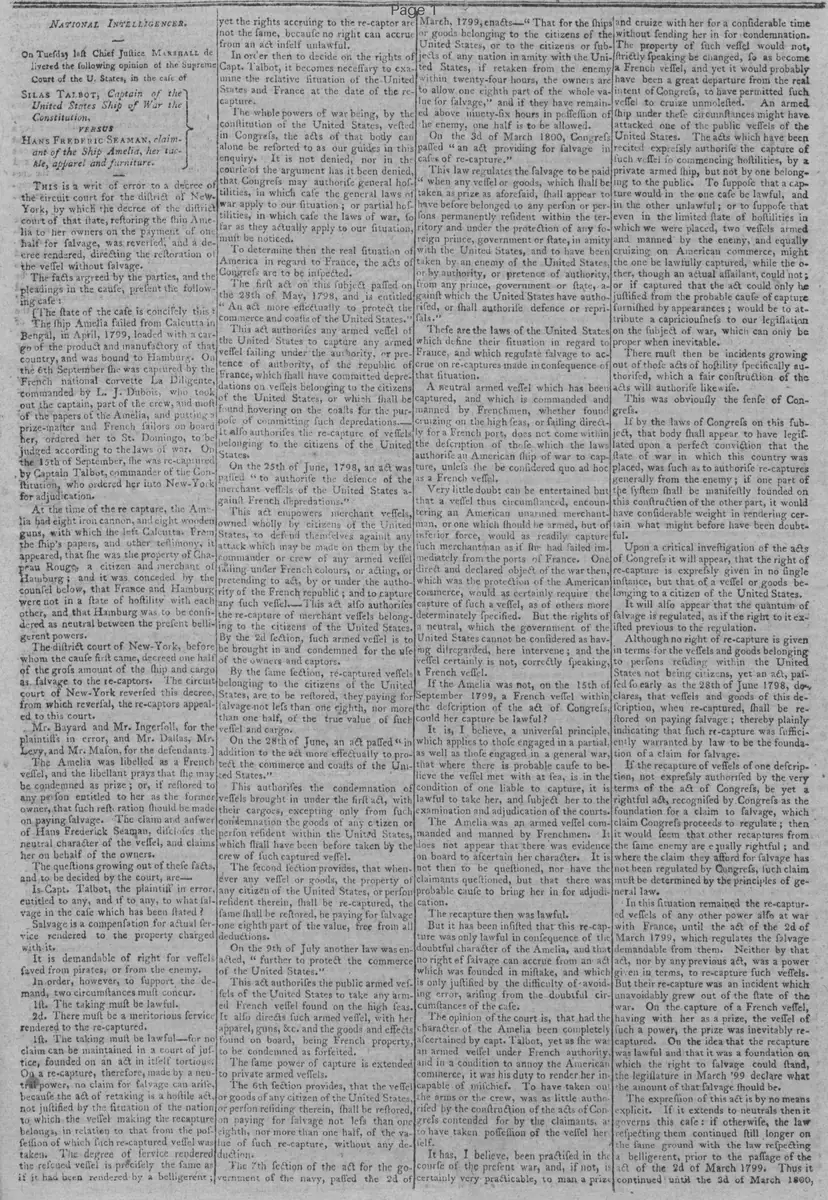
SILAS TALBOT, Captain of the United States Ship of War the Constitution,
VERSUS
Hans Frederick Seaman, claimant of the Ship Amelia, her tackle, apparel and furniture.
This is a writ of error to a decree of the circuit court for the district of New York, by which the decree of the district court of that state, restoring the ship Amelia to her owners on the payment of one half for salvage, was reversed, and a decree rendered, directing the restoration of the vessel without salvage.
The facts agreed by the parties, and the pleadings in the cause, present the following case:
[The state of the case is concisely this: The ship Amelia sailed from Calcutta in Bengal, in April, 1799, loaded with a cargo of the product and manufactory of that country, and was bound to Hamburg. On the 6th September she was captured by the French national corvette La Diligente, commanded by L. J. Dubois, who took out the captain, part of the crew, and most of the papers of the Amelia, and putting 3 prize-master and French sailors on board her, ordered her to St. Domingo, to be judged according to the laws of war. On the 15th of September, she was re-captured by Captain Talbot, commander of the Constitution, who ordered her into New-York for adjudication.
At the time of the re-capture, the Amelia had eight iron cannon, and eight wooden guns, with which she left Calcutta. From the ship's papers, and other testimony, it appeared, that she was the property of Chapeau Roquq, a citizen and merchant of Hamburg; and it was conceded by the counsel below, that France and Hamburg were not in a state of hostility with each other, and that Hamburg was to be considered as neutral between the present belligerent powers.
The district court of New-York, before whom the cause first came, decreed one half of the gross amount of the ship and cargo as salvage to the re-captors. The circuit court of New-York reversed this decree. From which reversal, the re-captors appealed to this court.
Mr. Bayard and Mr. Ingersoll, for the plaintiffs in error, and Mr. Dallas, Mr. Levy, and Mr. Mason, for the defendants.]
The Amelia was libelled as a French vessel, and the libellant prays that she may be condemned as prize; or, if restored to any person entitled to her as the former owner, that such restoration should be made on paying salvage. The claim and answer of Hans Frederick Seaman, discloses the neutral character of the vessel, and claims her on behalf of the owners.
The questions growing out of these facts, and to be decided by the court, are—
1st. Capt. Talbot, the plaintiff in error, entitled to any, and if to any, to what salvage in the case which has been stated?
Salvage is a compensation for actual service rendered to the property charged with it.
It is demandable of right for vessels saved from pirates, or from the enemy.
In order, however, to support the demand, two circumstances must concur.
1st. The taking must be lawful.
2d. There must be a meritorious service rendered to the re-captured.
1st. The taking must be lawful—for no claim can be maintained in a court of justice, founded on an act in itself tortious.
On a re-capture, therefore, made by a neutral power, no claim for salvage can arise, because the act of retaking is a hostile act, not justified by the situation of the nation to which the vessel making the recapture belongs, in relation to that from the possession of which such re-captured vessel was taken. The degree of service rendered the rescued vessel is precisely the same as if it had been rendered by a belligerent;
yet the rights accruing to the re-captor are not the same, because no right can accrue from an act itself unlawful.
In order then to decide on the rights of Capt. Talbot, it becomes necessary to examine the relative situation of the United States and France at the date of the re-capture.
The whole powers of war being, by the constitution of the United States, vested in Congress, the acts of that body can alone be resorted to as our guides in this enquiry. It is not denied, nor in the course of the argument has it been denied, that Congress may authorize general hostilities, in which case the general laws of war apply to our situation; or partial hostilities, in which case the laws of war, so far as they actually apply to our situation, must be noticed.
To determine then the real situation of America in regard to France, the acts of Congress are to be inspected.
The first act on this subject passed on the 28th of May, 1798, and is entitled "An act more effectually to protect the commerce and coasts of the United States." This act authorizes any armed vessel of the United States to capture any armed vessel sailing under the authority, or pretence of authority, of the republic of France, which shall have committed depredations on vessels belonging to the citizens of the United States, or which shall be found hovering on the coasts for the purpose of committing such depredations.— It also authorizes the re-capture of vessels belonging to the citizens of the United States
On the 25th of June, 1798, an act was passed "to authorize the defence of the merchant vessels of the United States against French depredations."
This act empowers merchant vessels, owned wholly by citizens of the United States, to defend themselves against any attack which may be made on them by the commander or crew of any armed vessel sailing under French colours, or acting, or pretending to act, by or under the authority of the French republic; and to capture any such vessel.—This act also authorizes the re-capture of merchant vessels belonging to the citizens of the United States.
By the 2d section, such armed vessel is to be brought in and condemned for the use of the owners and captors.
By the same section, re-captured vessels belonging to the citizens of the United States, are to be restored, they paying for salvage—not less than one eighth, nor more than one half, of the true value of such vessel and cargo.
On the 28th of June, an act passed "in addition to the act more effectually to protect the commerce and coasts of the United States."
This authorizes the condemnation of vessels brought in under the first act, with their cargoes, excepting only from such condemnation the goods of any citizen or person resident within the United States, which shall have been before taken by the crew of such captured vessel.
The second section provides, that whenever any vessel or goods, the property of any citizen of the United States, or person resident therein, shall be re-captured, the same shall be restored, he paying for salvage one eighth part of the value, free from all deductions.
On the 9th of July another law was enacted, "further to protect the commerce of the United States."
This act authorizes the public armed vessels of the United States to take any armed French vessel found on the high seas. It also directs such armed vessel, with her apparel, guns, &c. and the goods and effects found on board, being French property, to be condemned as forfeited.
The same power of capture is extended to private armed vessels.
The 6th section provides, that the vessel or goods of any citizen of the United States, or person residing therein, shall be restored, on paying for salvage not less than one eighth, nor more than one half, of the value of such re-capture, without any deduction.
The 7th section of the act for the government of the navy, passed the 2d of March, 1799, enacts—“That for the ships or goods belonging to the citizens of the United States, or to the citizens or subjects of any nation in amity with the United States, if retaken from the enemy within twenty-four hours, the owners are to allow one eighth part of the whole value or salvage,” and if they have remained above ninety-six hours in possession of the enemy, one half is to be allowed.
On the 3d of March 1800, Congress passed "an act providing for salvage in cases of re-capture."
This law regulates the salvage to be paid "when any vessel or goods, which shall be taken as prize as aforesaid, shall appear to have before belonged to any person or persons permanently resident within the territory and under the protection of any foreign prince, government or state, in amity with the United States, and to have been taken by an enemy of the United States, or by authority, or pretence of authority, from any prince, government or state, against which the United States have authorized, or shall authorize defence or reprisals."
These are the laws of the United States which define their situation in regard to France, and which regulate salvage to accrue on re-captures made in consequence of that situation.
A neutral armed vessel which has been captured, and which is commanded and manned by Frenchmen, whether found cruizing on the high seas, or sailing directly for a French port, does not come within the description of those which the laws authorize an American ship of war to capture, unless she be considered quo ad hoc as a French vessel.
Very little doubt can be entertained but that a vessel thus circumstanced, encountering an American unarmed merchantman, or one which should be armed, but of inferior force, would as readily capture such merchantman as if she had sailed immediately from the ports of France. One direct and declared object of the war then, which was the protection of the American commerce, would as certainly require the capture of such a vessel, as of others more determinately specified. But the rights of a neutral, which the government of the United States cannot be considered as having disregarded, here intervene; and the vessel certainly is not, correctly speaking, a French vessel.
If the Amelia was not, on the 15th of September 1799, a French vessel within the description of the act of Congress, could her capture be lawful?
It is, I believe, a universal principle, which applies to those engaged in a partial, as well as those engaged in a general war, that where there is probable cause to believe the vessel met with at sea, is in the condition of one liable to capture, it is lawful to take her, and subject her to the examination and adjudication of the courts.
The Amelia was an armed vessel commanded and manned by Frenchmen. It does not appear that there was evidence on board to ascertain her character. It is not then to be questioned, nor have the claimants questioned, but that there was probable cause to bring her in for adjudication.
The recapture then was lawful.
But it has been insisted that this re-capture was only lawful in consequence of the doubtful character of the Amelia, and that no right of salvage can accrue from an act which was founded in mistake, and which is only justified by the difficulty of avoiding error, arising from the doubtful circumstances of the case.
The opinion of the court is, that had the character of the Amelia been completely ascertained by capt. Talbot, yet as she was an armed vessel under French authority, and in a condition to annoy the American commerce, it was his duty to render her incapable of mischief. To have taken off the arms or the crew, was as little authorized by the construction of the acts of Congress contended for by the claimants, as to have taken possession of the vessel herself.
It has, I believe, been practised in the course of the present war, and, if not, it certainly very practicable, to man a prize
and cruize with her for a considerable time without sending her in for condemnation. The property of such vessel would not, strictly speaking be changed, so as become a French vessel, and yet it would probably have been a great departure from the real intent of Congress, to have permitted such vessel to cruize unmolested. An armed ship under these circumstances might have attacked one of the public vessels of the United States. The acts which have been recited expressly authorize the capture of such vessel so commencing hostilities, by a private armed ship, but not by one belonging to the public. To suppose that a capture would in the one case be lawful, and in the other unlawful: or to suppose that even in the limited state of hostilities in which we were placed, two vessels armed and manned by the enemy, and equally cruizing on American commerce, might the one be lawfully captured, while the other, though an actual assailant, could not; or if captured that the act could only be justified from the probable cause of capture furnished by appearances; would be to attribute a capriciousness to our legislation on the subject of war, which can only be proper when inevitable.
There must then be incidents growing out of those acts of hostility specifically authorized, which a fair construction of the acts will authorize likewise.
This was obviously the sense of Congress.
If by the laws of Congress on this subject, that body shall appear to have legislated upon a perfect conviction that the state of war in which this country was placed, was such as to authorize re-captures generally from the enemy; if one part of the system shall be manifestly founded on this construction of the other part, it would have considerable weight in rendering certain what might before have been doubtful.
Upon a critical investigation of the acts of Congress it will appear, that the right of re-capture is expressly given in no single instance, but that of a vessel or goods belonging to a citizen of the United States. It will also appear that the quantum of salvage is regulated, as if the right to it existed previous to the regulation.
Although no right of re-capture is given in terms for the vessels and goods belonging to persons residing within the United States not being citizens, yet an act, passed so early as the 28th of June 1798, declares, that vessels and goods of this description, when re-captured, shall be restored on paying salvage; thereby plainly indicating that such re-capture was sufficiently warranted by law to be the foundation of a claim for salvage.
If the recapture of vessels of one description, not expressly authorized by the very terms of the act of Congress, be yet a rightful act, recognized by Congress as the foundation for a claim to salvage, which claim Congress proceeds to regulate; then it would seem that other recaptures from the same enemy are equally rightful; and where the claim they afford for salvage has not been regulated by Congress, such claim must be determined by the principles of general law.
In this situation remained the re-captured vessels of any other power also at war with France, until the act of the 2d of March 1799, which regulates the salvage demandable from them. Neither by that act, nor by any previous act, was a power given in terms, to re-capture such vessels. But their re-capture was an incident which unavoidably grew out of the state of the war. On the capture of a French vessel, having with her as a prize, the vessel of such a power, the prize was inevitably re-captured. On the idea that the recapture was lawful and that it was a foundation on which the right to salvage could stand, the legislature in March '99 declare what the amount of that salvage should be.
The expression of this act is by no means explicit. If it extends to neutrals then it governs this case: if otherwise, the law respecting them continued till longer on the same ground with the law respecting a belligerent, prior to the passage of the act of the 2d of March 1799. Thus it continued until the 3d of March 1800, when the legislature regulated the salvage to be paid by neutrals, re-captured from a power against which the United States had authorized defence or reprisals. This act having passed subsequent to the recapture of the Amelia, can certainly not affect that case as to the quantity of salvage, or give a right to salvage which did not exist before. But it manifests in like manner with the laws already commented on, the system which Congress considered itself as having established. This act was passed at a time when no additional hostility against France could have been contemplated. It was only designed to keep up the defensive system which had before been formed, and which it was deemed necessary to continue, till the negotiation then pending should have a pacific termination. Accordingly there is no expression in the act extending the power of re-capture, or giving it in the case of neutrals. This power is supposed to exist as an incident growing out of the state of war, and the right to salvage produced by that power is regulated in the act. In case of a recapture subsequent to the act, no doubt could be entertained, but that salvage, according to its terms, would be demandable. Yet there is not a syllable in it which would warrant an idea that the right of recapture was extended by it, or did not exist before. It must then have existed from the passage of the laws, which commenced our general resistance to the aggressions we had so long experienced and submitted to. It is not unworthy of notice that the first regulation of the right of salvage in the case of a recapture, not expressly enumerated among the specified acts of hostility warranted by the law, is to be found in one of those acts which constitute a part of the very system of defence determined on by Congress; and is the first which subjects to condemnation the prizes made by our public ships of war. It has not escaped the consideration of the court that a legislative act, founded on a mistaken opinion of what was law, does not change the actual state of the law as to pre-existing cases. This principle is not shaken by the opinion now given. The court goes no further than to use the provisions in one of several acts forming a general system, as explanatory of other parts of the same system ; and this appears to be in obedience to the best established rules of exposition, and to be necessary to a sound construction of the law. An objection was made to the claim of salvage by one of the counsel for the defendant in error, unconnected with the acts of Congress, and which it is proper here to notice. He states that to give title to salvage the means used must not only have produced the benefit, but must have been used with that sole view. For this he cites Beawes lex mercatoria 158. The principle is applied by Beawes to the single case of a vessel saved at sea by throwing overboard a part of her cargo. In that case the principle is unquestionably correct, and in the case of a recapture it is as unquestionably incorrect. The recaptor is seldom actuated by the sole view of saving the vessel, and in no case of the sort has the inquiry ever been made. It is then the opinion of the court on a consideration of the acts of Congress, and of the circumstances of the case, that the re-capture of the Amelia was lawful, and that, if the claim to salvage be in other respects well founded, there is nothing to defeat it in the character of the original taking. It becomes then necessary to enquire, 2d. Whether there has been such a meritorious service rendered the recaptured as entitles the recaptor to salvage. The Amelia was a neutral ship, captured by a French Cruiser, and recaptured while on her way to a French port, to be adjudged according to the laws of war. It is stated to be the settled doctrine of the law of nations that a neutral vessel captured by a belligerent is to be discharged without paying salvage ; and for this several such authorities have been quoted, and many more might certainly be cited. That such has been a general rule is not to be questioned. As little is it to be questioned that this rule is founded exclusively on the supposed safety of the neutral. It is expressly stated in the case of the Waes Onskau, cited from Robinson's reports, to be founded on this plain principle, "that the liberation of a clear neutral from the hand of the enemy, is no essential service rendered to him, inasmuch as that same enemy would be compelled by the tribunals of his own country, after he had carried the neutral into port, to release him with costs and damages for the injurious seizure and detention." It is not unfrequent to consider and speak of a regular practice under a rule, as itself forming a rule. A regular course of decisions on the text of the law, constitute rules of construction by which that text is to be applied to all similar cases : But alter the text and the rules no longer govern. So in the case of salvage The general principle is, that salvage is only payable where a meritorious service has been rendered. In the application of this principle, it has been decided that neutrals 'carried in by a belligerent for examination, being in no danger, receive no benefit from recapture, and ought not therefore to pay salvage. The principle is that without benefit, salvage is not payable : and it is merely a consequence from this principle, which exempts re-captured neutrals from its payment. But let a nation change its laws and its practice on this subject; let its legislation be such as to subject to condemnation all neutrals captured by its cruisers. and who will say that no benefit is conferred by a recapture ? In such a course of things the state of the neutral is completely changed. So far from being safe he is in as much danger of condemnation as if captured by his own declared enemy. A series of decisions then, and of rules founded on his supposed safety, no longer apply. Only those rules are applicable, which regulate a situation of actual danger. This is not, as it has been termed, a change of principle, but a preservation of principle, by a practical application of it according to the substantial good sense of the rule. It becomes then necessary to enquire whether the laws of France were such as to have rendered the condemnation of the Amelia so extremely probable, as to create a case of such real danger, that her re-capture by Capt. Talbot must be considered as a meritorious service entitling him to salvage To prove this the counsel for the plaintiff in error has offered several decrees of the French government, and especially one of the 18th of January 1798. Objections have been made to the reading of these decrees as being the laws of a foreign nation, and therefore facts, which, like other facts, ought to have been proved, and to have formed a part of the case stated for the consideration of the court. That the laws of a foreign nation designed only for the direction of its own affairs, are not to be noticed by the courts of other countries unless proved as facts, and that this court, with respect to facts, is limited to the statement made in the court below, can not be questioned. The real and only question is whether the public laws of a foreign nation, on a subject of common concern to all nations, promulgated by the governing powers of a country, can be noticed as law by a court of admiralty of that country, or must be still further proved as a fact The negative of this proposition has not been maintained in any of the authorities which have been adduced. On the contrary several have been quoted, (and such seems to have been the general practice) in which the marine ordinances of a foreign nation are read as law without being proved as facts. It has been said that this is done by consent: that it is a matter of general convenience not to put parties to the trouble and expense of proving permanent and well known laws, which it is in their power to prove ; and this opinion is countenanced by the case cited from Douglas. If it be correct, yet this decree having been promulgated in the United States as the law of France, by the joint act of that department which is entrusted with foreign intercourse, and of that which is invested with the powers of war, seems to assume a character of notoriety which renders it admissible in our Court. It is therefore the opinion of the court that the decree should be read as an authenticated copy of a public law of France interesting to all nations The decree ordains- 'The first article ought to be inserted here.] This decree subjects to condemnation in the courts of France, a neutral vessel, laden in whole or in part, with articles the growth of England, or any of its possessions. A neutral thus circumstanced, cannot be considered as in a state of safety-His re-captor cannot be said to have rendered him no service. It cannot reasonably be contended that he would have been discharged in the ports of the belligerent, with costs and damages. Let us then enquire, whether this was the situation of the Amelia. The first fact states her to have sailed from Calcutta in Bengal, in April, 1799, laden with a cargo of the product and manufactory of that country. Here it is contended that the whole of Bengal may possibly not be in possession of the English, and therefore it does not appear that the cargo was within the description of. the decree. But to this it has been answered, that in enquiring whether the Amelia was in danger or not this court must put itself in the place of a French court of admiralty, and determine as such court would have determined.— Doing this, there seems to be no reason to doubt that the cargo, without enquiring into the precise situation of the British power in every part of Bengal, being prima facie of the product and manufacture of a possession of England, would have been so considered, unless the contrary could have been plainly shewn. The next act relied on by the defendant in error is, that the Amelia was sent to be adjudged according to the laws of war, and from thence it is inferred that she could not have been judged according to the decree of the 18th of January. It is to be remembered, that these are the orders of the captor, and without a question in the language of a French cruiser, a law of his own country, furnishing a rule of conduct in time of war, will be spoken of as one of the laws of war. But the 3d and 4th facts in the statement admit the Amelia, with her cargo, to have belonged to a citizen of Hamburg. which city was not in a state of hostility with the republic of France, but was to be considered as neutral between the then belligerent powers. It has been contended that these facts not only do not show the re-captured vessel to have been one on which the decree could operate, but positively show that the decree could not have affected her. The whole statement taken together, amounts to nothing more than that Hamburg was a neutral city and it is precisely against neutrals that the decree is in terms directed. To prove, therefore, that the Amelia was a neutral vessel, is to prove her within the very words of the decree, and consequently to establish the reality of her danger. .Among the very elaborate arguments which have been used in this case, there were some which the court deem it proper more particularly to notice. It has been contended that this decree might have been merely in terrorem ; that it might never have been executed; and that, being in opposition to the law of nations, the court ought to presume it never would have been executed. But the court cannot presume the laws of any country to have been enacted in terrorem, nor that they will be disregarded by its judicial authority. Their obligation on their own courts must be considered as complete; and, without resorting either to public notoriety, or the declarations of our own laws on the subject, the decisions of the French courts must be admitted to have conformed to the rules prescribed by their government. It has been contended that France is an independent nation, entitled to the benefits of the law of nations, and further, that if she has violated them, we ought not to violate them also, but ought to remonstrate against such misconduct. These positions have never been controverted; but they lead to a very different result from that which they have been relied on as producing The respect due to France is totally unconnected with the danger in which her laws had placed the Amelia ; nor is France in any manner to be affected by the decree this court may pronounce. Her interest in the vessel was terminated by the re-capture, which was authorized by the state of hostility then subsisting between the two nations. From that time it has been a question only between the Amelia and the re-captor, with which France has nothing to do. It is true, that a violation of the law of nations by one power does not justify its violation by another but that remonstrance is the proper course to be pursued, and this is the course which has been pursued. America did remonstrate, most earnestly remonstrate to France against the injuries committed on her : but remonstrance having failed, she appealed to a higher tribunal, and authorized limited hostilities. This was not violating the law of nations, but conforming to it. In the course of these limited hostilities, the Amelia has been re-captured, and the enquiry now is, not whether the conduct of France would justify a departure from the law of nations. but what is the real law in the case. This depends on the danger from which she has been saved. Much has been said about the general conduct of France and England on the seas, and it has been urged that the course of the latter has been still more injurious than that of the former.That is a consideration. not to be taken up in this cause. Animadversions on either, in the present case, would be considered as extremely unbecoming the judges of this 'court, who have only to enquire what was the real danger in which the laws of one of the countries placed the Amelia, and from which she has been freed by her re-capture. It has been contended that an illegal commission to take, given by France, cannot authorize our vessels to retake: that we have no right by legislation, to grant salvage out of the property of a citizen of Hamburg, who might have objected to the condition of the service. . But it is not the authority given by the French government to capture neutrals, which is relied on as legalizing the re-capture made by Capt. Talbot-it is the state of hostility between the two nations which is considered as having authorized that act. The re-capture having been made lawfully, then the right to salvage, on general principles, depends on the service rendered. We cannot presume this service to have been unacceptable to the Hamburgher, because it has bettered his condition; but a re-capture must always be made without consulting the re-captured. The act is one of the incidents of the state of war, and is in itself only offensive as against the enemy. The subsequent fate of the re-captured depends on the service he has received, and on other circumstances. To give a right to salvage, it is said there must be a contract either express or implied. Had Hamburg been in a state of declared war with France, the re-captured vessels of that city would be admitted to be liable to pay salvage. If a contract be necessary, from what circumstances would the law, in that state of things imply it? Clearly from the benefit received, and the risk incurred. If in the actual state of things there was also benefit and risk, then the same circumstances concur, and they warrant the same result. It is also urged that to maintain this right, the danger ought not to be merely speculative, but must be imminent and the loss certain. That a mere speculative danger will not be sufficient to entitle a person to salvage is unquestionably true. But that the danger must be such, that escape from it by other means was inevitable, can not be admitted. In all the cases stated by the counsel for the defendant in error, safety by other means was possible, though not probable. The flames of a ship on fire might be extinguished by the crew, or by a sudden tempest. A ship on the rocks might possibly be got off by the aid of wind and tides without assistance from others. A vessel captured by an enemy might be separated from her captor, and if sailors had been placed on board the prize, a thousand accidents might possibly destroy them; or they might even be blown by a storm into a port of the country to which the prize-vessel originally belonged. It cannot therefore be necessary that the loss should be inevitably certain, but it is necessary that the danger should be real and imminent. It is believed to have been such in this case. The captured vessel was of such description that the law by which she was to be tried, condemned her as good prize to the captor. Her danger then was real and imminent. The service rendered her was an essential service, and the court is therefore of opinion that the re-captor is entitled to salvage. The next object of enquiry, is, what salvage ought to be allowed ? The captors claim one half the gross value of the ship and cargo. To support this claim they rely on the act "for the government of the navy of the United States," passed the 2d of March, 1799. This act regulates the salvage payable on the ships or goods belonging to the citizens of the United States, or to the citizens or subjects of any nation in amity with the United States, re-taken from the enemy It has been contended that the case before the court is in the very words of the act. That the owner of the Amelia is a citizen of a state in amity with the United States, retaken from the enemy. That the description would have been more limited, had the intention of the act been to restrain its application to a recaptured vessel belonging to a nation engaged with the United States against the same enemy. The words of the act would certainly admit of this construction. Against it, it has been urged, and we think with great force, that the laws of the United States ought not, if it be avoidable. to be construed as to infract the common principles and usages of nations, or the general doctrines of national law. If the construction contended for, be given to the act, it subjects to the same rate of salvage a recaptured neutral, and a recaptured belligerent vessel. Yet according to the law of nations, a neutral is generally to be restored without salvage.
This argument, in the opinion of the court, derives great additional weight from the consideration that the act in question is not temporary, but permanent. It is not merely fitted to the then existing state of things, and calculated to expire with them, but is a regulation applying to present and future times.
Whenever the danger resulting to captured neutrals from the laws of France should cease, then, according to the principles laid down in this decree, the liability of recaptured neutrals to the payment of salvage, would, in conformity with the general law and usage of nations, cease also. This event might have happened, and probably did happen, before hostilities between the United States and France were terminated by treaty. Yet, if this law applies to the case, salvage from a recaptured neutral would still be demandable.
This act then, if the words admit it, since it provides a permanent rule for the payment of salvage, ought to be construed to apply only to cases in which salvage is permanently payable.
On inspecting the clause in question, the court is struck with the description of those from whom the vessel is to be retaken in order to come within the provisions of the act. The expression used is the enemy's. A vessel retaken from the enemy—the enemy of whom? The court thinks it not unreasonable to answer of both parties. By this construction, the act of Congress will never violate those principles which we believe, and which it is our duty to believe, the legislature of the United States will always hold sacred.
If this act does not comprehend the case, then the court is to decide on a just estimate of the danger from which the recaptured was saved, and of the risk attending the retaking of the vessel, what is a reasonable salvage. Considering the circumstances, and considering also what rule has been adopted in other courts of admiralty, one sixth appears to be a reasonable allowance.
It is therefore the opinion of the court that the decree of the circuit court held for the district of New-York, was correct in reversing the decree of the district court, but not correct in decreeing the restoration of the Amelia without paying salvage. This court therefore is of opinion, that that decree so far as the restoration of the Amelia without salvage is ordered ought to be reversed, and that the Amelia and her cargo ought to be restored to the claimant, on paying for salvage one sixth part of the net value, after deducting therefrom the charges which have been incurred.
What sub-type of article is it?
What themes does it cover?
What keywords are associated?
What entities or persons were involved?
Where did it happen?
Story Details
Key Persons
Location
High Seas, New York
Event Date
1799 09 15
Story Details
The neutral ship Amelia, owned by a Hamburg merchant, was captured by French corvette La Diligente in September 1799 and recaptured by U.S. Captain Talbot. Supreme Court rules the recapture lawful under U.S. acts against French aggression and awards one-sixth salvage due to danger from French decrees condemning neutral cargoes with British goods.