Thank you for visiting SNEWPapers!
Sign up free
Literary
January 25, 1770
The Virginia Gazette
Williamsburg, Virginia
What is this article about?
Humorous extracts from Yorick's Meditations, featuring satirical prose reflections on abstract philosophical concepts like 'nothing' and 'something,' extending to the British constitution's stability and praises of tobacco's societal virtues.
Clipping
OCR Quality
95%
Excellent
Full Text
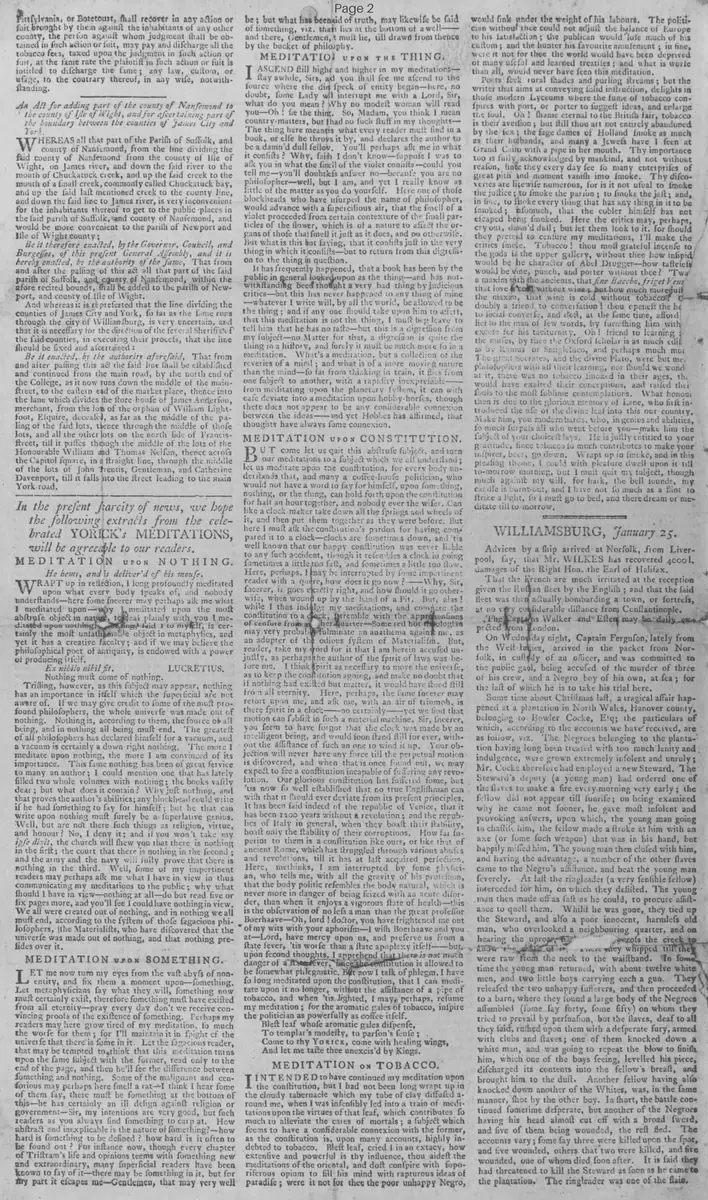
In the present scarcity of news, we hope the following extracts from the celebrated YORICK's MEDITATIONS, will be agreeable to our readers.
MEDITATION UPON NOTHING.
He hems, and is delivered of his mouse.
WRAPT up in refection, I long profoundly meditated upon what everybody speaks of, and nobody understands—here someone ere may perhaps ask me what I meditated upon—why I meditated upon the most abstruse object in nature, to deal plainly with you I meditated upon nothing. Nothing, said I to myself, is certainly the most unfathomable object in metaphysics, and yet it has a creative faculty; and if we may believe the philosophical poet of antiquity, is endowed with a power of producing itself.
Ex nihilo nihil fit.
LUCRETIUS.
Nothing must come of nothing.
Trifling, however, as this subject may appear, nothing has an importance in itself which the superficial are not aware of. If we may give credit to some of the most profound philosophers, the whole universe was made out of nothing. Nothing is, according to them, the source of all being, and in nothing all being must end. The greatest of all philosophers has declared himself for a vacuum, and a vacuum is certainly a downright nothing. The more I meditate upon nothing, the more I am convinced of its importance. This same nothing has been of great service to many an author; I could mention one that has lately filled two whole volumes with nothing: the books vastly dear: but what does it contain? Why just nothing, and that proves the author's abilities: any blockhead could write if he had something to say for himself: but he that can write upon nothing must surely be a superlative genius.
Well, but are there not such things as religion, virtue, and honour? No, I deny it; and if you won't take my ipse dixit, the church will show you that there is nothing in the first; the court that there is nothing in the second; and the army and the navy will fully prove that there is nothing in the third. Well, some of my impertinent readers may perhaps ask me what I have in view in thus communicating my meditations to the public; why what should I have in view—nothing at all—do but read five or six pages more, and you'll see I could have nothing in view.
We all were created out of nothing, and in nothing we all must end, according to the system of those sagacious philosophers, the Materialists, who have discovered that the universe was made out of nothing, and that nothing presides over it.
MEDITATION UPON SOMETHING.
Let me now turn my eyes from the vast abyss of non-entity, and fix them a moment upon something.
Let metaphysicians say what they will, something now must certainly exist, therefore something must have existed from all eternity—pray every day don't we receive convincing proofs of the existence of something. Perhaps my readers may here grow tired of my meditation. So much the worse for them: for I'll maintain it in spite of the universe that there is some in it. Let the sagacious reader, that may be tempted to think that this meditation turns upon the same subject with the former, read only to the end of the page, and then he'll see the difference between something and nothing. Some of the malignant and censorious may perhaps here smell a rat—I think I hear some of them say, there must be something at the bottom of this—he has certainly an ill design against religion or government—Sir, my intentions are very good, but such readers as you always find something to carp at. How abstract and inexplicable is the nature of something?—how hard is something to be defined? how hard is it often to be found out? For instance now, though every chapter of Tristram's life and opinions teems with something new and extraordinary, many superficial readers have been known to say of it—there may be something in it, but for my part it escapes me—Gentlemen, that may very well be: but what has been said of truth, may likewise be said of something, viz. that it lies at the bottom of a well—and there, Gentlemen, it must lie, till drawn from thence by the bucket of philosophy.
MEDITATION UPON THE THING.
I ASCEND still higher and higher in my meditations—stay awhile, Sirs, and you shall see me ascend to the source where the said speck of entity began—here, no doubt, some Lady will interrupt me with a Lord, Sir, what do you mean? Why no modest woman will read you—Oh! fie the thing. So, Madam, you think I mean country-matters, but I had no such stuff in my thoughts—The thing here meant is what every reader must find in a book, or else he throws it by, and declares the author to be a damn'd dull fellow. You'll perhaps ask me in what it consists? Why, faith I don't know—suppose I was to ask you in what the smell of the violet consists—could you tell me—you'll doubtless answer no—because you are no philosopher—well, but I am, and yet I really know as little of the matter as you do yourself. Here one of those blockheads who have usurped the name of philosopher, would advance with a supercilious air, that the smell of a violet proceeded from certain contexture of the small particles of the flower, which is of a nature to affect the organs of those that smell it just as it does, and no otherwise. But what is this but saying, that it consists just in the very thing in which it consists—but to return from this digression to the thing in question.
It has frequently happened, that a book has been by the public in general looked upon as the thing—and has notwithstanding been thought a very bad thing by judicious critics—but this has never happened to any thing of mine—whatever I write will, by all the world!, be allowed to be the thing: and if any one should take upon him to assert, that this meditation is not the thing, I must beg leave to tell him that he has no taste—but this is a digression from my subject—no Matter for that, a digression is quite the thing in a history, and surely it must be much more so in a meditation. What's a meditation but a collection of the reveries of a mind; and what is of a more movir nature than the mind so far from thinking in train. it flies from one subject to another, with a rapidity inexpressible—from meditating upon the planetary system, it can with ease deviate into a meditation upon hobby-horses, though there does not appear to be any considerable connexion between the ideas—and yet Hobbes has affirmed, that thoughts have always some connexion.
MEDITATION UPON CONSTITUTION.
BUT come let us quit this abstruse subject, and turn our meditations to a subject which we all understand; let us meditate upon the constitution, for everybody understands that, and many a coffee-house politician, who would not have a word to say for himself, upon something, nothing, or the thing, can hold forth upon the constitution for half an hour together, and nobody ever the wiser. Can like a clock-maker take down all the springs and wheels of it, and then put them together as they were before. But here I must ask the constitution's pardon for having compared it to a clock—clocks are sometimes down, and 'tis well known that our happy constitution was never liable to any such accident, though it resembles a clock in going sometimes a little too fast, and sometimes a little too slow.
Here, perhaps. I may be interrupted by some impertinent reader with a quaere, how does it go now? —Why, Sir, sneer not, it goes exactly right, and how should it go otherwise, when wound up by the hand of a Pitt. But, alas! while I thus indulge my meditations, and compare the constitution to a clock, I tremble with the apprehensions of censure from another quarter—Some red hot monopolian may very probably fulminate an anathema against me, as an adopter of the odious system of Materialism. But, reader, take my word for it that I am herein accused unjustly, as perhaps the author of the spirit of laws was before me. I think spirit as necessary to move the universe, as to keep the constitution a-going, and make no doubt that if nothing had existed but matter. it would have stood still from all eternity. Here, perhaps, the same sneerer may retort upon me, and ask me, with an air of triumph, is there spirit in a clock—no certainly—yet we find that motion can subsist in such a material machine. Sir, sneerer, you seem to have forgot that the clock was made by an intelligent being, and would soon stand still for ever, without the assistance of such an one to wind it up. Your objection will never have any force till the perpetual motion is discovered, and when that is once found out, we may expect to see a constitution incapable of suffering any revolution. Our glorious constitution has suffered some, but 'tis now so well established that no true Englishman can wish that it should ever deviate from its present principles.
It has been said indeed of the republic of Venice, that it has been 1200 years without revolution: and the republics of Italy in general, when they boast their stability, boast only the stability of their corruptions. How far superior to them is a constitution like ours, or like that of ancient Rome, which has struggled through various abuses and revolutions, till it has at last acquired perfection.
Here, methinks, I am interrupted by some physician, who tells me, with all the gravity of his profession, that the body politic resembles the body natural, which is never more in danger of being seized with an acute disorder, than when it enjoys a vigorous state of health—this is the observation of no less a man than the great professor Boerhaave. Oh, lord! doctor, you have frightened me out of my wits with your aphorism—I wish Boerhaave and you at—Lord, have mercy upon us, and preserve us from a state fever, 'tis worse than a state apoplexy itself—but, upon second thoughts, I apprehend that there is not much danger of a state-fever, since the constitution is allowed to be somewhat phlegmatic. But now I talk of phlegm, I have so long meditated upon the constitution, that I can meditate upon it no longer, without the assistance of a pipe of tobacco, and when 'tis lighted, I may perhaps, resume my meditation; for the aromatic gales of tobacco, inspire the politician as powerfully as coffee itself.
Blest leaf whose aromatic gales dispense,
To templar's modesty, to parson's sense:
Come to thy Yorick, come with healing wings,
And let me taste thee unexcised by Kings.
MEDITATION ON TOBACCO.
I INTENDED to have continued my meditation upon the constitution, but I had not been long wrapt up in the cloudy tabernacle which my tube of clay diffused around me, when I was insensibly led into a train of meditations upon the virtues of that leaf, which contributes so much to alleviate the cares of mortals: a subject which seems to have a considerable connexion with the former, as the constitution is, upon many accounts, highly indebted to tobacco. Blest leaf, cried I in an extacy, how extensive and powerful is thy influence, thou aidest the meditations of the oriental, and dost conspire with opiferous opium to fill his mind with rapturous ideas of paradise; were it not for thee the poor unhappy Negro, would sink under the weight of his labours. The politician without thee could not adjust the balance of Europe to his satisfaction; the publican would lose much of his custom; and the hunter his favourite amusement: in fine, were it not for thee the world would have been deprived of many useful and learned treatises: and what is worse than all, would never have seen this meditation.
Poets seek rural shades and purling streams: but the writer that aims at conveying solid instruction, delights in those modern Lyceums where the fume of tobacco conspires with port, or porter to suggest ideas, and enlarge the soul. Oh! shame eternal to the British fair, tobacco is their aversion: but still thou art not entirely abandoned by the sex; the sage dames of Holland smoke as much as their husbands, and many a Jewess have I seen at Grand Cairo with a pipe in her mouth. Thy importance too is fully acknowledged by mankind, and not without reason, since they every day see so many enterprises of great pith and moment vanish into smoke. Thy discoveries are likewise numerous, for is it not usual to smoke the justice; to smoke the parson; to smoke the jest; and, in fine, to smoke every thing that has any thing in it to be smoked; insomuch, that the cobler himself has not escaped being smoked. Here the critics may, perhaps, cry out, damn'd dull: but let them look to it. for should they pretend to censure my meditations, I'll make the critics smoke. Tobacco! thou most grateful incense to the gods is the upper gallery, without thee how insipid would be the character of Abel Drugger—how tasteless would be wine, punch, and porter without thee? 'Twas a maxim with the ancients, that in Baccho, friget Venus—that love is cold without wine: but how much more just the maxim, that wine is cold without tobacco? C doubly a friend to conversation! thou openest the heart to social converse, and dost, at the same time, afford a pretext to the man of few words, by furnishing him with excuse for his taciturnity. Oh! friend to learning and the muses, by thee the Oxford scholar is as much edified as by Xanthus or Snigelguco, and perhaps much more. The great Socrates, and the divine Plato, were but mere philosophers with all their learning, nor should we wonder at it, there was no tobacco smoked in their ages, that would have exalted their conceptions, and raised their souls to the most sublime contemplations. What honour then is due to the glorious memory of Lane, who first introduced the use of the divine leaf into this our country.
Make him, you modern bards, who, in genius and abilities, so much surpass all who went before you—make him the subject of your choicest lays. He is justly entitled to your gratitude, since tobacco so much contributes to make your inspirer, best go down. Wrapt up in smoke, and in this pleasing theme, I could with pleasure dwell upon it till to-morrow morning, but I must quit my subject, though much against my will. for hark, the bell sounds, my candle is burnt out, and I have not so much as a flint to strike a light, so I must go to bed, and there dream or meditate till to-morrow.
MEDITATION UPON NOTHING.
He hems, and is delivered of his mouse.
WRAPT up in refection, I long profoundly meditated upon what everybody speaks of, and nobody understands—here someone ere may perhaps ask me what I meditated upon—why I meditated upon the most abstruse object in nature, to deal plainly with you I meditated upon nothing. Nothing, said I to myself, is certainly the most unfathomable object in metaphysics, and yet it has a creative faculty; and if we may believe the philosophical poet of antiquity, is endowed with a power of producing itself.
Ex nihilo nihil fit.
LUCRETIUS.
Nothing must come of nothing.
Trifling, however, as this subject may appear, nothing has an importance in itself which the superficial are not aware of. If we may give credit to some of the most profound philosophers, the whole universe was made out of nothing. Nothing is, according to them, the source of all being, and in nothing all being must end. The greatest of all philosophers has declared himself for a vacuum, and a vacuum is certainly a downright nothing. The more I meditate upon nothing, the more I am convinced of its importance. This same nothing has been of great service to many an author; I could mention one that has lately filled two whole volumes with nothing: the books vastly dear: but what does it contain? Why just nothing, and that proves the author's abilities: any blockhead could write if he had something to say for himself: but he that can write upon nothing must surely be a superlative genius.
Well, but are there not such things as religion, virtue, and honour? No, I deny it; and if you won't take my ipse dixit, the church will show you that there is nothing in the first; the court that there is nothing in the second; and the army and the navy will fully prove that there is nothing in the third. Well, some of my impertinent readers may perhaps ask me what I have in view in thus communicating my meditations to the public; why what should I have in view—nothing at all—do but read five or six pages more, and you'll see I could have nothing in view.
We all were created out of nothing, and in nothing we all must end, according to the system of those sagacious philosophers, the Materialists, who have discovered that the universe was made out of nothing, and that nothing presides over it.
MEDITATION UPON SOMETHING.
Let me now turn my eyes from the vast abyss of non-entity, and fix them a moment upon something.
Let metaphysicians say what they will, something now must certainly exist, therefore something must have existed from all eternity—pray every day don't we receive convincing proofs of the existence of something. Perhaps my readers may here grow tired of my meditation. So much the worse for them: for I'll maintain it in spite of the universe that there is some in it. Let the sagacious reader, that may be tempted to think that this meditation turns upon the same subject with the former, read only to the end of the page, and then he'll see the difference between something and nothing. Some of the malignant and censorious may perhaps here smell a rat—I think I hear some of them say, there must be something at the bottom of this—he has certainly an ill design against religion or government—Sir, my intentions are very good, but such readers as you always find something to carp at. How abstract and inexplicable is the nature of something?—how hard is something to be defined? how hard is it often to be found out? For instance now, though every chapter of Tristram's life and opinions teems with something new and extraordinary, many superficial readers have been known to say of it—there may be something in it, but for my part it escapes me—Gentlemen, that may very well be: but what has been said of truth, may likewise be said of something, viz. that it lies at the bottom of a well—and there, Gentlemen, it must lie, till drawn from thence by the bucket of philosophy.
MEDITATION UPON THE THING.
I ASCEND still higher and higher in my meditations—stay awhile, Sirs, and you shall see me ascend to the source where the said speck of entity began—here, no doubt, some Lady will interrupt me with a Lord, Sir, what do you mean? Why no modest woman will read you—Oh! fie the thing. So, Madam, you think I mean country-matters, but I had no such stuff in my thoughts—The thing here meant is what every reader must find in a book, or else he throws it by, and declares the author to be a damn'd dull fellow. You'll perhaps ask me in what it consists? Why, faith I don't know—suppose I was to ask you in what the smell of the violet consists—could you tell me—you'll doubtless answer no—because you are no philosopher—well, but I am, and yet I really know as little of the matter as you do yourself. Here one of those blockheads who have usurped the name of philosopher, would advance with a supercilious air, that the smell of a violet proceeded from certain contexture of the small particles of the flower, which is of a nature to affect the organs of those that smell it just as it does, and no otherwise. But what is this but saying, that it consists just in the very thing in which it consists—but to return from this digression to the thing in question.
It has frequently happened, that a book has been by the public in general looked upon as the thing—and has notwithstanding been thought a very bad thing by judicious critics—but this has never happened to any thing of mine—whatever I write will, by all the world!, be allowed to be the thing: and if any one should take upon him to assert, that this meditation is not the thing, I must beg leave to tell him that he has no taste—but this is a digression from my subject—no Matter for that, a digression is quite the thing in a history, and surely it must be much more so in a meditation. What's a meditation but a collection of the reveries of a mind; and what is of a more movir nature than the mind so far from thinking in train. it flies from one subject to another, with a rapidity inexpressible—from meditating upon the planetary system, it can with ease deviate into a meditation upon hobby-horses, though there does not appear to be any considerable connexion between the ideas—and yet Hobbes has affirmed, that thoughts have always some connexion.
MEDITATION UPON CONSTITUTION.
BUT come let us quit this abstruse subject, and turn our meditations to a subject which we all understand; let us meditate upon the constitution, for everybody understands that, and many a coffee-house politician, who would not have a word to say for himself, upon something, nothing, or the thing, can hold forth upon the constitution for half an hour together, and nobody ever the wiser. Can like a clock-maker take down all the springs and wheels of it, and then put them together as they were before. But here I must ask the constitution's pardon for having compared it to a clock—clocks are sometimes down, and 'tis well known that our happy constitution was never liable to any such accident, though it resembles a clock in going sometimes a little too fast, and sometimes a little too slow.
Here, perhaps. I may be interrupted by some impertinent reader with a quaere, how does it go now? —Why, Sir, sneer not, it goes exactly right, and how should it go otherwise, when wound up by the hand of a Pitt. But, alas! while I thus indulge my meditations, and compare the constitution to a clock, I tremble with the apprehensions of censure from another quarter—Some red hot monopolian may very probably fulminate an anathema against me, as an adopter of the odious system of Materialism. But, reader, take my word for it that I am herein accused unjustly, as perhaps the author of the spirit of laws was before me. I think spirit as necessary to move the universe, as to keep the constitution a-going, and make no doubt that if nothing had existed but matter. it would have stood still from all eternity. Here, perhaps, the same sneerer may retort upon me, and ask me, with an air of triumph, is there spirit in a clock—no certainly—yet we find that motion can subsist in such a material machine. Sir, sneerer, you seem to have forgot that the clock was made by an intelligent being, and would soon stand still for ever, without the assistance of such an one to wind it up. Your objection will never have any force till the perpetual motion is discovered, and when that is once found out, we may expect to see a constitution incapable of suffering any revolution. Our glorious constitution has suffered some, but 'tis now so well established that no true Englishman can wish that it should ever deviate from its present principles.
It has been said indeed of the republic of Venice, that it has been 1200 years without revolution: and the republics of Italy in general, when they boast their stability, boast only the stability of their corruptions. How far superior to them is a constitution like ours, or like that of ancient Rome, which has struggled through various abuses and revolutions, till it has at last acquired perfection.
Here, methinks, I am interrupted by some physician, who tells me, with all the gravity of his profession, that the body politic resembles the body natural, which is never more in danger of being seized with an acute disorder, than when it enjoys a vigorous state of health—this is the observation of no less a man than the great professor Boerhaave. Oh, lord! doctor, you have frightened me out of my wits with your aphorism—I wish Boerhaave and you at—Lord, have mercy upon us, and preserve us from a state fever, 'tis worse than a state apoplexy itself—but, upon second thoughts, I apprehend that there is not much danger of a state-fever, since the constitution is allowed to be somewhat phlegmatic. But now I talk of phlegm, I have so long meditated upon the constitution, that I can meditate upon it no longer, without the assistance of a pipe of tobacco, and when 'tis lighted, I may perhaps, resume my meditation; for the aromatic gales of tobacco, inspire the politician as powerfully as coffee itself.
Blest leaf whose aromatic gales dispense,
To templar's modesty, to parson's sense:
Come to thy Yorick, come with healing wings,
And let me taste thee unexcised by Kings.
MEDITATION ON TOBACCO.
I INTENDED to have continued my meditation upon the constitution, but I had not been long wrapt up in the cloudy tabernacle which my tube of clay diffused around me, when I was insensibly led into a train of meditations upon the virtues of that leaf, which contributes so much to alleviate the cares of mortals: a subject which seems to have a considerable connexion with the former, as the constitution is, upon many accounts, highly indebted to tobacco. Blest leaf, cried I in an extacy, how extensive and powerful is thy influence, thou aidest the meditations of the oriental, and dost conspire with opiferous opium to fill his mind with rapturous ideas of paradise; were it not for thee the poor unhappy Negro, would sink under the weight of his labours. The politician without thee could not adjust the balance of Europe to his satisfaction; the publican would lose much of his custom; and the hunter his favourite amusement: in fine, were it not for thee the world would have been deprived of many useful and learned treatises: and what is worse than all, would never have seen this meditation.
Poets seek rural shades and purling streams: but the writer that aims at conveying solid instruction, delights in those modern Lyceums where the fume of tobacco conspires with port, or porter to suggest ideas, and enlarge the soul. Oh! shame eternal to the British fair, tobacco is their aversion: but still thou art not entirely abandoned by the sex; the sage dames of Holland smoke as much as their husbands, and many a Jewess have I seen at Grand Cairo with a pipe in her mouth. Thy importance too is fully acknowledged by mankind, and not without reason, since they every day see so many enterprises of great pith and moment vanish into smoke. Thy discoveries are likewise numerous, for is it not usual to smoke the justice; to smoke the parson; to smoke the jest; and, in fine, to smoke every thing that has any thing in it to be smoked; insomuch, that the cobler himself has not escaped being smoked. Here the critics may, perhaps, cry out, damn'd dull: but let them look to it. for should they pretend to censure my meditations, I'll make the critics smoke. Tobacco! thou most grateful incense to the gods is the upper gallery, without thee how insipid would be the character of Abel Drugger—how tasteless would be wine, punch, and porter without thee? 'Twas a maxim with the ancients, that in Baccho, friget Venus—that love is cold without wine: but how much more just the maxim, that wine is cold without tobacco? C doubly a friend to conversation! thou openest the heart to social converse, and dost, at the same time, afford a pretext to the man of few words, by furnishing him with excuse for his taciturnity. Oh! friend to learning and the muses, by thee the Oxford scholar is as much edified as by Xanthus or Snigelguco, and perhaps much more. The great Socrates, and the divine Plato, were but mere philosophers with all their learning, nor should we wonder at it, there was no tobacco smoked in their ages, that would have exalted their conceptions, and raised their souls to the most sublime contemplations. What honour then is due to the glorious memory of Lane, who first introduced the use of the divine leaf into this our country.
Make him, you modern bards, who, in genius and abilities, so much surpass all who went before you—make him the subject of your choicest lays. He is justly entitled to your gratitude, since tobacco so much contributes to make your inspirer, best go down. Wrapt up in smoke, and in this pleasing theme, I could with pleasure dwell upon it till to-morrow morning, but I must quit my subject, though much against my will. for hark, the bell sounds, my candle is burnt out, and I have not so much as a flint to strike a light, so I must go to bed, and there dream or meditate till to-morrow.
What sub-type of article is it?
Satire
Essay
What themes does it cover?
Political
Moral Virtue
Religious
What keywords are associated?
Meditation
Nothing
Something
Constitution
Tobacco
Satire
Philosophy
Yorick
What entities or persons were involved?
Yorick
Literary Details
Title
Yorick's Meditations
Author
Yorick
Subject
Meditations Upon Nothing, Something, The Thing, Constitution, And Tobacco
Form / Style
Satirical Prose Meditations
Key Lines
Nothing, Said I To Myself, Is Certainly The Most Unfathomable Object In Metaphysics, And Yet It Has A Creative Faculty; And If We May Believe The Philosophical Poet Of Antiquity, Is Endowed With A Power Of Producing Itself.
Ex Nihilo Nihil Fit.
Our Glorious Constitution Has Suffered Some, But 'Tis Now So Well Established That No True Englishman Can Wish That It Should Ever Deviate From Its Present Principles.
Blest Leaf Whose Aromatic Gales Dispense, To Templar's Modesty, To Parson's Sense: Come To Thy Yorick, Come With Healing Wings, And Let Me Taste Thee Unexcised By Kings.
What Honour Then Is Due To The Glorious Memory Of Lane, Who First Introduced The Use Of The Divine Leaf Into This Our Country.