Thank you for visiting SNEWPapers!
Sign up free
Lewistown Gazette
Lewistown, Mifflin County, Pennsylvania
What is this article about?
J.G. Sevier writes to the Baltimore Patriot defending Henry Clay's memory against the Baltimore Daily Argus's claim that Clay would support Democratic nominees Pierce and King. Based on personal interactions during Clay's final illness, Sevier asserts Clay approved the Whig nomination of Scott and Graham and wished them success.
Clipping
OCR Quality
Full Text
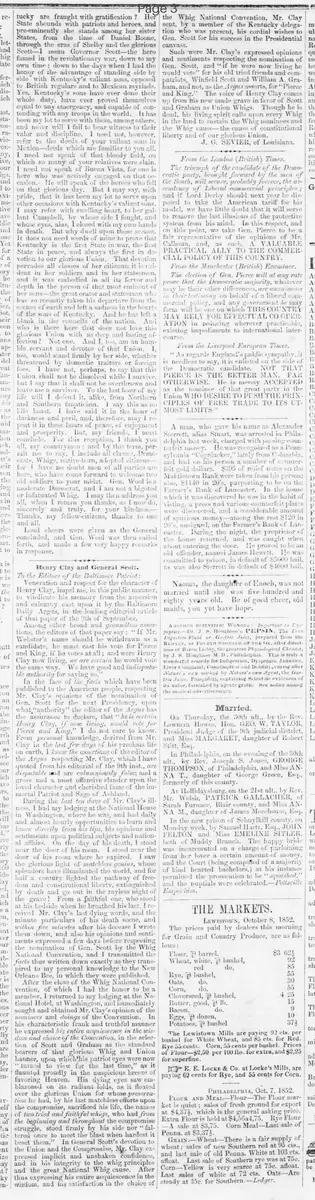
To the Editors of the Baltimore Patriot:
Veneration and respect for the character of Henry Clay, impel me, in this public manner, to vindicate his memory from the aspersion and calumny cast upon it by the Baltimore Daily Argus, in the leading editorial article of that paper of the 9th of September.
Among other broad and groundless assertions, the editors of that paper say: "If Mr. Webster's name should be withdrawn as a candidate, he must cast his vote for Pierce and King, if he votes at all; and were Henry Clay now living, we are certain he would vote the same way. We have good and indisputable authority for saying so."
In the face of the facts which have been published to the American people, respecting Mr. Clay's opinions of the nomination of Gen. Scott for the next Presidency, upon what "authority" the editor of the Argus has the assurance to declare, that "he is certain Henry Clay, if now living, would vote for Pierce and King," I do not care to know.
From personal knowledge, derived from Mr. Clay in the last few days of his precious life on earth, I know the assertions of the editor of the Argus respecting Mr. Clay, which I have quoted from his editorial of the 9th inst., are disputable and are calumniously false; and a gross and a most offensive slander upon the loved character and cherished fame of the immortal Patriot and Sage of Ashland.
During the last ten days of Mr. Clay's illness, I had my lodging at the National House in Washington, where he was, and had daily and almost hourly opportunities to learn and know directly from his lips, his opinions and sentiments upon political subjects and national affairs. On the day of his death, I stood near the door of his room. I stood near the door of his room where he expired. I saw the glorious light of matchless genius, whose splendors have illuminated the world, and for half a century lighted the pathway of freedom and constitutional liberty, extinguished by death and go out in the rayless night of the grave! From a faithful one, who stood at his bedside when he breathed his last, I received Mr. Clay's last dying words, and the minute particulars of his death scene, and within five minutes after his decease I wrote them down, and also his opinions and sentiments expressed a few days before respecting the nomination of Gen. Scott by the Whig National Convention, and I transmitted the facts thus written down exactly as they transpired to my personal knowledge to the New Orleans Bee, in which they were published.
After the close of the Whig National Convention, of which I had the honor to be a member, I returned to my lodging at the National Hotel, at Washington, and immediately sought and obtained Mr. Clay's opinion of the nominees and doings of the Convention. In his characteristic frank and truthful manner he expressed his entire acquiescence in the wisdom and choice of the Convention, in the selection of Scott and Graham as the standard bearers of that glorious Whig and Union banner, upon which his patriot eyes were now "turned to view for the last time," as it flaunted proudly in the auspicious breeze of favoring Heaven. His dying eyes saw emblazoned on its radiant folds, as it floated over the glorious Union for whose preservation he had, by his last matchless efforts upon the compromise, sacrificed his life, the names of two tried and faithful whigs, who had from the beginning and throughout the compromise struggle, stood firmly by his side nor "faltered once to meet the blast when hardest it beset them." In General Scott's devotion to the Union and the Compromise, Mr. Clay expressed implicit and unshaken confidence, and in his integrity to the whig principles and the great National Whig cause. After thus expressing his entire acquiescence in the wisdom, and his satisfaction in the choice of the Whig National Convention, Mr. Clay sent, by a member of the Kentucky delegation who was present, his cordial wishes to Gen. Scott for his success in the Presidential canvass.
Such were Mr. Clay's expressed opinions and sentiments respecting the nomination of Gen. Scott, and "if he were now living he would vote" for his old tried friends and compatriots, Winfield Scott and William A. Graham, and not, as the Argus asserts, for "Pierce and King." The voice of Henry Clay comes up from his new made grave in favor of Scott and Graham as Union Whigs. Though he is dead, his living spirit calls upon every Whig in the land to sustain the Whig nominees and the Whig cause—the cause of constitutional liberty and of our glorious Union.
J. G. SEVIER, of Louisiana.
What sub-type of article is it?
What themes does it cover?
What keywords are associated?
What entities or persons were involved?
Letter to Editor Details
Author
J. G. Sevier, Of Louisiana
Recipient
To The Editors Of The Baltimore Patriot
Main Argument
henry clay, in his final days, expressed approval of the whig nomination of scott and graham and would have voted for them, not pierce and king as falsely claimed by the baltimore daily argus; the writer vindicates clay's memory based on personal knowledge.
Notable Details