Thank you for visiting SNEWPapers!
Sign up free
Editorial
August 25, 1803
Alexandria Advertiser And Commercial Intelligencer
Alexandria, Virginia
What is this article about?
This concluding installment of a series critiques Secretary of the Treasury Albert Gallatin's management and legal interpretations of the sinking fund, pointing out contradictions in his reports on advances for Dutch debt payments from the 1802 and 1803 appropriations.
Clipping
OCR Quality
95%
Excellent
Full Text
From the Gazette of the United States
MANAGEMENT OF THE SINKING FUND.
No. VI.
(CONCLUDED.)
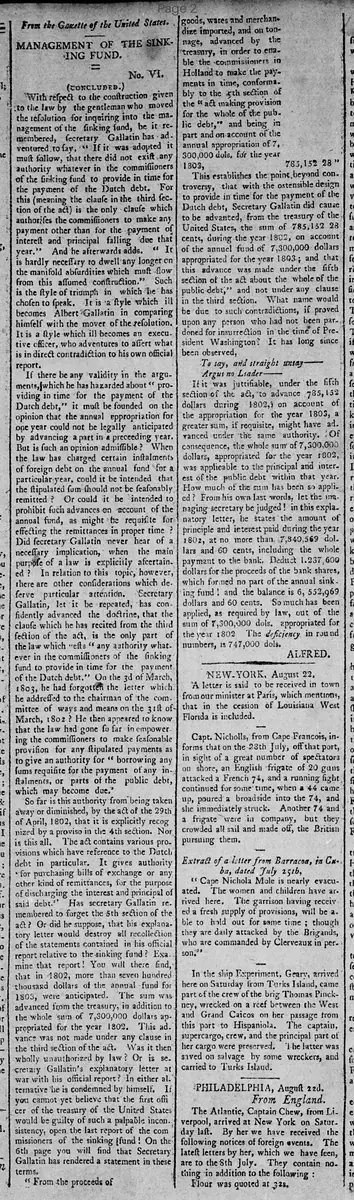
With respect to the construction given to the law by the gentleman who moved the resolution of inquiring into the management of the sinking fund, be it remembered, secretary Gallatin has adventured to say, "If it was adopted it must follow, that there did not exist any authority whatever in the commissioners of the sinking fund to provide in time for the payment of the Dutch debt. For this (meaning the clause in the third section of the act) is the only clause which authorises the commissioners to make any payment other than for the payment of interest and principal falling due that year." And he afterwards adds. "It is hardly necessary to dwell any longer on the manifold absurdities which must flow from this assumed construction." Such is the style of triumph in which he has chosen to speak. It is a style which ill becomes Albert Gallatin in comparing himself with the mover of the resolution. It is a style which ill becomes an executive officer, who adventures to assert what is in direct contradiction to his own official report.
If there be any validity in the arguments, which he has hazarded about "providing in time for the payment of the Dutch debt," it must be founded on the opinion that the annual appropriation for one year could not be legally anticipated by advancing a part in a preceding year. But is such an opinion admissible? When the law has charged certain instalments of foreign debt on the annual fund for a particular year, could it be intended that the stipulated sum should not be seasonably remitted? Or could it be intended to prohibit such advances on account of the annual fund, as might be requisite for effecting the remittances in proper time? Did secretary Gallatin never hear of a necessary implication, when the main purpose of a law is explicitly ascertained? In relation to this topic, however, there are other considerations which deserve particular attention. Secretary Gallatin, let it be repeated, has confidently advanced the doctrine, that the clause which he has recited from the third section of the act, is the only part of the law which "sets any authority whatever in the commissioners of the sinking fund to provide in time for the payment of the Dutch debt." On the 3d of March, 1803, he had forgotten the letter which he addressed to the chairman of the committee of ways and means on the 31st of March, 1802? He then appeared to know that the law had gone so far in empowering the commissioners to make seasonable provision for any stipulated payments as to give an authority for "borrowing any sums requisite for the payment of any instalments, or parts of the public debt, which may become due."
So far is this authority from being taken away or diminished, by the act of the 29th of April, 1802, that it is explicitly recognized by a proviso in the 4th section. Nor is this all. The act contains various provisions which have reference to the Dutch debt in particular. It gives authority *for purchasing bills of exchange or any other kind of remittances, for the purpose of discharging the interest and principal of said debt." Has secretary Gallatin remembered to forget the 5th section of the act? Or did he suppose, that his explanatory letter would destroy all recollection of the statements contained in his official report relative to the sinking fund? Examine that report! You will there find, that in 1802, more than seven hundred thousand dollars of the annual fund for 1803, were anticipated. The sum was advanced from the treasury, in addition to the whole sum of 7,300,000 dollars appropriated for the year 1802. This advance was not made under any clause in the third section of the act. Was it then wholly unauthorized by law? Or is secretary Gallatin's explanatory letter at war with his official report? In either alternative he is condemned by himself. If you cannot yet believe that the first officer of the treasury of the United States would be guilty of such a palpable inconsistency, open the last report of the commissioners of the sinking fund! On the 6th page you will find that Secretary Gallatin has rendered a statement in these terms.
"From the proceeds of
goods, wares and merchan-
dize imported, and on ton-
nage, advanced by the
treasury, in order to ena-
ble the commissioners in
Holland to make the pay-
ments in time, conforma-
bly to the 5th section of
the "act making provision
for the whole of the pub-
lic debt," and being in
part and on account of the
annual appropriation of 7.
300,000 dols, for the year
1803,
785,152 28"
This establishes the point beyond controversy, that with the ostensible design to provide in time for the payment of the Dutch debt, Secretary Gallatin did cause to be advanced, from the treasury of the United States, the sum of 785,152 28 cents, during the year 1802, on account of the annual fund of 7,300,000 dollars appropriated for the year 1803: and that this advance was made under the fifth section of the act about the whole of the public debt," and not under any clause in the third section. What name would be due to such contradictions, if proved upon any person who had not been pardoned for insurrection in the time of President Washington! It has long since been observed,
To say, and straight unsay-
Argus no leader-
If it was justifiable, under the fifth section of the act, 'to advance 785,152 dollars during 1802, on account of the appropriation for the year 1803, a greater sum, if requisite, might have advanced under the same authority. Of consequence, the whole sum of 7,300,000 dollars, appropriated for the year 1802, was applicable to the principal and interest of the public debt within that year. How much of the sum has been so applied? From his own last words, let the managing secretary be judged! in this explanatory letter, he states 'the amount of principle and interest paid during the year 1802, at no more than, 7,840,569 dollars and 60 cents, including the whole payment to the bank. Deduct 1,237,600 dollars for the proceeds of the bank shares, which formed no part of the annual sinking fund! and the balance is 6,552,969 dollars and 60 cents. So much has been applied, as required by law, out of the sum of 7,300,000 dols. appropriated for the year 1802 The deficiency in round numbers, is 747,000 dols.
ALFRED.
MANAGEMENT OF THE SINKING FUND.
No. VI.
(CONCLUDED.)
With respect to the construction given to the law by the gentleman who moved the resolution of inquiring into the management of the sinking fund, be it remembered, secretary Gallatin has adventured to say, "If it was adopted it must follow, that there did not exist any authority whatever in the commissioners of the sinking fund to provide in time for the payment of the Dutch debt. For this (meaning the clause in the third section of the act) is the only clause which authorises the commissioners to make any payment other than for the payment of interest and principal falling due that year." And he afterwards adds. "It is hardly necessary to dwell any longer on the manifold absurdities which must flow from this assumed construction." Such is the style of triumph in which he has chosen to speak. It is a style which ill becomes Albert Gallatin in comparing himself with the mover of the resolution. It is a style which ill becomes an executive officer, who adventures to assert what is in direct contradiction to his own official report.
If there be any validity in the arguments, which he has hazarded about "providing in time for the payment of the Dutch debt," it must be founded on the opinion that the annual appropriation for one year could not be legally anticipated by advancing a part in a preceding year. But is such an opinion admissible? When the law has charged certain instalments of foreign debt on the annual fund for a particular year, could it be intended that the stipulated sum should not be seasonably remitted? Or could it be intended to prohibit such advances on account of the annual fund, as might be requisite for effecting the remittances in proper time? Did secretary Gallatin never hear of a necessary implication, when the main purpose of a law is explicitly ascertained? In relation to this topic, however, there are other considerations which deserve particular attention. Secretary Gallatin, let it be repeated, has confidently advanced the doctrine, that the clause which he has recited from the third section of the act, is the only part of the law which "sets any authority whatever in the commissioners of the sinking fund to provide in time for the payment of the Dutch debt." On the 3d of March, 1803, he had forgotten the letter which he addressed to the chairman of the committee of ways and means on the 31st of March, 1802? He then appeared to know that the law had gone so far in empowering the commissioners to make seasonable provision for any stipulated payments as to give an authority for "borrowing any sums requisite for the payment of any instalments, or parts of the public debt, which may become due."
So far is this authority from being taken away or diminished, by the act of the 29th of April, 1802, that it is explicitly recognized by a proviso in the 4th section. Nor is this all. The act contains various provisions which have reference to the Dutch debt in particular. It gives authority *for purchasing bills of exchange or any other kind of remittances, for the purpose of discharging the interest and principal of said debt." Has secretary Gallatin remembered to forget the 5th section of the act? Or did he suppose, that his explanatory letter would destroy all recollection of the statements contained in his official report relative to the sinking fund? Examine that report! You will there find, that in 1802, more than seven hundred thousand dollars of the annual fund for 1803, were anticipated. The sum was advanced from the treasury, in addition to the whole sum of 7,300,000 dollars appropriated for the year 1802. This advance was not made under any clause in the third section of the act. Was it then wholly unauthorized by law? Or is secretary Gallatin's explanatory letter at war with his official report? In either alternative he is condemned by himself. If you cannot yet believe that the first officer of the treasury of the United States would be guilty of such a palpable inconsistency, open the last report of the commissioners of the sinking fund! On the 6th page you will find that Secretary Gallatin has rendered a statement in these terms.
"From the proceeds of
goods, wares and merchan-
dize imported, and on ton-
nage, advanced by the
treasury, in order to ena-
ble the commissioners in
Holland to make the pay-
ments in time, conforma-
bly to the 5th section of
the "act making provision
for the whole of the pub-
lic debt," and being in
part and on account of the
annual appropriation of 7.
300,000 dols, for the year
1803,
785,152 28"
This establishes the point beyond controversy, that with the ostensible design to provide in time for the payment of the Dutch debt, Secretary Gallatin did cause to be advanced, from the treasury of the United States, the sum of 785,152 28 cents, during the year 1802, on account of the annual fund of 7,300,000 dollars appropriated for the year 1803: and that this advance was made under the fifth section of the act about the whole of the public debt," and not under any clause in the third section. What name would be due to such contradictions, if proved upon any person who had not been pardoned for insurrection in the time of President Washington! It has long since been observed,
To say, and straight unsay-
Argus no leader-
If it was justifiable, under the fifth section of the act, 'to advance 785,152 dollars during 1802, on account of the appropriation for the year 1803, a greater sum, if requisite, might have advanced under the same authority. Of consequence, the whole sum of 7,300,000 dollars, appropriated for the year 1802, was applicable to the principal and interest of the public debt within that year. How much of the sum has been so applied? From his own last words, let the managing secretary be judged! in this explanatory letter, he states 'the amount of principle and interest paid during the year 1802, at no more than, 7,840,569 dollars and 60 cents, including the whole payment to the bank. Deduct 1,237,600 dollars for the proceeds of the bank shares, which formed no part of the annual sinking fund! and the balance is 6,552,969 dollars and 60 cents. So much has been applied, as required by law, out of the sum of 7,300,000 dols. appropriated for the year 1802 The deficiency in round numbers, is 747,000 dols.
ALFRED.
What sub-type of article is it?
Economic Policy
Taxation
Legal Reform
What keywords are associated?
Sinking Fund
Dutch Debt
Gallatin
Public Debt
Treasury Advances
Legal Authority
Annual Appropriation
What entities or persons were involved?
Secretary Gallatin
Commissioners Of The Sinking Fund
Dutch Debt Holders
President Washington
Editorial Details
Primary Topic
Critique Of Gallatin's Sinking Fund Management And Legal Interpretations
Stance / Tone
Strongly Critical Of Secretary Gallatin
Key Figures
Secretary Gallatin
Commissioners Of The Sinking Fund
Dutch Debt Holders
President Washington
Key Arguments
Gallatin's Construction Of The Law Contradicts His Own Official Reports
Advances For Dutch Debt Were Made Under The 5th Section, Not 3rd
785,152 Dollars Advanced In 1802 From 1803 Appropriation
Gallatin's Statements Show Inconsistencies And Potential Unauthorized Actions
The Full 7.3 Million Appropriation Was Applicable To Debt Payments