Thank you for visiting SNEWPapers!
Sign up free
The Lincoln Times
Lincolnton, Lincoln County, North Carolina
What is this article about?
Washington, Aug. 16: Officials predict 5M munitions workers jobless within 60 days of Japan's surrender, swelling unemployment to 4M, but quick civilian shifts expected. Gasoline rationing ends soon after V-J Day; food shortages persist.
Clipping
OCR Quality
Full Text
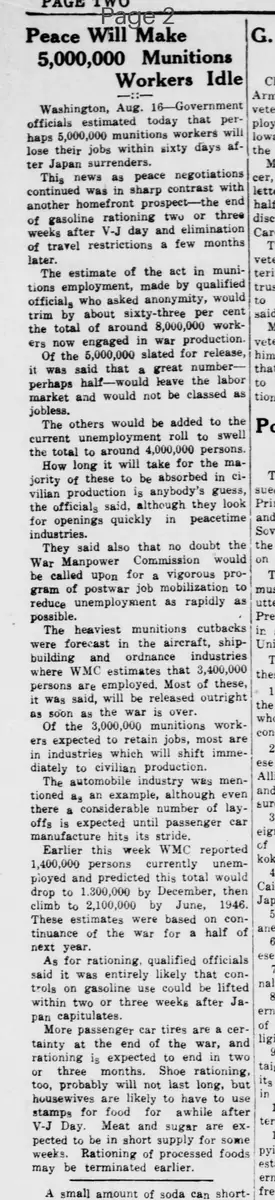
Washington, Aug. 16—Government officials estimated today that perhaps 5,000,000 munitions workers will lose their jobs within sixty days after Japan surrenders.
This news as peace negotiations continued was in sharp contrast with another homefront prospect—the end of gasoline rationing two or three weeks after V-J day and elimination of travel restrictions a few months later.
The estimate of the cut in munitions employment, made by qualified official, who asked anonymity, would trim by about sixty-three per cent the total of around 8,000,000 workers now engaged in war production.
Of the 5,000,000 slated for release, it was said that a great number—perhaps half—would leave the labor market and would not be classed as jobless.
The others would be added to the current unemployment roll to swell the total to around 4,000,000 persons.
How long it will take for the majority of these to be absorbed in civilian production is anybody's guess, the officials said, although they look for openings quickly in peacetime industries.
They said also that no doubt the War Manpower Commission would be called upon for a vigorous program of postwar job mobilization to reduce unemployment as rapidly as possible.
The heaviest munitions cutbacks were forecast in the aircraft, shipbuilding and ordnance industries where WMC estimates that 3,400,000 persons are employed. Most of these, it was said, will be released outright as soon as the war is over.
Of the 3,000,000 munitions workers expected to retain jobs, most are in industries which will shift immediately to civilian production.
The automobile industry was mentioned as an example, although even there a considerable number of layoffs is expected until passenger car manufacture hits its stride.
Earlier this week WMC reported 1,400,000 persons—currently unemployed and predicted this total would drop to 1,300,000 by December, then climb to 2,100,000 by June, 1946.
These estimates were based on continuance of the War for a half of next year.
As for rationing, qualified officials said it was entirely likely that controls on gasoline use could be lifted within two or three weeks after Japan capitulates.
More passenger car tires are a certainty at the end of the war, and rationing is expected to end in two or three months. Shoe rationing, too, probably will not last long, but housewives are likely to have to use stamps for food for awhile after V-J Day. Meat and sugar are expected to be in short supply for some weeks. Rationing of processed foods may be terminated earlier.
What sub-type of article is it?
What themes does it cover?
What keywords are associated?
Where did it happen?
Story Details
Location
Washington
Event Date
Aug. 16
Story Details
Government officials estimate 5,000,000 munitions workers will lose jobs within 60 days after Japan's surrender, reducing war production workforce by 63%. Half may leave labor market; others add to 4,000,000 unemployed. Quick absorption expected in civilian industries. Heaviest cuts in aircraft, shipbuilding, ordnance. Gasoline rationing to end 2-3 weeks post V-J Day; tires, shoes soon after; food rationing longer.