Thank you for visiting SNEWPapers!
Sign up free
St. Ignatius Post
Saint Ignatius, Lake County, Montana
What is this article about?
The U.S. Bureau of Labor Statistics' cost of living index hit a record 185.4% of 1935-39 average, up nearly 9% from June 1950 Korean War start, signaling inflation's onset and triggering wage hikes for over a million railroad workers via escalator clauses. Rises in apparel, furnishings, rent, and services; food dipped slightly.
Clipping
OCR Quality
Full Text
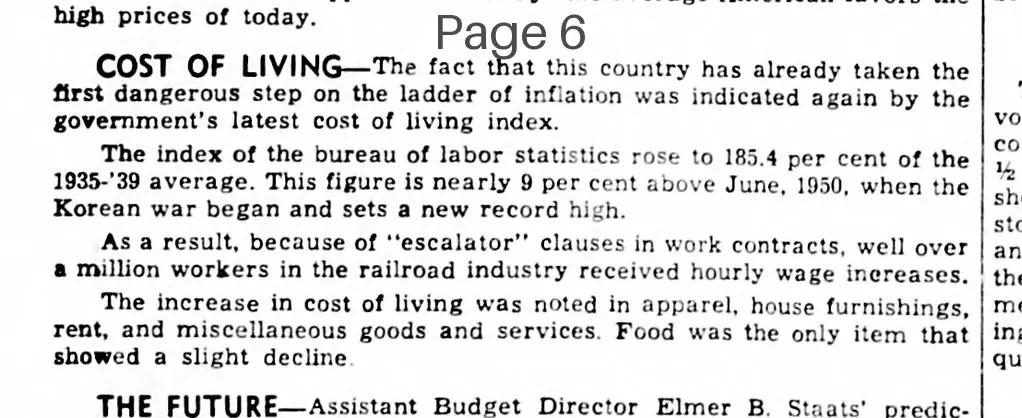
The index of the bureau of labor statistics rose to 185.4 per cent of the 1935-'39 average. This figure is nearly 9 per cent above June, 1950, when the Korean war began and sets a new record high.
As a result, because of "escalator" clauses in work contracts, well over a million workers in the railroad industry received hourly wage increases.
The increase in cost of living was noted in apparel, house furnishings, rent, and miscellaneous goods and services. Food was the only item that showed a slight decline.
What sub-type of article is it?
What keywords are associated?
Domestic News Details
Outcome
well over a million workers in the railroad industry received hourly wage increases. the increase in cost of living was noted in apparel, house furnishings, rent, and miscellaneous goods and services. food was the only item that showed a slight decline.
Event Details
The government's latest cost of living index rose to 185.4 per cent of the 1935-'39 average, nearly 9 per cent above June, 1950, when the Korean war began, setting a new record high. This indicates the country has taken the first dangerous step on the ladder of inflation. As a result of "escalator" clauses in work contracts, well over a million workers in the railroad industry received hourly wage increases.