Thank you for visiting SNEWPapers!
Sign up free
Literary
March 22, 1809
The Rhode Island Republican
Newport, Newport County, Rhode Island
What is this article about?
An 1805 letter from an American traveler in Florence describes the lives, achievements, and posthumous honors of figures like Galileo, Dante, and Michelangelo, highlighting their persecutions by church and state, and the city's cultural legacy.
Merged-components note: Garbled table is OCR error for part of the Latin inscription in the letter about Florence; the components are sequential in reading order and continue the same literary letter across columns.
Clipping
OCR Quality
65%
Fair
Full Text
AMUSING MISCELLANY
[With the first number of our paper, we commence the re-publication, from the Monthly Anthology, published at Boston, ) a series of Letters from Europe. They were written by a respectable American gentleman, while making a tour of that continent. As they have been perused with infinite satisfaction; by the readers of that work, and the limits of its circulation having been very circumscribed, we think they may be both new and acceptable to most of our patrons.]
FROM THE ANTHOLOGY.
Original Letters, from an American Traveller in Europe, to his friends in this country.
LETTER FIRST.
Florence, February 12, 1805.
MY DEAR FRIEND,
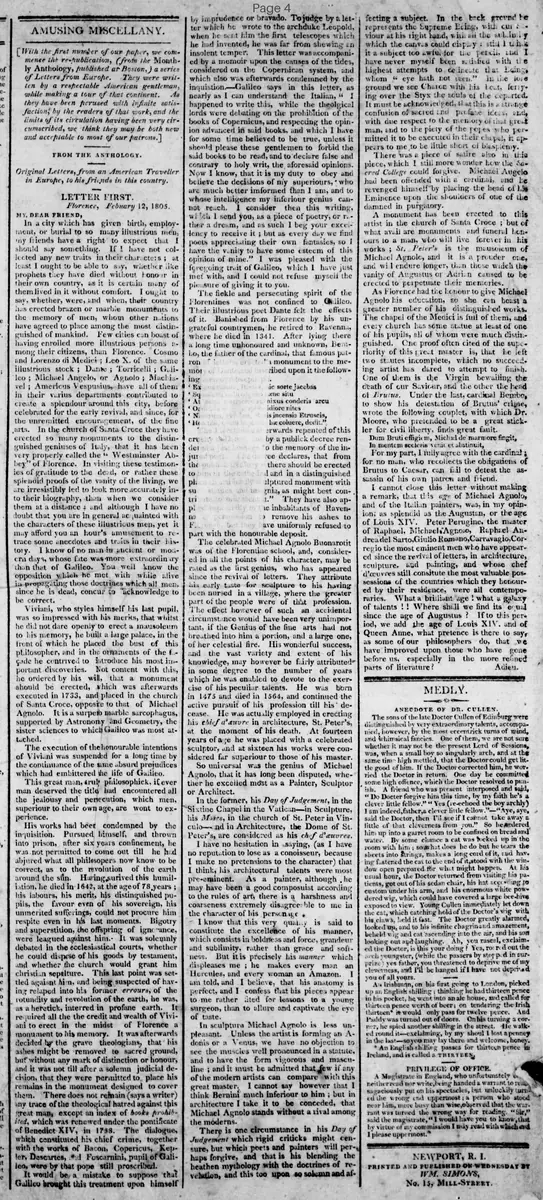
In a city which has given birth, employment, or burial to so many illustrious men, my friends have a right to expect that I should say something. If I have not collected any new traits in their characters; at least I ought to be able to say, whether like prophets they have died without honour in their own country, as it is certain many of them lived in it without comfort. I ought to say, whether, were, and when, their country has erected brazen or marble monuments to the memory of men, whom other nations have agreed to place among the most distinguished of mankind. Few cities can boast of having enrolled more illustrious persons among their citizens, than Florence. Cosmo and Lorenzo di Medici; Leo X. of the same illustrious stock; Dante; Torricelli; Galileo; Michael Angelo, or Agnolo; Machiavelli; Americus Vespusius, have all of them in their various departments contributed to create a splendour around this city, before celebrated for the early revival, and since, for the unremitted encouragement, of the fine arts. In the church of Santa Croce they have erected so many monuments to the distinguished geniuses of Italy, that it has been very properly called the "Westminster Abbey" of Florence. In visiting these testimonies of gratitude to the dead, or rather these splendid proofs of the vanity of the living, we are irresistibly led to look more accurately into their biography, than when we consider them at a distance; and although I have no doubt that you are in general acquainted with the characters of these illustrious men, yet it may afford you an hour's amusement to retrace some anecdotes and traits in their history. I know of no man in ancient or modern days, whose fate was more extraordinary than that of Galileo. You well know the opposition which he met with while alive in propagating those doctrines which all men, since he is dead, concur to acknowledge to be correct.
Viviani, who styles himself his last pupil, was so impressed with his merits, that whilst he did not dare openly to erect a mausoleum to his memory, he built a large palace, in the front of which he placed the bust of this philosopher, and in the ornaments of the façade he contrived to introduce his most important discoveries. Not content with this. he ordered by his will, that a monument should be erected, which was afterwards executed in 1733, and placed in the church of Santa Croce, opposite to that of Michael Agnolo. It is a superb marble sarcophagus, supported by Astronomy and Geometry, the sister sciences to which Galileo was most attached.
The execution of the honourable intentions of Viviani was suspended for a long time by the continuance of the same absurd prejudices which had embittered the life of Galileo. This great man, true philosophick, if ever man deserved the title had encountered all the jealousy and persecution, which men, superior to their own age, are wont to experience. His works had been condemned by the inquisition. Pursued himself, and thrown into prison, after six years confinement, he was not permitted to come out till he had abjured what all philosophers now know to be correct, as to the revolution of the earth around the sun. Having survived this humiliation, he died in 1642, at the age of 78 years; his labours, his merit, his distinguished pupils, the favour even of his sovereign, his unmerited sufferings, could not procure him respite even in his last moments. Bigotry and superstition, the offspring of ignorance, were leagued against him.— It was solemnly debated in the ecclesiastical courts, whether he could dispose of his goods by testament, and whether the church would grant him christian sepulture. This last point was settled against him, and being suspected of having relapsed into his former errours, of the rotundity and revolution of the earth, he was, as a heretick, interred in profane earth. It required all the credit and wealth of Viviani to erect in the midst of Florence a monument to his memory. It was afterwards decided by the grave theologians, that his ashes might be removed to sacred ground, but without any mark of distinction or honour; and it was not till after a solemn judicial decision, that they were permitted to, place his remains in the monument designed to cover them. There does not remain (says a writer) any trace of the theological hatred against this great man, except an index of books prohibited, which was renewed under the pontificate of Benedict XIV, in 1758. The dialogue, which constituted his chief crime, together with the works of Bacon, Copernicus, Kepler, Descartes, and Foscarini, pupil of Galileo, were by that pope still proscribed.
It would be a mistake to suppose that Galileo brought this treatment upon himself by imprudence or bravado. To judge by a letter which he wrote to the archduke Leopold, when he sent him the first telescopes which he had invented, he was far from shewing an insolent temper. This letter was accompanied by a memoir upon the causes of the tides, considered on the Copernican system, and which also was afterwards condemned by the inquisition.—Galileo says in this letter, as nearly as I can understand the Italian, "I happened to write this, while the theological lords were debating on the prohibition of the books of Copernicus, and respecting the opinion advanced in said books, and which I have for some time believed to be true, unless it should please these gentlemen to forbid the said books to be read, and to declare false and contrary to holy writ, the aforesaid opinions. Now I know, that it is my duty to obey and believe the decisions of my superiors, who are much better informed than I am, and to whose intelligence my inferior genius cannot reach. I consider then this writing, which I send you, as a piece of poetry, or rather a dream, and as such I beg your excellency to receive it; but as every day we find poets appreciating their own fantasies, so I have the vanity to have some esteem of this opinion of mine." I was pleased with the foregoing trait of Galileo, which I have just met with, and I could not refuse myself the pleasure of giving it to you.
The fickle and persecuting spirit of the Florentines was not confined to Galileo. Their illustrious poet Dante felt the effects of it. Banished from Florence by his ungrateful countrymen, he retired to Ravenna, where he died in 1341. After lying there a long time unhonoured and unknown, Benibo, the father of the cardinal, that famous patron of i monument to the me- mo1 cibed upon it the follow. purt" w iln luc " mouuultavc ucjxosit: The celebrated Michael Agnolo Buonarroti was of the Florentine school, and, considered in all the points of his character, may be rated as the first genius, who has appeared since the revival of letters. They attribute his early taste for sculpture to his having been nursed in a village, where the greater part of the people were of that profession. The effect however of such an accidental circumstance would have been very unimportant, if the Genius of the fine arts had not breathed into him a portion, and a large one, of her celestial fire. His wonderful success, and the vast variety and extent of his knowledge, may however be fairly attributed in some degree to the number of years which he was enabled to devote to the exercise of his peculiar talents. He was born in 1475 and died in 1564, and continued the active pursuit of his profession till his decease. He was actually employed in erecting his chief œvre in architecture, St. Peter's, at the moment of his death. At fourteen years of age he was placed with a celebrated sculptor, and at sixteen his works were considered far superior to those of his master. So universal was the genius of Michael Agnolo, that it has long been disputed, whether he excelled most as a Painter, Sculptor or Architect. In the former, his Day of Judgement, in the Sixtine Chapel in the Vatican—in Sculpture, his Moses, in the church of St. Peter in Vin- culo—and in Architecture, the Dome of St. Peter's, are considered as his chef d'œuvres. I have no hesitation in saying, (as I have no reputation to lose as a connoisseur, because I make no pretensions to the character) that I think, his architectural talents were most pre-eminent. As a painter, although he may have been a good composer according to the rules of art, there is a harshness and coarseness extremely disagreeable to me in the character of his personage But it is precisely his manner which displeases me; he makes every man an Hercules, and every woman an Amazon. I am told, and I believe, that his anatomy is perfect, and I confess that his pieces appear to me rather fitted for lessons to a young surgeon, than to allure and captivate the eye of taste. In sculpture Michael Agnolo is less unpleasant. Unless the artist is forming an A- donis or a Venus, we have no objection to see the muscles well pronounced in a statue, and to have the form vigorous and masculine; and it must be admitted that few if any of the modern artists can compare with this great master. I cannot say however that I think Bernini much inferior to him; but in architecture I take it to be conceded, that Michael Agnolo stands without a rival among the moderns. There is one circumstance in his Day of Judgement which rigid critics might censure, but which poets and painters will perhaps forgive, and that is his blending the heathen mythology with the doctrines of revelation, and this too upon so solemn and affecting a subject. In the back ground he
represents the Supreme Being, with our Saviour at his right hand, with all the sublimity which the canvas could display: still I think it a subject too awful for the pencil, and I have never myself been satisfied with the highest attempts to delineate that Being whom "eye hath not seen." In the fore ground we see Charon with his boat, ferrying over the Styx the souls of the departed. It must be acknowledged, that this is a strange confusion of sacred and profane ideas, and, with due respect to the memory of that great man, and to the piety of the popes who permitted it to be executed in their chapel, it appears to me to be little short of blasphemy. There was a piece of satire also in this piece, which I still more wonder how the Sacred College could forgive. Michael Angelo had been offended with a cardinal, and he revenged himself by placing the head of his Eminence upon the shoulders of one of the damned in purgatory.
A monument has been erected to this artist in the church of Santa Croce; but of what avail are monuments and funeral honours to a man, who will live forever in his works; St. Peter's is the mausoleum of Michael Angelo, and it is a prouder one, and will endure longer, than those which the vanity of Augustus or Adrian caused to be erected to perpetuate their memories.
As Florence had the honour to give Michael Angelo his education, so she can boast a greater number of his distinguished works. The chapel of the Medici is full of them, and every church has some statue at least of one of his pupils, all of whom were much distinguished. One proof often cited of the superiority of this great master is, that he left two statues incomplete, which no succeeding artist has dared to attempt to finish. One of them is the Virgin bewailing the death of our Saviour, and the other the head of Brutus. Under the last, cardinal Bembo, to show his detestation of Brutus' crime, wrote the following couplet, with which Dr. Moore, who pretended to be a great stickler for civil liberty, finds great fault.
Dum Bruti effigiem, Michal de marmore fingit,
In mentem sceleris venit et abstinuit,
For my part, I fully agree with the cardinal: for no man, who recollects the obligations of Brutus to Caesar, can fail to detest the assassin of his own patron and friend.
I cannot close this letter without making a remark, that this age of Michael Angelo, and of the Italian painters, was, in my opinion; as splendid as the Augustan, or the age of Louis XIV. Peter Perugino, the master of Raphael, Michael Angelo, Raphael Andrea del Sarto, Giulio Romano, Caravaggio, Correggio the most eminent men who have appeared since the revival of letters, in architecture, sculpture, and painting, and whose chef d'œuvres still constitute the most valuable possessions of the countries which they honoured by their residence, were all contemporaries. What a brilliant age! what a galaxy of talents !! Where shall we find its equal since the age of Augustus? If to this period, we add the age of Louis XIV. and of Queen Anne, what pretence is there to say, as some of our philosophers do, that we have improved upon those who have gone before us, especially in the more refined parts of literature?
Adieu.
[With the first number of our paper, we commence the re-publication, from the Monthly Anthology, published at Boston, ) a series of Letters from Europe. They were written by a respectable American gentleman, while making a tour of that continent. As they have been perused with infinite satisfaction; by the readers of that work, and the limits of its circulation having been very circumscribed, we think they may be both new and acceptable to most of our patrons.]
FROM THE ANTHOLOGY.
Original Letters, from an American Traveller in Europe, to his friends in this country.
LETTER FIRST.
Florence, February 12, 1805.
MY DEAR FRIEND,
In a city which has given birth, employment, or burial to so many illustrious men, my friends have a right to expect that I should say something. If I have not collected any new traits in their characters; at least I ought to be able to say, whether like prophets they have died without honour in their own country, as it is certain many of them lived in it without comfort. I ought to say, whether, were, and when, their country has erected brazen or marble monuments to the memory of men, whom other nations have agreed to place among the most distinguished of mankind. Few cities can boast of having enrolled more illustrious persons among their citizens, than Florence. Cosmo and Lorenzo di Medici; Leo X. of the same illustrious stock; Dante; Torricelli; Galileo; Michael Angelo, or Agnolo; Machiavelli; Americus Vespusius, have all of them in their various departments contributed to create a splendour around this city, before celebrated for the early revival, and since, for the unremitted encouragement, of the fine arts. In the church of Santa Croce they have erected so many monuments to the distinguished geniuses of Italy, that it has been very properly called the "Westminster Abbey" of Florence. In visiting these testimonies of gratitude to the dead, or rather these splendid proofs of the vanity of the living, we are irresistibly led to look more accurately into their biography, than when we consider them at a distance; and although I have no doubt that you are in general acquainted with the characters of these illustrious men, yet it may afford you an hour's amusement to retrace some anecdotes and traits in their history. I know of no man in ancient or modern days, whose fate was more extraordinary than that of Galileo. You well know the opposition which he met with while alive in propagating those doctrines which all men, since he is dead, concur to acknowledge to be correct.
Viviani, who styles himself his last pupil, was so impressed with his merits, that whilst he did not dare openly to erect a mausoleum to his memory, he built a large palace, in the front of which he placed the bust of this philosopher, and in the ornaments of the façade he contrived to introduce his most important discoveries. Not content with this. he ordered by his will, that a monument should be erected, which was afterwards executed in 1733, and placed in the church of Santa Croce, opposite to that of Michael Agnolo. It is a superb marble sarcophagus, supported by Astronomy and Geometry, the sister sciences to which Galileo was most attached.
The execution of the honourable intentions of Viviani was suspended for a long time by the continuance of the same absurd prejudices which had embittered the life of Galileo. This great man, true philosophick, if ever man deserved the title had encountered all the jealousy and persecution, which men, superior to their own age, are wont to experience. His works had been condemned by the inquisition. Pursued himself, and thrown into prison, after six years confinement, he was not permitted to come out till he had abjured what all philosophers now know to be correct, as to the revolution of the earth around the sun. Having survived this humiliation, he died in 1642, at the age of 78 years; his labours, his merit, his distinguished pupils, the favour even of his sovereign, his unmerited sufferings, could not procure him respite even in his last moments. Bigotry and superstition, the offspring of ignorance, were leagued against him.— It was solemnly debated in the ecclesiastical courts, whether he could dispose of his goods by testament, and whether the church would grant him christian sepulture. This last point was settled against him, and being suspected of having relapsed into his former errours, of the rotundity and revolution of the earth, he was, as a heretick, interred in profane earth. It required all the credit and wealth of Viviani to erect in the midst of Florence a monument to his memory. It was afterwards decided by the grave theologians, that his ashes might be removed to sacred ground, but without any mark of distinction or honour; and it was not till after a solemn judicial decision, that they were permitted to, place his remains in the monument designed to cover them. There does not remain (says a writer) any trace of the theological hatred against this great man, except an index of books prohibited, which was renewed under the pontificate of Benedict XIV, in 1758. The dialogue, which constituted his chief crime, together with the works of Bacon, Copernicus, Kepler, Descartes, and Foscarini, pupil of Galileo, were by that pope still proscribed.
It would be a mistake to suppose that Galileo brought this treatment upon himself by imprudence or bravado. To judge by a letter which he wrote to the archduke Leopold, when he sent him the first telescopes which he had invented, he was far from shewing an insolent temper. This letter was accompanied by a memoir upon the causes of the tides, considered on the Copernican system, and which also was afterwards condemned by the inquisition.—Galileo says in this letter, as nearly as I can understand the Italian, "I happened to write this, while the theological lords were debating on the prohibition of the books of Copernicus, and respecting the opinion advanced in said books, and which I have for some time believed to be true, unless it should please these gentlemen to forbid the said books to be read, and to declare false and contrary to holy writ, the aforesaid opinions. Now I know, that it is my duty to obey and believe the decisions of my superiors, who are much better informed than I am, and to whose intelligence my inferior genius cannot reach. I consider then this writing, which I send you, as a piece of poetry, or rather a dream, and as such I beg your excellency to receive it; but as every day we find poets appreciating their own fantasies, so I have the vanity to have some esteem of this opinion of mine." I was pleased with the foregoing trait of Galileo, which I have just met with, and I could not refuse myself the pleasure of giving it to you.
The fickle and persecuting spirit of the Florentines was not confined to Galileo. Their illustrious poet Dante felt the effects of it. Banished from Florence by his ungrateful countrymen, he retired to Ravenna, where he died in 1341. After lying there a long time unhonoured and unknown, Benibo, the father of the cardinal, that famous patron of i monument to the me- mo1 cibed upon it the follow. purt" w iln luc " mouuultavc ucjxosit: The celebrated Michael Agnolo Buonarroti was of the Florentine school, and, considered in all the points of his character, may be rated as the first genius, who has appeared since the revival of letters. They attribute his early taste for sculpture to his having been nursed in a village, where the greater part of the people were of that profession. The effect however of such an accidental circumstance would have been very unimportant, if the Genius of the fine arts had not breathed into him a portion, and a large one, of her celestial fire. His wonderful success, and the vast variety and extent of his knowledge, may however be fairly attributed in some degree to the number of years which he was enabled to devote to the exercise of his peculiar talents. He was born in 1475 and died in 1564, and continued the active pursuit of his profession till his decease. He was actually employed in erecting his chief œvre in architecture, St. Peter's, at the moment of his death. At fourteen years of age he was placed with a celebrated sculptor, and at sixteen his works were considered far superior to those of his master. So universal was the genius of Michael Agnolo, that it has long been disputed, whether he excelled most as a Painter, Sculptor or Architect. In the former, his Day of Judgement, in the Sixtine Chapel in the Vatican—in Sculpture, his Moses, in the church of St. Peter in Vin- culo—and in Architecture, the Dome of St. Peter's, are considered as his chef d'œuvres. I have no hesitation in saying, (as I have no reputation to lose as a connoisseur, because I make no pretensions to the character) that I think, his architectural talents were most pre-eminent. As a painter, although he may have been a good composer according to the rules of art, there is a harshness and coarseness extremely disagreeable to me in the character of his personage But it is precisely his manner which displeases me; he makes every man an Hercules, and every woman an Amazon. I am told, and I believe, that his anatomy is perfect, and I confess that his pieces appear to me rather fitted for lessons to a young surgeon, than to allure and captivate the eye of taste. In sculpture Michael Agnolo is less unpleasant. Unless the artist is forming an A- donis or a Venus, we have no objection to see the muscles well pronounced in a statue, and to have the form vigorous and masculine; and it must be admitted that few if any of the modern artists can compare with this great master. I cannot say however that I think Bernini much inferior to him; but in architecture I take it to be conceded, that Michael Agnolo stands without a rival among the moderns. There is one circumstance in his Day of Judgement which rigid critics might censure, but which poets and painters will perhaps forgive, and that is his blending the heathen mythology with the doctrines of revelation, and this too upon so solemn and affecting a subject. In the back ground he
| ing | ic sorte jacebas |
| 'Ex' | ene situ |
| 'Sq' | nixus conderis arcu |
| 'At' | idiore nites |
| 'Or' | is incensis Etruscis, |
| 'N' | ha coluere, dedit." |
| 'Hu' | erwards repented of this by a public decree ren- |
| cru | o the memory of the in- |
| der | ree declares, that from |
| jur | there should be erected |
| the | d and in a distinguished |
| to | plptured monument with |
| pl | gnia, as might best con- |
| su | t." They have also ap- |
| tri | he inhabitants of Raven- |
| pl | n) remove his ashes to |
| F | ave uniformly refused to |
represents the Supreme Being, with our Saviour at his right hand, with all the sublimity which the canvas could display: still I think it a subject too awful for the pencil, and I have never myself been satisfied with the highest attempts to delineate that Being whom "eye hath not seen." In the fore ground we see Charon with his boat, ferrying over the Styx the souls of the departed. It must be acknowledged, that this is a strange confusion of sacred and profane ideas, and, with due respect to the memory of that great man, and to the piety of the popes who permitted it to be executed in their chapel, it appears to me to be little short of blasphemy. There was a piece of satire also in this piece, which I still more wonder how the Sacred College could forgive. Michael Angelo had been offended with a cardinal, and he revenged himself by placing the head of his Eminence upon the shoulders of one of the damned in purgatory.
A monument has been erected to this artist in the church of Santa Croce; but of what avail are monuments and funeral honours to a man, who will live forever in his works; St. Peter's is the mausoleum of Michael Angelo, and it is a prouder one, and will endure longer, than those which the vanity of Augustus or Adrian caused to be erected to perpetuate their memories.
As Florence had the honour to give Michael Angelo his education, so she can boast a greater number of his distinguished works. The chapel of the Medici is full of them, and every church has some statue at least of one of his pupils, all of whom were much distinguished. One proof often cited of the superiority of this great master is, that he left two statues incomplete, which no succeeding artist has dared to attempt to finish. One of them is the Virgin bewailing the death of our Saviour, and the other the head of Brutus. Under the last, cardinal Bembo, to show his detestation of Brutus' crime, wrote the following couplet, with which Dr. Moore, who pretended to be a great stickler for civil liberty, finds great fault.
Dum Bruti effigiem, Michal de marmore fingit,
In mentem sceleris venit et abstinuit,
For my part, I fully agree with the cardinal: for no man, who recollects the obligations of Brutus to Caesar, can fail to detest the assassin of his own patron and friend.
I cannot close this letter without making a remark, that this age of Michael Angelo, and of the Italian painters, was, in my opinion; as splendid as the Augustan, or the age of Louis XIV. Peter Perugino, the master of Raphael, Michael Angelo, Raphael Andrea del Sarto, Giulio Romano, Caravaggio, Correggio the most eminent men who have appeared since the revival of letters, in architecture, sculpture, and painting, and whose chef d'œuvres still constitute the most valuable possessions of the countries which they honoured by their residence, were all contemporaries. What a brilliant age! what a galaxy of talents !! Where shall we find its equal since the age of Augustus? If to this period, we add the age of Louis XIV. and of Queen Anne, what pretence is there to say, as some of our philosophers do, that we have improved upon those who have gone before us, especially in the more refined parts of literature?
Adieu.
What sub-type of article is it?
Epistolary
Essay
What themes does it cover?
Political
Religious
Moral Virtue
What keywords are associated?
Florence
Galileo
Dante
Michael Angelo
Medici
Inquisition
Persecution
Fine Arts
Monuments
What entities or persons were involved?
A Respectable American Gentleman
Literary Details
Title
Letter First.
Author
A Respectable American Gentleman
Subject
Observations On Illustrious Florentines During A Tour Of Europe
Key Lines
I Consider Then This Writing, Which I Send You, As A Piece Of Poetry, Or Rather A Dream, And As Such I Beg Your Excellency To Receive It; But As Every Day We Find Poets Appreciating Their Own Fantasies, So I Have The Vanity To Have Some Esteem Of This Opinion Of Mine.
Dum Bruti Effigiem, Michal De Marmore Fingit,
In Mentem Sceleris Venit Et Abstinuit,