Thank you for visiting SNEWPapers!
Sign up free
Alexandria Advertiser And Commercial Intelligencer
Alexandria, Virginia
What is this article about?
Citizen Laussat, French Colonial Prefect, arrived in New Orleans on March 26, 1803, received by Spanish Governor and officials, signaling the cession of Louisiana from Spain to France. He issued assurances of prosperity and order. Detailed Arret outlines governance by Captain General, Prefect, and Justice Commissary.
Merged-components note: Continuation of the foreign news article detailing the reception of Citizen Laussat and the full text of the French Arret decree across pages 2 and 3; relabeled the second component from 'notice' to 'foreign_news'.
Clippings
1 of 2
OCR Quality
Full Text
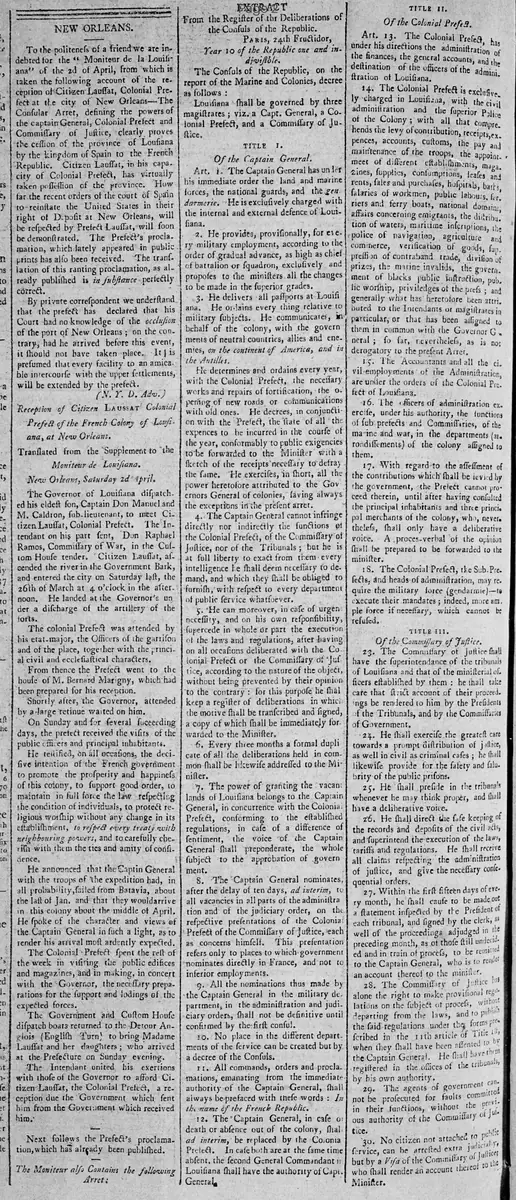
To the politeness of a friend we are indebted for the "Moniteur de la Louisiana" of the 2d of April, from which is taken the following account of the reception of Citizen Laussat, Colonial Prefect at the city of New Orleans--The Consular Arret, defining the powers of the Captain General, Colonial Prefect and Commissary of Justice, clearly, proves the cession of the province of Louisiana by the kingdom of Spain to the French Republic. Citizen Laussat, in his capacity of Colonial Prefect, has virtually taken possession of the province. How far the recent orders of the court of Spain to reinstate the United States in their right of Deposit at New Orleans, will be respected by Prefect Laussat, will soon be demonstrated. The Prefect's proclamation, which lately appeared in public prints has also been received. The translation of this ranting proclamation, as already published is in substance perfectly correct.
By private correspondent we understand that the prefect has declared that his Court had no knowledge of the occlusion of the port of New Orleans: on the contrary, had he arrived before this event, it should not have taken place. It is presumed that every facility to an amicable intercourse with the upper settlements, will be extended by the prefect.
(N. Y. D. Adv.)
Reception of Citizen Laussat Colonial Prefect of the French Colony of Louisiana, at New Orleans.
Translated from the Supplement to the Moniteur de Louisiana.
New Orleans, Saturday 2d April.
The Governor of Louisiana dispatched his eldest son, Captain Don Manuel and M. Caldron, sub-lieutenant, to meet Citizen Laussat, Colonial Prefect. The Intendant on his part sent, Don Raphael Ramos, Commissary of War, in the Custom House tender. Citizen Laussat, ascended the river in the Government Bark, and entered the city on Saturday last, the 26th of March at 4 o'clock in the afternoon. He landed at the Governor's under a discharge of the artillery of the forts.
The colonial Prefect was attended by his etat-major, the Officers of the garrison and of the place, together with the principal civil and ecclesiastical characters. From thence the Prefect went to the house of M. Bernard Marigny, which had been prepared for his reception.
Shortly after, the Governor, attended by a large retinue waited on him.
On Sunday and for several succeeding days. the prefect received the visits of the public officers and principal inhabitants. He testified. on all occasions. the decisive intention of the French government to promote the prosperity and happiness of this colony, to support good order, to maintain in full force the law respecting the condition of individuals, to protect religious worship without any change in its establishment, to respect every treaty with neighbouring powers, and to carefully cherish with them the ties and amity of confidence.
He announced that the Captain General with the troops of the expedition had, in all probability, sailed from Batavia, about the last of Jan. and that they would arrive in this colony about the middle of April. He spoke of the character and views of the Captain General in such a light, as to render his arrival most ardently expected.
The Colonial Prefect spent the rest of the week in visiting the public edifices and magazines, and in making, in concert with the Governor, the necessary preparations for the support and lodgings of the expected forces.
The Government and Custom House dispatch boats returned to the Detour Anglais (English Turn) to bring Madame Laussat and her daughters: who arrived at the Prefecture on Sunday evening.
The Intendant united his exertions with those of the Governor to afford Citizen Laussat, the Colonial Prefect, a reception due the Government which sent him from the Government which received him.
Next follows the Prefect's proclamation, which has already been published.
The Moniteur also Contains the following Arret:
From the Register of the Deliberations of the Consuls of the Republic.
Paris, 24th Fructidor,
Year 10 of the Republic one and indivisible.
The Consuls of the Republic, on the report of the Marine and Colonies, decree as follows:
Louisiana shall be governed by three magistrates; viz. a Capt. General, a Colonial Prefect, and a Commissary of Justice.
TITLE I.
Of the Captain General.
Art. 1. The Captain General has under his immediate order the land and marine forces, the national guards, and the gendarmerie. He is exclusively charged with the internal and external defence of Louisiana.
2. He provides, provisionally, for every military employment, according to the order of gradual advance, as high as chief of battalion or squadron, exclusively and proposes to the ministers all the changes to be made in the superior grades.
3. He delivers all passports at Louisiana. He ordains every thing relative to military subjects. He communicates, in behalf of the colony, with the governments of neutral countries, allies and enemies, on the continent of America, and in the Antilles.
He determines and ordains every year, with the Colonial Prefect, the necessary works and repairs of fortification, the opening of new roads or communications with old ones. He decrees, in conjunction with the Prefect, the state of all the expences to be incurred in the course of the year, conformably to public exigencies to be forwarded to the Minister with a sketch of the receipts necessary to defray the same. He exercises, in short, all the power heretofore attributed to the Governors General of colonies, saving always the exceptions in the present arret.
4. The Captain General cannot infringe directly nor indirectly the functions of the Colonial Prefect, of the Commissary of Justice, nor of the Tribunals; but he is at full liberty to exact from them every intelligence he shall deem necessary to demand, and which they shall be obliged to furnish, with respect to every department of public service whatsoever.
5. He can moreover, in case of urgent necessity, and on his own responsibility, supercede in whole or part the execution of the laws and regulations, after having on all occasions deliberated with the Colonial Prefect or the Commissary of Justice, according to the nature of the object, without being prevented by their opinion to the contrary: for this purpose he shall keep a register of deliberations in which the motive shall be transcribed and signed, a copy of which shall be immediately forwarded to the Minister.
6. Every three months a formal duplicate of all the deliberations held in common shall be likewise addressed to the Minister.
7. The power of granting the vacant lands of Louisiana belongs to the Captain General, in concurrence with the Colonial Prefect, conforming to the established regulations, in case of a difference of sentiment, the voice of the Captain General Shall preponderate, the whole subject to the approbation of government.
8. The Captain General nominates, after the delay of ten days, ad interim, to all vacancies in all parts of the administration and of the judiciary order, on the respective presentations of the Colonial Prefect of the Commissary of Justice, each as concerns himself. This presentation refers only to places to which government nominates directly in France, and not to inferior employments.
9. All the nominations thus made by the Captain General in the military department, in the administration and judiciary orders, shall not be definitive until confirmed by the first consul.
10. No place in the different departments of the service can be created but by a decree of the Consuls.
11. All commands, orders and proclamations, emanating from the immediate authority of the Captain General, shall always be prefaced with these words: In the name of the French Republic.
12. The Captain General, in case or death or absence out of the colony, shall ad interim. be replaced by the Colonial Prefect. In case both are at the same time absent, the second General Commandant Louisiana shall have the authority of Capt. General
Of the Colonial Prefect.
Art. 13. The Colonial Prefect, has under his directions the administration of the finances, the general accounts, and the destination of the officers of the administration of Louisiana.
14. The Colonial Prefect is exclusively charged in Louisiana, with the civil administration and the superior Police of the Colony; with all that comprehends the levy of contribution, receipts, expences, accounts, customs, the pay and maintenance of the troops, the appointment of different establishments, magazines, supplies, consumptions, leases and rents, sales and purchases, hospitals, baths, salaries of workmen, public labours, ferriers and ferry boats, national domains affairs concerning emigrants, the distribution of waters, maritime inscriptions, the police of navigation, agriculture and commerce, verification of goods, suppression of contraband trade, division of prizes, the marine invalids, the government of blacks public instruction, public worship, privileges of the press; and generally what has heretofore been attributed to the Intendants or magistrates in particular, or that has been assigned to them in common with the Governor General: so far, nevertheless, as is not derogatory to the present Arret.
15. The Accountants and all the civil employments of the Administration, are under the orders of the Colonial Prefect of Louisiana.
16. The officers of administration exercise, under his authority, the functions of sub prefects and Commissaries, of the marine and war, in the departments (arrondissements) of the colony assigned to them.
17. With regard to the assessment of the contributions which shall be levied by the government, the Prefect cannot proceed therein, until after having consulted the principal inhabitants and three principal merchants of the colony, who, nevertheless, Shall only have a deliberative voice. A proces-verbal of the opinion shall be prepared to be forwarded to the minister.
18. The Colonial Prefect, the Sub.Prefects. and heads-of administration, may require the military force (gendarmerie) to execute their mandates; indeed, more ample force if necessary, which cannot be refused.
TITLE III.
Of the Commissary of Justice.
23. The Commissary of Justice shall have the superintendence of the tribunals of Louisiana and that of the ministerial officers established by them: he shall take care that strict account of their proceedings be rendered to him by the Presidents of the Tribunals, and by the Commissaries of Government.
24. He shall exercise the greatest care towards a prompt distribution of justice, as well in civil as criminal cases; he shall likewise provide for the safety and salubrity of the public prisons.
25. He shall preside in the tribunals whenever he may think proper, and shall have a deliberative voice.
26. He shall direct the safe keeping of the records and deposits of the civil acts, and superintend the execution of the laws, tariffs and regulations. He shall receive all claims respecting the administration of justice, and give the necessary consequential orders.
27. Within the first fifteen days of every month, he shall cause to be made out a statement inspected by the President of each tribunal, and signed by the clerk, as well of the proceedings adjudged in the preceding month, as of those still undecided and in train of process. to be remitted to the Captain General, who is to render an account thereof to the minister.
28. The Commissary of Justice has alone the right to make provisional regulations on the subject of process, without departing from the laws, and to publish the aid regulations under the forms prescribed in the fifth article of Title III, when they shall have been assented to by the Captain General. He Shall have them registered in the offices of the tribunals, by his own authority.
29. The agents of government cannot be prosecuted for faults committed in their functions, without the previous authority of the Commissary of Justice.
30. No citizen not attached to public service, can be arrested extra judicially, but by a Visa of the Commissary of Justice; who shall render an account thereof to the Minister.
The Commissary of Justice shall be adapted to compose the future civil and prepare such laws as he shall judge best for the criminal code of the colony he superintends. His plans shall be communicated to the Captain General, and forwarded to the Minister, with the proces verbal of their deliberations and respective opinions.
32. He is especially charged with the public respecting vagrants and vagabonds, and condition of prosecuting them before whom he shall issue his mandate of arrest, be disturbers of public tranquility, against the competent tribunals.
33. He may require the military force, or even more adequate force, if necessary, for ordinances, as those of the judgment of the tribunals; which force cannot be refused for the execution of his own orders.
34. The Commissary of Justice, in case of death, or absence out of the colony, shall be replaced provisionally by the Commissary of Government, attached to the tribunal of appeals, and the latter by the first of his substitute.
(Signed)
BONAPARTE, First Consul.
By the First Consul.
(Signed)
HUGUES B. MARET.
Secretary of State.
Copy conformable with the original,
(Signed)
DECRES,
Minister of Marine and Colonies.
What sub-type of article is it?
What keywords are associated?
What entities or persons were involved?
Where did it happen?
Foreign News Details
Primary Location
New Orleans, Louisiana
Event Date
26th Of March
Key Persons
Outcome
virtual possession of louisiana taken by france; assurances of prosperity, order, religious protection, and respect for treaties; governance structure defined by arret for captain general, colonial prefect, and commissary of justice.
Event Details
Citizen Laussat arrived in New Orleans on March 26, received by Spanish Governor's son Don Manuel, M. Caldron, and Don Raphael Ramos. He was attended by officials and stayed at M. Bernard Marigny's house. Laussat expressed French intentions for prosperity and order, announced Captain General's imminent arrival, and collaborated on preparations. The Arret from Paris details powers of the three magistrates governing Louisiana.