Thank you for visiting SNEWPapers!
Sign up free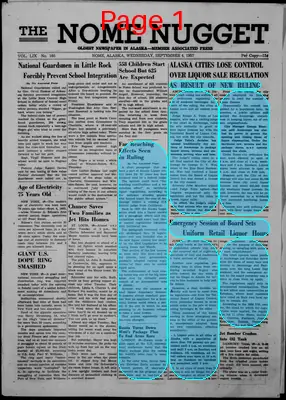
The Nome Nugget
Nome, Nome County, Alaska
What is this article about?
A federal judge in Anchorage ruled that Alaska cities lack authority to regulate liquor sales, nullifying local ordinances and shifting control to the Territorial Board. The board then set uniform hours and banned B-girls in cities over 750 population, affecting 11 municipalities.
Merged-components note: Merging section title with the main body and continuation of the Alaska liquor control ruling story across columns and sections. Original foreign_news component primarily covers domestic liquor topic but appends an unrelated short foreign news item on Russia disarmament; the merged component focuses on the dominant domestic liquor regulation subject.
Clipping
OCR Quality
Full Text
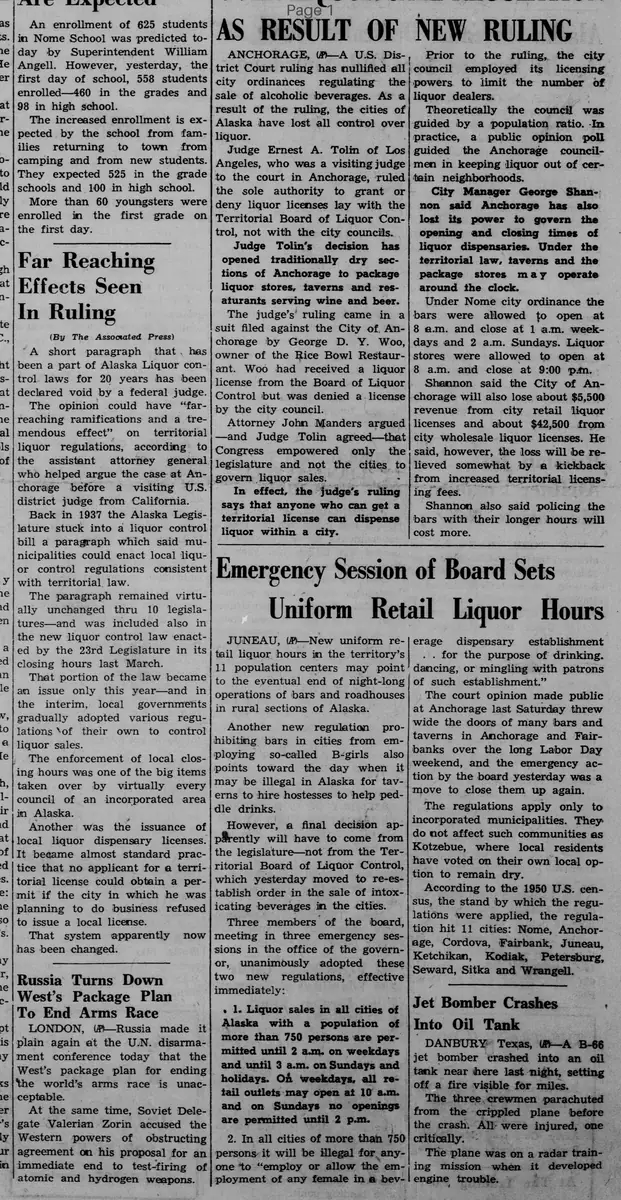
Far Reaching
Effects Seen
In Ruling
(By The Associated Press)
A short paragraph that has been a part of Alaska Liquor control laws for 20 years has been declared void by a federal judge.
The opinion could have "far-reaching ramifications and a tremendous effect" on territorial liquor regulations, according to the assistant attorney general who helped argue the case at Anchorage before a visiting U.S. district judge from California.
Back in 1937 the Alaska Legislature stuck into a liquor control bill a paragraph which said municipalities could enact local liquor control regulations consistent with territorial law.
The paragraph remained virtually unchanged thru 10 legislatures-and was included also in the new liquor control law enacted by the 23rd Legislature in its closing hours last March.
That portion of the law became an issue only this year-and in the interim, local governments gradually adopted various regulations of their own to control liquor sales.
The enforcement of local closing hours was one of the big items taken over by virtually every council of an incorporated area in Alaska.
Another was the issuance of local liquor dispensary licenses.
It became almost standard practice that no applicant for a territorial license could obtain a permit if the city in which he was planning to do business refused to issue a local license.
That system apparently now has been changed.
ANCHORAGE, (AP)--A U.S. District Court ruling has nullified all city ordinances regulating the sale of alcoholic beverages. As a result of the ruling, the cities of Alaska have lost all control over liquor.
Judge Ernest A. Tolin of Los Angeles, who was a visiting judge to the court in Anchorage, ruled the sole authority to grant or deny liquor licenses lay with the Territorial Board of Liquor Control, not with the city councils.
Judge Tolin's decision has opened traditionally dry sections of Anchorage to package liquor stores, taverns and restaurants serving wine and beer.
The judge's ruling came in a suit filed against the City of Anchorage by George D. Y. Woo, owner of the Rice Bowl Restaurant. Woo had received a liquor license from the Board of Liquor Control but was denied a license by the city council.
Attorney John Manders argued -and Judge Tolin agreed--that Congress empowered only the legislature and not the cities to govern liquor sales.
In effect, the judge's ruling says that anyone who can get a territorial license can dispense liquor within a city.
Prior to the ruling, the city council employed its licensing powers to limit the number of liquor dealers.
Theoretically the council was guided by a population ratio. In practice, a public opinion poll guided the Anchorage councilmen in keeping liquor out of certain neighborhoods.
City Manager George Shannon said Anchorage has also lost its power to govern the opening and closing times of liquor dispensaries. Under the territorial law, taverns and the package stores may operate around the clock.
Under Nome city ordinance the bars were allowed to open at 8 a.m. and close at 1 a.m. weekdays and 2 a.m. Sundays. Liquor stores were allowed to open at 8 a.m. and close at 9:00 p.m.
Shannon said the City of Anchorage will also lose about $5,500 revenue from city retail liquor licenses and about $42,500 from city wholesale liquor licenses. He said, however, the loss will be relieved somewhat by a kickback from increased territorial licensing fees.
Shannon also said policing the bars with their longer hours will cost more.
Emergency Session of Board Sets
Uniform Retail
Liquor
Hours
JUNEAU, (AP)-New uniform retail liquor hours in the territory's 11 population centers may point to the eventual end of night-long operations of bars and roadhouses in rural sections of Alaska.
Another new regulation prohibiting bars in cities from employing so-called B-girls also points toward the day when it may be illegal in Alaska for taverns to hire hostesses to help peddle drinks.
However, a final decision apparently will have to come from the legislature not from the Territorial Board of Liquor Control, which yesterday moved to re-establish order in the sale of intoxicating beverages in the cities.
Three members of the board, meeting in three emergency sessions in the office of the governor, unanimously adopted these two new regulations, effective immediately:
1. Liquor sales in all cities of Alaska with a population of more than 750 persons are permitted until 2 a.m. on weekdays and until 3 a.m. on Sundays and holidays. On weekdays, all retail outlets may open at 10 a.m. and on Sundays no openings are permitted until 2 p.m.
2. In all cities of more than 750 persons it will be illegal for anyone to "employ or allow the employment of any female in a beverage dispensary establishment . . . for the purpose of drinking, dancing, or mingling with patrons of such establishment."
The court opinion made public at Anchorage last Saturday threw wide the doors of many bars and taverns in Anchorage and Fairbanks over the long Labor Day weekend, and the emergency action by the board yesterday was a move to close them up again.
The regulations apply only to incorporated municipalities. They do not affect such communities as Kotzebue, where local residents have voted on their own local option to remain dry.
According to the 1950 U.S. census, the stand by which the regulations were applied, the regulation hit 11 cities: Nome, Anchorage, Cordova, Fairbanks, Juneau, Ketchikan, Kodiak, Petersburg, Seward, Sitka and Wrangell.
What sub-type of article is it?
What keywords are associated?
What entities or persons were involved?
Where did it happen?
Domestic News Details
Primary Location
Anchorage, Alaska
Event Date
Last Saturday (Ruling); Yesterday (Board Action)
Key Persons
Outcome
cities lose authority over liquor licensing and hours, leading to revenue loss of about $48,000 for anchorage; new uniform hours set (10 a.m. weekdays to 2 a.m., 2 p.m. sundays to 3 a.m.); ban on b-girls in cities over 750 population; affects 11 cities including anchorage, fairbanks, juneau.
Event Details
Federal judge ruled a 1937 law provision void, nullifying city ordinances on liquor sales; suit by Woo against Anchorage after territorial license denied by city; board in emergency sessions adopted uniform hours and B-girl prohibition for cities over 750 population.