Thank you for visiting SNEWPapers!
Sign up free
Literary
August 18, 1812
Kentucky Gazette
Lexington, Fayette County, Kentucky
What is this article about?
Skelton Jones delivers a patriotic oration on July 4, 1812, in Petersburg, VA, commemorating the 1776 Declaration of Independence, denouncing British historical and current aggressions including impressment of Americans, and rallying support for the ongoing war, emphasizing American principles of liberty and inevitable victory.
Clipping
OCR Quality
95%
Excellent
Full Text
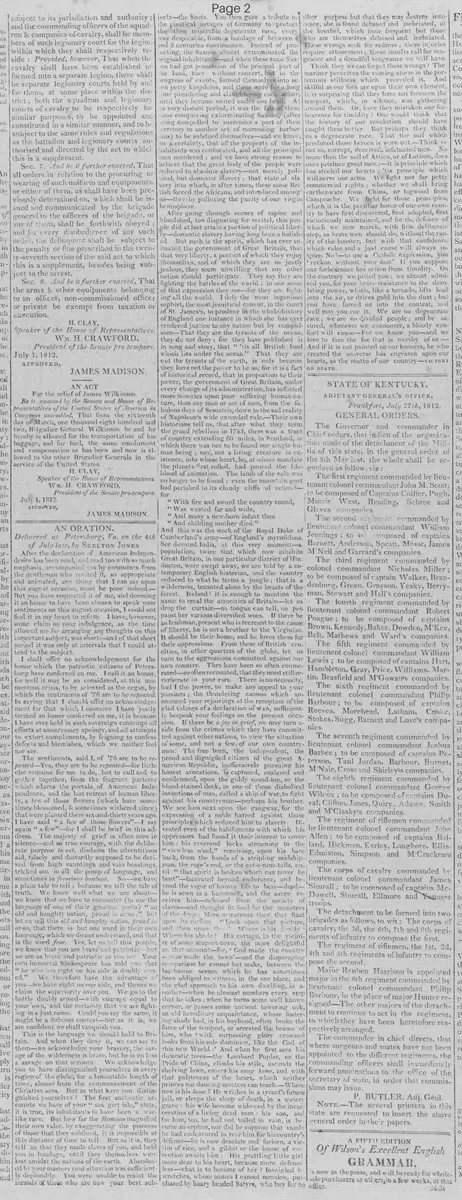
AN ORATION,
Delivered at Petersburg, Va. on the 4th of July last, by Skelton Jones
After the declaration of American Independence has been read, and read too with so much emphasis, accompanied too by comments from the gentleman who recited it, so appropriate and animated, any thing that I can say upon this august occasion, must be poor indeed.— But you have requested it of me, and deeming it an honor to have been chosen to speak your sentiments on this august occasion, I could not find it in my heart to refuse. I have, however, some claim on your indulgence, as the time allowed me for arranging any thoughts on this important subject, was short—and of that short period it was only at intervals that I could attend to the subject.
I shall offer no acknowledgement for the honor which the patriotic citizens of Petersburg have conferred on me. I call it an honor, for well it may be so considered, at this momentous crisis, to be selected as the organ, by which the sentiments of '76 are to be repeated. In saying that I should offer no acknowledgement for that which I conceive I have justly termed an honor conferred on me, it is because I have ever held in such sovereign contempt all efforts at unnecessary apology, and all attempts to extort compliments, by feigning to confess defects and blemishes, which we neither feel nor see.
The sentiments, said I, of '76 are to be repeated—Yes, they are to be repeated—for little else remains for me to do, but to cull and to gather together, from the fragrant parterre which adorns the portals of American Independence, and the last retreat of human liberty, a few of those flowers (which have sometimes blossomed, & sometimes withered since) that were planted there six-and-thirty years ago. I have said "a few of those flowers"—I say again "a few"—for I shall be brief in this address. The majesty of grief is often seen in silence—and so true courage, with the deliberate purpose to act, disdains the adventitious aid, falsely and dastardly supposed to be derived from high vauntings and vain boastings, tricked out in all the pomp of language, and sometimes in ferocious bombast. No—we have a plain tale to tell; because we tell the tale of truth. We know well what we are about—we know that we have to encounter (to use the language of one of their greatest poets) "an old and haughty nation, proud in arms" but let us tell this old and haughty nation, proud in arms, that there is but one word in their own language, which we do not understand, and that is the word fear. Yes, let us tell this people, we know that you are brave and patriotic—but we are as brave and patriotic as you are. Your own immortal Shakespeare has told you that "he who has right on his side is doubly armed." We therefore have the advantage over you—we have right on our side, and thence we claim the superiority over you. We go to the battle doubly armed—with courage equal to your own, and the certainty that we are fighting in a just cause. Could you say the same, it might be a dubious contest—but as it is, we are confident we shall vanquish you.
This is the language we should hold to Britain. And when they deny it, we can say to them—we acknowledge your bravery, the savage of the wilderness is brave, but he is no less a savage on that account. We acknowledge you to have distinguished yourselves in every region of the globe, for a lamentable length of time, almost from the commencement of the Christian era. But in what have you distinguished yourselves? The first authentic accounts we have of your "sea girt isle," state, it is true, its inhabitants to have been a warlike race. But how far the Romans magnified their own valor, by exaggerating the prowess of those that they subdued, it is impossible at this distance of time to tell. But so it is, they tell us that they made slaves of you, and held you in bondage, until they themselves were lost amidst the nations of the earth. Abandoned by your masters your situation was sufficiently deplorable. You were unable to resist the inroads of those who are now your best subjects—the Scots. You then gave a tribute to the piratical savages of Germany to protect the then miserable degenerate race, every way despicable, from a bondage of between 4 and 5 centuries continuance. Instead of protecting, the Saxons almost exterminated the original inhabitants—and when these same Saxons had got possession of the principal part of the land, they without concert, but in the progress of events, formed themselves into seven petty kingdoms, and these were for a long time plundering and slaughtering each other, until they became united under one head. At a very distant period, it was the fate of these same conquering exterminating Saxons, (after being compelled to surrender a part of their territory to another set of marauding barbarians) to be subdued themselves—and we know, for a certainty, that all the property of the inhabitants was confiscated, and all the principal men murdered; and we have strong reason to believe that the great body of the people were reduced to absolute slavery—not merely political, but domestic slavery; that state of slavery into which, in after times, these same British forced the Africans, and introduced among us—thereby polluting the purity of our virgin hemisphere.
After going through scenes of rapine and bloodshed, too disgusting for recital, this people did at last attain a portion of political liberty—domestic slavery having long been abolished. But such is the spirit, which has ever animated the government of Great Britain, that that very liberty, a portion of which they enjoy themselves, and of which they are so justly jealous, they seem unwilling that any other nation should participate. They say they are fighting the battles of the world; in one sense of that expression they are—for they are fighting all the world. I defy the most ingenious sophist, the most jesuitical casuist, in the court of St James's, to produce in the whole history of England one instance in which she has ever rendered justice to any nation but by compulsion—That they are the tyrants of the ocean, they do not deny; for they have published it in song and story, that "'tis all British land which lies under the ocean." That they are not the tyrants of the earth, is only because they have not the power to be so, for it is a fact of historical record, that in proportion to their power, the government of Great Britain, under every change of its administration, has inflicted more miseries upon poor suffering human nature, than any man or set of men, from the fabulous days of Sesostris, down to the sad reality of Napoleon's wide extended rule.—Their own historians tell us, that after what they term the grand rebellion in 1745, there was a tract of country extending 60 miles, in Scotland, in which there was not to be found one single human being; nay, not a living creature in existence, into whose heart, he, at whose mandate the planets first rolled, had poured the life-blood of animation. The lamb of the vale was no longer to be found; even the mountain goat had perished in its cloudy cliffs of retreat—for
And childing mother died."
And this was the work of the Royal Duke of Cumberland's army—of England's myrmidons. See devoted India, at this very moment—a population, twice that which now inhabits Great Britain, in one particular district of Hindostan, were swept away, we are told by a contemporary English historian, and the country reduced to what he terms a jungle; that is a wilderness, tenanted alone by the beasts of the forest. Ireland! it is enough to mention the name to recal the atrocities of Britain—let us drop the curtain—no tongue can tell, no pen paint her various diversified woes. If there be an Irishman, present who is recreant to the cause of liberty, he is not a brother to the Virginian. It should be their home, and he loves them for their oppressions. From these of British cruelties, in other quarters of the globe, let us turn to the aggressions committed against our own country. They have been so often enumerated—so often recounted, that they must still reverbate in your ears. There is no necessity, had I the power, to make any appeal to your passions; the thundering cannon which announced your rejoicings at the reception of the glad tidings of a declaration of war, sufficiently bespeak your feelings on the present occasion. If there be a joy in grief, we may turn aside from the crimes which they have committed against other nations, to view the situation of some, and not a few, of our own countrymen. The free born, the independent, the proud and dignified citizen of the great American Republic, inoffensively pursuing his honest avocations, is captured, enslaved and condemned, upon the giddy round-top, or the blood-stained deck, in one of those diabolical inventions of man, called a ship of war, to fight against his countryman—perhaps his brother. We see him next upon the gangway, for the expression of a noble hatred against those principles which reduced him to slavery. Divested even of the habiliments with which his oppressors had found it their interest to cover him: his reverend locks streaming to the "viewless wind," receiving, upon his bare back, from the hands of a stripling midshipman, the rope's end, or the cat-o'-nine-tails, until "that spirit is broken which can never be bent"—lacerated beyond endurance, and beyond the vigor of human life to bear—dead— he is sewn in a hammock, and the surge receives him—released from the society of slaves—and thought fit food for the monsters of the deep: More monstrous they that float upon its surface "Look upon that picture, and then upon this."
Where is his family? Where his abode? His cottage, in the vicinity of some seaport-town, the more delightful on that account—for, 'God made the country—man made the town'—and the disparaging comparison he cannot but make, between the loathsome scenes which he has sometimes been obliged to witness, in the one place, and the glad approach to his own dwelling, in another—when he almost numbers every step that he takes: when he turns some well known corner, or passes some ancient towering oak, an old hereditary acquaintance, whose fostering shade had, in his boyhood, often broke the force of the tempest, or arrested the beams of him, who 'with surpassing glory crowned looks from his sole dominion, like the God of this new World:' And when he first sees his domestic trees—the Lombardy Poplar, or the Pride of China, climbs his stile, ascends the shelving lawn, enters his snug home, and with that politeness of the heart, which neither princes nor dancing-masters can teach—There now is his home? He writhes in a tyrant's future jail, or sleeps the sleep of death, in a water grave: his wife become widowed by the incarceration of a living dead man: his son, and for him, too, he had not toiled in vain, is become an orphan, nor did he suppose that vainly he had endeavored to rear him for his country's defence—he is now desolate and forlorn, a victim of vice, and a gibbet or the house of correction awaits him: His prattling little girl more dear to his heart, because more defenceless—what is to become of her? Inveigled by wretches, whose names I cannot mention, purchased by hoary headed Satyrs, who buy for no other purpose but that they may destroy innocence, she is found debased and inebriated, at the brothel, which none frequent but those who are themselves debased and inebriated.
These wrongs seek for redress; these injuries require atonement; these insults call for vengeance and a dreadful vengeance we will have. Think they we can forget these wrongs? The mariner perceives the coming storm in the portentous stillness which preceded it. And skilful as our foes are upon their own element, it is surprising that they have not foreseen the tempest, which, in silence, was gathering around them. Or, have they mistaken our forbearance for timidity? One would think that the history of our revolution should have taught them better. But perhaps they think us a degenerate race. That the soil which produced those heroes is worn out—Think ye not so, corrupt, deceived, infatuated men. No more than the soil of Attica, or of Latium, does ours produce great men;—it is principle which has steeled our hearts; 'tis principle which will nerve our arms. We fight not for petty commercial rights; whether we shall bring carthenware from China, or logwood from Campeachy. We fight for those principles, which it is the peculiar honor of our own country to have first discovered, first adopted, first victoriously maintained, and for the defence of which we now march, with firm deliberate step, as brave men should do, without the vanity of the boaster, but with that confidence which valor and a just cause will always inspire. No!—to use a Catholic expression, you 'reckon without your host.' If you suppose our forbearance has arisen from timidity. On the contrary we pitied you; we almost admired you, for your brave resistance to the desolating power, which, like a tornado, lifts lead into the air, or drives gold into the dust; but you have forced us into the contest, and well may you rue it. We are no degenerate race; we are no divided people; and be assured, whenever we encounter, a bloody conflict will ensue—For we know you—and we love to face the foe that is worthy of us:— And if it is not painted on our banners, he who created the universe has engraven upon our hearts, as the motto of our country—VICTORY OR DEATH.
Delivered at Petersburg, Va. on the 4th of July last, by Skelton Jones
After the declaration of American Independence has been read, and read too with so much emphasis, accompanied too by comments from the gentleman who recited it, so appropriate and animated, any thing that I can say upon this august occasion, must be poor indeed.— But you have requested it of me, and deeming it an honor to have been chosen to speak your sentiments on this august occasion, I could not find it in my heart to refuse. I have, however, some claim on your indulgence, as the time allowed me for arranging any thoughts on this important subject, was short—and of that short period it was only at intervals that I could attend to the subject.
I shall offer no acknowledgement for the honor which the patriotic citizens of Petersburg have conferred on me. I call it an honor, for well it may be so considered, at this momentous crisis, to be selected as the organ, by which the sentiments of '76 are to be repeated. In saying that I should offer no acknowledgement for that which I conceive I have justly termed an honor conferred on me, it is because I have ever held in such sovereign contempt all efforts at unnecessary apology, and all attempts to extort compliments, by feigning to confess defects and blemishes, which we neither feel nor see.
The sentiments, said I, of '76 are to be repeated—Yes, they are to be repeated—for little else remains for me to do, but to cull and to gather together, from the fragrant parterre which adorns the portals of American Independence, and the last retreat of human liberty, a few of those flowers (which have sometimes blossomed, & sometimes withered since) that were planted there six-and-thirty years ago. I have said "a few of those flowers"—I say again "a few"—for I shall be brief in this address. The majesty of grief is often seen in silence—and so true courage, with the deliberate purpose to act, disdains the adventitious aid, falsely and dastardly supposed to be derived from high vauntings and vain boastings, tricked out in all the pomp of language, and sometimes in ferocious bombast. No—we have a plain tale to tell; because we tell the tale of truth. We know well what we are about—we know that we have to encounter (to use the language of one of their greatest poets) "an old and haughty nation, proud in arms" but let us tell this old and haughty nation, proud in arms, that there is but one word in their own language, which we do not understand, and that is the word fear. Yes, let us tell this people, we know that you are brave and patriotic—but we are as brave and patriotic as you are. Your own immortal Shakespeare has told you that "he who has right on his side is doubly armed." We therefore have the advantage over you—we have right on our side, and thence we claim the superiority over you. We go to the battle doubly armed—with courage equal to your own, and the certainty that we are fighting in a just cause. Could you say the same, it might be a dubious contest—but as it is, we are confident we shall vanquish you.
This is the language we should hold to Britain. And when they deny it, we can say to them—we acknowledge your bravery, the savage of the wilderness is brave, but he is no less a savage on that account. We acknowledge you to have distinguished yourselves in every region of the globe, for a lamentable length of time, almost from the commencement of the Christian era. But in what have you distinguished yourselves? The first authentic accounts we have of your "sea girt isle," state, it is true, its inhabitants to have been a warlike race. But how far the Romans magnified their own valor, by exaggerating the prowess of those that they subdued, it is impossible at this distance of time to tell. But so it is, they tell us that they made slaves of you, and held you in bondage, until they themselves were lost amidst the nations of the earth. Abandoned by your masters your situation was sufficiently deplorable. You were unable to resist the inroads of those who are now your best subjects—the Scots. You then gave a tribute to the piratical savages of Germany to protect the then miserable degenerate race, every way despicable, from a bondage of between 4 and 5 centuries continuance. Instead of protecting, the Saxons almost exterminated the original inhabitants—and when these same Saxons had got possession of the principal part of the land, they without concert, but in the progress of events, formed themselves into seven petty kingdoms, and these were for a long time plundering and slaughtering each other, until they became united under one head. At a very distant period, it was the fate of these same conquering exterminating Saxons, (after being compelled to surrender a part of their territory to another set of marauding barbarians) to be subdued themselves—and we know, for a certainty, that all the property of the inhabitants was confiscated, and all the principal men murdered; and we have strong reason to believe that the great body of the people were reduced to absolute slavery—not merely political, but domestic slavery; that state of slavery into which, in after times, these same British forced the Africans, and introduced among us—thereby polluting the purity of our virgin hemisphere.
After going through scenes of rapine and bloodshed, too disgusting for recital, this people did at last attain a portion of political liberty—domestic slavery having long been abolished. But such is the spirit, which has ever animated the government of Great Britain, that that very liberty, a portion of which they enjoy themselves, and of which they are so justly jealous, they seem unwilling that any other nation should participate. They say they are fighting the battles of the world; in one sense of that expression they are—for they are fighting all the world. I defy the most ingenious sophist, the most jesuitical casuist, in the court of St James's, to produce in the whole history of England one instance in which she has ever rendered justice to any nation but by compulsion—That they are the tyrants of the ocean, they do not deny; for they have published it in song and story, that "'tis all British land which lies under the ocean." That they are not the tyrants of the earth, is only because they have not the power to be so, for it is a fact of historical record, that in proportion to their power, the government of Great Britain, under every change of its administration, has inflicted more miseries upon poor suffering human nature, than any man or set of men, from the fabulous days of Sesostris, down to the sad reality of Napoleon's wide extended rule.—Their own historians tell us, that after what they term the grand rebellion in 1745, there was a tract of country extending 60 miles, in Scotland, in which there was not to be found one single human being; nay, not a living creature in existence, into whose heart, he, at whose mandate the planets first rolled, had poured the life-blood of animation. The lamb of the vale was no longer to be found; even the mountain goat had perished in its cloudy cliffs of retreat—for
And childing mother died."
And this was the work of the Royal Duke of Cumberland's army—of England's myrmidons. See devoted India, at this very moment—a population, twice that which now inhabits Great Britain, in one particular district of Hindostan, were swept away, we are told by a contemporary English historian, and the country reduced to what he terms a jungle; that is a wilderness, tenanted alone by the beasts of the forest. Ireland! it is enough to mention the name to recal the atrocities of Britain—let us drop the curtain—no tongue can tell, no pen paint her various diversified woes. If there be an Irishman, present who is recreant to the cause of liberty, he is not a brother to the Virginian. It should be their home, and he loves them for their oppressions. From these of British cruelties, in other quarters of the globe, let us turn to the aggressions committed against our own country. They have been so often enumerated—so often recounted, that they must still reverbate in your ears. There is no necessity, had I the power, to make any appeal to your passions; the thundering cannon which announced your rejoicings at the reception of the glad tidings of a declaration of war, sufficiently bespeak your feelings on the present occasion. If there be a joy in grief, we may turn aside from the crimes which they have committed against other nations, to view the situation of some, and not a few, of our own countrymen. The free born, the independent, the proud and dignified citizen of the great American Republic, inoffensively pursuing his honest avocations, is captured, enslaved and condemned, upon the giddy round-top, or the blood-stained deck, in one of those diabolical inventions of man, called a ship of war, to fight against his countryman—perhaps his brother. We see him next upon the gangway, for the expression of a noble hatred against those principles which reduced him to slavery. Divested even of the habiliments with which his oppressors had found it their interest to cover him: his reverend locks streaming to the "viewless wind," receiving, upon his bare back, from the hands of a stripling midshipman, the rope's end, or the cat-o'-nine-tails, until "that spirit is broken which can never be bent"—lacerated beyond endurance, and beyond the vigor of human life to bear—dead— he is sewn in a hammock, and the surge receives him—released from the society of slaves—and thought fit food for the monsters of the deep: More monstrous they that float upon its surface "Look upon that picture, and then upon this."
Where is his family? Where his abode? His cottage, in the vicinity of some seaport-town, the more delightful on that account—for, 'God made the country—man made the town'—and the disparaging comparison he cannot but make, between the loathsome scenes which he has sometimes been obliged to witness, in the one place, and the glad approach to his own dwelling, in another—when he almost numbers every step that he takes: when he turns some well known corner, or passes some ancient towering oak, an old hereditary acquaintance, whose fostering shade had, in his boyhood, often broke the force of the tempest, or arrested the beams of him, who 'with surpassing glory crowned looks from his sole dominion, like the God of this new World:' And when he first sees his domestic trees—the Lombardy Poplar, or the Pride of China, climbs his stile, ascends the shelving lawn, enters his snug home, and with that politeness of the heart, which neither princes nor dancing-masters can teach—There now is his home? He writhes in a tyrant's future jail, or sleeps the sleep of death, in a water grave: his wife become widowed by the incarceration of a living dead man: his son, and for him, too, he had not toiled in vain, is become an orphan, nor did he suppose that vainly he had endeavored to rear him for his country's defence—he is now desolate and forlorn, a victim of vice, and a gibbet or the house of correction awaits him: His prattling little girl more dear to his heart, because more defenceless—what is to become of her? Inveigled by wretches, whose names I cannot mention, purchased by hoary headed Satyrs, who buy for no other purpose but that they may destroy innocence, she is found debased and inebriated, at the brothel, which none frequent but those who are themselves debased and inebriated.
These wrongs seek for redress; these injuries require atonement; these insults call for vengeance and a dreadful vengeance we will have. Think they we can forget these wrongs? The mariner perceives the coming storm in the portentous stillness which preceded it. And skilful as our foes are upon their own element, it is surprising that they have not foreseen the tempest, which, in silence, was gathering around them. Or, have they mistaken our forbearance for timidity? One would think that the history of our revolution should have taught them better. But perhaps they think us a degenerate race. That the soil which produced those heroes is worn out—Think ye not so, corrupt, deceived, infatuated men. No more than the soil of Attica, or of Latium, does ours produce great men;—it is principle which has steeled our hearts; 'tis principle which will nerve our arms. We fight not for petty commercial rights; whether we shall bring carthenware from China, or logwood from Campeachy. We fight for those principles, which it is the peculiar honor of our own country to have first discovered, first adopted, first victoriously maintained, and for the defence of which we now march, with firm deliberate step, as brave men should do, without the vanity of the boaster, but with that confidence which valor and a just cause will always inspire. No!—to use a Catholic expression, you 'reckon without your host.' If you suppose our forbearance has arisen from timidity. On the contrary we pitied you; we almost admired you, for your brave resistance to the desolating power, which, like a tornado, lifts lead into the air, or drives gold into the dust; but you have forced us into the contest, and well may you rue it. We are no degenerate race; we are no divided people; and be assured, whenever we encounter, a bloody conflict will ensue—For we know you—and we love to face the foe that is worthy of us:— And if it is not painted on our banners, he who created the universe has engraven upon our hearts, as the motto of our country—VICTORY OR DEATH.
What sub-type of article is it?
Essay
Soliloquy
What themes does it cover?
Liberty Freedom
Patriotism
Political
What keywords are associated?
American Independence
British Tyranny
War Of 1812
Liberty
Patriotism
Impressment
July Fourth Oration
What entities or persons were involved?
Skelton Jones
Literary Details
Title
An Oration, Delivered At Petersburg, Va. On The 4th Of July Last, By Skelton Jones
Author
Skelton Jones
Subject
Celebration Of American Independence And Rallying For War Against Britain
Form / Style
Patriotic Prose Oration
Key Lines
The Sentiments, Said I, Of '76 Are To Be Repeated—Yes, They Are To Be Repeated—For Little Else Remains For Me To Do, But To Cull And To Gather Together, From The Fragrant Parterre Which Adorns The Portals Of American Independence, And The Last Retreat Of Human Liberty, A Few Of Those Flowers (Which Have Sometimes Blossomed, & Sometimes Withered Since) That Were Planted There Six And Thirty Years Ago.
We Know That You Are Brave And Patriotic—But We Are As Brave And Patriotic As You Are. Your Own Immortal Shakespeare Has Told You That "He Who Has Right On His Side Is Doubly Armed."
These Wrongs Seek For Redress; These Injuries Require Atonement; These Insults Call For Vengeance And A Dreadful Vengeance We Will Have.
We Fight For Those Principles, Which It Is The Peculiar Honor Of Our Own Country To Have First Discovered, First Adopted, First Victoriously Maintained, And For The Defence Of Which We Now March, With Firm Deliberate Step, As Brave Men Should Do, Without The Vanity Of The Boaster, But With That Confidence Which Valor And A Just Cause Will Always Inspire.
Victory Or Death.