Thank you for visiting SNEWPapers!
Sign up free
Story
October 11, 1908
Bismarck Daily Tribune
Bismarck, Burleigh County, North Dakota
What is this article about?
William H. Denny, former Williston mayor and banker, convicted of receiving stolen horses from Montana rustlers, granted new trial by North Dakota Supreme Court due to errors in jury instructions and evidence admission, including secondary testimony on a lost letter.
Clipping
OCR Quality
95%
Excellent
Full Text
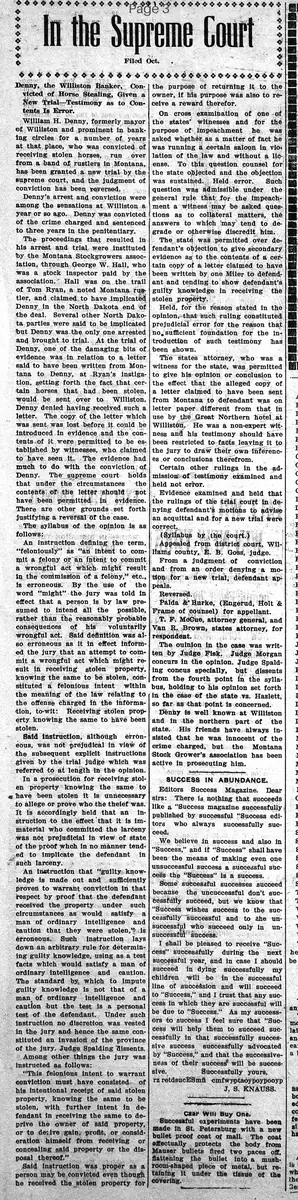
In the Supreme Court
Denny, the Williston Banker, Convicted of Horse Stealing, Given a New Trial—Testimony as to Contents Is Error.
William H. Denny, formerly mayor of Williston and prominent in banking circles for a number of years at that place, who was convicted of receiving stolen horses, run over from a band of rustlers in Montana, has been granted a new trial by the supreme court, and the judgment of conviction has been reversed.
Denny's arrest and conviction were among the sensations at Williston a year or so ago. Denny was convicted of the crime charged and sentenced to three years in the penitentiary.
The proceedings that resulted in his arrest and trial were instituted by the Montana Stockgrowers association, through George W. Hall, who was a stock inspector paid by the association. Hall was on the trail of Tom Ryan, a noted Montana rustler, and claimed to have implicated Denny in the North Dakota end of the deal. Several other North Dakota parties were said to be implicated but Denny was the only one arrested and brought to trial. At the trial of Denny, one of the damaging bits of evidence was in relation to a letter said to have been written from Montana to Denny, at Ryan's instigation, setting forth the fact that certain horses that had been stolen would be sent over to Williston.
Denny denied having received such a letter. The copy of the letter which was sent was lost before it could be introduced in evidence and the contents of it were permitted to be established by witnesses, who claimed to have seen it. The evidence had much to do with the conviction of Denny. The supreme court holds that under the circumstances the contents of the letter should not have been permitted in evidence.
There are other grounds set forth justifying a reversal of the case.
The syllabus of the opinion is as follows:
An instruction defining the term, "feloniously" as "an intent to commit a felony or an intent to commit a wrongful act which might result in the commission of a felony," etc., is erroneous. By the use of the word "might" the jury was told in effect that a person is by law presumed to intend all the possible, rather than the reasonably probable consequences of his voluntarily wrongful act. Said definition was also erroneous as it in effect informed the jury that an attempt to commit a wrongful act which might result in receiving stolen property knowing the same to be stolen, constituted a felonious intent within the meaning of the law relating to the offense charged in the information, to-wit: Receiving stolen property, knowing the same to have been stolen.
Said instruction, although erroneous, was not prejudicial in view of the subsequent explicit instructions given by the trial judge which was referred to at length in the opinion.
In a prosecution for receiving stolen property knowing the same to have been stolen it is unnecessary to allege or prove who the thief was. It is accordingly held that an instruction to the effect that it is immaterial who committed the larceny was not prejudicial in view of state of the proof which in no manner tended to implicate the defendant in such larceny.
An instruction that "guilty knowledge is made out and sufficiently proven to warrant conviction in that respect by proof that the defendant received the property under such circumstances, as would satisfy a man of ordinary intelligence and caution that they were stolen," is erroneous. Such instruction lays down an arbitrary rule for determining guilty knowledge, using as a test facts which would satisfy a man of ordinary intelligence and caution. The standard by which to impute guilty knowledge is not that of a man of ordinary intelligence and caution but the test is a personal test of the defendant. Under such instruction no discretion was vested in the jury and hence the same constituted an invasion of the province of the jury. Judge Spalding dissents.
Among other things the jury was instructed as follows:
"This felonious intent to warrant conviction must have consisted of his intentional receipt of said stolen property, knowing the same to be stolen, with further intent in defendant in receiving the same to deprive the owner of said property, or to derive gain, profit, or consideration himself from receiving or concealing said property or the disposal thereof."
Said instruction was proper as a person may be convicted even though he received the stolen property for the purpose of returning it to the owner, if his purpose was also to receive a reward therefor.
On cross examination of one of the state's witnesses and for the purpose of impeachment, he was asked whether as a matter of fact he was running a certain saloon in violation of the law and without a license. To this question counsel for the state objected and the objection was sustained. Held error. Such question was admissible under the general rule that for the impeachment a witness may be asked questions as to collateral matters, the answers to which may tend to degrade or otherwise discredit him.
The state was permitted over defendant's objection to give secondary evidence as to the contents of a certain copy of a letter claimed to have been written by one Miller to defendant and tending to show defendant's guilty knowledge in receiving the stolen property.
Held, for the reason stated in the opinion, that such ruling constituted prejudicial error for the reason that no sufficient foundation for the introduction of such testimony has been shown.
The state's attorney, who was a witness for the state, was permitted to give his opinion or conclusion to the effect that the alleged copy of a letter claimed to have been sent from Montana to defendant was on letter paper, different from that in use by the Great Northern hotel at Williston. He was a non-expert witness and his testimony should have been restricted to facts leaving it to the jury to draw their own inferences or conclusions therefrom.
Certain other rulings in the admission of testimony examined and held not error.
Evidence examined and held that the rulings of the trial court in denying defendant's motions to advise an acquittal and for a new trial were correct.
(Syllabus by the court.)
Appealed from district court, Williams county, E. B. Goss, judge.
From a judgment of conviction and from an order denying a motion for a new trial, defendant appeals.
Reversed.
Palda & Burke, (Engerud, Holt & Frame of counsel) for appellant.
T. F. McCue, attorney general, and Van R. Brown, state's attorney, for respondent.
The opinion in the case was written by Judge Fisk. Judge Morgan concurs in the opinion. Judge Spalding concurs specially, but dissents from the fourth point in the syllabus, holding to his opinion set forth in the case of the state vs. Hazlett, so far as that point is concerned.
Denny is well known at Williston and in the northern part of the state. His friends have always insisted that he was innocent of the crime charged, but the Montana Stock Grower's association has been active in prosecuting him.
Denny, the Williston Banker, Convicted of Horse Stealing, Given a New Trial—Testimony as to Contents Is Error.
William H. Denny, formerly mayor of Williston and prominent in banking circles for a number of years at that place, who was convicted of receiving stolen horses, run over from a band of rustlers in Montana, has been granted a new trial by the supreme court, and the judgment of conviction has been reversed.
Denny's arrest and conviction were among the sensations at Williston a year or so ago. Denny was convicted of the crime charged and sentenced to three years in the penitentiary.
The proceedings that resulted in his arrest and trial were instituted by the Montana Stockgrowers association, through George W. Hall, who was a stock inspector paid by the association. Hall was on the trail of Tom Ryan, a noted Montana rustler, and claimed to have implicated Denny in the North Dakota end of the deal. Several other North Dakota parties were said to be implicated but Denny was the only one arrested and brought to trial. At the trial of Denny, one of the damaging bits of evidence was in relation to a letter said to have been written from Montana to Denny, at Ryan's instigation, setting forth the fact that certain horses that had been stolen would be sent over to Williston.
Denny denied having received such a letter. The copy of the letter which was sent was lost before it could be introduced in evidence and the contents of it were permitted to be established by witnesses, who claimed to have seen it. The evidence had much to do with the conviction of Denny. The supreme court holds that under the circumstances the contents of the letter should not have been permitted in evidence.
There are other grounds set forth justifying a reversal of the case.
The syllabus of the opinion is as follows:
An instruction defining the term, "feloniously" as "an intent to commit a felony or an intent to commit a wrongful act which might result in the commission of a felony," etc., is erroneous. By the use of the word "might" the jury was told in effect that a person is by law presumed to intend all the possible, rather than the reasonably probable consequences of his voluntarily wrongful act. Said definition was also erroneous as it in effect informed the jury that an attempt to commit a wrongful act which might result in receiving stolen property knowing the same to be stolen, constituted a felonious intent within the meaning of the law relating to the offense charged in the information, to-wit: Receiving stolen property, knowing the same to have been stolen.
Said instruction, although erroneous, was not prejudicial in view of the subsequent explicit instructions given by the trial judge which was referred to at length in the opinion.
In a prosecution for receiving stolen property knowing the same to have been stolen it is unnecessary to allege or prove who the thief was. It is accordingly held that an instruction to the effect that it is immaterial who committed the larceny was not prejudicial in view of state of the proof which in no manner tended to implicate the defendant in such larceny.
An instruction that "guilty knowledge is made out and sufficiently proven to warrant conviction in that respect by proof that the defendant received the property under such circumstances, as would satisfy a man of ordinary intelligence and caution that they were stolen," is erroneous. Such instruction lays down an arbitrary rule for determining guilty knowledge, using as a test facts which would satisfy a man of ordinary intelligence and caution. The standard by which to impute guilty knowledge is not that of a man of ordinary intelligence and caution but the test is a personal test of the defendant. Under such instruction no discretion was vested in the jury and hence the same constituted an invasion of the province of the jury. Judge Spalding dissents.
Among other things the jury was instructed as follows:
"This felonious intent to warrant conviction must have consisted of his intentional receipt of said stolen property, knowing the same to be stolen, with further intent in defendant in receiving the same to deprive the owner of said property, or to derive gain, profit, or consideration himself from receiving or concealing said property or the disposal thereof."
Said instruction was proper as a person may be convicted even though he received the stolen property for the purpose of returning it to the owner, if his purpose was also to receive a reward therefor.
On cross examination of one of the state's witnesses and for the purpose of impeachment, he was asked whether as a matter of fact he was running a certain saloon in violation of the law and without a license. To this question counsel for the state objected and the objection was sustained. Held error. Such question was admissible under the general rule that for the impeachment a witness may be asked questions as to collateral matters, the answers to which may tend to degrade or otherwise discredit him.
The state was permitted over defendant's objection to give secondary evidence as to the contents of a certain copy of a letter claimed to have been written by one Miller to defendant and tending to show defendant's guilty knowledge in receiving the stolen property.
Held, for the reason stated in the opinion, that such ruling constituted prejudicial error for the reason that no sufficient foundation for the introduction of such testimony has been shown.
The state's attorney, who was a witness for the state, was permitted to give his opinion or conclusion to the effect that the alleged copy of a letter claimed to have been sent from Montana to defendant was on letter paper, different from that in use by the Great Northern hotel at Williston. He was a non-expert witness and his testimony should have been restricted to facts leaving it to the jury to draw their own inferences or conclusions therefrom.
Certain other rulings in the admission of testimony examined and held not error.
Evidence examined and held that the rulings of the trial court in denying defendant's motions to advise an acquittal and for a new trial were correct.
(Syllabus by the court.)
Appealed from district court, Williams county, E. B. Goss, judge.
From a judgment of conviction and from an order denying a motion for a new trial, defendant appeals.
Reversed.
Palda & Burke, (Engerud, Holt & Frame of counsel) for appellant.
T. F. McCue, attorney general, and Van R. Brown, state's attorney, for respondent.
The opinion in the case was written by Judge Fisk. Judge Morgan concurs in the opinion. Judge Spalding concurs specially, but dissents from the fourth point in the syllabus, holding to his opinion set forth in the case of the state vs. Hazlett, so far as that point is concerned.
Denny is well known at Williston and in the northern part of the state. His friends have always insisted that he was innocent of the crime charged, but the Montana Stock Grower's association has been active in prosecuting him.
What sub-type of article is it?
Crime Story
Historical Event
What themes does it cover?
Crime Punishment
Justice
Fortune Reversal
What keywords are associated?
Horse Stealing
Conviction Reversal
Supreme Court
Stolen Property
Jury Instructions
Evidentiary Error
Montana Rustlers
Williston Banker
What entities or persons were involved?
William H. Denny
Tom Ryan
George W. Hall
Judge Fisk
Judge Morgan
Judge Spalding
Where did it happen?
Williston, North Dakota; Montana
Story Details
Key Persons
William H. Denny
Tom Ryan
George W. Hall
Judge Fisk
Judge Morgan
Judge Spalding
Location
Williston, North Dakota; Montana
Event Date
A Year Or So Ago
Story Details
William H. Denny convicted of receiving stolen horses from Montana rustlers, sentenced to three years; Supreme Court reverses conviction due to errors in jury instructions on felonious intent and guilty knowledge, and improper admission of secondary evidence on a lost letter, granting new trial.