Thank you for visiting SNEWPapers!
Sign up free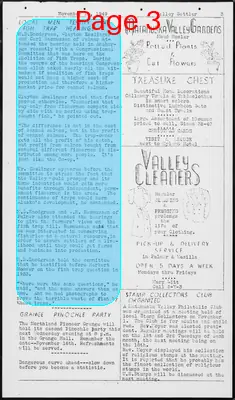
The Valley Settler
Palmer, Alaska
What is this article about?
Local men from Palmer—M.D. Snodgrass, Clayton Esslinger, and Carl Rasmussen—testified before a Congressional Committee in Anchorage on abolishing fish traps. They argued against traps, citing benefits to local fishermen, economy, and Alaska's development, and referenced past waste issues from 1923.
Clipping
OCR Quality
Full Text
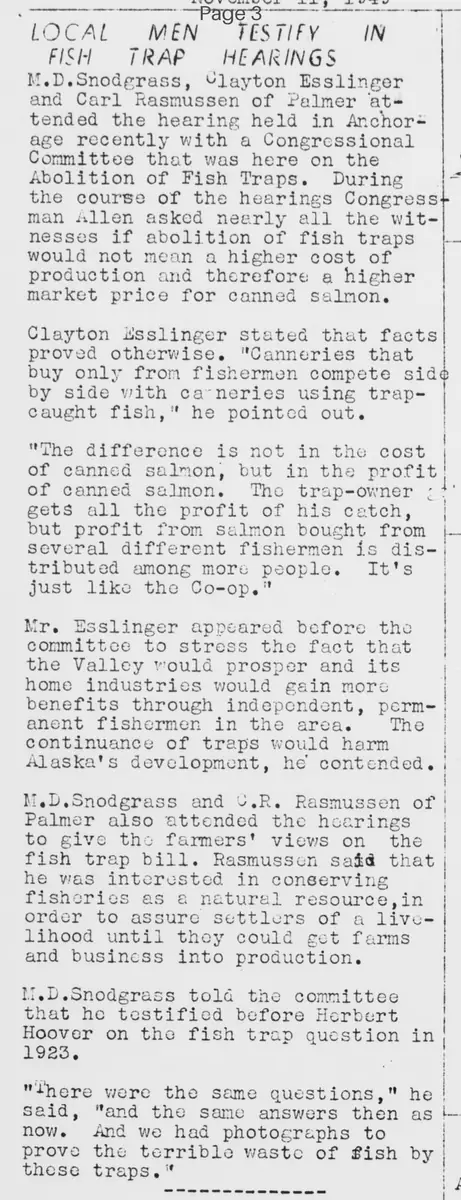
M.D. Snodgrass, Clayton Esslinger and Carl Rasmussen of Palmer attended the hearing held in Anchorage recently with a Congressional Committee that was here on the Abolition of Fish Traps. During the course of the hearings Congressman Allen asked nearly all the witnesses if abolition of fish traps would not mean a higher cost of production and therefore a higher market price for canned salmon. Clayton Esslinger stated that facts proved otherwise. "Canneries that buy only from fishermen compete side by side with canneries using trap-caught fish," he pointed out. "The difference is not in the cost of canned salmon, but in the profit of canned salmon. The trap-owner gets all the profit of his catch, but profit from salmon bought from several different fishermen is distributed among more people. It's just like the Co-op."
Mr. Esslinger appeared before the committee to stress the fact that the Valley would prosper and its home industries would gain more benefits through independent, permanent fishermen in the area. The continuance of traps would harm Alaska's development, he contended.
M.D. Snodgrass and C.R. Rasmussen of Palmer also attended the hearings to give the farmers' views on the fish trap bill. Rasmussen said that he was interested in conserving fisheries as a natural resource, in order to assure settlers of a livelihood until they could get farms and business into production.
M.D. Snodgrass told the committee that he testified before Herbert Hoover on the fish trap question in 1923. "There were the same questions," he said, "and the same answers then as now. And we had photographs to prove the terrible waste of fish by these traps."
What sub-type of article is it?
What keywords are associated?
What entities or persons were involved?
Where did it happen?
Domestic News Details
Primary Location
Anchorage
Event Date
Recently
Key Persons
Event Details
M.D. Snodgrass, Clayton Esslinger, and Carl Rasmussen of Palmer attended a hearing in Anchorage before a Congressional Committee on the abolition of fish traps. Esslinger argued that abolishing traps would distribute profits more widely among fishermen, benefiting the Valley's industries and Alaska's development. Snodgrass and Rasmussen presented farmers' views on conserving fisheries for settlers' livelihoods. Snodgrass referenced testifying to Herbert Hoover in 1923 on the same issue, with evidence of fish waste by traps.