Thank you for visiting SNEWPapers!
Sign up free
Editorial
February 21, 1866
The Daily Dispatch
Richmond, Virginia
What is this article about?
The editorial analyzes the ambiguous state constitutional provision for nominating judges by the governor, discussing two possible interpretations and the need for good faith between executive and legislative branches to prevent manipulation.
Clipping
OCR Quality
98%
Excellent
Full Text
Nomination of Judges.
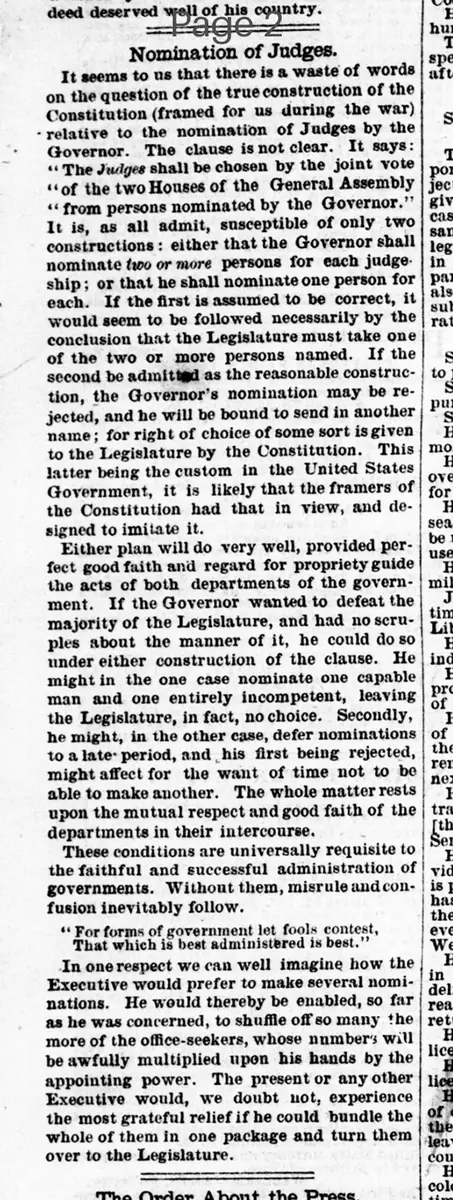
It seems to us that there is a waste of words on the question of the true construction of the Constitution (framed for us during the war) relative to the nomination of Judges by the Governor. The clause is not clear. It says: "The Judges shall be chosen by the joint vote of the two Houses of the General Assembly from persons nominated by the Governor." It is, as all admit, susceptible of only two constructions: either that the Governor shall nominate two or more persons for each judgeship; or that he shall nominate one person for each. If the first is assumed to be correct, it would seem to be followed necessarily by the conclusion that the Legislature must take one of the two or more persons named. If the second be admitted as the reasonable construction, the Governor's nomination may be rejected, and he will be bound to send in another name; for right of choice of some sort is given to the Legislature by the Constitution. This latter being the custom in the United States Government, it is likely that the framers of the Constitution had that in view, and designed to imitate it. Either plan will do very well, provided perfect good faith and regard for propriety guide the acts of both departments of the government. If the Governor wanted to defeat the majority of the Legislature, and had no scruples about the manner of it, he could do so under either construction of the clause. He might in the one case nominate one capable man and one entirely incompetent, leaving the Legislature, in fact, no choice. Secondly, he might, in the other case, defer nominations to a late period, and his first being rejected, might affect for the want of time not to be able to make another. The whole matter rests upon the mutual respect and good faith of the departments in their intercourse. These conditions are universally requisite to the faithful and successful administration of governments. Without them, misrule and confusion inevitably follow.
"For forms of government let fools contest,
That which is best administered is best."
In one respect we can well imagine how the Executive would prefer to make several nominations. He would thereby be enabled, so far as he was concerned, to shuffle off so many the more of the office-seekers, whose numbers will be awfully multiplied upon his hands by the appointing power. The present or any other Executive would, we doubt not, experience the most grateful relief if he could bundle the whole of them in one package and turn them over to the Legislature.
It seems to us that there is a waste of words on the question of the true construction of the Constitution (framed for us during the war) relative to the nomination of Judges by the Governor. The clause is not clear. It says: "The Judges shall be chosen by the joint vote of the two Houses of the General Assembly from persons nominated by the Governor." It is, as all admit, susceptible of only two constructions: either that the Governor shall nominate two or more persons for each judgeship; or that he shall nominate one person for each. If the first is assumed to be correct, it would seem to be followed necessarily by the conclusion that the Legislature must take one of the two or more persons named. If the second be admitted as the reasonable construction, the Governor's nomination may be rejected, and he will be bound to send in another name; for right of choice of some sort is given to the Legislature by the Constitution. This latter being the custom in the United States Government, it is likely that the framers of the Constitution had that in view, and designed to imitate it. Either plan will do very well, provided perfect good faith and regard for propriety guide the acts of both departments of the government. If the Governor wanted to defeat the majority of the Legislature, and had no scruples about the manner of it, he could do so under either construction of the clause. He might in the one case nominate one capable man and one entirely incompetent, leaving the Legislature, in fact, no choice. Secondly, he might, in the other case, defer nominations to a late period, and his first being rejected, might affect for the want of time not to be able to make another. The whole matter rests upon the mutual respect and good faith of the departments in their intercourse. These conditions are universally requisite to the faithful and successful administration of governments. Without them, misrule and confusion inevitably follow.
"For forms of government let fools contest,
That which is best administered is best."
In one respect we can well imagine how the Executive would prefer to make several nominations. He would thereby be enabled, so far as he was concerned, to shuffle off so many the more of the office-seekers, whose numbers will be awfully multiplied upon his hands by the appointing power. The present or any other Executive would, we doubt not, experience the most grateful relief if he could bundle the whole of them in one package and turn them over to the Legislature.
What sub-type of article is it?
Constitutional
Legal Reform
What keywords are associated?
Judge Nomination
Constitution Interpretation
Governor Power
Legislative Choice
Good Faith Government
What entities or persons were involved?
Governor
Legislature
General Assembly
Framers Of The Constitution
Editorial Details
Primary Topic
Interpretation Of Constitutional Clause On Governor's Nomination Of Judges
Stance / Tone
Neutral Analysis Emphasizing Mutual Respect And Good Faith
Key Figures
Governor
Legislature
General Assembly
Framers Of The Constitution
Key Arguments
The Constitutional Clause On Judge Nomination Is Ambiguous And Susceptible To Two Constructions: Nominating Multiple Persons Or One Per Judgeship.
Under Multiple Nominations, The Legislature Must Choose One.
Under Single Nomination, The Legislature Can Reject And Require Another.
The Framers Likely Intended To Imitate The U.S. Government Custom Of Single Nominations.
Good Faith And Mutual Respect Between Executive And Legislative Branches Are Essential For Either Interpretation.
Without Good Faith, The Governor Could Manipulate The Process To Defeat The Legislature.
The Executive Might Prefer Multiple Nominations To Offload Office Seekers To The Legislature.