Thank you for visiting SNEWPapers!
Sign up free
The Virginia Gazette
Richmond, Williamsburg, Richmond County, Virginia
What is this article about?
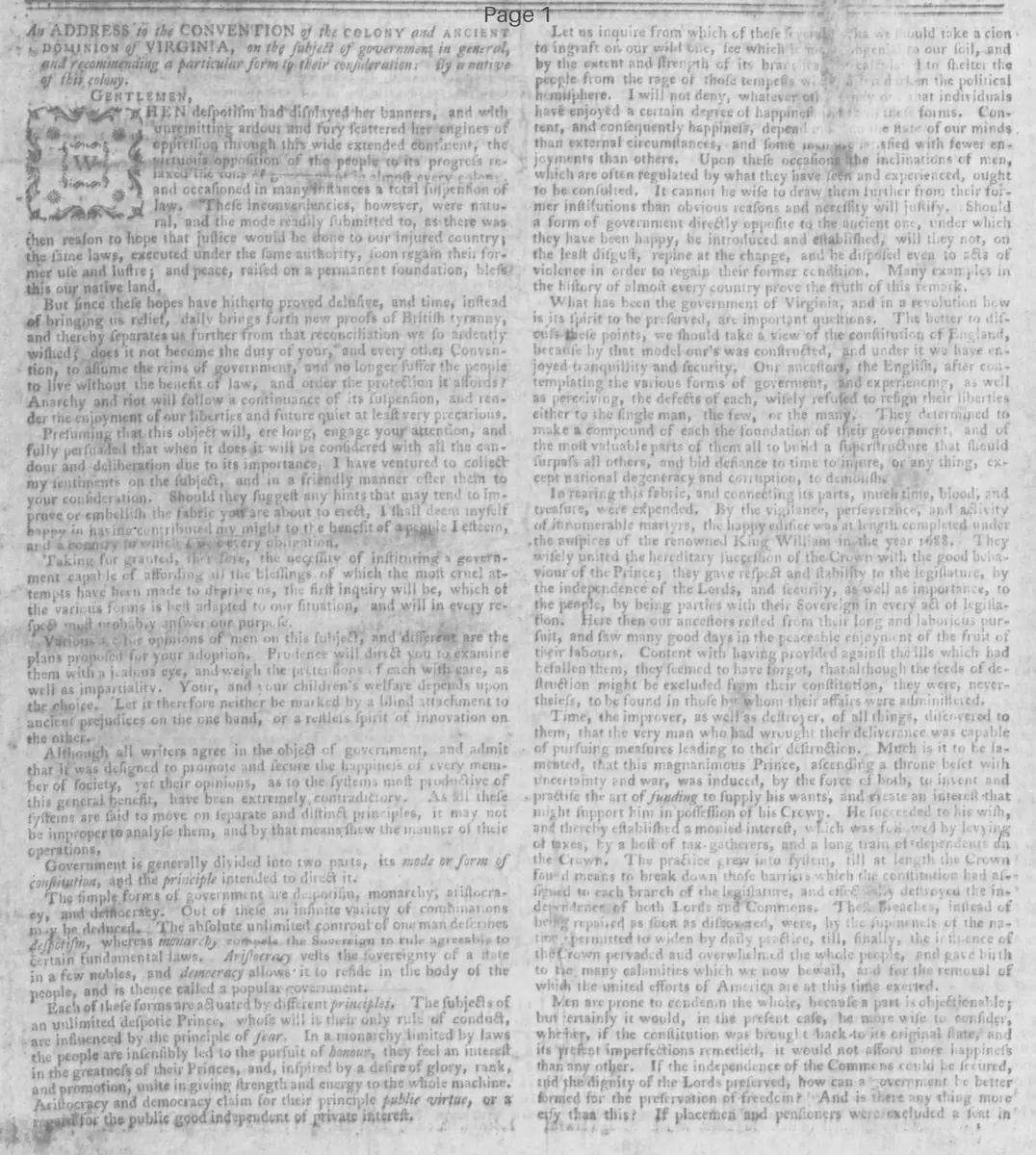
An anonymous Virginian addresses the colony's convention, urging adoption of a mixed government like England's original constitution to replace suspended laws amid British oppression, critiquing pure democracy as impractical and unstable.
Merged-components note: This is a single editorial continued across pages 1 and 2, as indicated by the text flow and the note '[The remainder in our next.]'.
Clippings
1 of 2
OCR Quality
Full Text
GENTLEMEN,
When despotism had displayed her banners, and with unremitting ardour and fury scattered her engines of oppression through this wide extended continent, the virtuous opposition of the people to its progress relaxed the tone in almost every column, and occasioned in many instances a total suspension of law. These inconveniences, however, were natural, and the mode readily submitted to, as there was then reason to hope that justice would be done to our injured country; the same laws, executed under the same authority, soon regain their former use and lustre; and peace, raised on a permanent foundation, bless this our native land.
But since these hopes have hitherto proved delusive, and time, instead of bringing us relief, daily brings forth new proofs of British tyranny, and thereby separates us further from that reconciliation we so ardently wished; does it not become the duty of your, and every other Convention, to assume the reins of government, and no longer suffer the people to live without the benefit of law, and order the protection it affords? Anarchy and riot will follow a continuance of its suspension, and render the enjoyment of our liberties and future quiet at least very precarious.
Presuming that this object will, ere long, engage your attention, and fully persuaded that when it does it will be considered with all the candour and deliberation due to its importance, I have ventured to collect my sentiments on the subject, and in a friendly manner offer them to your consideration. Should they suggest any hints that may tend to improve or embellish the fabric you are about to erect, I shall deem myself happy in having contributed my mite to the benefit of a people I esteem, and a country to which every obligation.
Taking for granted, this once, the necessity of instituting a government capable of affording us the blessings of which the most cruel attempts have been made to deprive us, the first inquiry will be, which of the various forms is best adapted to our situation, and will in every respect most probably answer our purpose. Various are the opinions of men on this subject, and different are the plans proposed for your adoption. Prudence will direct you to examine them with a jealous eye, and weigh the pretensions of each with care, as well as impartiality. Your, and your children's welfare depends upon the choice. Let it therefore neither be marked by a blind attachment to ancient prejudices on the one hand, or a restless spirit of innovation on the other.
Although all writers agree in the object of government, and admit that it was designed to promote and secure the happiness of every member of society, yet their opinions, as to the systems most productive of this general benefit, have been extremely contradictory. As all these systems are said to move on separate and distinct principles, it may not be improper to analyse them, and by that means shew the manner of their operations.
Government is generally divided into two parts, its mode or form of constitution, and the principle intended to direct it.
The simple forms of government are despotism, monarchy, aristocracy, and democracy. Out of these an infinite variety of combinations may be deduced. The absolute unlimited controul of one man describes despotism, whereas monarchy compels the Sovereign to rule agreeable to certain fundamental laws. Aristocracy vests the sovereignty of a state in a few nobles, and democracy allows it to reside in the body of the people, and is thence called a popular government.
Each of these forms are actuated by different principles. The subjects of despotism are influenced by the principle of fear. In a monarchy limited by laws the people are insensibly led to the pursuit of honour, they feel an interest in the greatness of their Princes, and, inspired by a desire of glory, rank, and promotion, unite in giving strength and energy to the whole machine. Aristocracy and democracy claim for their principle public virtue, or a regard for the public good independent of private interest.
Let us inquire from which of these we should take a scion to ingraft on our wild one, see which will be seen to our soil, and by the extent and strength of its branches promise to shelter the people from the rage of those tempests which, when the political hemisphere.
I will not deny, whatever of individuals have enjoyed a certain degree of happiness under these forms. Content, and consequently happiness, depend more on the state of our minds than external circumstances, and some men enjoyed with fewer enjoyments than others.
Upon these occasions the inclinations of men, which are often regulated by what they have seen and experienced, ought to be consulted.
It cannot be wise to draw them further from their former institutions than obvious reasons and necessity will justify. Should a form of government directly opposite to the ancient one, under which they have been happy, be introduced and established, will they not, on the least disgust, repine at the change, and be disposed even to acts of violence in order to regain their former condition.
Many examples in the history of almost every country prove the truth of this remark.
What has been the government of Virginia, and in a revolution how is its spirit to be preserved, are important questions. The better to discuss these points, we should take a view of the constitution of England, because by that model ours was constructed, and under it we have enjoyed tranquillity and security. Our ancestors, the English, after contemplating the various forms of government, and experiencing, as well as perceiving, the defects of each, wisely refused to resign their liberties either to the single man, the few, or the many. They determined to make a compound of each the foundation of their government, and of the most valuable parts of them all to build a superstructure that should surpass all others, and bid defiance to time to injure, or any thing, except national degeneracy and corruption, to demolish.
In rearing this fabric, and connecting its parts, much time, blood, and treasure, were expended. By the vigilance, perseverance, and activity of innumerable martyrs, the happy edifice was at length completed under the auspices of the renowned King William in the year 1688. They wisely united the hereditary succession of the Crown with the good behaviour of the Prince; they gave respect and stability to the legislature, by the independence of the Lords, and security, as well as importance, to the people, by being parties with their Sovereign in every act of legislation. Here then our ancestors rested from their long and laborious pursuit, and saw many good days in the peaceable enjoyment of the fruit of their labours, Content with having provided against the ills which had befallen them, they seemed to have forgot, that although the seeds of destruction might be excluded from their constitution, they were, nevertheless, to be found in those by whom their affairs were administered.
Time, the improver, as well as destroyer, of all things, discovered to them, that the very man who had wrought their deliverance was capable of pursuing measures leading to their destruction. Much is it to be lamented, that this magnanimous Prince, ascending a throne beset with uncertainty and war, was induced, by the voice of both, to invent and practice the art of funding to supply his wants, and create an interest that might support him in possession of his Crown. He succeeded to his wish, and thereby established a monied interest, which was soon wed by levying of taxes, by a host of tax-gatherers, and a long train of dependents on the Crown.
The practice grew into system, till at length the Crown found means to break down those barriers which the constitution had affixed to each branch of the legislature, and cut by degrees the independence of both Lords and Commons. These breaches, instead of being repaired as soon as discovered, were, by the supineness of the nation permitted to widen by daily practice, till, finally, the influence of the Crown pervaded and overwhelmed the whole people, and gave birth to the many calamities which we now bewail, and for the removal of which the united efforts of America are at this time exerted.
Men are prone to condemn the whole, because a part is objectionable but certainly it would, in the present case, be more wise to consider, whether, if the constitution was brought back to its original state, and its present imperfections remedied, it would not afford more happiness than any other. If the independence of the Commons could be secured, and the dignity of the Lords preserved, how can a government be better formed for the preservation of freedom? And is there any thing more essential than this? If placemen and pensioners were excluded from sitting in L
either House, and elections triennial, what danger could be apprehended from prerogative? Have the best authority for asserting, that with these improvements, added to the suppression of boroughs, and giving the people an equal and adequate representation, England would have remained a land of liberty to the latest ages.
Judge of the principle of this constitution by the great effects it has produced. Their code of laws, the boast of Englishmen and of freedom; the rapid progress they have made in trade, in arts and sciences; the respect they command from their neighbours, then gaining the empire of the sea; are all powerful arguments of the wisdom of that constitution and government, which raised the people of that island to their late degree of greatness. But though I admire their perfections, I must mourn their faults; and though I would guard against, and cut off their oppression, yet would I retain all their wise maxims, and derive advantage from their mistakes and misfortunes. The testimony of the learned Montesquieu in favour of the English constitution is very respectable.
"There is (says he) one nation in the world that has for the direct end of its constitution political liberty." Again he says, "It is not my business to examine whether the English actually enjoy this liberty or not; sufficient it is for my purpose to observe, that it is established by their laws, and I inquire no further."
This constitution, and these laws, have also been those of Virginia, and let it be remembered, that under them she flourished and was happy. The same principles which led the English to greatness animates us. To that principle our laws, our customs, and our manners, are adapted, and it would be perverting all order to oblige us, by a novel government, to give up our laws, our customs, and our manners.
However necessary it may be to shake off the authority of arbitrary British dictators, we ought, nevertheless, to adopt and perfect that system, which England has suffered to be so grossly abused, and the experience of ages has taught us to venerate.
This, like almost every thing else, is perhaps liable to objections, and probably the difficulty of adopting a limited monarchy will be largely insisted on. Admit this objection to have weight, and that we cannot in every instance assimilate a government to that, yet no good reason can be assigned why the same principle, or spirit, may not in a great measure be preserved. But, honourable as this spirit is, we daily see it calumniated by advocates for popular governments, and rendered obnoxious to all whom their artifices can influence or delude. The systems recommended to the colonies seem to accord with the temper of the times, and are fraught with all the tumult and riot incident to simple democracy; systems which many think it their interest to support, and without doubt will be industriously propagated among you.
The best of these systems exist only in theory, and were never confirmed by the experience, even of those who recommend them. I flatter myself, therefore, that you will not quit a substance actually enjoyed, for a shadow or phantom, by which, instead of being benefited, many have been misled and perplexed.
Let us examine the principles they assign to their government, and try its merits by the unerring standard of truth. In a late pamphlet it is thus stated: The happiness of man, as well as his dignity, consists in virtue; if there be a form of government, then, whose principle is virtue, will not every sober man acknowledge it better calculated to promote the general happiness of society than any other form. Virtue is the principle of a republic, therefore a republic is the best form of government.
The author, with what design I know not, seems to have cautiously blended private with public virtue, as if for the purpose of confounding the two, and thereby recommending his plan under the amiable appearance of courting virtue. It is well known that private and public virtue are materially different. The happiness and dignity of man I admit consists in the practice of private virtues, and to this he is stimulated by the rewards promised to such conduct. In this he acts for himself, and with a view of promoting his own particular welfare. Public virtue, on the other hand, means a disinterested attachment to the public good, exclusive and independent of all private and selfish interest, and which, though sometimes possessed by a few individuals, never characterized the mass of the people in any state. And this is said to be the principle of democratical governments, and to influence every subject of it to pursue such measures as conduce to the prosperity of the whole. A man, therefore, to qualify himself for a member of such a community, must divest himself of all interested motives, and engage in no pursuits which do not ultimately redound to the benefit of society. He must not, through ambition, desire to be great, because it would destroy that equality on which the security of the government depends; nor ought he to be rich, lest he be tempted to indulge himself in those luxuries, which, though lawful, are not expedient, and might occasion envy and emulation.
Should a man deserve the esteem of his fellow citizens, and become popular, his growing influence must be neglected, if not banished, lest it disturb the equilibrium.
It is remarkable, that neither the justice of Aristides, or the bravery of Themistocles, could shield them from the darts of envy and jealousy; nor are modern times without examples of the same kind.
To this species of government every thing that looks like elegance and refinement is inimical, however necessary to the introduction of manufactures, and the cultivation of arts and sciences. Hence, in some ancient republics, owed those numberless sumptuary laws, which restrained men to plainness and similarity in dress and diet, and all the mischiefs which attend Agrarian laws, and unjust attempts to maintain their idol equality by an equal division of property.
Schemes like these may be practicable in countries of a sterile nature as to afford a scanty supply of the necessaries, and none of the conveniences, of life; but they can never meet with a favourable reception from people who inhabit a country to which Providence has been more bountiful. They will always claim a right of using and enjoying the fruits of their honest industry, unrestrained by any ideal principles of government, and will gather estates for themselves and children without regarding the whimsical impropriety of being richer than their neighbours.
These are rights which freemen will never consent to relinquish, and after fighting for deliverance from one species of tyranny, it would be unreasonable to expect they should tamely acquiesce under another.
The truth is, that men will not be poor from choice or compulsion, and these governments can exist only in countries where the people are so from necessity. In all others they have ceased almost as soon as erected, and in many instances been succeeded by despotism, and the arbitrary sway of some usurper, who had before perhaps gained the confidence of the people by eulogiums on liberty, and possessing no property of his own, by most disinterestedly opposing depredations on that of his neighbours.
The most considerable state in which the shadow of democracy exists (for it is far from being purely so) is that of the united provinces of Holland, &c. Their territories are confined within narrow limits, and the exports of their own produce very inconsiderable. Trade is the support of that people, and, however aid to be considerable, will not admit of luxury. With the greatest parsimony and industry, they, as a people, can but barely support themselves, although individuals among them may amass estates. I own they have exhibited to mankind an example of perseverance and magnanimity that appeared like a prodigy. By the profits of their trade they maintained large armies, and supported a navy equal to the first in their day of warfare; but their military strength, as well as the form of their government, have long since given way. Their navy has dwindled into a few ships of war, and their government into an aristocracy, as unhappy and despotic as the one of which we complain.
The state of Venice, once a republic, is now governed by one of the worst of despotisms. In short, I do not recollect a single instance of a nation who supported this form of government for any length of time, or with any degree of greatness; which convinces me, as it has many others, that the principle contended for is ideal, and a mere creature of a warm imagination.
[The remainder in our next.]
What sub-type of article is it?
What keywords are associated?
What entities or persons were involved?
Editorial Details
Primary Topic
Recommendation For A Mixed Constitutional Government Modeled On England's For Virginia
Stance / Tone
Advocacy For Preserving English Constitutional Principles Against Pure Democracy And British Tyranny
Key Figures
Key Arguments