Thank you for visiting SNEWPapers!
Sign up free
Domestic News
August 3, 1835
Lynchburg Virginian
Lynchburg, Virginia
What is this article about?
Article from Maine Farmer discusses debate on removing suckers from Indian corn, arguing they aid pollination and kernel fertilization, preventing incomplete ears. Urges farmers to observe and test.
Clipping
OCR Quality
98%
Excellent
Full Text
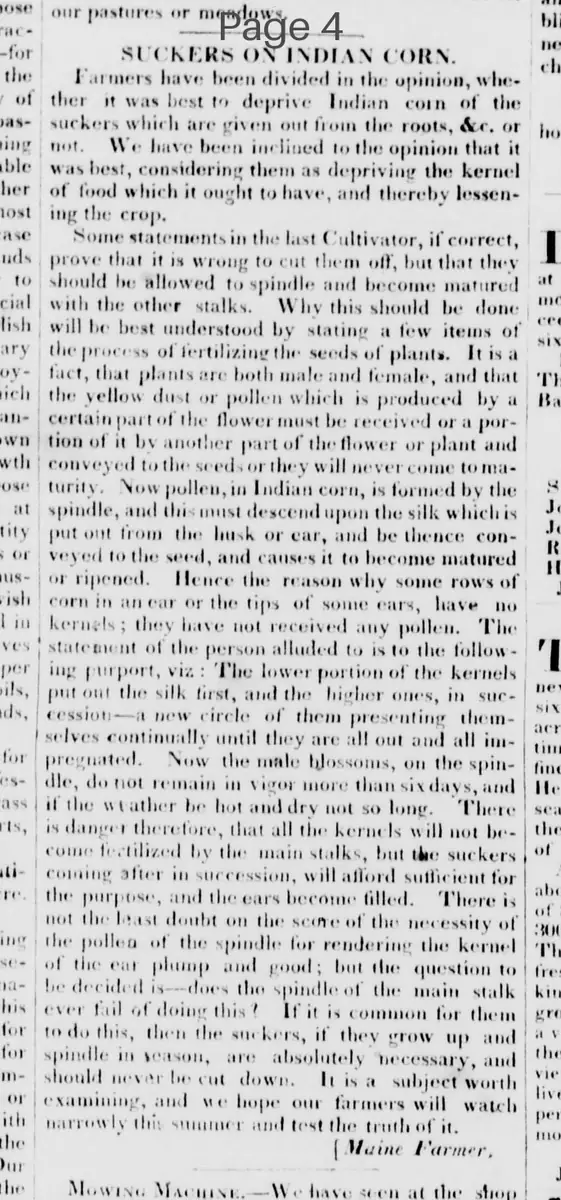
SUCKERS ON INDIAN CORN.
Farmers have been divided in the opinion, whether it was best to deprive Indian corn of the suckers which are given out from the roots, &c. or not. We have been inclined to the opinion that it was best, considering them as depriving the kernel of food which it ought to have, and thereby lessening the crop.
Some statements in the last Cultivator, if correct, prove that it is wrong to cut them off, but that they should be allowed to spindle and become matured with the other stalks. Why this should be done will be best understood by stating a few items of the process of fertilizing the seeds of plants. It is a fact, that plants are both male and female, and that the yellow dust or pollen which is produced by a certain part of the flower must be received or a portion of it by another part of the flower or plant and conveyed to the seed, or they will never come to maturity. Now pollen, in Indian corn, is formed by the spindle, and this must descend upon the silk which is put out from the husk or ear, and be thence conveyed to the seed, and causes it to become matured or ripened. Hence the reason why some rows of corn in an ear or the tips of some ears, have no kernels; they have not received any pollen. The statement of the person alluded to is to the following purport, viz: The lower portion of the kernels put out the silk first, and the higher ones, in succession--a new circle of them presenting themselves continually until they are all out and all impregnated. Now the male blossoms, on the spindle, do not remain in vigor more than six days, and if the weather be hot and dry not so long. There is danger therefore, that all the kernels will not become fertilized by the main stalks, but the suckers coming after in succession, will afford sufficient for the purpose, and the ears become filled. There is not the least doubt on the score of the necessity of the pollen of the spindle for rendering the kernel of the ear plump and good; but the question to be decided is--does the spindle of the main stalk ever fail of doing this? If it is common for them to do this, then the suckers, if they grow up and spindle in season, are absolutely necessary, and should never be cut down. It is a subject worth examining, and we hope our farmers will watch narrowly this summer and test the truth of it.
Maine Farmer.
Farmers have been divided in the opinion, whether it was best to deprive Indian corn of the suckers which are given out from the roots, &c. or not. We have been inclined to the opinion that it was best, considering them as depriving the kernel of food which it ought to have, and thereby lessening the crop.
Some statements in the last Cultivator, if correct, prove that it is wrong to cut them off, but that they should be allowed to spindle and become matured with the other stalks. Why this should be done will be best understood by stating a few items of the process of fertilizing the seeds of plants. It is a fact, that plants are both male and female, and that the yellow dust or pollen which is produced by a certain part of the flower must be received or a portion of it by another part of the flower or plant and conveyed to the seed, or they will never come to maturity. Now pollen, in Indian corn, is formed by the spindle, and this must descend upon the silk which is put out from the husk or ear, and be thence conveyed to the seed, and causes it to become matured or ripened. Hence the reason why some rows of corn in an ear or the tips of some ears, have no kernels; they have not received any pollen. The statement of the person alluded to is to the following purport, viz: The lower portion of the kernels put out the silk first, and the higher ones, in succession--a new circle of them presenting themselves continually until they are all out and all impregnated. Now the male blossoms, on the spindle, do not remain in vigor more than six days, and if the weather be hot and dry not so long. There is danger therefore, that all the kernels will not become fertilized by the main stalks, but the suckers coming after in succession, will afford sufficient for the purpose, and the ears become filled. There is not the least doubt on the score of the necessity of the pollen of the spindle for rendering the kernel of the ear plump and good; but the question to be decided is--does the spindle of the main stalk ever fail of doing this? If it is common for them to do this, then the suckers, if they grow up and spindle in season, are absolutely necessary, and should never be cut down. It is a subject worth examining, and we hope our farmers will watch narrowly this summer and test the truth of it.
Maine Farmer.
What sub-type of article is it?
Agriculture
What keywords are associated?
Indian Corn
Suckers
Pollination
Corn Farming
Agricultural Advice
Domestic News Details
Event Details
Farmers debate whether to remove suckers from Indian corn roots, as they may deprive kernels of food and reduce crop yield. The article argues against removal, explaining that plants are both male and female, with pollen from spindles fertilizing silk on ears. Suckers provide additional pollen if main stalks fail, ensuring full kernel maturation. Farmers urged to test this in summer.