Thank you for visiting SNEWPapers!
Sign up free
Literary
August 26, 1805
Norfolk Gazette And Publick Ledger
Norfolk, Virginia
What is this article about?
This political essay critiques pure democracy using ancient Athenian examples from Plutarch and Gillies, arguing that the US Constitution establishes a balanced republic, not a democracy, with powers vested in representatives rather than direct popular assemblies. It warns against democratic excesses that could lead to tyranny.
Clipping
OCR Quality
95%
Excellent
Full Text
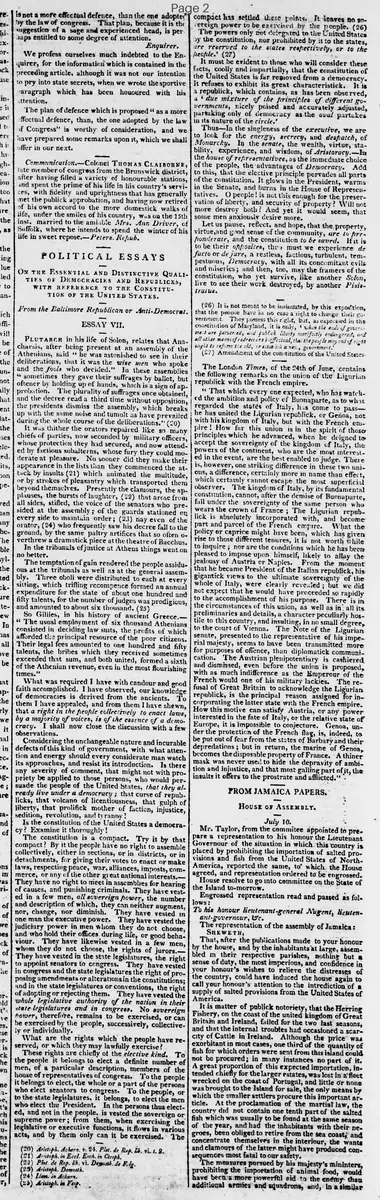
POLITICAL ESSAYS
On the Essential and Distinctive Qualities of Democracies and Republicks,
WITH REFERENCE TO THE CONSTITUTION of THE UNITED STATES.
From the Baltimore Republican or Anti-Democrat.
ESSAY VII.
Plutarch in his life of Solon, relates that Anacharsis, after being present at an assembly of the Athenians, said "he was astonished to see in their deliberations, that it was the wise men who spoke and the fools who decided." In these assemblies "sometimes they gave their suffrages by ballot, but oftener by holding up of hands, which is a sign of approbation. The plurality of suffrages once obtained, and the decree read a third time without opposition, the presidents dismiss the assembly, which breaks up with the same noise and tumult as have prevailed during the whole course of the deliberations." (20)
It was thither the orators repaired like so many chiefs of parties, now seconded by military officers whose protection they had secured, and now attended by factious subalterns, whose fury they could moderate at pleasure. No sooner did they make their appearance in the lists than they commenced the attack by insults (21) which animated the multitude, or by strokes of pleasantry which transported them beyond themselves. Presently the clamours, the applauses, the bursts of laughter, (22) that arose from all sides, stifled, the voice of the senators who presided at the assembly; of the guards stationed on every side to maintain order; (23) nay even of the orator, (24) who frequently saw his decree fall to the ground, by the same paltry artifices that so often overthrew a dramatick piece at the theatre of Bacchus.
In the tribunals of justice at Athens things went on no better.
The temptation of gain rendered the people assiduous at the tribunals as well as at the general assembly. Three oboli were distributed to each at every sitting, which trifling recompence formed an annual expenditure for the state of about one hundred and fifty talents, for the number of judges was prodigious, and amounted to about six thousand. (25)
So Gillies, in his history of ancient Greece.- "The usual employment of six thousand Athenians consisted in deciding law suits, the profits of which afforded the principal resource of the poor citizens. Their legal fees amounted to one hundred and fifty talents, the bribes which they received sometimes exceeded that sum, and both united, formed a sixth of the Athenian revenue, even in the most flourishing times."
What was required I have with candour and good faith accomplished. I have observed, our knowledge of democracies is derived from the ancients. To them I have appealed, and from them I have shewn, that a right in the people collectively to enact laws, by a majority of voices, is of the essence of a democracy. I shall now close the discussion with a few observations.
Considering the unchangeable nature and incurable defects of this kind of government, with what attention and energy should every considerate man watch its approaches, and resist its introduction. Is there any severity of comment, that might not with propriety be applied to those persons, who would persuade the people of the United States, that they already live under a democracy; that curse of republics, that volcano of licentiousness, that gulph of liberty, that prolifick mother of faction, injustice, sedition, revolution, and tyranny!
Is the constitution of the United States a democracy? Examine it thoroughly!
The constitution is a compact. Try it by that compact? By it the people have no right to assemble collectively, either in sections, or in districts, or in detachments, for giving their votes to enact or make laws, respecting peace, war, alliances, imposts, commerce, or any of the other great national interests.- They have no right to meet in assembles for hearing of causes, and punishing criminals. They have vested in a few men, all sovereign power, the number and description of which, they can neither augment, nor, change, nor diminish. They have vested in one man the executive power. They have vested the judiciary power in men whom they do not choose, and who hold their offices during life, or good behaviour. They have likewise vested in a few men, whom they do not choose, the rights of jurors.- They have vested in the state legislatures, the right to appoint senators to congress. They have vested in congress and the state legislatures the right of proposing amendments or alterations in the constitutions; and in the state legislatures or conventions, the right of adopting or rejecting them. They have vested the whole legislative authority of the nation in their state legislatures and in congress. No sovereign power, therefore, remains to be exercised, or can be exercised by the people, successively, collectively or individually.
What are the rights which the people have reserved, or which they may lawfully exercise?
These rights are chiefly of the elective kind. To the people it belongs to elect a definite number of men, of a particular description, members of the house of representatives of congress. To the people it belongs to elect, the whole or a part of the persons who elect senators to congress. To the people, or to the state legislatures, it belongs, to elect the men who elect the President. In the persons thus elected, and not in the people, is vested the sovereign or supreme power; from them, when exercising the legislative or executive functions, it flows in various acts, and by them only can it be exercised.
compact has settled these points. It leaves no sovereign power to be exercised by the people. (26)
The powers only not delegated to the United States by the constitution, nor prohibited by it to the states, are reserved to the states respectively, or to the people.' (27)
It must be evident to those who will consider these facts, coolly and impartially, that the constitution of the United States is far removed from a democracy. It refuses to exhibit its great characteristick. It is a republick, which contains, as has been observed, a 'due mixture of the principles of different governments, nicely poised and accurately adjusted, partaking only of democracy as the oval partakes in its nature of the circle.'
Thus--In the singleness of the executive, we are to look for the energy, secrecy, and dispatch, of Monarchy. In the senate, the wealth, virtue, stability, experience, and wisdom, of Aristocracy.-In the house of representatives, as the immediate choice of the people, the advantages of Democracy. Add to this, that the elective principle pervades all parts of the constitution. It glows in the President, warms in the Senate, and burns in the House of Representatives. O people! is not this enough for the preservation of liberty, and security of property? Will not more destroy both? And yet it would seem, that some men anxiously desire more.
Let us pause, reflect, and hope, that the property, virtue, and good sense of the community, are to preponderate, and the constitution to be saved. If it is to be their opposites, then must we experience de facto or de jure, a restless, factious, turbulent, tempestuous, Democracy, with all its concomitant evils and miseries; and then, too, may the framers of the constitution, who yet survive, like another Solon, live to see their work destroyed, by another Pisistratus.
(26) It is not meant to be insinuated, by this exposition, that the people have in no case a right to change their government. They possess this right, but, as expressed in the constitution of Maryland, it is only, 'when the ends of government are perverted, and publick liberty manifestly endangered and all other means of redress are ineffectual, that the people may and of right ought to reform the old, or establish a new, government.
(27) Amendment of the constitution of the United States-
On the Essential and Distinctive Qualities of Democracies and Republicks,
WITH REFERENCE TO THE CONSTITUTION of THE UNITED STATES.
From the Baltimore Republican or Anti-Democrat.
ESSAY VII.
Plutarch in his life of Solon, relates that Anacharsis, after being present at an assembly of the Athenians, said "he was astonished to see in their deliberations, that it was the wise men who spoke and the fools who decided." In these assemblies "sometimes they gave their suffrages by ballot, but oftener by holding up of hands, which is a sign of approbation. The plurality of suffrages once obtained, and the decree read a third time without opposition, the presidents dismiss the assembly, which breaks up with the same noise and tumult as have prevailed during the whole course of the deliberations." (20)
It was thither the orators repaired like so many chiefs of parties, now seconded by military officers whose protection they had secured, and now attended by factious subalterns, whose fury they could moderate at pleasure. No sooner did they make their appearance in the lists than they commenced the attack by insults (21) which animated the multitude, or by strokes of pleasantry which transported them beyond themselves. Presently the clamours, the applauses, the bursts of laughter, (22) that arose from all sides, stifled, the voice of the senators who presided at the assembly; of the guards stationed on every side to maintain order; (23) nay even of the orator, (24) who frequently saw his decree fall to the ground, by the same paltry artifices that so often overthrew a dramatick piece at the theatre of Bacchus.
In the tribunals of justice at Athens things went on no better.
The temptation of gain rendered the people assiduous at the tribunals as well as at the general assembly. Three oboli were distributed to each at every sitting, which trifling recompence formed an annual expenditure for the state of about one hundred and fifty talents, for the number of judges was prodigious, and amounted to about six thousand. (25)
So Gillies, in his history of ancient Greece.- "The usual employment of six thousand Athenians consisted in deciding law suits, the profits of which afforded the principal resource of the poor citizens. Their legal fees amounted to one hundred and fifty talents, the bribes which they received sometimes exceeded that sum, and both united, formed a sixth of the Athenian revenue, even in the most flourishing times."
What was required I have with candour and good faith accomplished. I have observed, our knowledge of democracies is derived from the ancients. To them I have appealed, and from them I have shewn, that a right in the people collectively to enact laws, by a majority of voices, is of the essence of a democracy. I shall now close the discussion with a few observations.
Considering the unchangeable nature and incurable defects of this kind of government, with what attention and energy should every considerate man watch its approaches, and resist its introduction. Is there any severity of comment, that might not with propriety be applied to those persons, who would persuade the people of the United States, that they already live under a democracy; that curse of republics, that volcano of licentiousness, that gulph of liberty, that prolifick mother of faction, injustice, sedition, revolution, and tyranny!
Is the constitution of the United States a democracy? Examine it thoroughly!
The constitution is a compact. Try it by that compact? By it the people have no right to assemble collectively, either in sections, or in districts, or in detachments, for giving their votes to enact or make laws, respecting peace, war, alliances, imposts, commerce, or any of the other great national interests.- They have no right to meet in assembles for hearing of causes, and punishing criminals. They have vested in a few men, all sovereign power, the number and description of which, they can neither augment, nor, change, nor diminish. They have vested in one man the executive power. They have vested the judiciary power in men whom they do not choose, and who hold their offices during life, or good behaviour. They have likewise vested in a few men, whom they do not choose, the rights of jurors.- They have vested in the state legislatures, the right to appoint senators to congress. They have vested in congress and the state legislatures the right of proposing amendments or alterations in the constitutions; and in the state legislatures or conventions, the right of adopting or rejecting them. They have vested the whole legislative authority of the nation in their state legislatures and in congress. No sovereign power, therefore, remains to be exercised, or can be exercised by the people, successively, collectively or individually.
What are the rights which the people have reserved, or which they may lawfully exercise?
These rights are chiefly of the elective kind. To the people it belongs to elect a definite number of men, of a particular description, members of the house of representatives of congress. To the people it belongs to elect, the whole or a part of the persons who elect senators to congress. To the people, or to the state legislatures, it belongs, to elect the men who elect the President. In the persons thus elected, and not in the people, is vested the sovereign or supreme power; from them, when exercising the legislative or executive functions, it flows in various acts, and by them only can it be exercised.
compact has settled these points. It leaves no sovereign power to be exercised by the people. (26)
The powers only not delegated to the United States by the constitution, nor prohibited by it to the states, are reserved to the states respectively, or to the people.' (27)
It must be evident to those who will consider these facts, coolly and impartially, that the constitution of the United States is far removed from a democracy. It refuses to exhibit its great characteristick. It is a republick, which contains, as has been observed, a 'due mixture of the principles of different governments, nicely poised and accurately adjusted, partaking only of democracy as the oval partakes in its nature of the circle.'
Thus--In the singleness of the executive, we are to look for the energy, secrecy, and dispatch, of Monarchy. In the senate, the wealth, virtue, stability, experience, and wisdom, of Aristocracy.-In the house of representatives, as the immediate choice of the people, the advantages of Democracy. Add to this, that the elective principle pervades all parts of the constitution. It glows in the President, warms in the Senate, and burns in the House of Representatives. O people! is not this enough for the preservation of liberty, and security of property? Will not more destroy both? And yet it would seem, that some men anxiously desire more.
Let us pause, reflect, and hope, that the property, virtue, and good sense of the community, are to preponderate, and the constitution to be saved. If it is to be their opposites, then must we experience de facto or de jure, a restless, factious, turbulent, tempestuous, Democracy, with all its concomitant evils and miseries; and then, too, may the framers of the constitution, who yet survive, like another Solon, live to see their work destroyed, by another Pisistratus.
(26) It is not meant to be insinuated, by this exposition, that the people have in no case a right to change their government. They possess this right, but, as expressed in the constitution of Maryland, it is only, 'when the ends of government are perverted, and publick liberty manifestly endangered and all other means of redress are ineffectual, that the people may and of right ought to reform the old, or establish a new, government.
(27) Amendment of the constitution of the United States-
What sub-type of article is it?
Essay
What themes does it cover?
Political
Liberty Freedom
What keywords are associated?
Democracy
Republic
Constitution
United States
Athens
Solon
Plutarch
Liberty
Government
What entities or persons were involved?
From The Baltimore Republican Or Anti Democrat.
Literary Details
Title
Essay Vii. On The Essential And Distinctive Qualities Of Democracies And Republicks, With Reference To The Constitution Of The United States.
Author
From The Baltimore Republican Or Anti Democrat.
Subject
With Reference To The Constitution Of The United States
Form / Style
Political Essay Critiquing Democracy
Key Lines
Plutarch In His Life Of Solon, Relates That Anacharsis, After Being Present At An Assembly Of The Athenians, Said "He Was Astonished To See In Their Deliberations, That It Was The Wise Men Who Spoke And The Fools Who Decided."
Is The Constitution Of The United States A Democracy? Examine It Thoroughly!
It Is A Republick, Which Contains, As Has Been Observed, A 'Due Mixture Of The Principles Of Different Governments, Nicely Poised And Accurately Adjusted, Partaking Only Of Democracy As The Oval Partakes In Its Nature Of The Circle.'