Thank you for visiting SNEWPapers!
Sign up free
Alexandria Daily Advertiser
Alexandria, Virginia
What is this article about?
Court opinion in Aaron Burr's treason trial rules that evidence of subsequent transactions is inadmissible without two witnesses proving the overt act of levying war. Witness Jacob Dunbaugh testifies on Burr's expedition activities, including arming, betrayal by Wilkinson, and preparations near Bayou Pierre.
Clipping
OCR Quality
Full Text
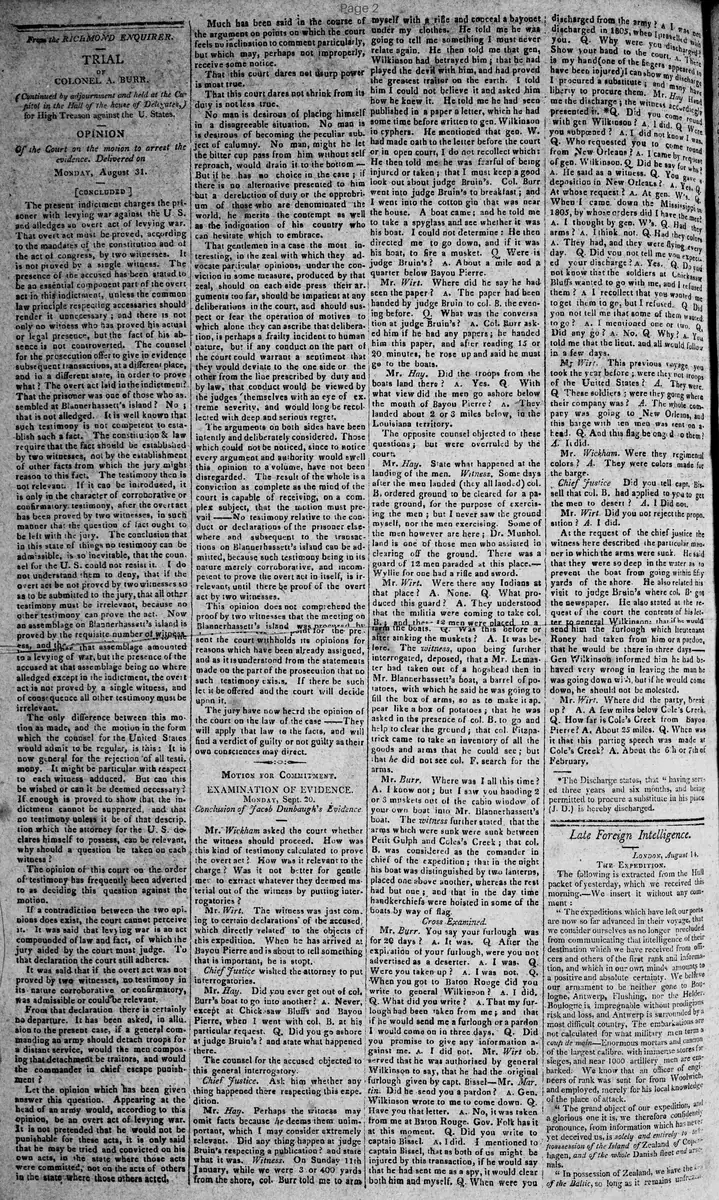
TRIAL
COLONEL A. BURR
Continued by adjournment and held at the Capitol in the Hall of the House of Delegates, for High Treason against the U. States.
OPINION
Of the Court on the motion to arrest the evidence. Delivered on
Monday, August 31.
CONCLUDED
The present indictment charges the prisoner with levying war against the U. S. and alleges no overt act of levying war.
That overt act must be proved, according to the mandates of the constitution and of the act of congress, by two witnesses. It is not proved by a single witness. The presence of the accused has been stated to be an essential component part of the overt act in this indictment, unless the common law principle respecting accessories should render it unnecessary; and there is not only no witness who has proved his actual or legal presence, but the fact of his absence is not controverted. The counsel for the prosecution offer to give in evidence subsequent transactions, at a different place, and in a different state, in order to prove what? The overt act laid in the indictment? That the prisoner was one of those who assembled at Blannerhassett's island? No; that is not alleged. It is well known that such testimony is not competent to establish such a fact. The constitution & law require that the fact should be established by two witnesses, not by the establishment of other facts from which the jury might reason to this fact. The testimony then is not relevant. If it can be introduced, it is only in the character of corroborative or confirmatory, testimony, after the overt act has been proved by two witnesses, in such manner that the question of fact ought to be left with the jury. The conclusion that in this state of things no testimony can be admissible, is so inevitable, that the counsel for the U. S. could not resist it. I do not understand them to deny, that if the overt act be not proved by two witnesses so as to be submitted to the jury, that all other testimony must be irrelevant, because no other testimony can prove the act. Now an assemblage on Blannerhassett's island is proved by the requisite number of witnesses, and the fact that assemblage amounted to a levying of war, but the presence of the accused at that assemblage being no where alleged except in the indictment, the overt act is not proved by a single witness, and of consequence all other testimony must be irrelevant.
The only difference between this motion as made, and the motion in the form which the counsel for the United States would admit to be regular, is this; It is now general for the rejection of all testimony. It might be particular with respect to each witness adduced. But can this be wished or can it be deemed necessary? If enough is proved to show that the indictment cannot be supported, and that no testimony unless it be of that description which the attorney for the U. S. declares himself to possess, can be relevant, why should a question be taken on each witness?
The opinion of this court on the order of testimony has frequently been adverted to as deciding this question against the motion.
If a contradiction between the two opinions does exist, the court cannot perceive it. It was said that levying war is an act compounded of law and fact, of which the jury aided by the court must judge. To that declaration the court still adheres.
It was said that if the overt act was not proved by two witnesses, no testimony in its nature corroborative or confirmatory, was admissible or could be relevant.
From that declaration there is certainly no departure. It has been asked, in allusion to the present case, if a general commanding an army should detach troops for a distant service, would the men composing that detachment be traitors, and would the commander in chief escape punishment?
Let the opinion which has been given answer this question. Appearing at the head of an army would, according to this opinion, be an overt act of levying war. It is not pretended that he would not be punishable for these acts, it is only said that he may be tried and convicted on his own acts, in the state where those acts were committed, not on the acts of others in the state where those others acted.
Much has been said in the course of the argument on points on which the court feels no inclination to comment particularly, but which may, perhaps not improperly, receive some notice.
That this court dares not usurp power is most true;
That this court dares not shrink from its duty is not less true.
No man is desirous of placing himself in a disagreeable situation, No man is desirous of becoming the peculiar subject of calumny. No man, might he let the bitter cup pass from him without self reproach, would drain it to the bottom.
But if he has no choice in the case; if there is no alternative presented to him but a dereliction of duty or the opprobrium of those who are denominated the world, he merits the contempt, as well as the indignation of his country who can hesitate which to embrace.
That gentlemen in a case the most interesting, in the zeal with which they advocate particular opinions, under the conviction in some measure, produced by that zeal, should on each side press their arguments too far, should be impatient at any deliberations in the court, and should suspect or fear the operation of motives to which alone they can ascribe that deliberation, is perhaps a frailty incident to human nature, but if any conduct on the part of the court could warrant a sentiment that they would deviate to the one side or the other from the line prescribed by duty and by law, that conduct would be viewed by the judges themselves with an eye of extreme severity, and would long be recollected with deep and serious regret.
The arguments on both sides have been intently and deliberately considered. Those which could not be noticed, since to notice every argument and authority would swell this opinion to a volume, have not been disregarded. The result of the whole is a conviction as complete as the mind of the court is capable of receiving, on a complex subject, that the motion must prevail. No testimony relative to the conduct or declarations of the prisoner elsewhere and subsequent to the transactions on Blannerhassett's island can be admitted, because such testimony being in its nature merely corroborative, and incompetent to prove the overt act in itself, is irrelevant, until there be proof of the overt act by two witnesses.
This opinion does not comprehend the proof by two witnesses that the meeting on Blannerhassett's island was proceeded by violence for the present the court withholds its opinion for reasons which have been already assigned, and as it is understood from the statements made on the part of the prosecution that no such testimony exists. If there be such let it be offered and the court will decide upon it.
The jury have now heard the opinion of the court on the law of the case. They will apply that law to the facts, and will find a verdict of guilty or not guilty as their own consciences may direct.
Motion for Commitment.
EXAMINATION OF EVIDENCE
Monday, Sept. 20.
Conclusion of Jacob Dunbaugh's Evidence
Mr. Wickham asked the court whether the witness should proceed. How was this kind of testimony calculated to prove the overt act? How was it relevant to the charge? Was it not better for gentlemen to extract whatever they deemed material out of the witness by putting interrogatories?
Mr. Wirt. The witness was just coming to certain declarations of the accused, which directly related to the objects of this expedition. When he has arrived at Bayou Pierre and is about to tell something that is important, he is stopt.
Chief Justice wished the attorney to put interrogatories.
Mr. Hay. Did you ever get out of col. Burr's boat to go into another? A. Never, except at Chickasaw Bluffs and Bayou Pierre, when I went with col. B. at his particular request. Q. Did you go ashore at judge Bruin's? and state what happened there.
The counsel for the accused objected to this general interrogatory.
Chief Justice. Ask him whether anything happened there respecting this expedition.
Mr. Hay. Perhaps the witness may omit facts because he deems them unimportant, which I may consider extremely relevant. Did anything happen at judge Bruin's respecting a publication? and state what it was. Witness. On Sunday 11th January, while we were 3 or 400 yards from the shore, col. Burr told me to arm myself with a rifle and conceal a bayonet under my clothes. He told me he was going to tell me something I must never relate again. He then told me that gen. Wilkinson had betrayed him; that he had played the devil with him, and had proved the greatest traitor on the earth. I told him I could not believe it and asked him how he knew it. He told me he had seen published in a paper a letter, which he had some time before written to gen. Wilkinson in cyphers. He mentioned that geo. W. had made oath to the letter before the court or in open court, I do not recollect which: He then told me he was fearful of being injured or taken; that I must keep a good look out about judge Bruin's. Col. Burr went into judge Bruin's to breakfast; and I went into the cotton gin that was near the house. A boat came: and he told me to take a spyglass and see whether it was his boat. I could not determine: He then directed me to go down, and if it was his boat, to fire a musket. Q. Where is judge Bruin's? A. About a mile and a quarter below Bayou Pierre.
Mr. Wirt. Where did he say he had seen the paper? A. The paper had been handed by judge Bruin to col. B. the evening before. Q. What was the conversation at judge Bruin's? A. Col. Burr asked him if he had any papers; he handed him this paper, and after reading 15 or 20 minutes, he rose up and said he must go to the boats.
Mr. Hay. Did the troops from the boats land there? A. Yes. Q. With what view did the men go ashore below the mouth of Bayou Pierre? A. They landed about 2 or 3 miles below, in the Louisiana territory.
The opposite counsel objected to these questions; but were overruled by the court.
7:
Mr. Hay. State what happened at the landing of the men. Witness. Some days after the men landed (they all landed) col. B. ordered ground to be cleared for a parade ground, for the purpose of exercising the men: but I never saw the ground myself, nor the men exercising. Some of the men however are here: Dr. Munholland is one of those men who assisted in clearing off the ground. There was a guard of 12 men paraded at this place. Wyllie for one had a rifle and sword.
Mr. Wirt. Were there any Indians at that place? A. None. Q. What produced this guard? A. They understood that the militia were coming to take col. B.: and these 12 men were placed to guard the boats. Q. Was this before or after sinking the muskets? A. It was before. The witness, upon being further interrogated, deposed, that Mr. Lemaster had taken out of a hogshead then in Mr. Blannerhassett's boat, a barrel of potatoes, with which he said he was going to fill the box of arms, so as to make it appear like a box of potatoes; that he was asked in the presence of col. B. to go and help to clear the ground; that col. Fitzpatrick came to take an inventory of all the goods and arms that he could see; but that he did not see col. F. search for the arms.
Mr. Burr. Where was I all this time? A. I know not; but I saw you handing 2 or 3 muskets out of the cabin window of your own boat into Mr. Blannerhassett's boat. The witness further stated, that the arms which were sunk were sunk between Petit Gulf and Cole's Creek: that col. B. was considered as the commander in chief of the expedition: that in the night his boat was distinguished by two lanterns, placed one above another, whereas the rest had but one; and that in the day time handkerchiefs were hoisted in some of the boats by way of flag.
Gross Examined
Mr. Burr. You say your furlough was for 20 days? A. It was. Q. After the expiration of your furlough, were you not advertised as a deserter? A. I was. Q. Were you taken-up? A. I was not. Q. When you got to Baton Rouge did you write to general Wilkinson? A. I did. Q. What did you write? A. That my furlough had been taken from me; and that if he would send me a furlough or a pardon I would come on in three days. Q. Did you promise to give any information against me? A. I did not. Mr. Wirt observed that he was authorised by general Wilkinson to say, that he had the original furlough given by capt. Bissel. Mr. Martin. Did he send you a pardon? A. Gen. Wilkinson wrote to me to come down. Q. Have you that letter? A. No, it was taken from me at Baton Rouge. Gov. Folk has it at this moment. Q. Did you write to captain Bissel? A. I did. I mentioned to captain Bissel, that as both of us might be injured by this transaction, if he would say that he had sent me as a spy, it would clear both him and myself. Q. When were you discharged from the army? A. I was not discharged in 1805, when I proceeded with you. Q. Were you? Show your hand to the court. This is my hand, one of appeared to have been injured, and no I procured a substitute; liberty to procure them. Mr. Hay handed me the discharge; the witness accordingly presented it. Did you come with gen Wilkinson? A. I did. Q. Were you subpoenaed? A. I did not know I was. Q. Who requested you to come round from New Orleans? A. I came by request of gen. Wilkinson. Q. Did he say for what? A. He said as a witness. Q. You gave a deposition in New Orleans? A. Yes. Q. At whose request? A. At gen. W's. Q. When I came down the Mississippi in 1805, by whose orders did I have the men? A. I thought by gen. W's. Q. Had they arms? A. I think not. Q. Had they colors? A. They had, and they were lying every day. Q. Did you not tell me you expected your discharge? A. Yes. Q. Do you not know that the soldiers at Chickasaw Bluffs wanted to go with me, and I refused them? A. I recollect that you wanted me to get them to go, but I refused. Q. Did you not tell me that some of them wanted to go? A. I mentioned one or two. Q. Did any go? A. No. Q. Why? A. You told me that the lieut. and all would follow in a few days.
Mr. Wirt. This previous voyage you took the year before; were they not troops of the United States? A. They were. Q. These soldiers: were they going where their company was? A. The whole company was going to New Orleans, and this barge with ten men was sent on ahead. Q. And this flag belonged to them? A. It did.
Mr. Wickham. Were they regimental colors? A. They were colors made for the barge.
Chief Justice. Did you tell capt. Bissel that col. B. had applied to you to get the men to desert? A. I did not.
Mr. Wirt. Did you not reject the proposition? A. I did.
At the request of the chief justice the witness here described the particular manner in which the arms were sunk. He said that they were so deep in the water as to prevent the boat from going within fifty yards of the shore. He also related his visit to judge Bruin's where col. B. got the newspaper. He also stated at the request of the court the contents of his letter to general Wilkinson: that if he would send him the furlough which lieutenant Roney had taken from him or a pardon, that he would be there in three days. Gen. Wilkinson informed him he had behaved very wrong in leaving the man he was going down with, but if he would come down, he should not be molested.
Mr. Wirt. Where did the party break up? A. A few miles below Cole's Creek. Q. How far is Cole's Creek from Bayou Pierre? A. About 25 miles. Q. When was it that this parting speech was made at Cole's Creek? A. About the 6th or 7th of February.
*The Discharge states, that "having served three years and six months, and being permitted to procure a substitute in his place (J. D.) is hereby discharged."
What sub-type of article is it?
What themes does it cover?
What keywords are associated?
What entities or persons were involved?
Where did it happen?
Story Details
Key Persons
Location
Capitol In The Hall Of The House Of Delegates
Event Date
Monday, August 31; Monday, Sept. 20
Story Details
The court rules that the overt act of levying war must be proved by two witnesses, rejecting subsequent evidence as irrelevant without it. Witness Jacob Dunbaugh testifies on Burr's expedition, including arming instructions, betrayal by Wilkinson, landing preparations, sinking arms, and his own military status.