Thank you for visiting SNEWPapers!
Sign up free
The Kenosha Telegraph
Kenosha, Kenosha County, Wisconsin
What is this article about?
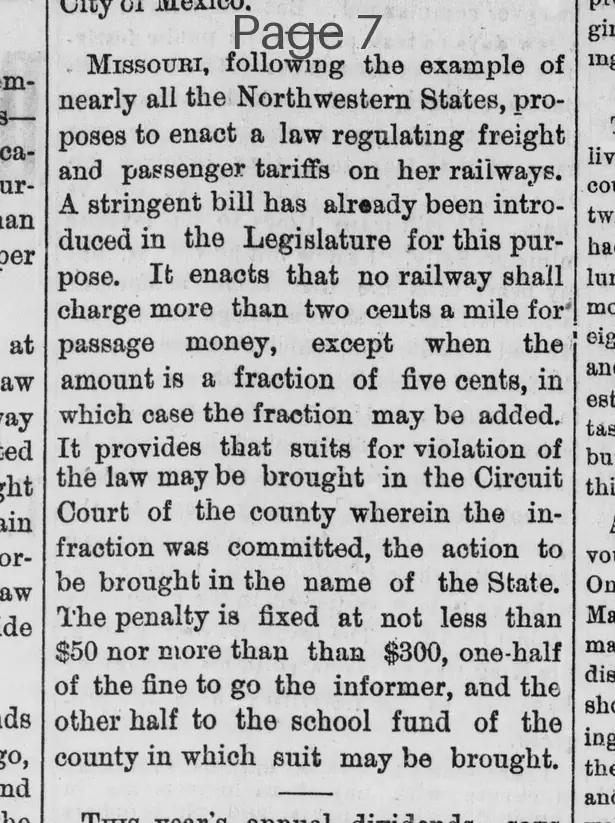
Missouri proposes a law to regulate railway freight and passenger tariffs, following Northwestern States. A bill introduced in the legislature limits charges to two cents per mile, with exceptions for fractions, and sets penalties of $50-$300 for violations, half to informer and half to county school fund. Suits in Circuit Court.
Clipping
OCR Quality
Full Text
What sub-type of article is it?
What keywords are associated?
Where did it happen?
Domestic News Details
Primary Location
Missouri
Outcome
penalty fixed at not less than $50 nor more than $300, one-half to informer, other half to county school fund.
Event Details
Following Northwestern States, Missouri proposes law regulating railway freight and passenger tariffs. Stringent bill introduced in Legislature: no railway charges more than two cents per mile for passage, except fractions of five cents may be added. Suits for violations in Circuit Court of county where infraction committed, in name of State.