Thank you for visiting SNEWPapers!
Sign up free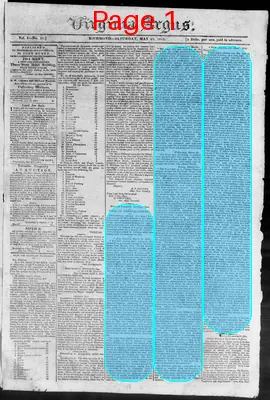
Story
May 20, 1815
Virginia Argus
Richmond, Virginia
What is this article about?
Detailed account of General Andrew Jackson's 1815 trial in New Orleans for opposing a habeas corpus writ during martial law, resulting in a $1000 fine despite public acclaim; includes proceedings, defenses, and Jackson's address to supporters.
Merged-components note: The letter continues the detailed account of General Jackson's trial.
Clipping
OCR Quality
95%
Excellent
Full Text
From the Louisville Correspondent.
TRIAL OF GENERAL JACKSON.
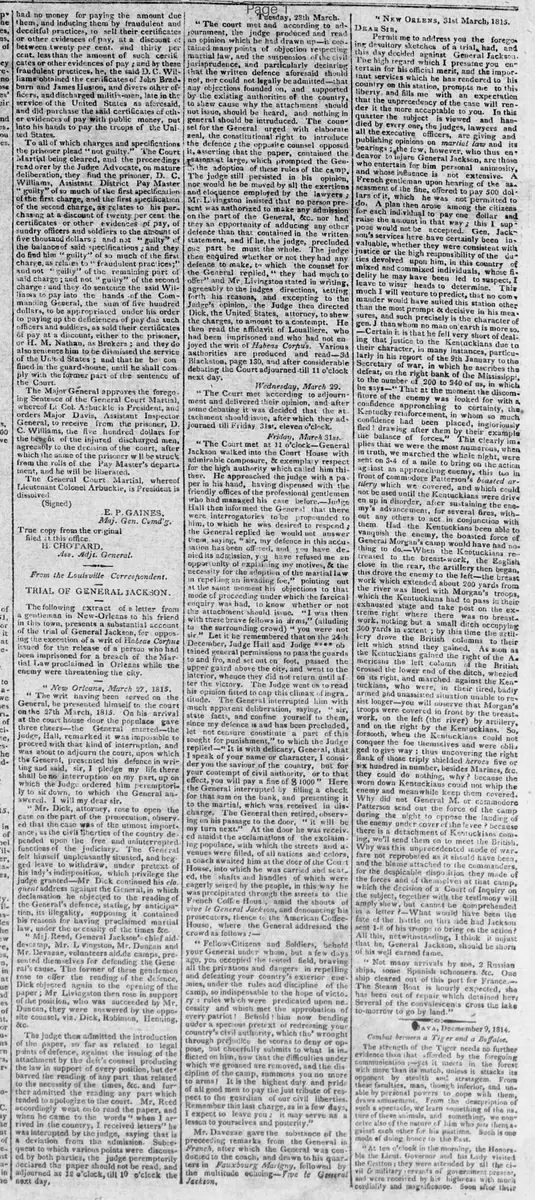
The following extract of a letter from a gentleman in New-Orleans to his friend in this town, presents a substantial account of the trial of General Jackson, for opposing the execution of a writ of Habeas Corpus issued for the release of a person who had been imprisoned for a breach of the Martial Law proclaimed in Orleans while the enemy were threatening the city.
"New Orleans, March 27, 1815.
"The writ having been served on the General, he presented himself to the court on the 27th March, 1815. On his arrival at the courthouse door the populace gave three cheers—the General entered the judge, Hall, remarked it was impossible to proceed with that kind of interruption, and was about to adjourn the court, upon which the General, presented his defence in writing and said, sir, I pledge my life there shall be no interruption on my part, upon which the Judge ordered him peremptorily to sit down, to which the General answered, I will, my dear sir.
"Mr. Dick, attorney, rose to open the Case on the part of the prosecution, observed that the case was of the utmost importance, as the civil liberties of the country depended upon the free and uninterrupted functions of the judiciary. The General felt himself unpleasantly situated, and begged leave to withdraw, under pretext of his lady's indisposition, which privilege the judge granted—Mr. Dick continued his eloquent address against the General, in which declamation he objected to the reading of the General's defence, stating, by anticipation, its illegality, supposing it contained his reasons for having proclaimed martial law, under the necessity of the times &c.
"Maj. Reid, General Jackson's chief aid de camp, Mr. L. Livingston, Mr. Duncan and Mr. Deveraux, volunteer aid de camps, presented themselves for defending the General's cause. The former of these gentlemen rose to offer the reading of the defence, Dick objected again to the opening of the paper; Mr. Livingston then rose in support of the position, who was succeeded by Mr. Duncan, they were answered by the opposite counsel, viz, Dick, Robinson, Henning, &c.
The judge then admitted the introduction of the paper, so far as related to legal points of defence, against the issuing of the attachment by the deft's counsel producing the law in support of every position, but debarred the reading of any part that related to the necessity of the times, &c. and further admitted the reading any part which tended to apologize to the court. Mr. Reid accordingly went on to read the paper, and when he came to the words "when I arrived in the country, I received letters" he was interrupted by the judge, saying that is a deviation from the admission. Subsequent to which various points were discussed by both parties, the judge peremptorily decided the paper should not be read, and adjourned at 12 o'clock, till 10 o'clock the next day.
Tuesday, 28th March.
"The court met and according to adjournments, the judge produced and read an opinion which he had drawn up it contained many points of objection respecting martial law, and the suspension of the civil jurisprudence, and particularly declaring that the written defence aforesaid should not, nor could not legally be admitted—that any objections founded on, and supported by the existing authorities of the country, to shew cause why the attachment should not issue, should be heard, and nothing in general should be introduced. The counsel for the General urged with elaborate zeal, the constitutional right to introduce the defence; the opposite counsel opposed it, asserting that the paper, contained the reasons at large, which prompted the Gen. the adoption of these rules of the camp. The judge still persisted in his opinion, nor would he be moved by all the exertions and eloquence employed by the lawyers; Mr. Livingston insisted that no person present was authorized to make any admission on the part of the General, &c. nor had they an opportunity of adducing any other defence than that contained in the written statement, and if he, the judge, precluded one part he must the whole. The judge then enquired whether or not they had any defence to make, to which the counsel for the General replied, "they had much to offer" and Mr. Livingston stated in writing, agreeably to the judges directions, setting forth his reasons, and excepting to the Judge's opinion, the Judge then directed Dick, the United States attorney, to shew the charges, to amount to a contempt. He then read the affidavit of Louallier, who had been imprisoned and who had not enjoyed the writ of Habeas Corpus. Various authorities are produced and read—3d Blackstone, page 130, and after considerable debating the Court adjourned till 11 o'clock next day.
Wednesday, March 29.
"The Court met according to adjournment and delivered their opinion, and after some debating it was decided that the attachment should issue, after which they adjourned till Friday 31st, eleven o'clock.
Friday, March 31st.
"The Court met at 11 o'clock—General Jackson walked into the Court House with admirable composure, & exemplary respect for the high authority which called him thither. He approached the judge with a paper in his hand, having dispensed with the friendly offices of the professional gentlemen who had managed his case before.—Judge Hall then informed the General that there were interrogatories to be propounded to him, to which he was desired to respond; the General replied he would not answer them, saying, "sir, my defence in this accusation has been offered, and you have denied its admission, you have refused me an opportunity of explaining my motives, & the necessity for the adoption of the martial law in repelling an invading foe." pointing out at the same moment his objections to that mode of proceeding under which the farcical enquiry was had, to know whether or not the attachment should issue. "I was then with these brave fellows in arms," (alluding to the surrounding crowd) "you were not sir." Let it be remembered that on the 24th December, Judge Hall and Judge **** obtained general permissions to pass the guards to and fro, and set out on foot, passed the upper guard above the city, and went to the interior, whence they did not return until after the victory. The Judge went on to read his opinion fitted to cap this climax of ingratitude. The General interrupted him with much apparent deliberation, saying, "sir, state facts, and confine yourself to them, since my defence is and has been precluded, let not censure constitute a part of this sought for punishment," to which the Judge replied—"It is with delicacy, General, that I speak of your name or character, I consider you the saviour of the country, but for your Contempt of civil authority, or to that effect, you will pay a fine of $1000" Here the General interrupted by filling a check for that sum on the bank, and presenting it to the marshal, which was received in discharge. The General then retired, observing on his passage to the door. "it will be my turn next." At the door he was received amidst the acclamations of the exclaiming populace, with which the streets and avenues were filled, of all nations and colors, a coach awaited him at the door of the Court House, into which he was carried and seated, the shafts and handles of which were eagerly seized by the people, in this way he was precipitated through the streets to the French Coffee House, amid the shouts of vive le General Jackson, and denouncing his prosecutors, thence to the American Coffee-House, where the General addressed the crowd as follows:-
"Fellow Citizens and Soldiers, behold your General under whom, but a few days ago, you occupied the tented field, braving all the privations and dangers in repelling and defeating your country's exterior enemies, under the rules and discipline of the camp, so indispensable to the hope of victory: rules which were predicated upon necessity and which met the approbation of every patriot! Behold! him now bending under a specious pretext of redressing your country's civil authority, which tho' wrought through prejudice he scorns to deny or oppose, but cheerfully submits to what is inflicted on him, now that the difficulties under which we groaned are removed, and the discipline of the camp, summons you no more to arms! It is the highest duty and pride of all good men to pay the just tribute of respect to the guardian of our civil liberties. Remember this last charge, as in a few days, I expect to leave you: it may serve as a lesson to yourselves and posterity."
Mr. Davezae gave the substance of the preceding remarks from the General in French, after which the General was conducted to the coach, and drawn to his quarters in Faubourg Marigny, followed by the multitude echoing—Vive le General Jackson.
"New Orleans, 31st March, 1815.
DEAR SIR,
Permit me to address you the foregoing desultory sketches of a trial had, and this day decided against General Jackson. The high regard which I presume you entertain for his official merit, and the important services which he has rendered to his country on this station, prompts me to this liberty, and fills me with an expectation that the unprecedency of the case will render it the more acceptable to you. In this quarter the subject is viewed and handled by every one, the judges, lawyers and all the executive officers, are giving and publishing opinions on martial law and its bearings; the few, however, who thus endeavor to injure General Jackson, are those who entertain for him personal animosity, and whose influence is not extensive. A French gentleman upon hearing of the assessment of the fine, offered to pay 500 dollars of it, which he was not permitted to do. A plan then arose among the citizens for each individual to pay one dollar and raise the amount in that way; this I suppose would not be accepted. Gen. Jackson's services here have certainly been invaluable, whether they were consistent with justice or the high responsibility of the duties devolved upon him, in this country of mixed and commixed individuals, whose fidelity he may have been led to suspect, I leave to wiser heads to determine. This much I will venture to predict, that no commander would have suited this station other than the most prompt & decisive in his measures, and such precisely is the character of gen. Jackson, than whom no man on earth is more so.
—Certain it is that he fell very short of dealing that justice to the Kentuckians due to their character, in many instances, particularly in his report of the 9th January to the Secretary of war, in which he ascribes the defeat, on the right bank of the Mississippi, to the number of 200 to 240 of us, in which he says—"That at the moment the discomfiture of the enemy was looked for with a confidence approaching to certainty, the Kentucky reinforcement, in whom so much confidence had been placed, ingloriously fled! drawing after them by their example the balance of forces." This clearly implies that we were the most numerous, when in truth, we marched the whole night, were sent on 3/4 of a mile to bring on the action against an approaching enemy, this too in front of commodore Patterson's boasted artillery which we covered, and which could not be used until the Kentuckians were driven up in disorder, after sustaining the enemy's advancement, for several fires, without any others to act in conjunction with them. Had the Kentuckians been able to vanquish the enemy, the boasted force of General Morgan's camp would have had nothing to do.—When the Kentuckians retreated to the breast-work, the English close in the rear, the artillery then began, this drove the enemy to the left—the breast work which extended about 200 yards from the river was lined with Morgan's troops, which the Kentuckians had to pass in their exhausted state and take post on the extreme right where there was no breast work, nothing but a small ditch occupying 300 yards in extent; by this time the artillery drove the British columns to their left which stand they gained, As soon as the Kentuckians gained the right of the Americans the left column of the British crossed the lower end of the ditch, wheeled on its right, and marched against the Kentuckians, who were, in their tired, badly armed and unassisted situation unable to resist longer—you will observe that Morgan's troops were covered in front by the breast-work, on the left (the river) by artillery, and on the right by the Kentuckians. So, forsooth, when the Kentuckians could not conquer the foe themselves and were obliged to give way: thus uncovering the right flank of those triply shielded heroes five or six hundred in number, besides Marines, &c. they could do nothing. why? because the worn down Kentuckians could not whip the enemy and meanwhile keep them covered. Why did not General M. or commodore Patterson send out the force of the camp during the night to oppose the landing of the enemy under cover of the levee? because there is a detachment of Kentuckians coming, we'll send them on to meet the British. Why was this unprecedented mode of warfare not reprobated as it should have been, and the blame attached to the commanders, for the despicable disposition they made of the forces and of themselves at that camp, which the decision of a Court of Inquiry on the subject, together with the testimony will amply shew, but cannot be comprehended in a letter—What would have been the fate of the battle on this side had Jackson sent 1/8 of his troop to bring on the action? All this, notwithstanding, I think it unjust that he, General Jackson, should be shorn of his well earned fame.
"Not many arrivals by sea, 2 Russian ships, some Spanish schooners, &c. One ship cleared out of this port for France. The Steam Boat is hourly expected, she has been out of repair which detained her Several of the Convalescents cross the lake to-morrow to go by land."
TRIAL OF GENERAL JACKSON.
The following extract of a letter from a gentleman in New-Orleans to his friend in this town, presents a substantial account of the trial of General Jackson, for opposing the execution of a writ of Habeas Corpus issued for the release of a person who had been imprisoned for a breach of the Martial Law proclaimed in Orleans while the enemy were threatening the city.
"New Orleans, March 27, 1815.
"The writ having been served on the General, he presented himself to the court on the 27th March, 1815. On his arrival at the courthouse door the populace gave three cheers—the General entered the judge, Hall, remarked it was impossible to proceed with that kind of interruption, and was about to adjourn the court, upon which the General, presented his defence in writing and said, sir, I pledge my life there shall be no interruption on my part, upon which the Judge ordered him peremptorily to sit down, to which the General answered, I will, my dear sir.
"Mr. Dick, attorney, rose to open the Case on the part of the prosecution, observed that the case was of the utmost importance, as the civil liberties of the country depended upon the free and uninterrupted functions of the judiciary. The General felt himself unpleasantly situated, and begged leave to withdraw, under pretext of his lady's indisposition, which privilege the judge granted—Mr. Dick continued his eloquent address against the General, in which declamation he objected to the reading of the General's defence, stating, by anticipation, its illegality, supposing it contained his reasons for having proclaimed martial law, under the necessity of the times &c.
"Maj. Reid, General Jackson's chief aid de camp, Mr. L. Livingston, Mr. Duncan and Mr. Deveraux, volunteer aid de camps, presented themselves for defending the General's cause. The former of these gentlemen rose to offer the reading of the defence, Dick objected again to the opening of the paper; Mr. Livingston then rose in support of the position, who was succeeded by Mr. Duncan, they were answered by the opposite counsel, viz, Dick, Robinson, Henning, &c.
The judge then admitted the introduction of the paper, so far as related to legal points of defence, against the issuing of the attachment by the deft's counsel producing the law in support of every position, but debarred the reading of any part that related to the necessity of the times, &c. and further admitted the reading any part which tended to apologize to the court. Mr. Reid accordingly went on to read the paper, and when he came to the words "when I arrived in the country, I received letters" he was interrupted by the judge, saying that is a deviation from the admission. Subsequent to which various points were discussed by both parties, the judge peremptorily decided the paper should not be read, and adjourned at 12 o'clock, till 10 o'clock the next day.
Tuesday, 28th March.
"The court met and according to adjournments, the judge produced and read an opinion which he had drawn up it contained many points of objection respecting martial law, and the suspension of the civil jurisprudence, and particularly declaring that the written defence aforesaid should not, nor could not legally be admitted—that any objections founded on, and supported by the existing authorities of the country, to shew cause why the attachment should not issue, should be heard, and nothing in general should be introduced. The counsel for the General urged with elaborate zeal, the constitutional right to introduce the defence; the opposite counsel opposed it, asserting that the paper, contained the reasons at large, which prompted the Gen. the adoption of these rules of the camp. The judge still persisted in his opinion, nor would he be moved by all the exertions and eloquence employed by the lawyers; Mr. Livingston insisted that no person present was authorized to make any admission on the part of the General, &c. nor had they an opportunity of adducing any other defence than that contained in the written statement, and if he, the judge, precluded one part he must the whole. The judge then enquired whether or not they had any defence to make, to which the counsel for the General replied, "they had much to offer" and Mr. Livingston stated in writing, agreeably to the judges directions, setting forth his reasons, and excepting to the Judge's opinion, the Judge then directed Dick, the United States attorney, to shew the charges, to amount to a contempt. He then read the affidavit of Louallier, who had been imprisoned and who had not enjoyed the writ of Habeas Corpus. Various authorities are produced and read—3d Blackstone, page 130, and after considerable debating the Court adjourned till 11 o'clock next day.
Wednesday, March 29.
"The Court met according to adjournment and delivered their opinion, and after some debating it was decided that the attachment should issue, after which they adjourned till Friday 31st, eleven o'clock.
Friday, March 31st.
"The Court met at 11 o'clock—General Jackson walked into the Court House with admirable composure, & exemplary respect for the high authority which called him thither. He approached the judge with a paper in his hand, having dispensed with the friendly offices of the professional gentlemen who had managed his case before.—Judge Hall then informed the General that there were interrogatories to be propounded to him, to which he was desired to respond; the General replied he would not answer them, saying, "sir, my defence in this accusation has been offered, and you have denied its admission, you have refused me an opportunity of explaining my motives, & the necessity for the adoption of the martial law in repelling an invading foe." pointing out at the same moment his objections to that mode of proceeding under which the farcical enquiry was had, to know whether or not the attachment should issue. "I was then with these brave fellows in arms," (alluding to the surrounding crowd) "you were not sir." Let it be remembered that on the 24th December, Judge Hall and Judge **** obtained general permissions to pass the guards to and fro, and set out on foot, passed the upper guard above the city, and went to the interior, whence they did not return until after the victory. The Judge went on to read his opinion fitted to cap this climax of ingratitude. The General interrupted him with much apparent deliberation, saying, "sir, state facts, and confine yourself to them, since my defence is and has been precluded, let not censure constitute a part of this sought for punishment," to which the Judge replied—"It is with delicacy, General, that I speak of your name or character, I consider you the saviour of the country, but for your Contempt of civil authority, or to that effect, you will pay a fine of $1000" Here the General interrupted by filling a check for that sum on the bank, and presenting it to the marshal, which was received in discharge. The General then retired, observing on his passage to the door. "it will be my turn next." At the door he was received amidst the acclamations of the exclaiming populace, with which the streets and avenues were filled, of all nations and colors, a coach awaited him at the door of the Court House, into which he was carried and seated, the shafts and handles of which were eagerly seized by the people, in this way he was precipitated through the streets to the French Coffee House, amid the shouts of vive le General Jackson, and denouncing his prosecutors, thence to the American Coffee-House, where the General addressed the crowd as follows:-
"Fellow Citizens and Soldiers, behold your General under whom, but a few days ago, you occupied the tented field, braving all the privations and dangers in repelling and defeating your country's exterior enemies, under the rules and discipline of the camp, so indispensable to the hope of victory: rules which were predicated upon necessity and which met the approbation of every patriot! Behold! him now bending under a specious pretext of redressing your country's civil authority, which tho' wrought through prejudice he scorns to deny or oppose, but cheerfully submits to what is inflicted on him, now that the difficulties under which we groaned are removed, and the discipline of the camp, summons you no more to arms! It is the highest duty and pride of all good men to pay the just tribute of respect to the guardian of our civil liberties. Remember this last charge, as in a few days, I expect to leave you: it may serve as a lesson to yourselves and posterity."
Mr. Davezae gave the substance of the preceding remarks from the General in French, after which the General was conducted to the coach, and drawn to his quarters in Faubourg Marigny, followed by the multitude echoing—Vive le General Jackson.
"New Orleans, 31st March, 1815.
DEAR SIR,
Permit me to address you the foregoing desultory sketches of a trial had, and this day decided against General Jackson. The high regard which I presume you entertain for his official merit, and the important services which he has rendered to his country on this station, prompts me to this liberty, and fills me with an expectation that the unprecedency of the case will render it the more acceptable to you. In this quarter the subject is viewed and handled by every one, the judges, lawyers and all the executive officers, are giving and publishing opinions on martial law and its bearings; the few, however, who thus endeavor to injure General Jackson, are those who entertain for him personal animosity, and whose influence is not extensive. A French gentleman upon hearing of the assessment of the fine, offered to pay 500 dollars of it, which he was not permitted to do. A plan then arose among the citizens for each individual to pay one dollar and raise the amount in that way; this I suppose would not be accepted. Gen. Jackson's services here have certainly been invaluable, whether they were consistent with justice or the high responsibility of the duties devolved upon him, in this country of mixed and commixed individuals, whose fidelity he may have been led to suspect, I leave to wiser heads to determine. This much I will venture to predict, that no commander would have suited this station other than the most prompt & decisive in his measures, and such precisely is the character of gen. Jackson, than whom no man on earth is more so.
—Certain it is that he fell very short of dealing that justice to the Kentuckians due to their character, in many instances, particularly in his report of the 9th January to the Secretary of war, in which he ascribes the defeat, on the right bank of the Mississippi, to the number of 200 to 240 of us, in which he says—"That at the moment the discomfiture of the enemy was looked for with a confidence approaching to certainty, the Kentucky reinforcement, in whom so much confidence had been placed, ingloriously fled! drawing after them by their example the balance of forces." This clearly implies that we were the most numerous, when in truth, we marched the whole night, were sent on 3/4 of a mile to bring on the action against an approaching enemy, this too in front of commodore Patterson's boasted artillery which we covered, and which could not be used until the Kentuckians were driven up in disorder, after sustaining the enemy's advancement, for several fires, without any others to act in conjunction with them. Had the Kentuckians been able to vanquish the enemy, the boasted force of General Morgan's camp would have had nothing to do.—When the Kentuckians retreated to the breast-work, the English close in the rear, the artillery then began, this drove the enemy to the left—the breast work which extended about 200 yards from the river was lined with Morgan's troops, which the Kentuckians had to pass in their exhausted state and take post on the extreme right where there was no breast work, nothing but a small ditch occupying 300 yards in extent; by this time the artillery drove the British columns to their left which stand they gained, As soon as the Kentuckians gained the right of the Americans the left column of the British crossed the lower end of the ditch, wheeled on its right, and marched against the Kentuckians, who were, in their tired, badly armed and unassisted situation unable to resist longer—you will observe that Morgan's troops were covered in front by the breast-work, on the left (the river) by artillery, and on the right by the Kentuckians. So, forsooth, when the Kentuckians could not conquer the foe themselves and were obliged to give way: thus uncovering the right flank of those triply shielded heroes five or six hundred in number, besides Marines, &c. they could do nothing. why? because the worn down Kentuckians could not whip the enemy and meanwhile keep them covered. Why did not General M. or commodore Patterson send out the force of the camp during the night to oppose the landing of the enemy under cover of the levee? because there is a detachment of Kentuckians coming, we'll send them on to meet the British. Why was this unprecedented mode of warfare not reprobated as it should have been, and the blame attached to the commanders, for the despicable disposition they made of the forces and of themselves at that camp, which the decision of a Court of Inquiry on the subject, together with the testimony will amply shew, but cannot be comprehended in a letter—What would have been the fate of the battle on this side had Jackson sent 1/8 of his troop to bring on the action? All this, notwithstanding, I think it unjust that he, General Jackson, should be shorn of his well earned fame.
"Not many arrivals by sea, 2 Russian ships, some Spanish schooners, &c. One ship cleared out of this port for France. The Steam Boat is hourly expected, she has been out of repair which detained her Several of the Convalescents cross the lake to-morrow to go by land."
What sub-type of article is it?
Historical Event
Biography
What themes does it cover?
Justice
Bravery Heroism
What keywords are associated?
Jackson Trial
Martial Law
Habeas Corpus
New Orleans Court
Civil Liberties
Battle Of New Orleans
Kentucky Troops
What entities or persons were involved?
General Jackson
Judge Hall
Mr. Dick
Maj. Reid
Mr. L. Livingston
Mr. Duncan
Mr. Deveraux
Louallier
Where did it happen?
New Orleans
Story Details
Key Persons
General Jackson
Judge Hall
Mr. Dick
Maj. Reid
Mr. L. Livingston
Mr. Duncan
Mr. Deveraux
Louallier
Location
New Orleans
Event Date
March 27 31, 1815
Story Details
General Jackson tried for contempt by opposing habeas corpus during martial law; court rejects his defense citing necessity; fined $1000; exits to public acclaim and delivers speech on civil liberties and military duty.