Thank you for visiting SNEWPapers!
Sign up free
Johnstown Weekly Democrat
Johnstown, Cambria County, Pennsylvania
What is this article about?
Special correspondence from Washington details relics and memorials of Christopher Columbus in the Capitol rotunda and National Museum, including a plaster portrait, chain bolt from his 1500 imprisonment, disputed wooden cross, bronze doors with life panels, outdoor statue, and Vanderlyn's 1492 landing painting.
Clipping
OCR Quality
Full Text
THEY ARE SCARCE, BUT WASHINGTON HAS A FEW.
The Ideal Bust of the Discoverer - A Bolt from His Prison - The Ring to Which He Was Chained - The Bronze Doors of the Capitol.
[Special Correspondence.]
WASHINGTON, Nov. 21. - In the great rotunda of the Capitol is a plaster medallion portrait of a man who will be much talked about during the next three years. It is an imaginary portrait, for the subject has been dead nearly four centuries, and no authentic picture of him is in existence. For the first time, the name of Christopher Columbus is to be intimately associated with a great public event in the chief nation of the world which he discovered. The Columbus fair of 1892 will make the voyager's name a household word. His struggles and triumphs will be recited in the ears of millions of human beings. The nations of the Old World will gather with those of the new to do him honor.
All the public memorials of Columbus which this country has erected are clustered about the rotunda of the capital. It is a matter of proper pride with Americans that, though Columbus spoke not the English tongue, and though he never set foot on the soil of the present territory of the United States, this country has not been slow to honor his name and his deeds in monuments of bronze and marble.
This plaster head is one of the saddest things I have seen in the Capitol. Sad because it is a bogus Columbus. Pity that the head of the real Columbus—of the Columbus who lived in a land of painting and sculpture—should have been lost in the mists of the past. Sad because it reminds one of the great man journeying back to the Old World, from the New World which he had discovered, in chains. Sad because it brings to mind the death of Columbus in ignorance of the magnitude of his discovery, in ignorance of the fact that he had brought a new world under the domain of civilization.
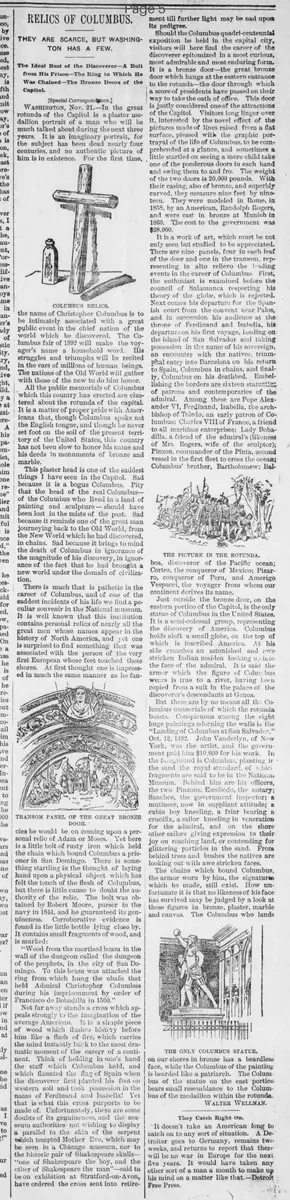
There is much that is pathetic in the career of Columbus, and of one of the saddest incidents of his life we find a peculiar souvenir in the National museum. It is well known that this institution contains personal relics of nearly all the great men whose names appear in the history of North America, and yet one is surprised to find something that was associated with the person of the very first European whose feet touched these shores. At first thought one is impressed in much the same manner as he fancies he would be on coming upon a personal relic of Adam or Moses. Yet here is a little bolt of rusty iron which held the chain which bound Columbus a prisoner in San Domingo. There is something startling in the thought of laying hand upon a physical object which has felt the touch of the flesh of Columbus, but there is little cause to doubt the authority of the relic. The bolt was obtained by Robert Moore, purser in the navy in 1844, and he guaranteed its genuineness. Corroborative evidence is found in the little bottle lying close by. It contains small fragments of wood, and is marked:
"Wood from the mortised beam in the wall of the dungeon called the dungeon of the prophets, in the city of San Domingo. To this beam was attached the ring from which hung the chain that held Admiral Christopher Columbus during his imprisonment by order of Francisco de Bobadilla in 1500."
Not far away stands a cross which appeals strongly to the imagination of the average American. It is a simple piece of wood which flashes history before him like a flash of fire, which carries the mind instantly back to the most dramatic moment of the career of a continent. Think of holding in one's hand the staff which Columbus held, and which flaunted the flag of Spain when the discoverer first planted his foot on western soil and took possession in the name of Ferdinand and Isabella! Yet that is what this cross purports to be made of. Unfortunately, there are some doubts of its genuineness, and the museum authorities not wishing to display a parallel to the skin of the serpent which tempted Mother Eve, which may be seen in a Chicago museum, nor to the historic pair of Shakespeare skulls—“one of Shakespeare the boy, and the other of Shakespeare the man”—said to be on exhibition at Stratford-on-Avon, have ordered the cross sent into retirement till further light may be had upon its pedigree.
Should the Columbus quadri-centennial exposition be held in the capital city, visitors will here find the career of the discoverer epitomized in a most curious, most admirable and most enduring form. It is a bronze door—the great bronze door which hangs at the eastern entrance to the rotunda—the door through which a score of presidents have passed on their way to take the oath of office. This door is justly considered one of the attractions of the Capitol. Visitors long linger over it, interested by the novel effect of the pictures made of lines raised from a flat surface, pleased with the graphic portrayal of the life of Columbus, to be comprehended at a glance, and sometimes a little startled on seeing a mere child take one of the ponderous doors in each hand and swing them to and fro. The weight of the two doors is 20,000 pounds. With their casing, also of bronze, and superbly carved, they measure nine feet by nineteen. They were modeled in Rome, in 1858, by an American, Randolph Rogers, and were cast in bronze at Munich in 1860. The cost to the government was $28,000.
It is a work of art, which must be not only seen but studied to be appreciated. There are nine panels, four in each leaf of the door and one in the transom, representing in alto relievo the leading events in the career of Columbus. First, the enthusiast is examined before the council of Salamanca respecting his theory of the globe, which is rejected. Next comes his departure for the Spanish court from the convent near Palos, and in succession his audience at the throne of Ferdinand and Isabella, his departure on his first voyage, landing on the island of San Salvador and taking possession in the name of his sovereign, an encounter with the natives, triumphal entry into Barcelona on his return to Spain, Columbus in chains, and finally, Columbus on his deathbed. Embellishing the borders are sixteen statuettes of patrons and contemporaries of the admiral. Among these are Pope Alexander VI, Ferdinand, Isabella, the archbishop of Toledo, an early patron of Columbus; Charles VIII of France, a friend to all maritime enterprises; Lady Bobadilla, a friend of the admiral's (likeness of Mrs. Rogers, wife of the sculptor); Pinzon, commander of the Pinta, second vessel in the first fleet to cross the ocean; Columbus' brother, Bartholomew; Balboa, discoverer of the Pacific ocean; Cortez, the conqueror of Mexico; Pizarro, conqueror of Peru, and Amerigo Vespucci, the voyager from whom our continent derives its name.
Just outside the bronze door, on the eastern portico of the Capitol, is the only statue of Columbus in the United States. It is a semi-colossal group, representing the discovery of America. Columbus holds aloft a small globe, on the top of which is inscribed America. At his side crouches an astonished and awe stricken Indian maiden looking up into the face of the admiral. It is said the armor which the figure of Columbus wears is true to a rivet, having been copied from a suit in the palace of the discoverer's descendants at Genoa.
But these are by no means all the Columbus memorials of which the rotunda boasts. Conspicuous among the eight huge paintings adorning the walls is the "Landing of Columbus at San Salvador." Oct. 12, 1492. John Vanderlyn, of New York, was the artist, and the government paid him $10,000 for his work. In the foreground is Columbus, planting in the sand the royal standard, of which fragments are said to be in the National Museum. Behind him are his officers, the two Pinzons, Escobedo, the notary; Sanchez, the government inspector; a mutineer, now in suppliant attitude; a cabin boy kneeling, a friar bearing a crucifix, a sailor kneeling in veneration for the admiral, and on the shore other sailors giving expression to their joy on reaching land, or contending for glittering particles in the sand. From behind trees and bushes the natives are looking out with awe stricken faces.
The chains which bound Columbus, the armor worn by him, the signatures which he made, still exist. How unfortunate it is that no likeness of his face has survived may be judged by a look at these figures in bronze, plaster, marble and canvas. The Columbus who lands on our shores in bronze has a beardless face, while the Columbus of the painting is bearded like a patriarch. The Columbus of the statue on the east portico bears small resemblance to the Columbus of the medallion within the rotunda.
WALTER WELLMAN.
TRANSOM PANEL OF THE GREAT BRONZE DOOR.
THE PICTURE IN THE ROTUNDA.
THE ONLY COLUMBUS STATUE
What sub-type of article is it?
What themes does it cover?
What keywords are associated?
What entities or persons were involved?
Where did it happen?
Story Details
Key Persons
Location
Washington, D.C., Capitol Rotunda, National Museum
Event Date
Nov. 21
Story Details
Description of Columbus relics in Washington: plaster medallion portrait, iron bolt from his chains in San Domingo 1500, wooden cross from his landing staff, bronze doors depicting his life events, statue on east portico, and Vanderlyn painting of landing at San Salvador Oct. 12, 1492.