Thank you for visiting SNEWPapers!
Sign up free
Editorial
May 3, 1823
Alexandria Gazette & Advertiser
Alexandria, Virginia
What is this article about?
Governor Thomas B. Robertson of Louisiana vetoes a bill to prevent usury, arguing that government should not regulate interest rates or interfere in free contracts, as individuals are best judges of their own interests. He cites economic realities and historical precedents against such laws.
Clipping
OCR Quality
95%
Excellent
Full Text
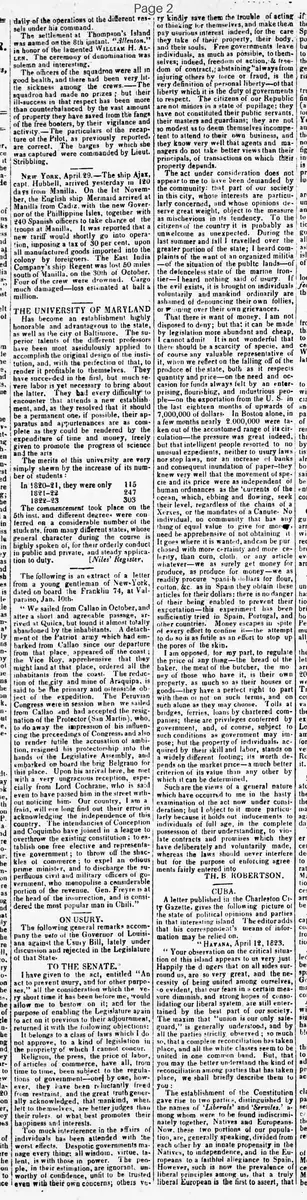
ON USURY.
The following general remarks accompany the veto of the Governor of Louisiana against the Usury Bill, lately under discussion and rejected in the Legislature of that State.
TO THE SENATE.
I have given to the act, entitled "An act to prevent usury, and for other purposes," all the consideration which the very short time it has been before me, would allow me to bestow on it; and for the purpose of enabling the Legislature again to act on it previous to their adjournment, returned it with the following objections:
It belongs to a class of laws which I do not approve, to a kind of legislation in the propriety of which I cannot concur. Religion, the press, the price of labor, of articles of commerce, have all, from time to time, been subject to the regulations of government—one by one, however, they have been reluctantly freed from restraint, and the great truth generally acknowledged, that mankind, when left to themselves, are better judges than their rulers, of what best promotes their happiness and interests.
Too much interference in the affairs of individuals has been attended with the worst effects. Despotic governments manage every thing: all wisdom, virtue, talent, is with those in power. The people, in their estimation, are ignorant unworthy of confidence, unfit to be trusted even with their own concerns; others very kindly save them the trouble of acting or thinking for themselves, and make them pay usurious interest indeed, for the care they take of their property, their body, and their souls. Free governments leave individuals, as much as possible, to themselves; indeed, freedom of action, & freedom of contract, abstaining always from injuring others by force or fraud, is the very definition of personal liberty—of that liberty which it is the duty of governments to respect. The citizens of our Republic are not minors in a state of pupilage; they have not constituted their public servants their masters and guardians; they are not so modest as to deem themselves incompetent to attend to their own business, and they know very well that agents and managers do not take better views than their principals, of transactions on which their property depends.
The act under consideration does not appear to me to have been demanded by the community: that part of our society in this city, whose interests are particularly concerned, and whose opinions deserve great weight, object to the measure as mischievous in its tendency. To the citizens of the country it is probably as unwelcome as unexpected. During the last summer and fall I travelled over the greater portion of the state; I heard complaints of the want of an organized militia—of the situation of the public lands—of the defenceless state of the marine frontier—I heard nothing said of usury. If the evil exists, it is brought on individuals voluntarily and mankind ordinarily are ashamed of denouncing their own follies, or ringing over their own grievances.
That there is want of money, I am not disposed to deny; but that it can be made by legislation more abundant and cheap, I cannot admit. It is not wonderful that there should be a scarcity of specie, and of course any valuable representative of it, when we reflect on the falling off of the produce of the state, both as it respects quantity and price—on the need and occasion for funds always felt by an enterprising, flourishing, and industrious people—on the exportation from the U. S. in the last eighteen months of upwards of 7,000,000 of dollars. In Boston alone, in a few months nearly 2,000,000 were taken out of the accustomed range of its circulation—the pressure was great indeed, but that intelligent people resorted to no unusual expedients, neither to usury laws nor stop laws, nor an increase of banks and consequent inundation of paper—they knew very well that the movement of specie and its price were as independent of human ordinances as the currents of the ocean, which, ebbing and flowing, seek their level, regardless of the chains of a Xerxes, or the mandates of a Canute. No individual, no community that has anything of equal value to give for money, need be apprehensive of not obtaining it. It goes where it is wanted, and can be purchased with more certainty and more celerity, than corn, cloth, or any article whatever—we as surely get money for produce, as produce for money—we as readily procure Spanish dollars for flour, cotton, &c. as in Spain they obtain these articles for their dollars: there is no danger of their being enabled to prevent their exportation—this experiment has been sufficiently tried in Spain, Portugal, and other countries. Money escapes in spite of every effort to confine it—the attempt to do so is as futile as an effort to stop up the pores of the skin.
I am opposed, for my part, to regulate the price of any thing—the bread of the baker, the meat of the butcher, the money of those who have it, is their own property, as much so as their houses or goods—they have a perfect right to part with them or not on such terms, and on such alone as they may choose. Tolls at bridges, ferries, loans by chartered companies; these are privileges conferred by government, and, of course, subject to such conditions as government may impose; but the property of individuals, acquired by their skill and labor, stands on a widely different footing; its worth depends on the market price—a much better criterion of its value than any other by which it can be determined.
Such are the views of a general nature which have occurred to me in the hasty examination of the act now under consideration: but I object to it more particularly because it holds out inducements to individuals of full age, in the complete possession of their understanding, to violate contracts and promises which they have deliberately and voluntarily made, whereas the laws should never interfere but for the purpose of enforcing agreements fairly entered into.
TH. B. ROBERTSON.
The following general remarks accompany the veto of the Governor of Louisiana against the Usury Bill, lately under discussion and rejected in the Legislature of that State.
TO THE SENATE.
I have given to the act, entitled "An act to prevent usury, and for other purposes," all the consideration which the very short time it has been before me, would allow me to bestow on it; and for the purpose of enabling the Legislature again to act on it previous to their adjournment, returned it with the following objections:
It belongs to a class of laws which I do not approve, to a kind of legislation in the propriety of which I cannot concur. Religion, the press, the price of labor, of articles of commerce, have all, from time to time, been subject to the regulations of government—one by one, however, they have been reluctantly freed from restraint, and the great truth generally acknowledged, that mankind, when left to themselves, are better judges than their rulers, of what best promotes their happiness and interests.
Too much interference in the affairs of individuals has been attended with the worst effects. Despotic governments manage every thing: all wisdom, virtue, talent, is with those in power. The people, in their estimation, are ignorant unworthy of confidence, unfit to be trusted even with their own concerns; others very kindly save them the trouble of acting or thinking for themselves, and make them pay usurious interest indeed, for the care they take of their property, their body, and their souls. Free governments leave individuals, as much as possible, to themselves; indeed, freedom of action, & freedom of contract, abstaining always from injuring others by force or fraud, is the very definition of personal liberty—of that liberty which it is the duty of governments to respect. The citizens of our Republic are not minors in a state of pupilage; they have not constituted their public servants their masters and guardians; they are not so modest as to deem themselves incompetent to attend to their own business, and they know very well that agents and managers do not take better views than their principals, of transactions on which their property depends.
The act under consideration does not appear to me to have been demanded by the community: that part of our society in this city, whose interests are particularly concerned, and whose opinions deserve great weight, object to the measure as mischievous in its tendency. To the citizens of the country it is probably as unwelcome as unexpected. During the last summer and fall I travelled over the greater portion of the state; I heard complaints of the want of an organized militia—of the situation of the public lands—of the defenceless state of the marine frontier—I heard nothing said of usury. If the evil exists, it is brought on individuals voluntarily and mankind ordinarily are ashamed of denouncing their own follies, or ringing over their own grievances.
That there is want of money, I am not disposed to deny; but that it can be made by legislation more abundant and cheap, I cannot admit. It is not wonderful that there should be a scarcity of specie, and of course any valuable representative of it, when we reflect on the falling off of the produce of the state, both as it respects quantity and price—on the need and occasion for funds always felt by an enterprising, flourishing, and industrious people—on the exportation from the U. S. in the last eighteen months of upwards of 7,000,000 of dollars. In Boston alone, in a few months nearly 2,000,000 were taken out of the accustomed range of its circulation—the pressure was great indeed, but that intelligent people resorted to no unusual expedients, neither to usury laws nor stop laws, nor an increase of banks and consequent inundation of paper—they knew very well that the movement of specie and its price were as independent of human ordinances as the currents of the ocean, which, ebbing and flowing, seek their level, regardless of the chains of a Xerxes, or the mandates of a Canute. No individual, no community that has anything of equal value to give for money, need be apprehensive of not obtaining it. It goes where it is wanted, and can be purchased with more certainty and more celerity, than corn, cloth, or any article whatever—we as surely get money for produce, as produce for money—we as readily procure Spanish dollars for flour, cotton, &c. as in Spain they obtain these articles for their dollars: there is no danger of their being enabled to prevent their exportation—this experiment has been sufficiently tried in Spain, Portugal, and other countries. Money escapes in spite of every effort to confine it—the attempt to do so is as futile as an effort to stop up the pores of the skin.
I am opposed, for my part, to regulate the price of any thing—the bread of the baker, the meat of the butcher, the money of those who have it, is their own property, as much so as their houses or goods—they have a perfect right to part with them or not on such terms, and on such alone as they may choose. Tolls at bridges, ferries, loans by chartered companies; these are privileges conferred by government, and, of course, subject to such conditions as government may impose; but the property of individuals, acquired by their skill and labor, stands on a widely different footing; its worth depends on the market price—a much better criterion of its value than any other by which it can be determined.
Such are the views of a general nature which have occurred to me in the hasty examination of the act now under consideration: but I object to it more particularly because it holds out inducements to individuals of full age, in the complete possession of their understanding, to violate contracts and promises which they have deliberately and voluntarily made, whereas the laws should never interfere but for the purpose of enforcing agreements fairly entered into.
TH. B. ROBERTSON.
What sub-type of article is it?
Economic Policy
Constitutional
Legal Reform
What keywords are associated?
Usury Bill
Veto Message
Economic Freedom
Personal Liberty
Free Contracts
Louisiana Governor
What entities or persons were involved?
Governor Thomas B. Robertson
Louisiana Legislature
Citizens Of Louisiana
Editorial Details
Primary Topic
Veto Of Usury Prevention Act
Stance / Tone
Opposition To Government Regulation Of Interest Rates And Advocacy For Free Contracts And Personal Liberty
Key Figures
Governor Thomas B. Robertson
Louisiana Legislature
Citizens Of Louisiana
Key Arguments
Government Interference In Individual Affairs Leads To Poor Outcomes
Freedom Of Contract Defines Personal Liberty In Free Governments
Usury Bill Not Demanded By The Community
Legislation Cannot Increase Money Supply Or Cheapen It
Individuals Have Right To Set Prices For Their Property Including Money
Law Should Enforce Rather Than Encourage Violation Of Voluntary Contracts