Thank you for visiting SNEWPapers!
Sign up free
The Enquirer
Richmond, Henrico County, Virginia
What is this article about?
New York merchants' memorial to the US President and Congress protests British seizures of neutral ships trading colonial goods to Europe, argues against new interpretations of direct trade, warns of economic harm, and urges naval defenses against West Indies piracy.
Clipping
OCR Quality
Full Text
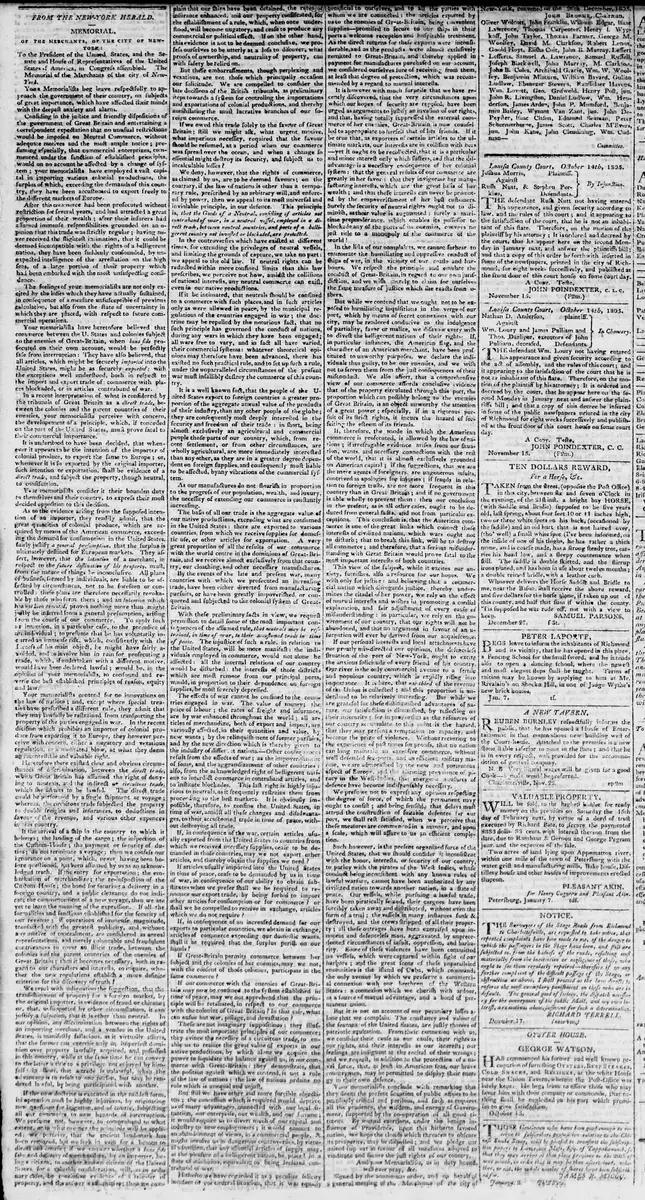
MEMORIAL,
OF THE MERCHANTS, OF THE CITY OF NEW-YORK:
To the President of the United States, and the Senate and House of Representatives of the United States of America, in Congress assembled. The Memorial of the Merchants of the city of New-York.
Your Memorialists beg leave respectfully to approach the government of their country, on subjects of great importance, which have affected their minds with the deepest anxiety and alarm. Confiding in the justice and friendly dispositions of the government of Great Britain and entertaining a correspondent expectation that no unusual restrictions would be imposed on Neutral Commerce, without adequate motives and the most ample notice; presuming especially, that commercial enterprizes, commenced under the sanction of established principles would on no account be affected by a change of system; your memorialists have employed a vast capital in importing various colonial productions, the surplus of which, exceeding the demands of this country, they have been accustomed to export freely to the different markets of Europe.
After this commerce had been prosecuted without restriction for several years, and had attracted a great proportion of their wealth; after their insurers had assumed immense responsibilities grounded on an opinion that this trade was strictly regular; having never received the slightest intimation, that it could be deemed incompatible with the rights of a belligerent nation, they have been suddenly confounded, by unexpected intelligence of the arrestation on the high seas, of a large portion of their property which has been embarked with the most unsuspicious confidence.
The feelings of your memorialists are not only excited by the losses which they have actually sustained, in consequence of a measure unsusceptible of previous calculation, but also from the state of uncertainty in which they are placed, with respect to future commercial operations.
Your memorialists have heretofore believed that commerce between the U. States and colonies subject to the enemies of Great-Britain, when bona fide prosecuted on their own account, would be perfectly safe from interruption: They have also believed, that all articles, which might be securely imported into the United States, might be as securely exported; with the exceptions well understood, both in respect to the import and export trade of commerce with places blockaded, or in articles contraband of war.
In a recent interpretation of what is considered by the tribunals of Great Britain as a direct trade, between the colonies and the parent countries of their enemies, your memorialists perceive with concern, the development of a principle, which, if conceded on the part of the United States, must prove fatal to their commercial importance.
It is understood to have been decided, that whenever it appears to be the intention of the importer of colonial produce, to export the same to Europe; or, whenever it is so exported by the original importer, such intention or exportation, shall be evidence of a direct trade, and subject the property, though neutral, to confiscation.
Your memorialists consider it their bounden duty to themselves and their country, to express their most decided opposition to this decision. As to the evidence arising from the supposed intention of an importer, they readily admit, that the great quantities of colonial produce, which are acquired by means of the American commerce, exceeding the demand for consumption in the United States, fairly justify a general presumption, that the surplus is ultimately destined for European markets. They assert, however, that the intention of a merchant, in respect to the future destination of his property, must, from the nature of things be inconclusive. All plans of business, formed by individuals, are liable to be affected by circumstances, not to be foreseen or controlled: these plans are therefore necessarily revocable by those who form them; and an intention which has not been executed, proves nothing more than might justly be inferred from a general presumption, arising from the course of our commerce. To apply such an intention, in a particular case, to the prejudice of an individual; to presume that he has voluntarily incurred an immense risk, which, consistently with the success of his main object, he might have fairly avoided, and to involve him in ruin for prosecuting a trade, which, if undertaken with a different motive, would have been declared lawful; would be, in the opinion of your memorialists, to confound and reverse the best established principles of reason, equity and law.
Your memorialists contend for no innovations on the law of nations; and, except where special treaties have prescribed a different rule, they admit that they may lawfully be restrained from transporting the property of the parties engaged in war. In the recent decision which prohibits an importer of colonial produce from exporting it to Europe, they however perceive with concern, either a nugatory and vexatious regulation, or a meditated blow, at what they deem an incontestable and valuable right.
Heretofore there existed clear and obvious circumstances of discrimination, between the direct trade, which Great Britain has assumed the right of denying to neutrals, and the indirect or circuitous trade, which she admits to be lawful. The direct trade could be performed by a single shipment or voyage; whereas, the circuitous trade subjected the property to double freights and insurances, to deductions in favour of the revenue, and various other expences in this country.
If the arrival of a ship in the country to which it belongs; the landing of the cargo; the inspection of the Custom-House; the payment or security of duties; do not terminate a voyage; then we confess our ignorance on a point, which, never having been before questioned, has been assumed by us as an acknowledged truth. If the entry for exportation; the embarkation of merchandize; the re-inspection of the Custom-House; the bond for securing a delivery in a foreign country, and a public clearance do not indicate the commencement of a new voyage, then we are yet to learn the meaning of the expression. If all the formalities and sanctions established for the security of our revenue; if operations of immense magnitude, transacted with the greatest publicity, and, without any motive of concealment, are considered as unreal representations, and merely colourable and fraudulent contrivances to cover an illicit trade, between the colonies and the parent countries of the enemies of Great Britain; then it becomes necessary, both in regard to our characters and interests, to inquire, whether the new regulations establish a more definite criterion for the discovery of truth?
We repel with indignation the suggestion, that the trans-shipment of property for a foreign market, by the original importer, is evidence of fraud or chicane; or, that, unsupported by other circumstances, it can justify a suspicion, that it is other than neutral. In our opinion, any discrimination between the rights of an importing merchant, and a vendee in the United States, is manifestly fallacious, as it virtually affirms, that the former can exercise only an imperfect dominion over property lawfully acquired, and possessed in this country, while at the same time he can convey to the latter a title to a privilege not enjoyed by himself; in short, that a trade is unlawful, when the advantage is to result to one person, but may be rendered lawful, by being participated with another.
If the new doctrine is executed in the mildest form, its operation must be highly injurious, by originating new questions for litigation, and of course, subjecting all our commerce to new hazards of interruption. We presume not, however, to comprehend to what extent, or in what manner the principle will be applied: we perceive, that the ancient land-mark has been removed, but we seek in vain for a beacon to direct our course; if we enquire whether a bona fide sale and delivery of merchandize, by an importer, being a citizen, to another known citizen of the United States, for a valuable consideration, will, as in ordinary cases, be conclusive evidence of a transfer of property, and the answer is affirmative; then we conclude, that our ships have been detained, the rates of insurance enhanced, and our property confiscated, for the establishment of a rule, which, when once understood, will become nugatory, and cease to produce any commercial or political effect. If on the other hand this evidence is not to be deemed conclusive, we profess ourselves to be utterly at a loss to discover, what proofs of ownership, and neutrality of property, can with safety be relied on.
But these embarrassments, though perplexing and vexatious, are not those which principally occasion our solicitude. We are compelled to consider the late decisions of the British tribunals, as preliminary steps towards a system for controlling the importations and exportations of colonial productions, and thereby annihilating the most lucrative branches of our foreign commerce.
If we owed this trade solely to the favour of Great Britain; still we might ask, what urgent motive, what imperious necessity, required that the favour should be resumed, at a period when our commerce was spread over the ocean, and when a change so essential might destroy its security, and subject us to incalculable losses?
We deny, however, that the rights of commerce, as claimed by us, are to be deemed favours; on the contrary, if the law of nations is other than a temporary rule, prescribed by an arbitrary will, and enforced by power, then we appeal to its most universal and inviolable principle, in our defence. This principle is, that the goods of a Neutral, consisting of articles not contraband of war, in a neutral vessel, employed in a direct trade, between neutral countries, and ports of a belligerent country not invested or blockaded, are protected.
In the controversies which have existed at different times, for extending the privileges of neutral vessels, and limiting the grounds of capture, we take no part: we appeal to the old law. If neutral rights can be reduced within more confined limits than this law prescribes, we perceive not how, amidst the collisions of national interests, any neutral commerce can exist, even in our native productions.
If it be intimated, that neutrals should be confined to a commerce with such places, and in such articles only as were allowed in peace, by the municipal regulations of the countries engaged in war; the doctrine may be repelled by the notorious fact, that no such principle has governed the conduct of nations, during any wars in which they have been engaged: all were free to vary, and in fact all have varied, their commercial systems: whatever theoretical opinions may therefore have been advanced, there has existed no such practical rule, and to set up such a rule, under the unparalleled circumstances of the present war must infallibly destroy the commerce of this country.
It is a well known fact, that the people of the United States export to foreign countries a greater proportion of the aggregate annual value of the products of their industry, than any other people of the globe; they are consequently most deeply interested in the security and freedom of their trade: in short, being almost exclusively an agricultural and commercial people those parts of our country, which, from recent settlement, or from other circumstances, are wholly agricultural, are more immediately interested than any other, as they are in a greater degree dependent on foreign supplies, and consequently most liable to be affected, by any vibrations of the commercial system.
As our manufactures do not flourish in proportion to the progress of our population, wealth, and luxury, the necessity of extending our commerce is constantly increasing.
The basis of all our trade is the aggregate value of our native productions, exceeding what are consumed in the United States: there are exported to various countries, from which we receive supplies for domestic use, or other articles for exportation. A very great proportion of all the results of our commerce with the world centre in the dominions of Great-Britain, and we receive almost exclusively from that country, our clothing, and other necessary manufactures.
By the events of the late and present war, many countries with which we prosecuted an increasing trade, have been either diverted from manufacturing pursuits, or have been greatly impoverished, or conquered and subjected to the colonial system of Great-Britain.
With these preliminary facts in view, we request permission to detail some of the most important consequences of the assumed rule, that neutrals may be restrained, in time of war, to their accustomed trade in time of peace. The injustice of such a rule, in relation to the United States, will be more manifest: the individuals employed in commerce, would not alone be affected: all the internal relations of our country would be disturbed: the interests of those districts which are most remote from our principal ports, would, in proportion to their dependence on foreign supplies, be most severely depressed.
The effects of war cannot be confined to the countries engaged in war. The value of money; the price of labour; the rates of freight and insurance, are by war enhanced throughout the world; all articles of merchandize, both of export and import, are variously affected, in their quantities and value, by new wants; by the relinquishment of former pursuits, and by the new direction which is thereby given to the industry of different nations. Other consequences result from the effects of war; as the impoverishment of some, and the aggrandizement of other countries: also, from the acknowledged right of belligerent nations to interdict commerce in contraband articles, and to institute blockades. This last right is highly injurious to neutrals, as it frequently restrains them from proceeding to the best markets. It is obviously impossible, therefore, to confine the United States, in time of war, amidst all these changes and disadvantages, to their accustomed trade in time of peace, without destroying all trade.
If, in consequence of the war, certain articles usually exported from the United States to countries from which we received necessary supplies, cease to be demanded in those countries, may we not export other articles, and thereby obtain the supplies we need?
If articles usually imported into the United States in time of peace, cease to be demanded by us in time of war, in consequence of our ability to obtain substitutes when we prefer shall we be required to renounce our export trade, by being forbid to import other articles for consumption or for commerce? or shall we be compelled to receive in exchange, articles which we do not require?
If, in consequence of an increased demand for our exports to particular countries, we obtain in exchange, articles of commerce exceeding our domestic wants, shall it be required that the surplus perish on our hands?
If Great-Britain permits commerce between her subjects and the colonies of her enemies, may we not, with the consent of those colonies, participate in the same commerce?
If our commerce with the enemies of Great-Britain may now be confined to the system established in time of peace, may we not apprehend that the principle will be retaliated, in respect to our commerce with the colonies of Great Britain? In that case, what can ensue but war, pillage, and devastation?
These are not imaginary suppositions: they illustrate the most important principles of our commerce; they evince the necessity of a circuitous trade, to enable us to realize the great value of exports in our native productions, by which alone we acquire the power to liquidate the balance against us, in our commerce with Great-Britain; they demonstrate, that the position against which we contend, is not a rule of the law of nations; the law of nations proscribes no rule which is unequal and unjust.
But still we have other and more forcible objections; the concession which is required would deprive us of many advantages, connected with our local situation, our enterprize, our wealth, and our stupendous resources; it would require us to divert much of our capital and industry to new employments; it would amount to an abandonment of views, as a commercial people, and might involve us in dangerous controversies, by virtually admitting, that any essential articles of supply may, at the pleasure of a belligerent nation, be placed in a state of prohibition, equivalent to being declared contraband of war.
Heretofore, we have regarded it as a peculiar felicity in our neutral situation, as beneficial to ourselves, and to all the parties with whom we are connected: the articles exported by us to the enemies of Great-Britain, being convenient supplies-promised to secure to our ships in their ports a welcome reception and hospitable treatment.
As the direct returns for these exports were inconsiderable, and as the products were almost exclusively remitted to Great-Britain, and thereby applied in payment for manufactures purchased on our account, we considered ourselves sure of receiving from them at least that degree of protection, which was recommended by a regard to mutual interests.
It is however with much surprise that we have recently discovered, that the very circumstances upon which our hopes of security are reposed, have been urged as arguments to justify an invasion of our rights, and that, having totally suppressed the external commerce of her enemies, Great-Britain is now counselled to appropriate to herself that of her friends. If it be true that, as exporters of certain articles to the ultimate markets, our interests are in collision with hers--yet it ought to be recollected, that it is a particular and minor interest only which suffers, and that the disadvantage is a necessary consequence of her colonial system: that the general results of our commerce are greatly in her favor: that they invigorate her manufacturing interests, which are the great basis of her wealth; and that these interests can never be promoted by the impoverishment of her best customers.
Surely the security of neutral rights ought not to diminish, as their value is augmented: surely a maritime preponderancy, which enables its possessor to blockade any of the ports of its enemies, conveys no just title to a monopoly of the commerce of the world!
In the list of our complaints, we cannot forbear to enumerate the humiliating and oppressive conduct of ships of war, in this vicinity of our coasts and harbours. We respect the principle and emulate the conduct of Great-Britain, in regard to our own jurisdiction, and we wish merely to claim for ourselves the same measure of justice which she exacts from others.
But while we contend that we ought not to be exposed to humiliating inquisitions in the verge of our port, which by means of secret connexions with our city, may be rendered conducive to the indulgence of partiality, favor or malice, we disavow every wish to divest the belligerent nations of their rights: If, in particular instances, the American flag, and the character of an American merchant, have been prostituted to unworthy purposes, we declare the individuals thus guilty, to be our enemies, and we wish not to screen them from the just consequences of their misconduct. We also assert, that a comprehensive view of our commerce affords conclusive evidence that of the property circulated through this port, the proportion which can possibly belong to the enemies of Great Britain, is an object unworthy the attention of a great power; especially, if in a rigorous pursuit of its strict rights, it incurs the hazard of forfeiting the esteem of its friends.
If, therefore, the mode in which the American commerce is prosecuted, is allowed by the law of nations; if irrefragable evidence arises from our situation, wants, and necessary connections with the rest of the world, that it is almost exclusively grounded on American capital; if the suggestions, that we are the mere agents of foreigners, are ungenerous insults, contrived as apologies for injuries; if frauds in relation to foreign trusts, are not more frequent in this country than in Great Britain; and if no government is able wholly to prevent them: then our conclusion in the present, as in all other cases, ought to be deduced from general facts, and not from particular exceptions. This conclusion is, that the American commerce is one of the great links which connect those interests of civilized nations, which wars ought not to disturb; that to break this link, will be to destroy all commerce; and therefore, that a serious misunderstanding with Great Britain would prove fatal to the most important interests of both countries.
This view of the subject, while it excites our anxiety, furnishes, also a resource for our hopes. We wish only for justice: and believing that a commercial nation which disregards justice, thereby undermines the citadel of her power, we rely on the effect of mutual interests and wishes in promoting a cordial explanation, and fair adjustment of every cause of misunderstanding: in particular, we rely on the government of our country, that our rights will not be abandoned, and that no argument in favour of an usurpation will ever be derived from our acquiescence.
If our personal interests and local attachments have not greatly misdirected our opinions, the defenceless situation of the port of New-York, ought to excite the anxious solicitude of every friend of his country. Our river is the only commercial avenue to a fertile and populous country, which is rapidly rising into importance. It is here, that one-third of the revenue of the Union is collected; and this proportion is understood to be relatively increasing. But while we are grateful for these distinguished advantages of nature, our satisfaction is diminished, by reflecting on their insecurity; for in proportion as the resources of our country accumulate to this point is the hazard that they may present a temptation to rapacity, and become the prize of violence. Without recurring to the experience of past times for proofs, that no nation can long maintain an extensive commerce, without well defended sea-ports, and an efficient military marine, we are admonished by the new and portentous aspect of Europe, and the alarming prevalence of piracy in the West-Indies, that energetic measures of defence have become indispensably necessary.
We presume not to express any opinion respecting the degree of force, of which the permanent navy ought to consist; and being sensible that delays must attend the construction of suitable defences for our port, we shall rest satisfied, when we perceive that these measures are commenced in a manner, and upon a scale, which will assure to us an efficient completion.
Such however, is the present organized force of the United States, that we should consider it inconsistent with the honor, interests, or security of our country, to parley with the pirates of the West Indies, whose conduct being inconsistent with any known rules of lawful warfare, cannot have been authorized by any civilized nation towards another nation, in a state of peace. Our vessels, while pursuing a lawful trade, have been piratically seized, their cargoes have been forcibly taken away and distributed, without even the form of a trial; the vessels in many instances sunk & destroyed, and the crews stripped of all their property; all these outrages have been exercised upon innocent and defenceless men, aggravated by unprecedented circumstances of insult, oppression, and barbarity. Some of these violences have been committed on vessels, which were captured within sight of our harbors: and the great scene of these unparalleled enormities is the island of Cuba, which commands the only avenue by which we preserve a commercial connexion with our brethren of the Western States: a connexion which we cherish with ardour, as a source of mutual advantage, and a bond of permanent union.
But it is not on account of our pecuniary losses alone that we complain. The constancy and valour of the seamen of the United States, are justly themes of patriotic exultation. From their connexion with us, we consider their cause as our cause, their rights as our rights, and their interests as our interests; our feelings are indignant at the recital of their wrongs; and we request, in addition to the protection of a naval force, that, at least in American seas, our brave countrymen, may be permitted to display their energy in their own defence.
Your memorialists conclude with remarking that they deem the present situation of public affairs to be peculiarly critical and perilous, and such as requires all the prudence, the wisdom, and energy of Government, supported by the co-operation of all good citizens. By mutual exertions, under the benign influence of Providence, upon this hitherto favored nation, we hope the clouds which threaten to obscure its prosperity, may be dispelled; and we pledge our united support in favour of all measures adopted to vindicate and secure the just rights of our country.
And your Memorialists, as in duty bound will ever pray, &c.
Signed by the unanimous order, and on behalf of general meeting of the Merchants of the city of New-York,
John Broome, Chairman.
Oliver Wolcott, John Franklin, William Edgar, Isaac Lawrence, Thomas Carpenter, Henry C. Wyckoff, John Taylor, Thomas Farmer, George M. Woolsey, David M. Clarkson, Robert Lenox, Gold S. Hoyt, Elijah Corit, John D. Murray, Leffert Lefferts, Samuel A. Lawrence, Samuel Russell, Joseph Blackwell, John Murray, M. Clarkson, John B. Coles, Archibald Gracie, Wm. W. Woolsey, Benjamin Moore, William Bayard, Gulian Ludlow, Ebenezer Stevens, Nicholas I. Roosevelt, Wm. Lord, Geo. Griswold, Henry Post, jun. John R. Livingston, Daniel Ludlow, Wm. Henderson, James Arden, John P. Mumford, Benjamin Bailey, Wynant Van Zandt, jun. John Draper, Isaac Clarkson, Edmund Sharman, Peter Schermerhorne, James Shorts, Charles McEvers, jun. John Kane, John Cutting, Wm. Constable, &c. &c.
What sub-type of article is it?
What keywords are associated?
What entities or persons were involved?
Where did it happen?
Domestic News Details
Primary Location
New York
Key Persons
Outcome
losses from british seizures of neutral property; calls for protection against piracy; pledge of support for government measures to secure rights.
Event Details
Merchants of New-York present a memorial to the US government protesting British restrictions on neutral commerce, particularly the interpretation of direct trade with enemy colonies leading to confiscations, arguing it violates established principles and harms US economy; they also complain of piracy in West Indies, especially near Cuba, and urge naval defenses for the port.