Thank you for visiting SNEWPapers!
Sign up free
Southport Telegraph
Kenosha, Southport, Kenosha County, Wisconsin
What is this article about?
The U.S. House of Representatives acceded to Senate amendments on the apportionment bill, fixing the representation ratio at 70,680 for the next decade. The next House will have 223 members, down 19 from current, with Southern and some Northern states losing seats while Midwestern states gain.
Merged-components note: Merged table with preceding apportionment article for complete logical unit
Clipping
OCR Quality
Full Text
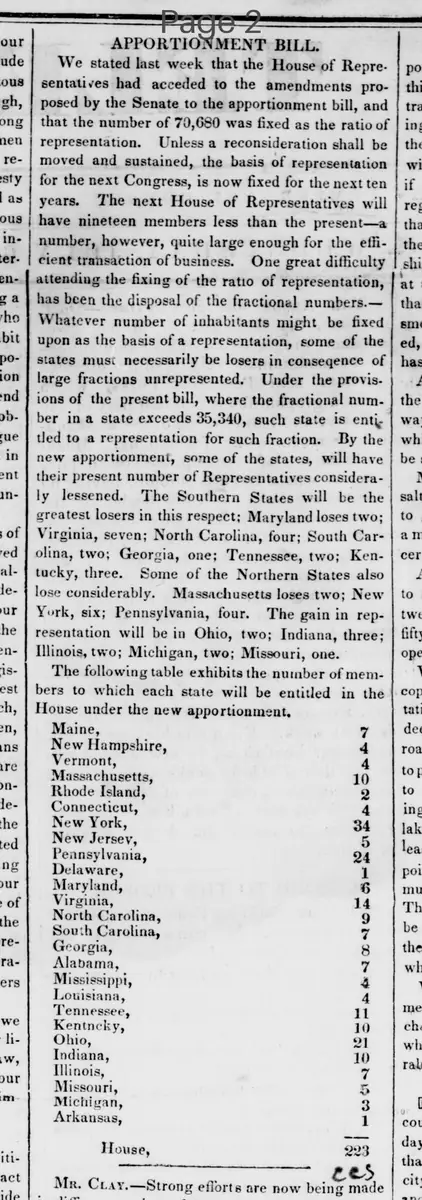
We stated last week that the House of Representatives had acceded to the amendments proposed by the Senate to the apportionment bill, and that the number of 70,680 was fixed as the ratio of representation. Unless a reconsideration shall be moved and sustained, the basis of representation for the next Congress, is now fixed for the next ten years. The next House of Representatives will have nineteen members less than the present—a number, however, quite large enough for the efficient transaction of business. One great difficulty attending the fixing of the ratio of representation, has been the disposal of the fractional numbers. Whatever number of inhabitants might be fixed upon as the basis of a representation, some of the states must necessarily be losers in consequence of large fractions unrepresented. Under the provisions of the present bill, where the fractional number in a state exceeds 35,340, such state is entitled to a representation for such fraction. By the new apportionment, some of the states, will have their present number of Representatives considerably lessened. The Southern States will be the greatest losers in this respect; Maryland loses two; Virginia, seven; North Carolina, four; South Carolina, two; Georgia, one: Tennessee, two; Kentucky, three. Some of the Northern States also lose considerably. Massachusetts loses two; New York, six; Pennsylvania, four. The gain in representation will be in Ohio, two; Indiana, three; Illinois, two; Michigan, two; Missouri, one.
The following table exhibits the number of members to which each state will be entitled in the House under the new apportionment.
| Maine, | 7 |
| New Hampshire, | 4 |
| Vermont, | 4 |
| Massachusetts, | 10 |
| Rhode Island, | 2 |
| Connecticut, | 4 |
| New York, | 34 |
| New Jersey, | 5 |
| Pennsylvania, | 24 |
| Delaware, | 1 |
| Maryland, | 6 |
| Virginia, | 14 |
| North Carolina, | 9 |
| South Carolina, | 7 |
| Georgia, | 8 |
| Alabama, | 7 |
| Mississippi, | 4 |
| Louisiana, | 4 |
| Tennessee, | 11 |
| Kentucky, | 10 |
| Ohio, | 21 |
| Indiana, | 10 |
| Illinois, | 7 |
| Missouri, | 5 |
| Michigan, | 3 |
| Arkansas, | 1 |
| House, | 223 |
What sub-type of article is it?
What keywords are associated?
Domestic News Details
Outcome
house reduced to 223 members; southern states lose seats (md-2, va-7, nc-4, sc-2, ga-1, tn-2, ky-3); northern states lose (ma-2, ny-6, pa-4); gains: oh+2, in+3, il+2, mi+2, mo+1. ratio fixed at 70,680 for 10 years.
Event Details
House acceded to Senate amendments on apportionment bill, fixing representation ratio at 70,680. Fractions over 35,340 entitle additional representation. Basis fixed for next Congress unless reconsidered.