Thank you for visiting SNEWPapers!
Sign up free
Daily National Intelligencer
Washington, District Of Columbia
What is this article about?
In a House of Representatives debate on a bill regulating seamen in U.S. public and merchant vessels, Mr. Pearson opposes striking the first section, supports the bill's principle for peace negotiations with Britain amid the War of 1812, critiques inconsistencies between sections, discusses rights of naturalized citizens versus natives, and objects to the eighth section's implications on personal freedoms.
Merged-components note: Continuation of congressional debate on the bill for regulation of seamen.
Clipping
OCR Quality
Full Text
HOUSE OF REPRESENTATIVES.
DEBATE ON THE BILL
For the regulation of Seamen on board the Public Vessels and in the Merchant service of the United States.
[CONTINUED]
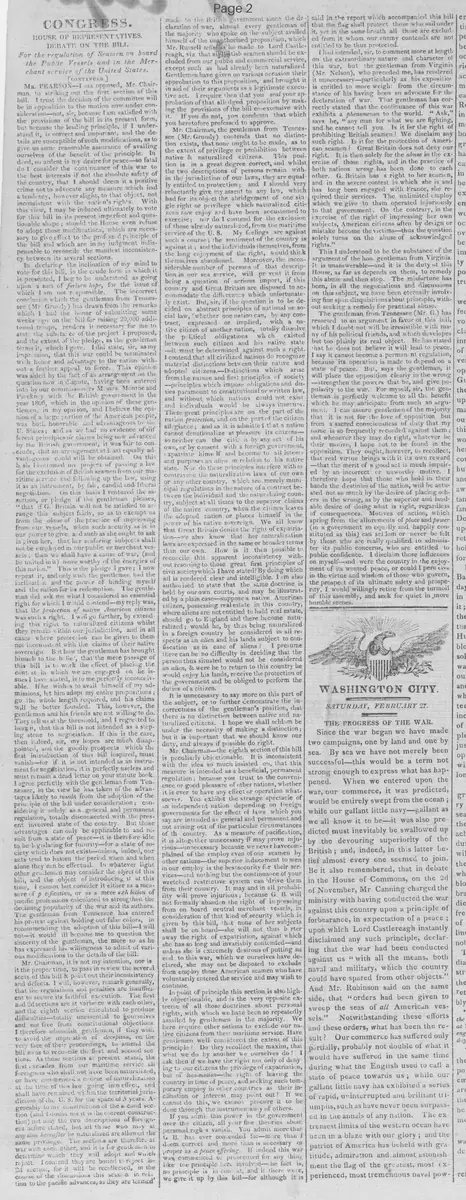
Mr. PEARSON—I am opposed, Mr. Chairman, to striking out the first section of this bill. I trust the decision of the committee will be in opposition to the motion now under consideration—not, sir, because I am satisfied with the provisions of the bill in its present form, but because the leading principle, if I understand it, is correct and important, and the details are susceptible of such modifications, as to give us some reasonable assurance of availing ourselves of the benefit of the principle. Indeed, so ardent is my desire for peace—so fatal do I consider the continuance of this war to the best interests if not the absolute safety of the country, that I should deem it a positive crime not to advocate any measure which had a tendency, however slight, to that object, not inconsistent with the nation's rights. With this view, I may be induced ultimately to vote for this bill in its present imperfect and questionable shape; should the House even refuse to adopt those modifications, which are necessary to give effect to the professed principle of the bill and which are in my judgment indispensable to reconcile the manifest inconsistency between its several sections.
In declaring the inclination of my mind to vote for this bill, in the crude form in which it is presented, I beg to be understood as going upon a sort of forlorn hope, for the issue of which I am not responsible. The incorrect conclusion which the gentleman from Tennessee (Mr. Grundy) has drawn from the remarks which I had the honor of submitting some weeks ago on the bill for raising 20,000 additional troops, renders it necessary for me to state the substance of the project I proposed, and the extent of the pledge, as the gentleman terms it, which I gave. I did state, sir, as my impression, that this war could be terminated with honor and advantage to the nation without a further appeal to force. This opinion was aided by the fact of an arrangement on the question now in dispute, having been entered into by our commissioners Messrs. Monroe and Pinkney with the British government in the year 1806, which in the opinion of these gentlemen, in my opinion, and I believe the opinion of a large portion of the American people, was both honorable and advantageous to the U. States: and as we had no evidence of different principles or claims being now advanced by the British government, it was fair to conclude, that an arrangement at least equally advantageous could still be obtained. On this basis I bottomed my project of passing a law for the exclusion of British seamen from our maritime service and following up the law, using it as an instrument, by fair, candid and liberal negotiation. On this basis I ventured the assertion, or pledge if the gentleman pleases, "that if G. Britain will not be satisfied to arrange this subject fairly, so as to exempt us from the abuse of the practice of impressing from our vessels, when such security as is in our power to give, and such as she ought to ask is given her, that her seafaring subjects shall not be employed in our public or merchant vessels; then we shall have a cause of war, (and be united in it) more worthy of the energies of this nation." This is the pledge I gave; I now repeat it, and only wish the gentlemen had the inclination and the power of binding myself and the nation for its redemption. The gentleman did ask me what I considered an essential right for which I would contend—my reply was, that the protection of native American citizens was such a right. I will go further, by extending this right to naturalized citizens whilst they remain within our jurisdiction, and in all cases where protection can be given to them not inconsistent with the claims of their native sovereign. But how the gentleman has brought himself to the belief, that the mere passage of this bill is to work the effect of placing the contest in which we are engaged on issues I have stated, is to me perfectly inconceivable. If he wishes to avail himself of my admissions, let him adopt my entire propositions; go the whole length required, and his claims will be better founded. This, however, the gentleman and his friends are not willing to do. They tell us at the threshold, and I regretted to hear it, that this bill is not intended as a stepping stone to negotiation. If this is the case, then indeed, sir, my hopes are much disappointed, and the goodly prospects which the first introduction of this bill inspired, must vanish—for if it is not intended as an instrument for negotiation, it is perfectly useless and must remain a dead letter on your statute book.
I agree perfectly with the gentleman from Tennessee, in the view he has taken of the advantages likely to result from the adoption of the principle of the bill under consideration; considering it solely as a general and permanent regulation, totally disconnected with the present involved state of the country. But those advantages can only be applicable to and result from a state of peace—it is therefore idle to be legislating for futurity—for a state of society which does not exist—unless, indeed, our acts tend to hasten the period when and where alone they can be effectual. In whatever light other gentlemen may consider the object of this bill, and the object of introducing it at this time, I cannot but consider it either as a measure of pacification, or as a mere exhibition of pacific professions calculated to strengthen the declining popularity of the war and its authors. The gentleman from Tennessee has entered his protest against holding out false colors, in recommending the adoption of this bill—I will not—it would ill become me to question the sincerity of the gentleman, the more so as he has expressed his willingness to admit of various modifications to the details of the bill.
Mr. Chairman, it is not my intention, nor is it the proper time, to pass in review the several sections of this bill & point out their inconsistency and defects. I will, however, remark generally, that the regulations and penalties are insufficient to secure its faithful execution. The first and 2d sections are at variance with each other, and the eighth section calculated to produce difficulties—totally unessential to ourselves and not free from constitutional objections. I therefore admonish gentlemen, if they wish to avoid the imputation of deception, on the very face of their proceedings, to amend the bill so as to reconcile the first and second sections. As those sections at present stand, the first excludes from our maritime service all foreigners who shall not have been naturalized, or have commenced a course of naturalization at the time of this law going into effect, and shall have remained within the territorial jurisdiction of the U. S. for the space of 5 years. Agreeably to my construction of the second section (and I doubt not it is the correct construction) not only the two descriptions of foreigners before stated, but all those who may at any time hereafter be naturalized are allowed the same privilege. The sections are therefore at war with each other, and it is for gentlemen to determine which they will adopt and which reject. I contend they are bound to reject the 2d section, for it will be recollected, in the course of the discussions this session in relation to the pacific advances, as they are termed
made to the British government since the declaration of war, almost every gentleman of the majority who spoke on the subject availed himself of the unauthorised proposition, which Mr. Russell tells us he made to Lord Castlereagh, viz that all British seamen should be excluded from our public and commercial service, except such as had already been naturalized. Gentlemen have given on various occasions their approbation to this proposition, and brought it in aid of their arguments as a legitimate executive act. I require then that you seal your approbation of that alleged proposition by making the provisions of the bill co-extensive with it. If you do not, you condemn that which you heretofore professed to approve.
Mr. Chairman, the gentleman from Tennessee (Mr. Grundy) contends that no distinction exists, that none ought to be made, as to the extent of privilege or prohibition between native & naturalized citizens. This position is in a great degree correct, and whilst the two descriptions of persons remain within the jurisdiction of our laws, they are equally entitled to protection; and I should very reluctantly give my assent to any law, which had for its object the abridgement of one single right or privilege which naturalized citizens now enjoy and have been accustomed to exercise; nor do I contend for the exclusion of those already naturalized, from the maritime service of the U. S. My feelings are against such a course; the sentiment of the country is against it; and the individuals themselves, from the long enjoyment of the right, would think themselves abandoned. Moreover, the inconsiderable number of persons of that description in our sea service, will prevent it from being a question of serious import, if this country and Great Britain are disposed to accommodate the differences which unfortunately exist. But, sir, if the question is to be decided on abstract principles of national or social law, "whether one nation can, by any contract, expressed or implied, with a native citizen of another nation, totally dissolve the political obligations which existed between such citizen and his native state"—it must be determined against such a right.
I contend that all civilized nations do recognize material distinctions between their native and adopted citizens.—Distinctions which arise from the nature and first principles of society—principles which impose obligations and duties paramount to constitutional or written law, and without which nations could not exist and individuals would be always insecure. These great principles are on the part of the nation protection, and on the part of the citizen allegiance; and as it is admitted that a nation cannot denationalize at pleasure its citizens—so neither can the citizen by any act of his own, or by consent with a foreign government, expatriate himself and become to all intents and purposes an alien in relation to his native state. Nor do these principles interfere with or contravene the naturalization laws of our own or any other country, which are merely municipal regulations in the nature of a contract between the individual and the naturalizing country, subject at all times to the superior claims of the native country, when the citizen leaves the adopted nation or places himself in the power of his native sovereign. We all know that Great Britain denies the right of expatriation—we also know that her naturalization laws are expressed in the same or broader terms than our own. How is it then possible to reconcile this apparent inconsistency without resorting to those great first principles of civil society which I have stated? By doing which all is rendered clear and intelligible. I am also authorised to state that the same doctrine is held by our own courts, and may be illustrated by a plain case—suppose a native American citizen, possessing real estate in this country, where aliens are not entitled to hold real estate, should go to England and there become naturalized; would he, by thus being naturalized in a foreign country be considered in all respects as an alien and his lands subject to confiscation as in case of aliens? I presume there can be no difficulty in deciding that the person thus situated would not be considered an alien, & were he to return to this country he would enjoy his lands, receive the protection of the government and be obliged to perform the duties of a citizen.
It is unnecessary to say more on this part of the subject, or to further demonstrate the incorrectness of the gentleman's position, that there is no distinction between native and naturalized citizens. I hope we shall seldom be under the necessity of making a distinction; but it is important that we should know our duty, and always if possible do right.
Mr Chairman—the eighth section of this bill is peculiarly objectionable. It is inconsistent with the idea so much insisted on, that this measure is intended as a beneficial, permanent regulation; because you trust to the convenience or good pleasure of other nations, whether it is ever to have any effect or operation whatever. You exhibit the strange spectacle of an independent nation depending on foreign governments for the effect of laws which you say are intended as general and permanent and not arising out of the particular circumstances of the country. As a measure of pacification, it is altogether unnecessary if may prove injurious—unnecessary because we never have complained of the employ even of our seamen by other nations—the superior inducement to men in our employ is the best security for their services—and nothing but the continuance of your wretched restrictive system can drive them from their country. It may and in all probability will prove injurious: because G. B. will not formally abandon the right of impressing from on board neutral merchant vessels, in consideration of that kind of security which is given by this bill, that none of her subjects shall be on board—she will not thus barter away the right of expatriation, against which she has so long and invariably contended—and unless she is extremely desirous of putting an end to this war, which we ourselves have declared, she may not be disposed to exclude from employ those American seamen who have voluntarily entered the service and may wish to continue.
In point of principle this section is also highly objectionable, and is the very opposite extreme of all those doctrines about personal rights, with which we have been so repeatedly assailed by gentlemen in the majority. We here require other nations to exclude our native citizens from their maritime service. Have gentlemen well considered the extent of this principle? Do they recollect the maxim, that what we do by another we ourselves do? I ask then if we have the right not only of denying to our citizens the privilege of expatriation, but of loco-motion—the right of leaving the country in time of peace, and seeking such temporary employ in other countries as their inclination or interest may point out? If we cannot do this, we cannot procure it to be done through the instrumentality of others.
If you admit this power in the government over the citizen, all your fine theories about personal rights vanish. You admit more than G B. has ever contended for—more than I deem correct and more than is necessary or proper as a peace offering. If indeed this war was commenced or prosecuted for any thing like the principle here involved—the fact is, no principle is in contest, and if there were, we give it up by this bill—for although it is said in the report which accompanied this bill that the flag shall protect those who sail under it, yet in the same breath all those are excluded from it whom our enemy contends are not entitled to be thus protected.
I had intended, sir, to comment more at length on the extraordinary nature and character of this war, but the gentleman from Virginia (Mr. Nelson), who preceded me, has rendered it unnecessary—particularly as his exposition is entitled to more weight from the circumstance of his having been an advocate for the declaration of war. That gentleman has correctly stated that the continuance of this war exhibits a phenomenon to the world. "Ask," says he, "any man for what we are fighting, and he cannot tell you. Is it for the right of prohibiting British seamen? We disclaim any such right. Is it for the protection of American seamen? Great Britain does not deny our right. It is then solely for the abuse in the exercise of those rights, and in the practice of both nations wrong has been done to each other. G. Britain has a right to her seamen, and in the severe contest in which she is and has long been engaged with France, she required their services. The unlimited employ which we give to them operated injuriously to that government. On the contrary, in the exercise of the right of impressing her own subjects, American citizens often by design or mistake become the victims—thus the question solely turns on the abuse of acknowledged rights."
This I understood to be the substance of the argument of the hon. gentleman from Virginia. It is unanswerable—and it is the duty of this House, as far as depends on them, to remedy this abuse and then stop. The misfortune has been, in all the negotiations and discussions on this subject, we have been eternally involving fine spun disquisitions about principle, without seeking a remedy for practical abuse.
The gentleman from Tennessee (Mr. G.) has resorted to an argument in favor of this bill, which I doubt not will be irresistible with many of his political friends, and which develops but too plainly its real object. He has stated that he does not believe it will lead to peace. I say it cannot become a permanent regulation, because its operation is made to depend on a state of peace. But, says the gentleman, it will place the opposition clearly in the wrong—strengthen the powers that be, and give popularity to the war. For myself, sir, the gentleman is perfectly welcome to all the benefit which he may anticipate from such an argument. I can assure gentlemen of the majority that it is not for the love of opposition but from a sacred consciousness of duty that my name is so frequently recorded against them; and whenever they may do right, whatever be their motive, I hope not to be found in the opposition. They ought, however, to recollect, that real virtue brings with it its own reward—that the merit of a good act is much impaired by an incorrect or unworthy motive. I therefore hope that those who hold in their hands the destinies of the nation, will be actuated not so much by the desire of placing others in the wrong, as by the superior and laudable desire of doing what is right, regardless of consequences. Motives of action, which spring from the allurements of place and power (in a government so equally and happily constituted as this) can seldom or never be felt by those who are really qualified to administer its public concerns, who are entitled to public confidence. I disclaim those influences on myself—and were the country in the enjoyment of its wonted peace, or could I perceive in the virtue and wisdom of those who govern, the prospect of its ultimate safety and prosperity, I would willingly retire from the turmoil of this assembly, and seek for quiet in more humble scenes.
What sub-type of article is it?
What themes does it cover?
What keywords are associated?
What entities or persons were involved?
Where did it happen?
Story Details
Key Persons
Location
House Of Representatives, United States
Event Date
Year 1806 (Prior Arrangement); During War Of 1812
Story Details
Mr. Pearson defends the bill's principle to exclude British seamen for peace negotiations, critiques inconsistencies in sections on naturalization and rights, argues distinctions between native and naturalized citizens, objects to the eighth section's implications, and urges remedying impressment abuses without escalating war principles.