Thank you for visiting SNEWPapers!
Sign up free
The Enquirer
Richmond, Henrico County, Virginia
What is this article about?
Detailed report by Baron Von Benningsen on the Battle of Prussian Eylau (26-27 Jan. 1807, old style), where Russian forces repelled French attacks led by Bonaparte, inflicting heavy losses (49,000 French casualties vs. 19,000 Russian) and capturing 12 eagles, remaining masters of the field.
Clipping
OCR Quality
Full Text
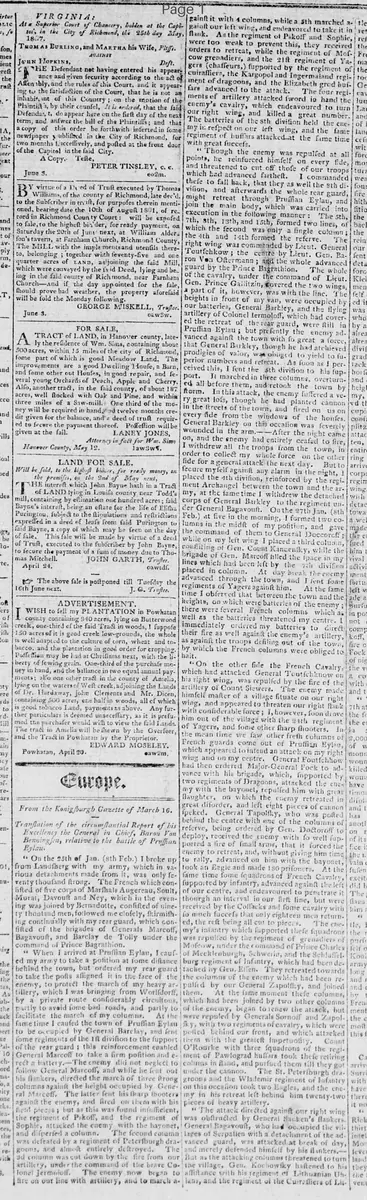
From the Konigsberg Gazette of March 16.
Translation of the circumstantial Report of his Excellency the General in Chief, Baron Von Benningsen, relative to the battle of Prussian Eylau.
"On the 25th of Jan. (8th Feb.) I broke up from Landsberg with my army, which in various detachments made from it, was only seventy thousand strong. The French which consisted of five corps of Marshals Augereau, Soult, Murat, Davoust and Ney, which in the evening was joined by Bernadotte, consisted of ninety thousand men, followed me closely, skirmishing continually with my rear guard, which consisted of the brigades of Generals Markov, Bagavout, and Barclay de Tolly under the command of Prince Bagration.
"When I arrived at Prussian Eylau, I caused my army to take a position at some distance behind the town, but ordered my rear guard to take the posts assigned it in the face of the enemy, to protect the march of my heavy artillery, which I was bringing from Worlsdorff, by a private route considerably circuitous, partly to avoid some bad roads, and partly to facilitate the march of my columns."
At the same time I caused the town of Prussian Eylau to be occupied by General Barclay, and sent some regiments of the 1st division to the support of the rear guard; this reinforcement enabled General Markov to take a firm position and erect a battery. The enemy did not neglect to follow General Markov, and while he sent out his flankers, directed the march of three strong columns against the height occupied by General Markov. The latter sent his sharp shooters against the enemy, and fired on them with his field pieces; but as this was found insufficient, the regiment of Pskoff, and the regiment of Sophie, attacked the enemy with the bayonet, and dispersed a column. The second column was defeated by a regiment of Petersburg dragoons, and almost entirely destroyed." The 3d column was cut down by the fire from our artillery, under the command of the brave Colonel Jermoloff. The enemy now began to fire on our line with artillery, and to march against it with 4 columns, while a 5th marched against our left wing, and endeavored to take it in flank. As the regiment of Pskoff and Sophie, were too weak to prevent this, they received orders to retreat, while the regiment of Moscow grenadiers, and the 21st regiment of Jaegers (chasseurs,) supported by the regiment of cuirassiers, the Kargopol and Ingermanland regiment of dragoons, and the Elizabeth guard hussars advanced to the attack. The four regiments of artillery attacked sword in hand the enemy's cavalry, which endeavored to turn our right wing, and killed a great number. The batteries of the 5th division held the enemy in check on our left wing, and the same regiment of hussars attacked at the same time with great success.
"Though the enemy was repulsed at all points, he reinforced himself on every side, and threatened to cut off those of our troops which had advanced farthest. I commanded these to fall back, that they as well the 5th division, and afterwards the whole rear guard, might retreat through Prussian Eylau, and join the main body, which was carried into execution in the following manner: The 5th, 7th, 8th, 13th, and 15th, formed two lines, of which the second was only a single column; the 4th and 14th formed the reserve. The right wing was commanded by Lieut. General Tutchkow; the centre by Lieut. Gen. Baron Von Osterman; and the whole advanced guard by the Prince Bagration. The whole of the cavalry, under the command of Lieut. Gen. Prince Gallitzin, covered the two wings a part of it, however, was with the line. The heights in front of my van, were occupied by our batteries, General Barkley, and the flying artillery of Colonel Jermoloff, which had covered the retreat of the rear guard, were still in Prussian Eylau; but presently the enemy advanced against the town with so great a force, that General Barkley, though he had achieved prodigies of valor, was obliged to yield to superior numbers and retreat. As soon as I perceived this, I sent the 5th division to his support. It marched in three columns, overturned all before them, and retook the town by storm. In this attack, the enemy suffered a very great loss, though he had planted cannon in the streets of the town, and fired on us on every side from the windows of the houses. General Barkley on this occasion was severely wounded in the arm.—After the night came on, and the enemy had entirely ceased to fire, I withdrew all the troops from the town, in order to collect my whole force on the other side for a general attack the next day. But to secure myself against any alarm in the night, I placed the 4th division, reinforced by the regiment Archangel between the town and the army, at the same time I withdrew the detached corps of General Barkley to the regiment under General Bagavout. On the 27th Jan. (9th Feb.) at five in the morning, I formed two columns in the midst of my position, and gave the command of them to General Dochtoroff; while on my left wing I placed a third column, consisting of Gen. Count Kamensky, while the brigade of Gen. Markov filled the space in my lines which had been left by the 7th division placed in column. At day break the enemy advanced through the town, and I sent some regiments of Jaegers against him. At the same time I observed that between the town and the heights, on which were batteries of the enemy; there were several French columns which as well as the batteries threatened my centre. I immediately ordered my batteries to direct their fire as well against the enemy's artillery, as against the troops defiling out of the town, by which the French columns were obliged to halt.
"On the other side the French Cavalry, which had attacked General Tutschkow on his right wing, was repulsed by the fire of the artillery of Count Sievers. The enemy made himself master of a village situate on our right wing, and appeared to threaten our right flank with considerable force; I, however, soon drove him out of the village with the 24th regiment of Jaegers, and some other sharp shooters. In the mean time we saw other fresh columns of French guards come out of Prussian Eylau, which appeared to intend an attack on my right wing and on my centre. General Tutschekow had then ordered Major-General Fock to advance with his brigade, which, supported by two regiments of Dragoons, attacked the enemy with the bayonet, repulsed him with great slaughter, on which the enemy retreated in great disorder, and left eight pieces of cannon spiked. General Tapolsky, who was posted behind the centre with one of the columns of reserve, being ordered by Gen. Dochtoroff to deploy, received the enemy with so well supported a fire of small arms, that it forced the enemy to retreat, and, without giving him time to rally, advanced on him with the bayonet, took an Eagle and made 150 prisoners. At the same time some squadrons of French Cavalry, supported by infantry, advanced against the left of our centre, and endeavoured to penetrate it through an interval in our first line, but were received by the Cossacks and some cavalry with so much success that only eighteen men returned, the rest being all cut to pieces. The enemy's infantry which supported these squadrons was repulsed by the regiment of grenadiers of Moscow, under the command of Prince Charles of Mecklenburgh, Schwerin, and the Schlusselburg regiment of Infantry, which had been detached by Gen. Essen. They retreated towards the columns of the enemy which had been repulsed by our General Tapolsky, and joined them. At the same moment these columns, which had been joined by two other columns of the enemy, began to renew the attack, but were repulsed by Generals Sornow and Tapolsky, with two regiments of cavalry, which were posted behind our front, and which attacked them with the greatest impetuosity. Count O'Rourke with three squadrons of the regiment of Pawlograd hussars took these retiring columns in flank, and pursued them till they got under the cannon. The St. Petersburg dragoons and the Wlademir regiment of hussars on this occasion took two Eagles, and the enemy in his retreat left behind him twenty-two pieces of heavy artillery.
"The attack directed against our right wing was obstructed by General Sacken’s flankers. General Bagavout, who had occupied the villages of Serpallen with a detachment of the advanced guard, was attacked at break of day, and merely defended himself by his flankers.—But as the attacking columns threatened to turn the village, Gen. Kochowsky hastened to his assistance with his regiment of Lithuanian Uhlans, and the regiment of the Cuirassiers of Little Prussia; they drove the enemy back, who retreated in the utmost confusion towards a forest. The same regiments then attacked with the same decisive success other columns of French infantry, which supported by cavalry made a movement towards our centre, threw them into the greatest confusion, killed some and took 67 prisoners, among whom are 10 officers. General Pahlen attacked with the brigade of cavalry of General Korff, several French columns which were marching against General Lestocq's division, threw them into disorder, and took one Eagle. The regiment of Hussars of Isum, and the regiment of Dragoons of Courland, also attacked the enemy with great success. The enemy finding themselves repulsed with considerable loss, they united their whole force, and formed in strong columns, which moved towards our left wing with a view of turning it. General Bagavout being too weak to resist a force so very superior to his, found himself necessitated to abandon and set fire to the village of Serpallen, which he had hitherto occupied in order to take another position.—His cavalry posted in front, attacked the enemy several times, but was obliged to fall back behind our left wing. In the mean time the enemy continued to receive considerable reinforcements, pursuing his plan of turning our left. Gen. Kamensky, who had already sent some reinforcements to General Bagavout, detachments of Uglitz and Kostrama to reinforce his left wing, and ordered the village of Klein-Sangarten to be occupied by the regiment of Reval. Count Osterman finding himself opposed by a very superior force, he deemed it necessary to retire his left wing, which was soon joined by General Bagavout, against whom the above French columns, preceded by a numerous artillery and flankers, and had already reached our flank, The enemy had already turned our left wing, and forced the divisions of Sacken and Osterman, to a retrograde movement, by concentrating all his attack against this point. I now ordered my horse artillery to advance. General Kutuzoff and colonel Jermoloff erected their batteries on a height, and kept up so brisk a fire on the enemy, that they halted a few moments, abandoned the farm of Anklappen, which they had occupied, in great haste, and fled in the utmost confusion. At the same time, general Tschaplitz, who commanded a detachment of horse, attacked the enemy in the village of Kutschitten, drove them out of it, and almost entirely destroyed the enemy's cavalry. During these transactions, lieut. gen. L’Estocq arrived in the field of battle with the Russian corps under his command, and two Russian regiments of foot, and hastened to reinforce our wing. As soon as he had formed a junction with the division of gen. Kamensky, and the detachment of gen. Tschaplitz, he marched towards the enemy, whom he cannonaded with a well directed fire from his battery. He then made a rapid movement against the left wing of the enemy, with a view of turning it, and pursued them until the fall of night, which forced him to relinquish a further pursuit. The arrival of lieutenant general L’Estocq. and the activity with which he performed his movements. contributed much to secure to us the fortune of the day. While the batteries of our left wing were then keeping up a brisk cannonade against the enemy, and lieut. gen. L'Etocq pursued them; the enemy, although they were in possession of the village of Schweditten, did not dare to attack our right wing, merely composed of the division of general Tutschekoff, on account of its being covered by the fire of a strong Russian battery, which general Fock had established on a height. At the fall of night I ordered the enemy to be driven from the village of Schweditten, where they sustained a considerable loss. The Cossacks behaved with distinguished gallantry, during the action, and took 470 prisoners.
"This destructive battle commenced on the 26th at three o'clock in the afternoon, and ended the following day at midnight. The loss of the enemy consists, by their own confession, in 30,000 killed and 19,000 wounded: 2,000 Frenchmen have been made prisoners of war, and 12 Eagles taken. Our loss amounts to twelve thousand killed, and 7,000 wounded: fourteen French generals were killed or wounded, nine of our generals are wounded, but most of them so slightly that they have already joined the army, to scarce testimony to the signal and persevering valor displayed by your Imperial Majesty's troops, and to assure you that your army, while it has thus acquired immortal glory has given another memorable proof of what a patriot may achieve, which fights in defence of its native country, and is ready to sacrifice its blood and life for the attainment of the noble purpose of an adored monarch. In vain did Bonaparte lavish with the utmost profuseness all his vast resources; in vain did he excite the courage of his soldiers, and in vain did he sacrifice so great a part of his army. The gallantry and persevering valor of the Russians withstood all his efforts, and wrested from him a victory long and severely contested.
"Having remained master of the field of battle, I continued there that night, and weighed the measures which I should further have to pursue; and I have reason to congratulate myself on the determination I took to march to Konigsberg. I was there able to supply my army with every thing it stood in need of; after long and glorious exertions it found there relief and repose, while the French army weakened and dispirited, continued under arms. I hoped by this retrograde movement to induce the French army to follow me, but twelve regiments of horse only made this attempt, under the command of marshal Murat, and were almost entirely destroyed near Maulsfield. After this fresh loss the enemy began to retreat.
"BARON BENNINGSEN."
What sub-type of article is it?
What keywords are associated?
What entities or persons were involved?
Where did it happen?
Foreign News Details
Primary Location
Prussian Eylau
Event Date
26th 27th January (8th 9th February)
Key Persons
Outcome
french: 30,000 killed, 19,000 wounded, 2,000 prisoners, 12 eagles captured, 14 generals killed or wounded. russian: 12,000 killed, 7,000 wounded, 9 generals wounded. russians remained master of the field; french retreated after further losses.
Event Details
Russian army under Benningsen, 70,000 strong, engaged French forces of 90,000 led by Bonaparte near Prussian Eylau. Intense fighting over two days involved multiple assaults on Russian positions, town occupations, cavalry charges, and artillery duels. Russians repulsed French attacks at various points, recaptured the town, and with L’Estocq's arrival, turned the tide, forcing French retreat.