Thank you for visiting SNEWPapers!
Sign up free
Letter to Editor
November 4, 1836
Alexandria Gazette
Alexandria, Alexandria County, District Of Columbia
What is this article about?
A letter to Fairfax voters critiques a pamphlet supporting Martin Van Buren, arguing he is not a true Jeffersonian Democrat based on his votes for Missouri restrictions, tariffs, internal improvements, the U.S. Bank, and positions on abolition, urging opposition to him in the 1836 election.
Clipping
OCR Quality
95%
Excellent
Full Text
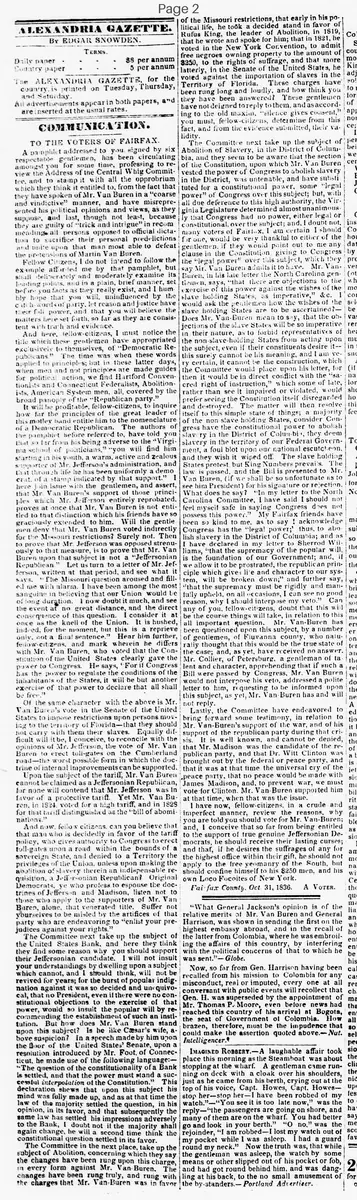
COMMUNICATION.
TO THE VOTERS OF FAIRFAX.
A pamphlet addressed to you, signed by six respectable gentlemen, has been circulating amongst you for some time, professing to review the Address of the Central Whig Committee, and to stamp it with all the opprobrium which they think it entitled to, from the fact that they have spoken of Mr. Van Buren in a "coarse and vindictive" manner, and have misrepresented his political opinions and views, as they suppose, and last, though not least, because they are guilty of "trick and intrigue" in recommending all persons opposed to official dictation to sacrifice their personal predilections and unite upon that man most able to defeat the pretensions of Martin Van Buren.
Fellow Citizens. I do not intend to follow the example afforded me by that pamphlet, but shall deliberately and moderately examine its leading points, and in a plain, brief manner, set before you facts as they really exist, and I humbly hope that you will, uninfluenced by the catch-words of party, let reason and justice have their full power, and that you will believe the matters here set forth, so far as they are consistent with truth and evidence.
And here, fellow-citizens, I must notice the title which these gentlemen have appropriated exclusively to themselves, of "Democratic Republicans." The time was when these words applied to principles; but in these latter days, when men and not principles are made guides for political action, we find Hartford Conventionists and Connecticut Federalists, Abolitionists, American System men, all, covered by the broad panoply of the "Republican party."
It will be profitable, fellow-citizens, to inquire how far the principles of the great leader of this motley band entitle him to the nomenclature of a Democratic Republican. The authors of the pamphlet before referred to, have told you that so far from his being adverse to the "Virginia school of politicians," "you will find him starting in his youth, a warm, active and zealous supporter of Mr. Jefferson's administration, and that through life he has been uniformly a democrat, of a stamp indicated by that support." I here join issue with the gentlemen, and assert, that Mr. Van Buren's support of those principles which Mr. Jefferson entirely reprobated, proves at once that Mr. Van Buren is not entitled to that distinction which his friends have so graciously extended to him. Will the gentlemen deny that Mr. Van Buren voted indirectly for the Missouri restrictions? Surely not. Then to prove that Mr. Jefferson was opposed strenuously to that measure, is to prove that Mr. Van Buren upon that subject is not a "Jeffersonian Republican." Let us turn to a letter of Mr. Jefferson, written at that period, and see what it says. "The Missouri question aroused and filled me with alarm. I have been among the most sanguine in believing that our Union would be of long duration. I now doubt it much, and see the event at no great distance, and the direct consequence of this question. I consider it at once as the knell of the Union. It is hushed, indeed, for the moment, but this is a reprieve only, not a final sentence." Hear him further, fellow-citizens, and mark wherein he differs with Mr. Van Buren, who voted that the Constitution of the United States clearly gave the power to Congress. He says, 'For if Congress has the power to regulate the conditions of the inhabitants of the States, it will be but another exercise of that power to declare that all shall be free.'
Of the same character with the above is Mr. Van Buren's vote in the Senate of the United States to impose restrictions upon persons moving to the territory of Florida—that they should not carry with them their slaves. Equally difficult will it be, I conceive, to reconcile with the opinions of Mr. Jefferson, the vote of Mr. Van Buren to erect toll-gates on the Cumberland road—the worst possible form in which the doctrine of internal improvements can be supported.
Upon the subject of the tariff, Mr. Van Buren cannot be claimed as a Jeffersonian Republican, for none will contend that Mr. Jefferson was in favor of a protective tariff. Yet Mr. Van Buren, in 1824, voted for a high tariff, and in 1828 for that tariff distinguished as the "bill of abominations."
And now, fellow citizens, can you believe that that man who is decidedly in favor of the tariff policy, who gives authority to Congress to erect toll-gates upon a road within the bounds of a sovereign State, and denied to a Territory the privileges of the Union, unless upon making the abolition of slavery therein an indispensable requisition, a Jeffersonian Republican? Original Democrats, ye who profess to espouse the doctrines of Jefferson and Madison, listen not to those who apply to the supporters of Mr. Van Buren, alone, that venerated title. Suffer not yourselves to be misled by the artifices of that party who are endeavoring to "enlist your prejudices against your rights."
The Committee next take up the subject of the United States Bank, and here they think they find some reason why you should support their Jeffersonian candidate. I will not insult your understandings by dwelling upon a subject which cannot, and I should think, will not be revived for years; for the burst of popular indignation against it was so decided and unequivocal, that no President, even if there were no constitutional objections to the exercise of that power, would so insult the popular will by recommending the establishment of such an institution. But how does Mr. Van Buren stand upon this subject? Is he like Cæsar's wife, above suspicion? In a speech made by him upon the floor of the United States' Senate, upon a resolution introduced by Mr. Foot, of Connecticut, he made use of the following language:—
The question of the constitutionality of a Bank is settled, and that the power must stand a successful interpolation of the Constitution. This declaration shews that upon this subject his mind was fully made up, and as at that time the law of the majority settled the question, in his opinion, in its favor, and that subsequently the same law has settled his impressions adversely to the Bank, I doubt not if the majority shall again change, he will a second time think the constitutional question settled in its favor.
The Committee in the next place, take up the subject of Abolition, concerning which they say the changes have been rung upon this charge, in every form against Mr. Van Buren. The changes have been rung truly, and rung with the charges that Mr. Van Buren was in favor of the Missouri restrictions, that early in his political life, he took a decided stand in favor of Rufus King, the leader of Abolition, in 1819, that he wrote and spoke for him; that in 1821, he voted in the New York Convention, to admit free negroes owning property to the amount of $250, to the rights of suffrage, and that more latterly, in the Senate of the United States, he voted against the importation of slaves in the Territory of Florida. These charges have been rung long and loudly, and how think you they have been answered? These gentlemen have not deigned to reply to them, and as according to the old maxim, "silence gives consent," you must, fellow-citizens, determine from this fact, and from the evidence submitted, their validity.
The Committee next take up the subject of Abolition of Slavery, in the District of Columbia, and they seem to be aware that the section of the Constitution, upon which Mr. Van Buren rested the power of Congress to abolish slavery in the District, was untenable, and have substituted for a constitutional power, some "legal power" of Congress over this subject; but, with all due deference to this high authority, the Virginia Legislature determined almost unanimously that Congress had no power, either legal or constitutional, over the subject; and, I doubt not many voters of Fairfax, I am certain I should for one, would be very thankful to either of the gentlemen, if they would point out to me any clause in the Constitution giving to Congress the "legal power" over this subject, which they say Mr. Van Buren admits it to have. Mr. Van Buren, in his late letter to the North Carolina gentlemen, says, "that there are objections to the exercise of this power against the wishes of the slave holding States, as imperative," &c. I would ask the gentlemen how the wishes of the slave holding States are to be ascertained?— Does Mr. Van Buren mean to say, that the objections of the slave States will be so imperative in their nature, as to forbid representatives of the non-slave-holding States from acting upon the subject, even if their constituents desire it— this surely cannot be his meaning, and I am very certain, it cannot be the construction, which the Committee would place upon his letter, for then it would be in direct conflict with the "sacred right of instruction," which some of late, rather than see it impaired or violated, would prefer seeing the Constitution itself disregarded and destroyed. The matter will then resolve itself to this simple state of things; a majority of the non slave holding States, consider Congress have the constitutional power to abolish slavery in the District of Columbia, they deem slavery in the territory of our Federal Government, a foul blot upon our national escutcheon, and they wish it wiped off. The slave holding States protest, but King Numbers prevails. The law is passed, and the Bill is presented to Mr. Van Buren, (if we shall be so unfortunate as to see him President) for his signature or rejection. What does he say? "In my letter to the North Carolina Committee, I have said I should not feel myself safe in saying Congress does not possess this power." My Fairfax friends have been so kind to me, as to say I acknowledge Congress has the "legal power;" thus, to abolish slavery in the District of Columbia; and as I have declared in my letter to Sherrod Williams, "that the supremacy of the popular will, is the foundation of our Government; and, if we allow it to be prostrated, the republican principle which gives life and character to our system, will be broken down;" and further say, "that the supremacy must be rigidly and manfully upheld, on all occasions. I can see no good reason, why I should interpose my veto." Can any of you, fellow-citizens, doubt that this will be the course things will take, in relation to this all important question. Mr. Van Buren has been questioned upon this subject, by a number of gentlemen, of Fluvanna county, who naturally thought that this would be the true state of the case; and, as yet, have received no answer. Mr. Collier, of Petersburg, a gentleman of talent and character, apprehending that if such a Bill were passed by Congress, Mr. Van Buren would not interpose his veto, addressed a polite letter to him, requesting to be informed upon this subject, as yet, Mr. Van Buren has and will not reply.
Lastly, the Committee have endeavored to bring forward some testimony, in relation to Mr. Van Buren's support of the war, and of his support of the republican party during that crisis. It is well known, and cannot be denied, that Mr. Madison was the candidate of the republican party, and that Dr. De Witt Clinton was brought out by the federal or peace party, and that it was at that time the universal cry of the peace party, that no peace would be made with James Madison, and, to prevent war, we must vote for Clinton. Mr. Van Buren supported him at that time, when that was the issue.
I have now, fellow-citizens, in a crude and imperfect manner, reviewed the reasons, why you are told you should vote for Mr. Van Buren; and, I conceive that so far from being entitled to the support of true genuine Jeffersonian Democrats, he should receive their lasting curses; and that, if he desires the suffrages of any for the highest office within their gift, he should not apply to the free yeomanry of the South, but should confine himself to his $250 men, and his own Loco Focoites of New York.
Fairfax County, Oct. 31, 1836. A VOTER.
TO THE VOTERS OF FAIRFAX.
A pamphlet addressed to you, signed by six respectable gentlemen, has been circulating amongst you for some time, professing to review the Address of the Central Whig Committee, and to stamp it with all the opprobrium which they think it entitled to, from the fact that they have spoken of Mr. Van Buren in a "coarse and vindictive" manner, and have misrepresented his political opinions and views, as they suppose, and last, though not least, because they are guilty of "trick and intrigue" in recommending all persons opposed to official dictation to sacrifice their personal predilections and unite upon that man most able to defeat the pretensions of Martin Van Buren.
Fellow Citizens. I do not intend to follow the example afforded me by that pamphlet, but shall deliberately and moderately examine its leading points, and in a plain, brief manner, set before you facts as they really exist, and I humbly hope that you will, uninfluenced by the catch-words of party, let reason and justice have their full power, and that you will believe the matters here set forth, so far as they are consistent with truth and evidence.
And here, fellow-citizens, I must notice the title which these gentlemen have appropriated exclusively to themselves, of "Democratic Republicans." The time was when these words applied to principles; but in these latter days, when men and not principles are made guides for political action, we find Hartford Conventionists and Connecticut Federalists, Abolitionists, American System men, all, covered by the broad panoply of the "Republican party."
It will be profitable, fellow-citizens, to inquire how far the principles of the great leader of this motley band entitle him to the nomenclature of a Democratic Republican. The authors of the pamphlet before referred to, have told you that so far from his being adverse to the "Virginia school of politicians," "you will find him starting in his youth, a warm, active and zealous supporter of Mr. Jefferson's administration, and that through life he has been uniformly a democrat, of a stamp indicated by that support." I here join issue with the gentlemen, and assert, that Mr. Van Buren's support of those principles which Mr. Jefferson entirely reprobated, proves at once that Mr. Van Buren is not entitled to that distinction which his friends have so graciously extended to him. Will the gentlemen deny that Mr. Van Buren voted indirectly for the Missouri restrictions? Surely not. Then to prove that Mr. Jefferson was opposed strenuously to that measure, is to prove that Mr. Van Buren upon that subject is not a "Jeffersonian Republican." Let us turn to a letter of Mr. Jefferson, written at that period, and see what it says. "The Missouri question aroused and filled me with alarm. I have been among the most sanguine in believing that our Union would be of long duration. I now doubt it much, and see the event at no great distance, and the direct consequence of this question. I consider it at once as the knell of the Union. It is hushed, indeed, for the moment, but this is a reprieve only, not a final sentence." Hear him further, fellow-citizens, and mark wherein he differs with Mr. Van Buren, who voted that the Constitution of the United States clearly gave the power to Congress. He says, 'For if Congress has the power to regulate the conditions of the inhabitants of the States, it will be but another exercise of that power to declare that all shall be free.'
Of the same character with the above is Mr. Van Buren's vote in the Senate of the United States to impose restrictions upon persons moving to the territory of Florida—that they should not carry with them their slaves. Equally difficult will it be, I conceive, to reconcile with the opinions of Mr. Jefferson, the vote of Mr. Van Buren to erect toll-gates on the Cumberland road—the worst possible form in which the doctrine of internal improvements can be supported.
Upon the subject of the tariff, Mr. Van Buren cannot be claimed as a Jeffersonian Republican, for none will contend that Mr. Jefferson was in favor of a protective tariff. Yet Mr. Van Buren, in 1824, voted for a high tariff, and in 1828 for that tariff distinguished as the "bill of abominations."
And now, fellow citizens, can you believe that that man who is decidedly in favor of the tariff policy, who gives authority to Congress to erect toll-gates upon a road within the bounds of a sovereign State, and denied to a Territory the privileges of the Union, unless upon making the abolition of slavery therein an indispensable requisition, a Jeffersonian Republican? Original Democrats, ye who profess to espouse the doctrines of Jefferson and Madison, listen not to those who apply to the supporters of Mr. Van Buren, alone, that venerated title. Suffer not yourselves to be misled by the artifices of that party who are endeavoring to "enlist your prejudices against your rights."
The Committee next take up the subject of the United States Bank, and here they think they find some reason why you should support their Jeffersonian candidate. I will not insult your understandings by dwelling upon a subject which cannot, and I should think, will not be revived for years; for the burst of popular indignation against it was so decided and unequivocal, that no President, even if there were no constitutional objections to the exercise of that power, would so insult the popular will by recommending the establishment of such an institution. But how does Mr. Van Buren stand upon this subject? Is he like Cæsar's wife, above suspicion? In a speech made by him upon the floor of the United States' Senate, upon a resolution introduced by Mr. Foot, of Connecticut, he made use of the following language:—
The question of the constitutionality of a Bank is settled, and that the power must stand a successful interpolation of the Constitution. This declaration shews that upon this subject his mind was fully made up, and as at that time the law of the majority settled the question, in his opinion, in its favor, and that subsequently the same law has settled his impressions adversely to the Bank, I doubt not if the majority shall again change, he will a second time think the constitutional question settled in its favor.
The Committee in the next place, take up the subject of Abolition, concerning which they say the changes have been rung upon this charge, in every form against Mr. Van Buren. The changes have been rung truly, and rung with the charges that Mr. Van Buren was in favor of the Missouri restrictions, that early in his political life, he took a decided stand in favor of Rufus King, the leader of Abolition, in 1819, that he wrote and spoke for him; that in 1821, he voted in the New York Convention, to admit free negroes owning property to the amount of $250, to the rights of suffrage, and that more latterly, in the Senate of the United States, he voted against the importation of slaves in the Territory of Florida. These charges have been rung long and loudly, and how think you they have been answered? These gentlemen have not deigned to reply to them, and as according to the old maxim, "silence gives consent," you must, fellow-citizens, determine from this fact, and from the evidence submitted, their validity.
The Committee next take up the subject of Abolition of Slavery, in the District of Columbia, and they seem to be aware that the section of the Constitution, upon which Mr. Van Buren rested the power of Congress to abolish slavery in the District, was untenable, and have substituted for a constitutional power, some "legal power" of Congress over this subject; but, with all due deference to this high authority, the Virginia Legislature determined almost unanimously that Congress had no power, either legal or constitutional, over the subject; and, I doubt not many voters of Fairfax, I am certain I should for one, would be very thankful to either of the gentlemen, if they would point out to me any clause in the Constitution giving to Congress the "legal power" over this subject, which they say Mr. Van Buren admits it to have. Mr. Van Buren, in his late letter to the North Carolina gentlemen, says, "that there are objections to the exercise of this power against the wishes of the slave holding States, as imperative," &c. I would ask the gentlemen how the wishes of the slave holding States are to be ascertained?— Does Mr. Van Buren mean to say, that the objections of the slave States will be so imperative in their nature, as to forbid representatives of the non-slave-holding States from acting upon the subject, even if their constituents desire it— this surely cannot be his meaning, and I am very certain, it cannot be the construction, which the Committee would place upon his letter, for then it would be in direct conflict with the "sacred right of instruction," which some of late, rather than see it impaired or violated, would prefer seeing the Constitution itself disregarded and destroyed. The matter will then resolve itself to this simple state of things; a majority of the non slave holding States, consider Congress have the constitutional power to abolish slavery in the District of Columbia, they deem slavery in the territory of our Federal Government, a foul blot upon our national escutcheon, and they wish it wiped off. The slave holding States protest, but King Numbers prevails. The law is passed, and the Bill is presented to Mr. Van Buren, (if we shall be so unfortunate as to see him President) for his signature or rejection. What does he say? "In my letter to the North Carolina Committee, I have said I should not feel myself safe in saying Congress does not possess this power." My Fairfax friends have been so kind to me, as to say I acknowledge Congress has the "legal power;" thus, to abolish slavery in the District of Columbia; and as I have declared in my letter to Sherrod Williams, "that the supremacy of the popular will, is the foundation of our Government; and, if we allow it to be prostrated, the republican principle which gives life and character to our system, will be broken down;" and further say, "that the supremacy must be rigidly and manfully upheld, on all occasions. I can see no good reason, why I should interpose my veto." Can any of you, fellow-citizens, doubt that this will be the course things will take, in relation to this all important question. Mr. Van Buren has been questioned upon this subject, by a number of gentlemen, of Fluvanna county, who naturally thought that this would be the true state of the case; and, as yet, have received no answer. Mr. Collier, of Petersburg, a gentleman of talent and character, apprehending that if such a Bill were passed by Congress, Mr. Van Buren would not interpose his veto, addressed a polite letter to him, requesting to be informed upon this subject, as yet, Mr. Van Buren has and will not reply.
Lastly, the Committee have endeavored to bring forward some testimony, in relation to Mr. Van Buren's support of the war, and of his support of the republican party during that crisis. It is well known, and cannot be denied, that Mr. Madison was the candidate of the republican party, and that Dr. De Witt Clinton was brought out by the federal or peace party, and that it was at that time the universal cry of the peace party, that no peace would be made with James Madison, and, to prevent war, we must vote for Clinton. Mr. Van Buren supported him at that time, when that was the issue.
I have now, fellow-citizens, in a crude and imperfect manner, reviewed the reasons, why you are told you should vote for Mr. Van Buren; and, I conceive that so far from being entitled to the support of true genuine Jeffersonian Democrats, he should receive their lasting curses; and that, if he desires the suffrages of any for the highest office within their gift, he should not apply to the free yeomanry of the South, but should confine himself to his $250 men, and his own Loco Focoites of New York.
Fairfax County, Oct. 31, 1836. A VOTER.
What sub-type of article is it?
Persuasive
Political
Investigative
What themes does it cover?
Politics
Slavery Abolition
Constitutional Rights
What keywords are associated?
Martin Van Buren
Jeffersonian Democrat
Missouri Restrictions
Protective Tariff
United States Bank
Abolition Slavery
Constitutional Power
Fairfax Voters
What entities or persons were involved?
A Voter
To The Voters Of Fairfax.
Letter to Editor Details
Author
A Voter
Recipient
To The Voters Of Fairfax.
Main Argument
martin van buren is not a true jeffersonian democrat, as evidenced by his votes supporting missouri restrictions, protective tariffs, internal improvements, the u.s. bank, and positions on abolition that contradict jefferson's principles; voters should oppose him.
Notable Details
Quotes Jefferson's Letter On Missouri Question
References Van Buren's Senate Votes On Florida Territory And Cumberland Road Toll Gates
Cites Van Buren's Speech On Bank Constitutionality
Notes Unanswered Queries From Fluvanna County And Mr. Collier