Thank you for visiting SNEWPapers!
Sign up free
Richmond Enquirer
Richmond, Richmond County, Virginia
What is this article about?
Account of Jacob Perkins' steam gun invention, praised in New York Post for ending sieges and revolutionizing navigation. Detailed London Times report on its powerful demonstration near Regent's Park, attended by Duke of Wellington and officers, shattering targets and proving superior to gunpowder.
Clipping
OCR Quality
Full Text
[From the London Times.]
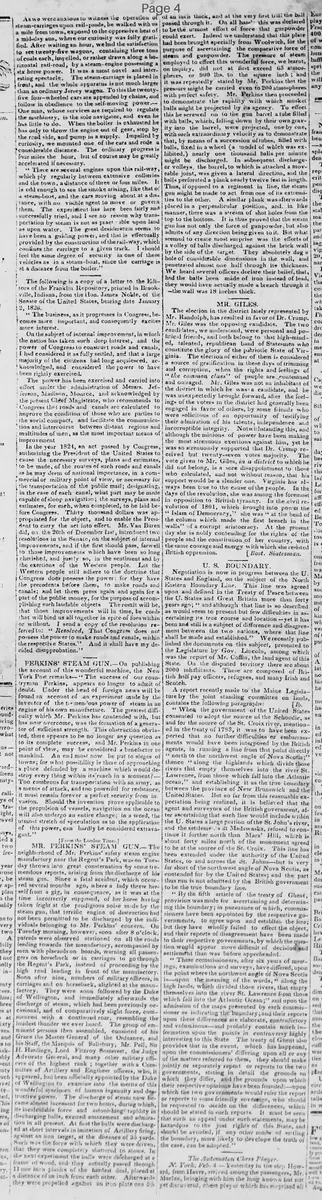
MR. PERKINS' STEAM GUN.--The neighborhood of Mr. Perkins' safety steam engine manufactory near the Regent's Park, was on Tuesday thrown into great consternation by some tremendous reports, arising from the discharge of his steam gun. Since a fatal accident, which occurred several months ago, where a lady threw herself from a gig, in consequence, as it was at the time incorrectly supposed, of her horse having taken fright at the prodigious noise made by the steam gun, that terrific engine of destruction had not been permitted to be discharged by the individuals belonging to Mr. Perkins' concern. On Tuesday morning, however, soon after 8 o'clock. patrols were observed stationed on all the roads leading towards the manufactory, accompanied by men with placards on boards, warning all passengers on horseback or in carriages to go through the Regent's Park, instead of proceeding by the high road leading in front of the manufactory. Soon after nine, numbers of military officers, in carriages and on horseback, alighted at the manufactory. They were soon followed by the Duke of Wellington, and immediately afterwards the discharge of steam, which had been previously occasional, and of comparatively slight force, commenced with a continued roar, resembling the loudest thunder we ever heard. The group of eminent persons then assembled, consisted of his Grace the Master General of the Ordnance, and his Staff, the Marquis of Salisbury, Mr. Pell, Sir H. Hardinge, Lord Fitzroy Somerset, the Judge Advocate General, and many other military officers of the highest rank ; together with a Committee of Artillery and Engineer officers, who, it appeared, had been officially appointed by the Duke of Wellington to examine into the merits of this wonderful specimen of human ingenuity and destructive power. The discharge of steam now became almost incessant for two hours, during which its incalculable force and astonishing rapidity in discharging balls, excited amazement and admiration in all present. At first the balls were discharged at short intervals in imitation of Artillery firing, against an iron target, at the distance of 30 yards. Such was the force with which they were driven, that they were completely shattered to atoms. In the next experiment the balls were discharged at a frame of wood, and they actually passed through 11 one inch planks of the hardest deal, placed at a distance of an inch from each other. Afterwards they were propelled against an iron plate one 1/4 of an inch thick, and at the very first trial the ball passed through it. On all hands this was declared to be the utmost effort of force that gunpowder could exert. Indeed we understand that this plate had been brought specially from Woolwich, for the purpose of ascertaining the comparative force of steam and gunpowder. The pressure of steam employed to effect this wonderful force, we learnt, on inquiry, did not at first exceed 65 atmospheres, or 900 lbs. to the square inch ; and it was repeatedly stated by Mr. Perkins that the pressure might be carried even to 200 atmospheres with perfect safety. Mr. Perkins then proceeded to demonstrate the rapidity with which musket balls might be projected by its agency. To effect this he screwed on to the gun barrel a tube filled with balls, which, falling down by their own gravity into the barrel, were projected, one by one, with such extraordinary velocity as to demonstrate that, by means of a succession of tubes, filled with balls, fixed in a wheel (a model of which was exhibited) nearly one thousand balls per minute might be discharged. In subsequent discharges or volleys, the barrel, to which is attached a movable joint, was given a lateral direction, and the balls perforated a plank nearly twelve feet in length. Thus, if opposed to a regiment in line, the steam gun might be made to act from one of its extremities to the other. A similar plank was afterwards placed in a perpendicular position, and, in like manner, there was a stream of shot holes from the top to the bottom. It is thus proved that the steam gun has not only the force of gunpowder, but also admits of any direction being given to it. But what seemed to create most surprise was the effects of a volley of balls discharged against the brick wall by the side of the target. They absolutely dug a hole of considerable dimensions in the wall, and penetrated almost one half through its thickness. We heard several officers declare their belief, that, had the balls been made of iron instead of lead, they would have actually made a breach through it --the wall was 18 inches thick.
What sub-type of article is it?
What themes does it cover?
What keywords are associated?
What entities or persons were involved?
Where did it happen?
Story Details
Key Persons
Location
Near The Regent's Park, London
Event Date
On Tuesday Morning
Story Details
Demonstration of Perkins' steam gun at his manufactory, attended by military officials including the Duke of Wellington; the gun shattered iron targets, penetrated wood and iron plates equivalent to gunpowder force, and fired rapidly up to 1000 balls per minute, proving its destructive power and versatility.