Thank you for visiting SNEWPapers!
Sign up free
Richmond Enquirer
Richmond, Richmond County, Virginia
What is this article about?
Congressional proceedings in Washington on Jan. 10.: Senate debates French Spoliations bill, grants committee meeting permission. House passes resolutions on pensions, quarantine mission, public lands sale; reconsiders Alexandria Canal; adjourns debate on Commodore Hull relief bill.
Clipping
OCR Quality
Full Text
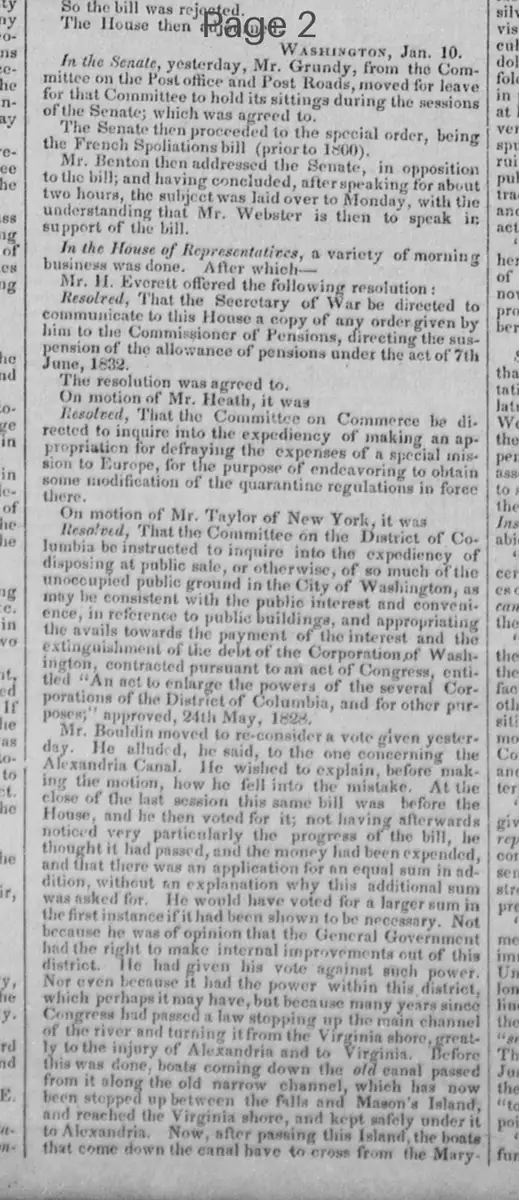
In the Senate, yesterday, Mr. Grundy, from the Committee on the Post office and Post Roads, moved for leave for that Committee to hold its sittings during the sessions of the Senate; which was agreed to.
The Senate then proceeded to the special order, being the French Spoliations bill (prior to 1800).
Mr. Benton then addressed the Senate, in opposition to the bill; and having concluded, after speaking for about two hours, the subject was laid over to Monday, with the understanding that Mr. Webster is then to speak in support of the bill.
In the House of Representatives, a variety of morning business was done. After which—
Mr. H. Everett offered the following resolution:
Resolved, That the Secretary of War be directed to communicate to this House a copy of any order given by him to the Commissioner of Pensions, directing the suspension of the allowance of pensions under the act of 7th June, 1832.
The resolution was agreed to.
On motion of Mr. Heath, it was
Resolved, That the Committee on Commerce be directed to inquire into the expediency of making an appropriation for defraying the expenses of a special mission to Europe, for the purpose of endeavoring to obtain some modification of the quarantine regulations in force there.
On motion of Mr. Taylor of New York, it was
Resolved, That the Committee on the District of Columbia be instructed to inquire into the expediency of disposing at public sale, or otherwise, of so much of the unoccupied public ground in the City of Washington, as may be consistent with the public interest and convenience, in reference to public buildings, and appropriating the avails towards the payment of the interest and the extinguishment of the debt of the Corporation of Washington, contracted pursuant to an act of Congress, entitled "An act to enlarge the powers of the several Corporations of the District of Columbia, and for other purposes;" approved, 24th May, 1828.
Mr. Bouldin moved to re-consider a vote given yesterday. He alluded, he said, to the one concerning the Alexandria Canal. He wished to explain, before making the motion, how he fell into the mistake. At the close of the last session this same bill was before the House, and he then voted for it; not having afterwards noticed very particularly the progress of the bill, he thought it had passed, and the money had been expended, and that there was an application for an equal sum in addition, without an explanation why this additional sum was asked for. He would have voted for a larger sum in the first instance if it had been shown to be necessary. Not because he was of opinion that the General Government had the right to make internal improvements out of this district. He had given his vote against such power. Nor even because it had the power within this district, which perhaps it may have, but because many years since Congress had passed a law stopping up the main channel of the river and turning it from the Virginia shore, greatly to the injury of Alexandria and to Virginia. Before this was done, boats coming down the old canal passed from it along the old narrow channel, which has now been stopped up between the falls and Mason's Island, and reached the Virginia shore, and kept safely under it to Alexandria. Now, after passing this Island, the boats that come down the canal have to cross from the Maryland shore, where the river is more than a mile wide, to the Virginia side, and cannot live in so wide a sheet of water. Then, though we should have no right to make internal improvement in or out of this district, still if we have done injury to any State, or any individual, we surely have the right to make the necessary amends, and ought to make them.
Mr. Whittlesey said that though the motion to re-consider was certainly in order, yet, as this day was set apart for the consideration of private bills, it would not be in order to set them aside to consider the motion, unless by a vote of two-thirds.
The Chair so decided, and the motion to re-consider was accordingly laid over, and the House proceeded to the consideration of
PRIVATE BILLS
and resumed the discussion of the bill for the relief of Commodore Hull. The question being on a motion to strike out the enacting clause of the bill.
The debate was renewed by Mr. Pearce of R. I., who spoke at length in opposition to the bill.
Mr. Burges replied, and advocated the bill with much zeal.
Mr. Parker spoke in opposition to the claim; and having concluded,
Mr. Binney expressed his desire to address the House for a short time on the subject before it, but would prefer doing so to-morrow. With a view to test the preference of the House as to the time, he moved an adjournment.
The motion carried by a large majority, and the House thereupon adjourned.
What sub-type of article is it?
What keywords are associated?
What entities or persons were involved?
Where did it happen?
Domestic News Details
Primary Location
Washington
Event Date
Jan. 10.
Key Persons
Outcome
committee granted leave to sit during sessions; french spoliations bill debate postponed to monday; resolutions on pensions, quarantine mission, and sale of public grounds agreed to; motion to reconsider alexandria canal vote laid over; debate on commodore hull relief bill adjourned.
Event Details
Senate: Committee on Post Office and Post Roads allowed to meet during sessions; debate on French Spoliations bill with Mr. Benton opposing and Mr. Webster to support later. House: Resolutions passed directing inquiries on pensions, European quarantine, and sale of Washington public grounds; motion to reconsider Alexandria Canal vote explained and laid over; private bills considered, including debate on Commodore Hull relief bill, adjourned after speeches.