Thank you for visiting SNEWPapers!
Sign up free
The Daily Union
Washington, District Of Columbia
What is this article about?
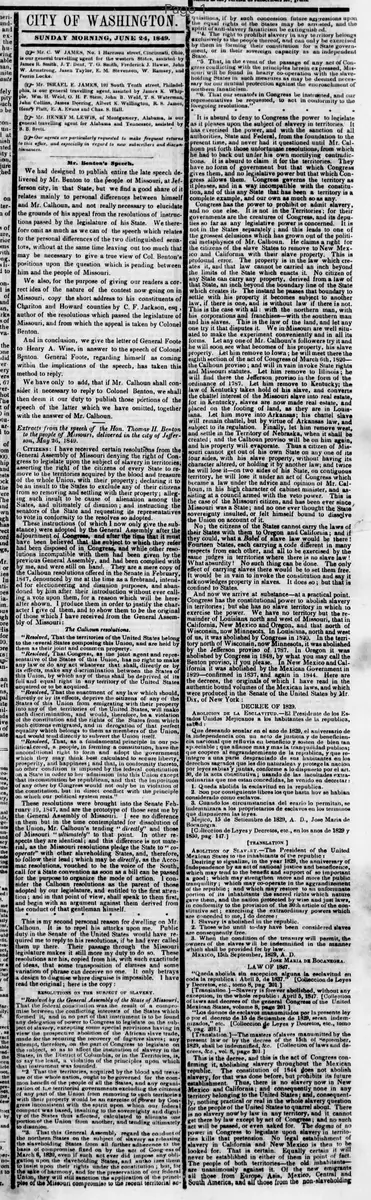
Newspaper article from 1849 publishing excerpts of Sen. Thomas H. Benton's speech in Jefferson City, MO, appealing against Missouri legislature's anti-slavery restriction resolutions modeled on Calhoun's, arguing they foster disunion. Includes Calhoun and Missouri resolutions, C.F. Jackson's defense, and Gen. Foote's critical letter to H.A. Wise.
Merged-components note: These components form a single continuous story on Mr. Benton's speech, spanning pages 1-3 with sequential reading order and matching content flow.
Clippings
1 of 3
OCR Quality
Full Text
We had designed to publish entire the late speech delivered by Mr. Benton to the people of Missouri, at Jefferson city, in that State, but we find a good share of it relates mainly to personal differences between himself and Mr. Calhoun, and not really necessary to elucidate the grounds of his appeal from the resolutions of instructions passed by the legislature of his State. We therefore omit as much as we can of the speech which relates to the personal differences of the two distinguished senators, without at the same time leaving out too much that may be necessary to give a true view of Col. Benton's positions upon the question which is pending between him and the people of Missouri.
We also, for the purpose of giving our readers a correct idea of the nature of the contest now going on in Missouri, copy the short address to his constituents of Chariton and Howard counties by C. F. Jackson, esq, author of the resolutions which passed the legislature of Missouri, and from which the appeal is taken by Colonel Benton.
And in conclusion, we give the letter of General Foote to Henry A. Wise, in answer to the speech of Colonel Benton. General Foote, regarding himself as coming within the implications of the speech, has taken this method to reply.
We have only to add, that if Mr. Calhoun shall consider it necessary to reply to Colonel Benton, we shall then deem it our duty to publish those portions of the speech of the latter which we have omitted, together with the answer of Mr. Calhoun.
Extracts from the speech of the Hon. Thomas H. Benton to the people of Missouri, delivered in the city of Jefferson, May 26, 1849.
Citizens: I have received certain resolutions from the General Assembly of Missouri denying the right of Congress to legislate upon the subject of slavery in territories; asserting the right of the citizens of every State to remove to the territories acquired by the blood and treasure of the whole Union, with their property; declaring it to be an insult to the States to exclude any of their citizens from so removing and settling with their property; alleging such insult to be cause of alienation among the States, and ultimately of disunion; and instructing the senators of the State and requesting its representatives to vote in conformity to the resolves so adopted.
These instructions (of which I now only give the substance) were adopted by the General Assembly after the adjournment of Congress, and after the time that it must have been believed that the subject to which they refer had been disposed of in Congress, and while other resolutions incompatible with them had been given by the previous General Assembly, and had been complied with by me, and were still on hand. They are a mere copy of the Calhoun resolutions offered in the Senate in February, 1847, denounced by me at the time as a firebrand, intended for electioneering and disunion purposes, and abandoned by him after their introduction without ever calling a vote upon them, for a reason which will be hereafter shown. I produce them in order to justify the character I give of them, and to show them to be the original of those which I have received from the General Assembly of Missouri:
The Calhoun resolutions.
"Resolved, That the territories of the United States belong to the several States composing this Union, and are held by them as their joint and common property.
"Resolved, That Congress, as the joint agent and representative of the States of this Union, has no right to make any law or do any act whatever that shall, directly or by its effects, make any discrimination between the States of this Union, by which any of them shall be deprived of its full and equal right in any territory of the United States acquired or to be acquired.
Resolved, That the enactment of any law which should, directly or by its effects, deprive the citizens of any of the States of this Union from emigrating with their property into any of the territories of the United States, will make such discrimination, and would, therefore, be a violation of the constitution and the rights of the States from which such citizens emigrated, and in derogation of that perfect equality which belongs to them as members of the Union, and would tend directly to subvert the Union itself.
Resolved, That, as a fundamental principle in our political creed, a people, in forming a constitution, have the unconditional right to form and adopt the government which they may think best calculated to secure liberty, prosperity, and happiness; and that, in conformity thereto, no other condition is imposed by the federal constitution on a State in order to her admission into this Union except that its constitution be republican, and that the imposition of any other by Congress would not only be in violation of the constitution, but in direct conflict with the principle on which our political system rests."
These resolutions were brought into the Senate February 19, 1847, and are the prototype of those sent me by the General Assembly of Missouri. I see no difference in them but in the time contemplated for dissolution of the Union, Mr. Calhoun's tending "directly" and those of Missouri "ultimately" to that point. In other respects they are identical; and this difference is not material, as the Missouri resolutions pledge the State to "co-operate" with other slaveholding States, and, therefore, to follow their lead; which may be directly, as the Accomac resolutions, vouched to be the voice of the South, call for a State convention as soon as a bill can be passed for the purpose to organize the mode of action. I consider the Calhoun resolutions as the parent of those adopted by our legislature, and entitled to the first attention; and in that point of view, shall speak to them first, and begin with an argument against them derived from the conduct of that gentleman himself.
This is my second personal reason for dwelling on Mr. Calhoun. It is to repel his attacks upon me. Public duty in the Senate of the United States would have required me to reply to his resolutions, if he had ever called them up there. Their passage through the Missouri legislature makes it still more my duty to do so. These resolutions are his, copied from his, with such exactitude of ideas, that some transposition of clauses and some variation of phrase can deceive no one. It only betrays a design to disguise where disguise is impossible. I have read the original; here is the copy:
RESOLUTIONS ON THE SUBJECT OF SLAVERY.
"Resolved by the General Assembly of the State of Missouri, That the federal constitution was the result of a compromise between the conflicting interests of the States which formed it, and in no part of that instrument is to be found any delegation of power to Congress to legislate on the subject of slavery, excepting some special provisions having in view the prospective abolition of the African slave trade, made for the securing the recovery of fugitive slaves; any attempt, therefore, on the part of Congress to legislate on the subject, so as to affect the institution of slavery in the States, in the District of Columbia, or in the Territories, is, to say the least, a violation of the principles upon which that instrument was founded.
"2. That the territories, acquired by the blood and treasure of the whole nation, ought to be governed for the common benefit of the people of all the States, and any organization of the territorial governments excluding the citizens of any part of the Union from removing to such territories with their property would be an exercise of power by Congress inconsistent with the spirit upon which our federal compact was based, insulting to the sovereignty and dignity of the States thus affected, calculated to alienate one portion of the Union from another, and tending ultimately to disunion.
"3. That this General Assembly regard the conduct of the northern States on the subject of slavery as releasing the slaveholding States from all further adherence to the basis of compromise fixed on by the act of Congress of March 6, 1820, even if such act ever did impose any obligation upon the slaveholding States, and authorizes them to insist upon their rights under the constitution; but, for the sake of harmony, and for the preservation of our federal Union, they will still sanction the application of the principles of the Missouri compromise to the recent territorial acquisitions.
"4. That, believing the right of property in slaves to be guaranteed by the constitution, and secured to the slaveholding States by compact, this General Assembly will, on all suitable occasions, resist all attempts to deprive them of this right, and will make all reasonable concessions, if by such concession future aggressions upon the equal rights of the States may be arrested, and the spirit of anti-slavery fanaticism be extinguished.
The right to prohibit slavery in any territory belongs exclusively to the people thereof, and can only be exercised by them in forming their constitution for a State government, or in their sovereign capacity as an independent State.
"5. That, in the event of the passage of any act of Congress conflicting with the principles herein expressed, Missouri will be found in hearty co-operation with the slaveholding States in such measures as may be deemed necessary for our mutual protection against the encroachment of northern fanaticism.
"6. That our senators in Congress be instructed, and our representatives be requested, to act in conformity to the foregoing resolutions."
"It is absurd to deny to Congress the power to legislate as it pleases upon the subject of slavery in territories.' It has exercised the power, and with the sanction of all authorities, State and Federal, from the foundation to the present time, and never had it questioned until Mr. Calhoun put forth those unfortunate resolutions, from which he had to back out under his own mortifying contradictions. It is absurd to claim it for the territories. They have no form of government but that which Congress gives them, and no legislative power but that which Congress allows them. Congress governs the territory as it pleases, and in a way incompatible with the constitution, and of this any State that has been a territory is a complete example, and our own as much so as any.
Congress has the power to prohibit or admit slavery, and no one else. It is not in the Territories; for their governments are the creatures of Congress, and its deputies so far as any legislative power is concerned. It is not in the States separately; and this leads to one of the grossest delusions which has grown out of the political metaphysics of Mr. Calhoun. He claims a right for the citizens of the slave States to remove to New Mexico and California with their slave property. This is profound error. The property is in the law which creates it, and that law cannot be carried an inch beyond the limits of the State which enacts it. No citizen of any State can carry any property, derived from a law of that State, an inch beyond the boundary line of the State which creates it. The instant he passes that boundary to settle with his property it becomes subject to another law, if there is one, and is without law if there is not. This is the case with all: with the northern man, with his corporations and franchises—with the southern man and his slaves. This is the law of the land, and let any one try it that disputes it. We in Missouri are well situated to make the experiment conveniently and in all its forms. Let any one of Mr. Calhoun's followers try it and he will soon see what becomes of his property, his slave property. Let him remove to Iowa; he will meet there the eighth section of the act of Congress of March 6th, 1820—the Calhoun proviso; and will in vain invoke State rights and Missouri statutes. Let him remove to Illinois; he will find there the Jefferson proviso in the form of the ordinance of 1787. Let him remove to Kentucky; the law of Kentucky takes hold of his slave, and converts the chattel interest of the Missouri slave into real estate, for in Kentucky, slaves are now made real estate, and placed on the footing of land, as they are in Louisiana. Let him move into Arkansas; his chattel slave will remain chattel but by virtue of Arkansas law and subject to its regulation. Finally, let him remove west, and settle in the Territory of Nebraska, when it shall be created; and the Calhoun proviso will be on him again, and his property will evaporate. Thus a citizen of Missouri cannot get out of his own State on any one of its four sides, with his slave property, without having its character altered, or holding it by another law; and twice he will lose it—on two sides of his State, on contiguous territory, he will lose it under an act of Congress which became a law under the advice and opinion of Mr. Calhoun, in his high character of cabinet minister, and assisting at a council armed with the veto power. This is the case of the Missouri citizen, and has been ever since Missouri was a State; and no one ever thought the State sovereignty insulted, or felt himself bound to dissolve the Union on account of it.
No: the citizens of the States cannot carry the laws of their States with them to Oregon and California; and if they could, what a Babel of slave law would be there! Fourteen States, each carrying a code different in many respects from each other, and all to be exercised by the same judges in territories where there is no slave law! What absurdity! No such thing can be done. The only effect of carrying slaves there would be to set them free. It would be in vain to invoke the constitution and say it acknowledges property in slaves. It does so; but that is confined to States.
And now we arrive at substance—at a practical point. Congress has the constitutional power to abolish slavery in territories; but she has no slave territory in which to exercise the power. We have no territory but the remainder of Louisiana north and west of Missouri that in California, New Mexico and Oregon, and that north of Wisconsin, now Minnesota. In Louisiana, north and west of us, it was abolished by Congress in 1820. In the territory north of Wisconsin, now Minnesota, it was abolished by the Jefferson proviso of 1787. In Oregon it was abolished by Congress in 1848, by what you may call the Benton proviso, if you please. In New Mexico and California it was abolished by the Mexican Government in 1829 confirmed in 1837, and again in 1844. Here are the decrees, the originals of which I have read in the authentic bound volumes of the Mexican laws, and which were produced in the Senate of the United States by Mr. Dix, of New York :
DECREE OF 1829.
Abolicion De LA Esclavitud.—El Presidente de los Estados Unidos Mejicanos a los habitantes de la republica, sabed :
Que deseando senalar en el ano de 1829, el aniversario de la independencia con un acto de justicta y de beneficencia nacional que refluvia en beneficio y sosten de bien tan apreciable; que afiance mas y mas la tranquilidad publica; que coopere al engrandecimiento de la republica, y que reintegre a una parte desgraciado de sus habitantes en los derechos sagrados que les dio naturaleza y protege la nacion por leyes sabias y justas, conforme a lo dispuesto por el art. 30, de la acta constitutiva; usando de las facultades extraordinarias que me estan concedidas, he venido en decretar:
I. Queda abolida la esclavitud en la republica.
2. Son por consiguiente libres los que hasta hoy se habian considerado como esclavos.
3. Cuando los circumstancias del erario lo permitan, se indemnizara a los proprietarios de esclavos en los terminos que dispusieren las leyes.
Mejico, 15 de Setiembre de 1829, A. D., Jose Maria de Bocanegra.
[Colleccion de Leyes y Decretos, etc., en los anos de 1829 y 1830, pag. 147.]
[TRANSLATION]
ABOLITION OF SLAVERY.—The President of the United Mexican States to the inhabitants of the republic:
Desiring to signalize, in the year 1829, the anniversary of Independence by an act of national justice and beneficence, which may tend to the benefit and support of so important a good; which may strengthen more and more the public tranquillity; which may co-operate in the aggrandizement of the republic; and which may restore to an unfortunate portion of its inhabitants the sacred rights which nature gave them, and the nation protected by wise and just laws, in conformity to the provision of the 30th article of the constitutive act; exercising the extraordinary powers which are conceded to me, I do decree:
1. Slavery is abolished in the republic.
2. Those who until to-day have been considered slaves are consequently free.
3. When the condition of the treasury will permit, the owners of the slaves will be indemnified in the manner which shall be provided for by law.
Mexico, 15th September, 1829, A. D.
Jose Maria De Bocanegra.
LAW OF 1837.
"Queda abolida sin excepcion alguna la esclavitud en toda la republica: Abril 5, de 1837.
[Colleccion de Leyes y Decretos, etc., tomo 8, pag 201.]
[Translation.]—Slavery is forever abolished, without any exception, in the whole republic: April 5, 1837. (Collection of laws and decrees of the general Congress of the United Mexican States, volume 8, page 201)
'Los duenos de esclavos manumitidos por la presente ley o por el decreto de 15 de Setiembre de 1829, seran indemnizados," etc.
(Colleccion de Leyes y Decretos, etc., tomo 8, pag. 201.)
[Translation.]—The masters of slaves manumitted by the present law or by the decree of the 15th of September, 1829, shall be indemnified, &c.
[Collection of laws and decrees, &c., vol 8, page 201.]
This is the decree, and this is the act of Congress confirming it, abolishing slavery throughout the Mexican republic. The constitution of 1844 does not abolish slavery, for that was done before, but prohibits its future establishment.
Thus there is no slavery now in New Mexico and California; and consequently none in any territory belonging to the United States; and, consequently, nothing practical or real in the whole slavery question for the people of the United States to quarrel about. There is no slavery now by law in any territory, and it cannot get there by law except by act of Congress; and no such act will be passed, or even asked for. The dogma of no power in Congress to legislate upon slavery in territories kills that pretension. No legal establishment of slavery in California and New Mexico is then to be looked for. That is certain. Equally certain it will never be established in either of them in point of fact. The people of both territories—the old inhabitants—all those from Europe, Asia, Mexico, Central and South America, and all those from the non-slaveholding States, are unanimously against it.
part of the United States, will be unanimously against it.
There remains, then, to overbalance all this unanimous the United States in itself the smallest branch of the mass only the emigrants from the slaveholding parts of emigration, and it divided on the question—many going for the express purpose of getting rid of slavery, and very few so far in love with it as to go that distance for the pleasure of having a law suit with his own negro, and with the certainty of coming out second best in the contest. There is then no slavery at this time, either in New Mexico or California, in law or in fact. What, then, is all the present uproar about? Abstraction, the abstract right of doing what cannot be done; the insult to the sovereignty of the States where there is no insult! All abstraction, and no reality, substance, or practice in it.
The Romans had a class of disputes which they called de lana caprina, that is to say, about goat's wool; and as the goat has no wool, the dispute was about nothing. So it is of this dispute among us about excluding slavery from New Mexico and California. There is none there to exclude; and the dispute now raging is about nothing.
The Missouri resolutions were copied from those of Calhoun; and I do not believe there exceeded half a dozen members in the two Houses, all told, who were in the secret either of the origin or design of that proceeding. They were copied from Calhoun; and to see their design, you must know his. His were aimed at the Union—at the harmony and stability of the Union, and at the members of the slaveholding States who would not follow his lead—myself especially. This makes it my duty to speak of him, and to show his design in bringing forward the resolutions from which he was so suddenly backed out in the Senate, and which some half dozen members have succeeded in passing through the Missouri legislature. This carries me rather far back; but I will make rapid work, and short work.
In his new-born zeal, then, to please the North he shot ahead—he must always be ahead—beating Woodbury, Buchanan, and other northern senators in his votes and speeches on the northern side of the question. Some view of this may be seen in my speech on the Ashburton treaty. But the subject requires a separate examination, and shall receive it, but not now. It will be a curious episode, and will place Mr. Calhoun a second time where he was in 1819-'20, on the northern side of the slave question; but only for a brief space. Mr. Van Buren preferred to try to be his own successor; and the Texas treaty having gone over without making its author President, and the Mexican war promising a large crop of popular presidential candidates, a new political test became necessary, and, the tariff question being settled by the act of 1846, a recourse to slavery and abolition became indispensable. Hence the firebrand resolutions of 1847—a firebrand which has had the singular fate of dying out where it was put, and of raising a conflagration a thousand miles off.
The design of these resolutions is now the question; and that design is apparent in the character and words of the resolutions themselves; in the previous course of Mr. Calhoun, which I have just faintly sketched; and in his subsequent conduct, which is yet to be exhibited. The resolutions, then, point directly to the subversion of the Union—it is their language—and for what cause? For a cause so absurd and unfounded, so contradicted by his own conduct, and by the whole action of the government, from its foundation to the present day, that, being confronted with his own conduct, he has never dared to ask a vote upon his resolutions.
I have no new opinions to express about the design of those resolutions. I gave my opinion of them at the time they were introduced, and in many ways, and, among the rest, in a letter to the people of Oregon, and another to the people of Howard county. The people of Oregon had formed a provisional government, and inserted in their articles of government a fundamental act for the prohibition of slavery, copied from the Jefferson proviso of 1787. The House of Representatives had passed a bill (at the session of '46-47) to establish a territorial government for Oregon, sanctioning their articles of government with the proviso against slavery in it. This bill was defeated in the Senate, just twelve days after Mr. Calhoun brought in his firebrand resolutions; and, in giving an account of that defeat to the people of Oregon, in a letter which was then published, I said:
"Your fundamental act against that institution, copied from the ordinance of 1787—the work of the South in the great day of the South, prohibiting slavery in a territory far less northern than yours—will not be abrogated! Nor is that the intention of the prime mover of the amendment. Upon the record, the Judiciary Committee of the Senate is the author of that amendment; but not so the fact. That committee is only midwife to it. Its author is, the same mind that generated the 'firebrand resolutions' of which I send you a copy; and the amendment is its legitimate derivation. Oregon is not the object! The most rabid propagandist of slavery cannot expect to plant it on the shores of The Pacific, in the latitude of Wisconsin and the Lake of the Woods. A home agitation, for election and disunion purposes, is all that is intended by thrusting that firebrand question into your bill, and, at the next session, when it is thrust in again, we will scourge it out."
A home agitation for election and disunion purposes, is what I told them the object of these resolutions was. Cass and Butler were defeated upon tests framed out of these resolutions; but the election part of the object was against all northern men, and to bring forward Mr. Calhoun himself as the southern candidate. Failing in this object to get himself nominated, the next design of the resolutions came into play; and this brings me to the meeting of southern members of Congress, got up and conducted by Mr. Calhoun. It was a meeting with closed doors. Every citizen, not an actual member from a slaveholding State, was excluded—even Mr. Bibb, of Kentucky, a former senator, and who was turned out under the special decision of Mr. Calhoun himself. Members came upon invitation. I was not invited, and would not have gone if I had been. Gen. Houston was not invited, but went without invitation, and moved the opening of the doors to the public, which was voted down. I have been told that disunion was expressly discussed; and that would seem to flow, as a regular consequence, from the fundamental proposition of the original address, drawn up by Mr. Calhoun, and assimilating its importance to the declaration of wrongs which separated the American colonies from Great Britain, and giving a higher importance to the present crisis, as going beyond the former, and involving not merely rights, but life and property—every thing; the safety of the South, and all.
The paragraph which contained this declaration was this:
"We, whose names are hereunto annexed, address you in discharge of what we believe to be a solemn duty, on the most important subject ever presented for your consideration, not excepting the declaration which separated you and the other united colonies from the parent country. That involved your independence; but this your all, not excepting even your safety. We allude to the conflict between the two great sections of the Union, growing out of a difference of feeling and opinion in reference to the relation existing between the two races, the European and African, which inhabit the southern section, and the acts of aggression and encroachment to which it has led."
From this strong language, exalting the crisis above that of the revolution, it would naturally be supposed that the remedy was to be the same; and so it was understood by many, and the words struck out. The same conclusion would seem naturally to result from a concluding part of the address, in which unanimity was invoked, consequences disregarded, the Union treated as hypothetically worse than useless; called a sword to assault, and not a shield to defend; and in which it was left to the North to count its value. This is the paragraph which contained these expressions:
"As the assailed, you would stand justified by all laws, human and Divine, in repelling a blow so dangerous, without looking to consequences, and to resort to all means necessary for that purpose. Your assailants, and not you, would be responsible for consequences. It would be for them, and not for you, to count the value of the Union. Without your rights it would be worse than useless—a sword to assault, and not a shield to defend you."
The most significant of these phrases were struck out doubtless because they more than squinted—in fact looked straight—at disunion. The striking out of these passages shows that the majority of the meeting dissented from Mr. Calhoun's views, and caused to be expunged from his address the anti-union passages. The majority were doubtless in favor of preserving the Union; but that is not the present inquiry. The present inquiry is into Mr. Calhoun's designs—his design in his resolutions of February, 1847; and everything that occurred in the meeting, and especially the passages expunged from his address, show that his deliberate design was what his resolutions hypothetically imported—the subversion of the Union.
The paragraph assimilating the condition of the South in relation to the North to that of the colonies at the Declaration of Independence, was awfully significant and dreadfully false. No wonder it was expunged. Compare the list of grievances which he drew up, and which constitute the staple of his address that was published—compare this with the list of grievances against Great Britain, drawn by Mr. Jefferson and prefixed to the Declaration of Independence—and then see what truth there was in Mr. Calhoun's reckless comparison. According to his assertion, the southern grievances were not only equal, but greater than those enumerated by Mr. Jefferson.
The Declaration of Independence is in every house; but there is another place where the list is more perfect—the preamble to the constitution of Virginia, also drawn by Mr. Jefferson, and where an item suppressed in the National Declaration of Independence, to gratify some extreme southern friends, was retained in all its vigor by his native State. That item was this:
"By prompting our negroes to rise in arms among us—those very negroes whom, by an inhuman use of his negative, he hath refused us permission to exclude by law."
What a contrast! The King's refusal to authorize the exclusion of slaves from Virginia, then one of the causes of separation, inserted in her declaration of wrongs, prefixed to her constitution—the nominal exclusion by law of slavery from a territory where it is not and cannot be, now cause of separation of the southern from the northern States! Surely the Father of his Country had in his mind's eye this address of Mr. Calhoun when, in his farewell to his children, he warned them against the misrepresentations of designing men, who, for their own ends, would raise up sectional differences for the purpose of alienating one part of the Union from another. His prophetic vision foresaw the present state of things when he wrote this paragraph:
"In contemplating the causes which may disturb our Union, it occurs, as a matter of serious concern, that any ground should have been furnished for characterizing parties by geographical discriminations—northern and southern, Atlantic and western—whence designing men may endeavor to excite a belief that there is real difference of local interests and views. One of the expedients of party, to acquire influence within particular districts, is to misrepresent the opinions and aims of other districts. You cannot shield yourselves too much against the jealousies and heart-burnings which spring from these misrepresentations: they tend to render alien to each other those who ought to be bound together by fraternal affection."
The malediction of the Father of his Country falls upon Calhoun—falls upon the twenty years' promoter of hatred and alienation between the North and the South. But, why multiply proofs? From the fullness of the heart the mouth speaketh, and for twenty years the mouth of Calhoun has poured forth the language of disunion. Surely the Holy Scriptures are right: and deadly enmity to the Union must be in that heart from which its death knell is daily sounded.
Mr. Calhoun is balked in his mode of proceeding. He finds a difficulty in the first step. The experience of the first nullification has convinced him that one State, and that a small one, is too narrow a foundation to build upon. He needs a broader foundation: and ever since the Texas annexation treaty of '1844 he has manœuvred for a Southern Convention, in order to unite all the southern States under his control. He wants a convention. He is great upon a small body, where he can work upon individuals in detail and by units. He is great then A Southern Convention was his plan at the rejection of the Texas treaty in 1844: I contributed to break up that plan. At the passing of the Oregon bill in the summer of 1844 he tried for the convention again: and a subscription paper was cautiously circulated in the House of Representatives for signatures. It was "no go." But few subscribers were got, and the paper was suppressed. This brings us to the last winter's work—the meeting convened of the members of Congress from the slaveholding States. Its object has been stated, and I do not repeat it. I only name it as a part of the machinery for getting up a Southern Convention. It was in fact a sort of a Southern Convention itself—a caucus convention—intended to pave the way for the real convention, and to call it. It was intended to combine whigs and democrats, and bring the whole under the control of the head contriver. It was a failure. The whigs hauled off from it: only a part of the democracy remained, and many of them for innocent and laudable purposes. Nothing came from this Congress convention but an emasculated address deprived of the venom in its head and of the sting in its tail, and proposing nothing. The contrivance for the Southern Convention had failed again: and his last resource was in State legislatures and county meetings. The firebrand resolutions were to be adopted in State legislatures, and county meetings got up to stimulate the people. I omit other States. The resolutions were adopted in Missouri immediately after the failure of the Congress caucus, and after the publication of the address—about as soon as they could be known. The resolutions had laid in a torpid state all the winter. They slept during the time they should have been awake, and in my hands at Washington, if they were intended for my guidance. They were passed after Congress adjourned, and the county meetings immediately started. This was in accordance with the practice elsewhere; and, if they still go on, should conform to Accomac, which have at least the merit of doing a wrong thing in the right way. They propose a convention of the State, to be called at a special session of the General Assembly, to decide fundamentally on the course of action. That at least is consulting the people fairly, and giving them a chance to decide understandingly. This is their resolution:
"Resolved, That the danger of the State, and the safety and welfare of the people of Virginia, call for a convention, to be assembled as soon as the legislature can pass a bill for that purpose, to determine upon the whole question of encroachment by the federal government, and by the free-soil States and the people of the North on the institution of slavery in the States, Territories, and districts of the United States; that it is full time for the State to decide what will be its sovereign action finally on this subject; and to inform its citizens and subjects whether they will be authorized to resist, if they are required by federal legislation to submit to the oppression of a majority in Congress, and that a State convention, organized according to law, can best settle the rule of conduct for the citizen."
The Accomac meeting reports its proceedings to Mr. Calhoun; and that is right again. He is the chief of the movement, and his adjuncts should report to him. I deem it most unfortunate that the General Assembly of Missouri should have adopted Mr. Calhoun's resolutions. I am certain not six members of the body had the scienter of their origin and design, or meant harm to the country or myself. But that is no impediment to their evil effect. They are the act of the General Assembly. Upon the record, they are the will of the State. Abroad, they are the pledge of the State to back Mr. Calhoun in his designs—to put the State under his lead—and to stop my opposition to his mad career. And although I know that the event will deceive his hopes, yet the mischief will be done, in the fatal encouragement he will receive before another General Assembly can correct the error.
I consider my proposition—the one with which I commenced my speech—now made good, namely, that the resolutions of the General Assembly of which I complain are copied from those of Mr. Calhoun—that to understand their design you must understand his design—and that, from the words of his own resolution, and from his conduct for twenty years past, the subversion of the Union is intended. In the execution of this design I cannot be an instrument, nor can I believe that the people or the mass of the General Assembly wish it; and I deem it right to have a full understanding with my constituents on the whole matter.
I therefore appeal from the instructions I have received, because they are in conflict with instructions already received and obeyed—because they did not emanate from any known desire or understood will of the people—because they contain unconstitutional expositions of the constitution which I am sworn to support—because they require me to promote disunion—because they pledge the State to co-operate with other States in eventual civil war—because they are copied from resolutions hatched for great mischief, which I have a right to oppose, and did oppose in my place of senator in the Senate of the United States, and which I cannot cease opposing without personal disgrace and official dereliction of public duty—and because I think it due to the people to give them an opportunity to consider of proceedings so gravely affecting them, and on which they have not been consulted.
I appeal to the people—the whole body of the people. It is a question above party, and should be kept above it. I mean to keep it there.
And now I have a secret to tell in relation to these resolutions, which I have guarded long enough. I marked their first appearance in the General Assembly, knew their origin and design, and determined to let them go on. It so happens that there are a few citizens in this State, successors to others who have passed away, and who are denominated, in the Accomac resolutions, adjuncts to Mr. Calhoun. The denomination is appropriate. Adjunct (English) is from ad and junctus, (Latin,) and signifies joined to; which this set of citizens seems to be both soul and body, with respect to their southern leader. These few are in a state of permanent conspiracy against me, either on their own account or that of their "leading friend at the South," or both, and hatch a perpetual succession of plots against me. To go no further back, I refer to the summer of 1844, and the plot on the Texas annexation question, which I will call the jewsharp plot in consideration of the music which was to be then made upon that instrument, and to discriminate it from others. That plot showed its head, but hid itself afterwards. It failed, and its contrivers went back into their perpetual state of incubation. When the Calhoun resolutions were moved in the General Assembly—at the commencement of the session—I saw that a new plot was hatching, and determined to let it quit the shell. I knew that if I gave a hint of what they were about—if I had communicated the tithe of what I have said to you to-day, it would have stopped the proceeding. But that would have done me no good. It would only have postponed and changed the form of the work. I determined to let it go on, and to do nothing to alarm the operators; and for that reason wrote not a word—not a word on the subject—to any one of the hundred members who would have blown the resolutions sky-high if they had known their origin and design. I did not even answer a letter from my friend who sits there, (Lieutenant Governor Price.) The resolutions were introduced at the very beginning of the session; they lay torpid until its end. The plotters were waiting for the signal from the "leading friend"—waiting the Calhoun address. The moment they got it they acted, although it was too late for the resolutions to have the effect of instructions. They were passed after Congress had adjourned, and after it must have been believed that the subject to which they relate had been disposed of; for it was notorious that the territorial government bills were in process of enactment, and in fact they only failed after midnight on the last night of the session, and that on disagreement between the two houses; and their failure, on the 3d of March, was not known at Jefferson on the 7th, the day of passing the resolutions. It was too late to pass the resolutions for the purpose of instructing me how to vote at Washington. It was too late for that, but was early enough for the summer campaign at home; and therefore they were passed. And now I have them! I mean the plotters; and between them and me, henceforth and forever, a high wall and a deep ditch, and no communion, no compromise, no caucus with them. Nor does it require any boldness on my part to give them defiance. There are only about a dozen of them—a baker's dozen perhaps—and half of them outside of the legislature. Woe to judges, if any such there are in this work! The children of Israel could not stand the government of judges; nor can we.
Citizens, I have patriotic friends which I proposed to people; but there are other matters upon which my constituents desire to hear from me, and in which desire it is right they should be gratified.
"Barnburner!" And what did I go to New York for last summer but to use my utmost exertions to prevent Mr. Van Buren and his friends from engaging in the Buffalo Convention? I went there; that is certain. My public speeches show that I went for that object, and the newspapers in the interest of those called barnburners, all assailed me for doing so, not with billingsgate and as blackguards, but with keen reproaches for coming out of my State, contrary to the practice of my life, to interfere in the politics of another State, and that against those who had always been my friends. My answer was, that I came to use the privilege of an old friend; to give my opinion that the separate organization contemplated was wrong in principle, and would be injurious to those engaged in it; and, what was more, injurious to the great party to which they belonged. Such was the object of my visit to New York, and such my reception The event disappointed my hopes and expectations and I had my trouble for my pains, and a good deal of newspaper condemnation into the bargain. All this was public and notorious, published in all the newspapers, and known to everybody. There is not a man in Missouri that does not know it. And now what are we to think of the language applied to me? Why, that it is a most excellent thing for me. It shows the character of the plotters, and that they will nullify and falsify public recorded history to vilify me.
"The Wilmot proviso!" Well, I think it is the Jefferson proviso—the same that Mr. Jefferson drew up for the Northwestern Territory in 1784—which was adopted in the Congress of the Confederation in 1787, with the unanimous voice of the slaveholding States—was ratified by the Virginia General Assembly the 30th of December 1788—which was applied by the Congress of 1820 to all the upper half of Louisiana—which was applied by the Congress of 1848 to the Oregon Territory—which was recommended for the new territories by the Missouri General Assembly on the 15th of February, 1847—and never attempted to be condemned until Friday. (a day of omen,) the 19th of February, 1847, just four days after the date of the Missouri recommendations, when Mr. Calhoun brought in his resolutions declaring it unconstitutional, insulting to the States, and subversive of the Union. I think Mr. Jefferson, and not Davy Wilmot, was the author of this proviso, and that it should bear his name, and not Davy's.
With respect to the character of the proviso, if it should be prescribed by Congress for any new territory, I think it will remain just what it has been for sixty years—a constitutional provision, made in pursuance of the constitution; and that, being so made, it is binding upon all law-abiding citizens, and that its resistance by force and arms, militarily, would be high treason against the United States, and punishable by death under the laws of the land. With respect to the expediency of the act, there is no necessity for it, and there are prudential reasons why it should not be passed. California and New Mexico are now free from slavery, both by law and by fact, and will forever remain free from it, both by law and in fact. As a general proposition, unnecessary laws ought not to be passed; but if it is passed, it is an empty provision, having no practical effect whatever. To make an issue against it between North and South is unwise, for it is an issue about nothing, and, on the part of the South, an issue made for defeat; for Delaware has instructed for it, and that insures a majority in the Senate for the proviso, there being already a large majority in the House of Representatives instructed for it.
"My opinions." They are wanted. Heretofore the public acts of public men have stood for their opinions: it has been only the new men, unknown by their acts, that have been subjected to political catechism. Thirty years, almost, I have been in the Senate; and during that time have always been a voter, and often a speaker on this subject of slavery; and commenced with it in my own State. I was politically born out of a slave agitation—out of the Missouri restriction controversy, and have acted an open part on it from the time it began to the present day. My writings had some influence on the formation of the constitution in this State. They were pretty well known then, though forgotten now. They contributed to keep off restriction, and to insert the clause in the constitution for the sanction of slavery. I urged the putting it in the constitution, for the express purpose of giving security to property, and preventing agitation. I wanted peace from the question at home, and contributed to provide for it by contributing to put that clause in the constitution: and now it is hard that we should have an agitation imported, or transported upon us, to harass us about slavery when we have taken such care to keep out agitation. My votes in Congress have been consistent with my conduct at home—non-interference, no agitation—security to property—and tranquillity to the people. In thirty years I have not given a vote that has been complained of. I have voted thirty years, avoiding all extremes, and giving satisfaction. The old generation, and the generation that has been born during that time, ought to consider this, so far as to let it stand as the evidence of my opinions. But it will not do. Finding nothing in the past to condemn, some people must go into futurity, to see if anything can be found there, and even into my bosom, to see if anything is hid there, which can be condemned. Very good: they shall know my opinions. And first, they may see them in my public acts—in my proposals for the admission of Texas five years ago, in which I proposed to limit the western extension of slavery by a longitudinal line, I believe the 100th degree of west longitude; next in my votes upon the Oregon bill, in which I opposed the introduction of slavery there; and again in my letter to the people of Oregon, in which I declare myself to be no propagandist of slavery. These were public acts. But you want public declarations of personal sentiments; very good; you shall have them My personal sentiments, then, are against the institution of slavery, and against its introduction into places in which it does not exist. If there was no slavery in Missouri to-day, I should oppose its coming in; if there was none in the United States, I should oppose its coming into the United States; as there is none in New Mexico or California, I am against sending it to those territories, and could not vote for such a measure—a declaration which costs me but little, the whole dispute now being about the abstract right of carrying slaves there, without the exercise of the right. No one asks for a law for the exercise of the right, and cannot ask it in the face of the dogma which denies the power to grant it. States do as they please. These are my principles; and they reduce the difference between Mr. Calhoun and myself to the difference between refusing and not asking. And for this the Union is to be subverted! Oh! metaphysics! political metaphysics! far better stick to the innocent business of amending the constitution by putting three States and a river together!
If any one wishes to know still more about my principles on slavery, I will give him a reference: he may find them in Tucker's edition of Blackstone's Commentaries, (appendix to the second volume,) where I imbibed them forty-four years ago, when a student at law; and have held fast to them ever since—all but the remedy; and the difficulty of that is one of the evils itself of slavery, and one of the arguments against one set of people putting it upon another and a distant set of people, and especially while they are lifting their imploring hands against it.
To finish this personal exposition, I have to say that my profession and conduct—no unusual thing with frail humanity—do not agree. I was born to the inheritance of slaves, and have never been without them. I have bought some, but only on their own entreaty, and to save them from execution sales. I have sold some, but only for misconduct. I have had two taken from me by the abolitionists, and never inquired after them, and liberated a third, who would not go with them. I have slaves now in Kentucky who were elevated to the dignity of real estate by being moved from Missouri to Kentucky, and will have to descend next fall to the low degree of a chattel interest, in spite of the laws of Kentucky, when I shall remove them back to Missouri. And I have slaves in Washington city—perhaps the only member of Congress that has any there—and am not the least afraid that Congress will pass any law to affect this property either there or here.
I have made no slave speeches in Congress, and do not mean to make them. Property is timid, and slave property above all. It is not right to disturb the quietude of the owner—to harass him with groundless apprehensions. It is a private wrong to disturb a single individual, by making him believe, untruly, that his property is insecure. It becomes a public evil to disturb a whole community. It creates a general uneasiness, generates animosities, deranges business, and often leads to hasty and improvident legislation. I have seen no danger to the slave property of any State in this Union by the action of Congress, and cannot contribute to alarm the country by engaging in discussions which assert or imply danger.
But I have a still higher reason for not engaging in these discussions. We are a republic—the head of that form of government—and owe a great example to a struggling and agonized world. All the American States of Spanish origin in spite of the difference of religion, language, manners, customs, have imitated our example. Europe is now attempting to imitate it. Liberty is now struggling in ancient empires, and her votaries are looking to us for the exemplification of the blessings of which she is in search, and for an argument in favor of her efforts. What do they see? Wrangling and strife, and bitter denunciations, and threats of separation. They see a quarrel about slavery—to them a strange and incomprehensible cause of quarrel. They see slavery and disunion coupled in one eternal wrangle. They see us almost in a state of disorganization; legislation paralyzed; distant territories left without government; insult, violence, outrage on the floors of Congress; disunion threatened. Their hearts are chilled at this sad spectacle; their enemies rejoice at it; and by every mail ship that leaves our shores the representatives of the crowned heads of Europe send forth the record of our debates to encourage the enemies and to confound the friends of freedom in France, in the Italian States, even the Papal States—all parts of Germany, even the old and gloomy empire of Austria—all, all are struggling for liberty, and turning anxious looks to us for aid and succor, not by arms, for that they know to be impossible, but for the moral aid of a grand example. They look in vain Our example is against them; and if the present struggle for liberty shall again miscarry in Europe, we may take to ourselves a large share of the blame. Once called the model republic by our friends, we are now so called in derision by our foes, and the slavery discussions and dissensions quoted as the proofs of the impracticable form of government which we have adopted. I cannot engage in such discussions, nor do anything to depress the cause of struggling freedom throughout Europe. Nor can I disparage the work or abuse the gift of our ancestors. Never has there appeared upon earth a body of men who left a richer inheritance or a nobler example to their posterity. Wisdom, modesty, decorum, forbearance, dignity, moderation, pervaded all their works and characterized all their conduct. They conducted a revolution with the order of an old established government; they founded a new government with the wisdom of sages; they administered it in their day with temperance and judgment. They left us the admiration and the envy of the friends of freedom throughout the world. And are we, their posterity, in the second generation, to spoil this rich inheritance, mar this noble work, discredit this great example, and throw the weight of the republic against the friends of republicanism in their deadly struggle? I cannot do it. Taught to admire the founders of our government in my early youth, I reverence them now: taught to value their work then, I worship it now A senator for thirty years, I cannot degrade the Senate by engaging in slavery and disunion discussions. Silence such debate is my prayer; and if that cannot be done, I silence myself.
Mr. Jackson's Address.
To the people of Howard and Chariton counties.
You have all doubtless seen the resolutions relating to the question of slavery, passed by the last General Assembly of this State, and the instructions given to our senators in Congress to obey them, Colonel Benton has excepted to these resolutions, and appealed to the people of the State. He charges that the legislature have instructed him to dissolve the Union; that the resolutions are "fundamentally wrong," and that he will not obey them. Nor does he stop here in his denunciations. He charges that the resolutions are the "offspring of the Calhoun address," as he calls it, and that they have been moulded and fashioned after that address. But for these unblushing charges, I should not now say a word, but should have waited until he "gave his reasons."
Being the author of these resolutions, I should at least know as much of their origin and paternity as Col. Benton, or any one else. The charge made by Col. Benton that the resolutions are the "offspring of the Calhoun address," is not only gratuitous, but is not founded in fact, and is not made for the purpose of giving the people any correct information on this exciting and important question, but to prejudice the public mind against the resolutions, and to create a false issue. I introduced these resolutions in fulfilment of pledges and promises made to you last summer. They contain the sentiments you all then entertained and all expressed upon this question. There was but one opinion among you, and that opinion was against the "Wilmot Proviso," and the doctrines of the "free-soil" party. These resolutions do not squint at dissolution. There are no disunionists in Missouri that I know of. The Union is in no danger. The resolutions advocate the doctrine of non-interference, and stand by the Missouri compromise. This is all they ask Col. Benton to do, and yet he alleges that he is instructed to dissolve the Union. The Executives of the northern States, their legislatures, and the senators and representatives, may denounce the Union; they may attack the rights of the South; and because the people of the South shall remonstrate against their aggressions, are they to be denounced as disunionists? Col. Benton says yes.
These resolutions express the sentiments we all entertained upon this question during the last canvass, and were introduced by me in compliance with pledges publicly made to you repeatedly. They are right in principle; and I stand ready to defend them whenever and by whomsoever they may be attacked; and I will only add, in conclusion, that whenever the people of this senatorial district shall change their opinions on this subject, and shall call upon me, as their senator and servant, to carry out the opposing doctrine of Wilmot, Van Buren, and the "free-soil" party, that moment I shall resign my seat in the Senate, for I cannot consent to be made the instrument by which such an outrage shall be inflicted upon the rights of the people of the slaveholding States.
Very respectfully,
C. F. JACKSON.
FAYETTE, May 24, 1849.
Gen. Foote's Letter.
WASHINGTON, June 23, 1849.
Hon. Henry A. Wise, Accomac county, Va.:
My Dear Sir: I wish I could say that I feel none of that solicitude expressed in your letter to our mutual friend, Dr. G***, (which has been just shown to me,) in regard to the existing condition of our public concerns, and the consequences likely to arise from certain movements of one or two of our leading politicians, to which you have invited my attention. Never in my life, I assure you, have I felt more sorely oppressed with doubt and despondency, or considered the Union itself in more danger, than I do at this moment. Last year, it seemed to be admitted by all discerning men that our political sky was not a little gloomy and menacing; but now, the very blackness of darkness appears to have spread like a funeral pall over the whole firmament. Had we been able to effect last winter some fair and fraternal compromise of the question of slavery in territories, as at one time was confidently expected, there would have been but little in the vista of the future to sadden the heart or alarm the fears of the patriot; but the machinations of wicked and perverse men have triumphed over the straight-forward honesty and manly energy of others; and, lo! hope has been transformed into dismay, and confusion has taken the place of order; just, too, as the season of danger and difficulty seemed drawing to a close! For one, I shall ever look upon the defeat of the Walker amendment of our last session as the most unfortunate event of our history; and I shall be indeed greatly disappointed if those who have been heard fiercely to exult over the success of their wicked dexterity, are not fated hereafter to lament the success of their efforts in sackcloth and ashes.
I confess myself wholly unable to divine how any man, wishing well to the administration of General Taylor, and really desirous that the ship of State, while under his guidance, should be favored with calm weather and tranquil seas, could wish, notwithstanding, to keep this alarming territorial question open for future agitation and excitement; nor do I find it a whit less difficult to understand how a leading democratic senator from one of the slave States of the confederacy, could reconcile it to his sense of duty to his constituents, deliberately to unite, at a moment so critical, with the worst and bitterest foes of our domestic southern institutions, in preventing the settlement of a question so full of perplexity and peril, not to the South only, but to the Union also. "And yet here is the vote in the Senate, on the 1st day of March last, upon the proposed amendment of Mr. Walker, after it had been agreed to in committee of the whole, and reported for final action:
Affirmative vote.—Messrs. Atchison, Bell, Berrien, Butler, Calhoun, Davis of Mississippi, Dickinson, Dodge of Iowa, Downs, Fitzpatrick, Foote, Hunter, Johnson of Maryland, Johnson of Georgia, King, Rusk, Sturgeon, Turney, Underwood, Walker, Westcott, and Yulee.
Negative vote.—Messrs. Allen, Atherton, Baldwin, BENTON, Corwin, Davis of Massachusetts, Dix, Felch, Greene, Hamlin, Miller, Niles, Phelps, Spruance, Upham, and Wales.
That, after making up his mind to join in defeating the only plan of compromise which seemed practicable, Mr. Benton should follow up his treachery to the South and the Union with further movements in the same direction, was to be expected from the man and his position; but that even he should have presumed to turn, without provocation, upon those who had been struggling ardently for two sessions to save the Union from destruction, and the South from degradation and ruin, and accuse them of being traitors and disunionists, was surely not to be anticipated. And yet this is precisely what has occurred and, though the intelligent freemen of Missouri appear to take a correct view of his conduct, still the fact cannot be concealed, that his defection has already imparted much confidence to our enemies in the North; whilst our friends in that quarter of the Union have been proportionately discouraged and paralyzed. It now appears manifest that the Wilmot Proviso will pass both houses of Congress; and if he who saved his country's honor upon the field of Buena Vista shall be found unwilling to rescue it again in the dread hour which is fast approaching, God only knows what horrid scenes we are to witness. Of one consolation, though, the generous sons of the South can never be defrauded: no instance has been yet recorded on the page of authentic history, in which the faithless soldier, who abandoned his colors, and stole over to the enemy, amidst the heat and confusion of battle, ever afterward found himself rewarded according to his hopes by those to whose triumph he had thus become auxiliary.
On reading the speech which Mr. Benton delivered at Jefferson city a few weeks since, a copy of which was sent to you a day or two ago from this place, you will not fail to be struck with the fact that, whilst he has taken it upon himself, at the safe distance of a thousand miles or so from the objects of his assailment to accuse all whose signatures were affixed to the "Address of the Southern Delegates in Congress to their Constituents," of having been found aiding and abetting in a rank disunion plot, he has done you and your patriotic county of Accomac the honor of arraying you in the very front rank of treason and rebellion. I cannot doubt that you will agree with me in considering this last harangue of Mr. Benton as one of the most remarkable productions of this remarkable age. It would appear to have met with unusual favor in certain vicinages, and to have called forth lusty commendation from one or two editors, who have not been heretofore classed as his admirers. Indeed, he is said to have been actually nominated for the presidency itself in several rather obscure abolition neighborhoods. And yet, for the life of me, I can see nothing either in the speech or the speaker which should provoke such admiration. It is evidently a long-meditated, laboriously-prepared, and diligently memorized discourse, upon certain national topics of most surpassing interest; and yet do I feel that I can observe of it justly, and without the smallest exaggeration, that its feeble and confused reasonings, its tawdry grandiloquence in some places, its coarse scurrility in others—its awkward and clownish attempts at a sort of Ciceronic facetiousness—its unmannerly dogmatism—its nauseating egotism—and that infernal spirit of malignity which it breathes throughout, and which would have been far better suited to animate the outcries of some "goblin damned," or devil broke loose from hell, than to give grace and dignity to aught of human mould and temperament—would be sufficient to extinguish the glory and blast the fame of the most distinguished orator that either ancient or modern times have afforded. I will not weary you by dilating further upon a theme which could not but prove unsavory You have heard this "man of head and intellect" attempt to grapple with great questions of State, when he evidently seemed to suppose that a fit of genuine rhetorical inspiration had come upon him; and you will have no difficulty in appreciating the enconiums which have been so lavishly bestowed upon the august deliverer of Calhounias.
It is amusing enough to observe with what pertinacity Mr. Benton keeps up his pursuit of the favorite statesman of South Carolina. The issues which he makes in his Jefferson City speech are all made with Mr. Calhoun. His denunciations are all for him. He ridicules him—he maligns him—without stint or remorse. He mentions no other signer of the Southern Address by name at all. He glances, to be sure; furtively, and almost as if by pure accident, once or twice, at those who united with the draughtsman of the address in the act of subscribing it; but affects to recognise every mother's son of them as mere "followers" of a sort of idolized political leader. His reason for adopting this particular course is obvious enough: he imagined that there yet lurked in the public mind a remnant of that once prevalent prejudice against Mr. Calhoun as the expounder of nullification; and supposed that if he could manage to connect our movement last winter with the noted measures of State resistance adopted by South Carolina a few years since, his triumph in the contest which he has sought would be quite an easy one. Besides, he had but little right to expect that Mr. Calhoun would come into the arena at all with such an antagonist as himself, as he is well known very seldom indeed to notice anything which chances to fall from Mr. Benton in the Senate, and to cherish for him only a sentiment of immeasurable contempt. By cautiously avoiding any special allusion to other signers of the address, he expected to be able to assail them thus indirectly, without affording them a pretext for retaliating his hostility. I regret to feel compelled to disappoint this anticipation of impunity. Representing, as I have the honor in part to do, a valiant, a patriotic, and Union-loving constituency—a constituency who, upon all questions which involve the honor of the nation, or their own domestic security, are united to a man—a constituency firm, discreet, enlightened; who
Their duties know,
But know their rights, and knowing, dare maintain;
Prevent the long-aimed blow,
And crush the tyrant when they rend the chain;"
acting by the authority of such a constituency, in a high place, I dare not prove recreant before their enemies, or patiently permit my standing and good faith as a trusted functionary to be called in question by any inflated and presumptuous demagogue that has ever yet cursed the republic with his presence.
I respect Mr. Calhoun very highly, and believe that few better, purer, and more patriotic men have ever lived on earth; but whilst I am not ashamed to acknowledge my high reverence for his mind and character, I am not afraid of being regarded by any man who knows me as his obsequious follower. A few days will determine, whether he who has been set forth as our leader, may not, in spite of his known aversion to controversial strife, and the feeble state of his physical health, prompted by the peculiar perils of the hour, a deep and swelling sense of long-accumulating wrongs, and this last vandalic outrage upon his feelings and character, snatch the sword of vengeance from the scabbard where it reposes, and wield it with a giant's strength for the destruction of such monsters as have seldom appeared in the world since the old days of Mythical renown:
Perrupit Acheronta Herculeus labor:
until he shall consider his assailants worthy of death at his own hands. It would ill-become one wholly uncommissioned for the purpose, to presume to lift lance in his defence. I shall confine myself to points which involve alike the honor of all who subscribed the Southern Address.
What are the circumstances connected with the origin of this much-censured document? They are easily stated, and as easily comprehended. Let it be borne in mind, that when the meeting or convention of the southern members of Congress was held in the Capitol last winter, various aggressions of a most serious character had from time to time been committed upon the peculiar institutions of the South; a graphic delineation of which will be found in the address itself. These aggressions must have been most serious and alarming, as all will admit that the outrages perpetrated within a few years past have been grosser and more vital than any heretofore complained of: and since it is a fact, also, that so early as the year 1830, Mr. Benton himself, who now has the effrontery to declare, in his Jefferson City speech, that he "has seen no danger to the slave property of any State in this Union from the action of Congress;" then, nineteen years ago, in his speech on Foot's resolutions, averred, with every appearance of deliberation, that the passage of a general emancipation law by Congress was not only "by no means improbable," but, "on the contrary, absolutely certain, in the event of the success of certain measures then on foot." When we held our meeting in the Senate chamber, a resolution had been introduced in the House of Representatives, the object of which was to repeal all acts or parts of acts which recognise the existence of slavery, or which authorize the selling or disposing of slaves in the District of Columbia; and almost enough votes had been cast in support of this resolution to carry it triumphantly through. At this period, also, a resolution had passed the House, by a vote of 107 to 80, instructing the Committee on Territories forthwith to report bills providing for the exclusion of slavery from California and New Mexico. This had been followed up by a bill providing for the taking of the votes of the inhabitants of the District of Columbia, inclusive of slaves and free negroes, upon the question whether slavery should not be abolished therein. A resolution had passed the House, by a vote of 98 to 88, directing the Committee on the District of Columbia to report a bill, so soon as practicable, prohibiting the slave trade in said District." Upon all these several questions, much exciting debate had occurred, and the language of reproach and menace had been freely and fiercely employed by certain abolition members. Various new recruits, also, had, in the progress of these transactions, been seen to take their stand amid the ranks of our enemies. Mr. Benton affects to think that there was nothing in the least degree alarming in this state of things; though, I repeat, he had expressed his fears of the passage of a general emancipation law by Congress as early as 1830: yea, had asserted that the passage of such a law was "almost absolutely certain in the event of the success of measures then on foot."
We of the meeting did not agree with Mr. Benton. We saw dangers, in the most appalling form, about us and around us, and that there was absolute necessity for looking at once to our own safety and that of our constituents. We believed the Union itself to be in imminent peril, and we resolved to do all in our power to preserve it from destruction. The meeting which has been so much denounced was accordingly convoked. No secrecy whatever was observed or enjoined: on the contrary, the utmost publicity was sought to be given to the whole affair.
Mr. Benton asserts, in his Jefferson City speech, that our meeting was gotten up by Mr. Calhoun. A statement more groundless could not have been hazarded. So far as I know or believe, Mr. Calhoun had no participancy whatever in getting up this particular meeting; nor do I believe that he knew it was to be assembled until most of those whose presence was desired had been already summoned. I gave an account of this meeting, as to its origin and objects, on the 23d day of February last, which no one undertook at the time to call in question, and which I do not believe that even the redoubtable senator from Missouri will ever be rash enough to deny in my hearing. In reply to Mr. Dayton, of New Jersey, who had evidently received some misrepresentations in regard to its character, thus did I express myself:
"Mr. President, the honorable senator from New Jersey permitted several allusions drop from his lips which have induced me to suppose that he designed to reflect somewhat upon the proceedings of a body which lately assembled in this city called the Southern Now Mr. President, though I can declare, without affectation, that I regard myself as among the humblest of those participated in the deliberations of that august assembly; yet, as I had a very particular connexion with it, and have been made, from accidental circumstances, more the subject of coarse denunciation and ruffianly ridicule than any other member of it, I beg leave to avow my whole responsibility in this affair, and to incur all the discredit to which the public may judge me entitled by reason of my acts. I avow, then, sir, (as I find I am charged in various newspapers with doing,) that I did, in conjunction with a worthy friend of mine, (also a member of this body,) enter the Hall of Representatives, in order to summon the southern members of that body to meet in this chamber, at night, (for that was the only time when such a meeting could be possibly held,) for the purpose of taking into grave consideration the various aggressions upon our rights which had been perpetrated, or which were in a course of being petrated, by wicked and unscrupulous men; and for the counteraction of which prompt and vigorous measures were necessary. Yes, sir, I did perform this subordinate ministerial part of moning the southern members of the House of Representa tives. I summoned whigs and I summoned democrats. I myself summoned, directly or indirectly, the representatives of nine of the sovereign States of the Union. More over, I talked freely with those whose presence I requested. in explanation of the objects of the contemplated meeting. could confidently appeal thein and each them whether in all I said I hinted at disunion. Well, sir, tha convention assembled. Much debate occurred, and much division sprang up, chiefly on minor points—such as the time most- proper for decided action aguinst our adverss ries, and the mode in which such action should take place. maintain and defy contradiction thrt there was not single sentiment ut erea in that body that. fairly and dispassionately if made known to the world could bring the least discredit upon tho assembly in which it was an nounced, Aue address was sent forth to the people of the South every statement of which is true beyond contradiction—every argument of which is of irresistible cogency—every sentence and une of which is marked with high toned pauriotism and devout regard tor the Union sub>cribed by a large number of the southorn monbers of Congress present was not subscribed for different rea sous, by others, whose refusal to subscribe it is, I hope, capable of satisfactory explauatioa to their respective constit uents I leel bound to go further, and say, that there are among those who thought not politie under ali the cir cumstances of the case, to subscribe the address, (as pre liminary to its publication.) some ol the most worthy men and unquestioned patriots to be found in the ropublic. And now, sir, the address has gone fortb—it has performed its high oifice. The South is roused up to a circutmspeet and scrutinizing survey of all the dangers which threaten her present peace and future safety. Our enemies stand paraiyzed by the moral energy so suddenly and so impo singly displayed by southern senators and representatives and the contemporaneous legislative resolves of nearly the southern States of the confederacy At last there is some prospect of pacification, of compromise, of the tinal set tlement oi the most distracting and dangerous question which has been agitated in our umes. Darkness is fleeing away, and light is beginning to beam upon us. Who sha dure to denounce those who met in that convention as uuors to the constitution and the Union? Who shall presuine to arraign now the sound intentions of that southern gentleimen and patriots? Who among all those that so fraternally co-operated lor the defence and vindica- tion of southern rights and southern honor will ever cease be proud that he was one ot that glorious Southern Con vention, the members of which dared, in pite of maledic- tions misrepresenations and ridicuis to perform high and sacred duty to their constituents and country, by which those constituents and that country have been, in all probabitiiy rescaed from been ellectually warded off save by the means so providen tialiy adopted, and so fearlessly put in exercise ?"
Mr. Benton complains that he was not invited to attend the meeting of the southern members of Congress. I should have thought that a man of his sagacity would have been able to account for this failure to secure his valuable presence, without feeling himself compelled to impute unworthy designs to those who got up the meeting. I will enlighten him though a little on this point. He was not invited to be present, because he was known to be hostile to the adoption of all defensive measures against abolition and free-soil hostility; because it was as well known then as it is now that he was a free-soil man in opinion and feeling; because he was known to be in secret correspondence with the enemies of the South, and had already entered into a compact with certain abolition and free-soil managers, to sacrifice southern honor and southern prosperity upon the altar of his own political advancement. It was known to some of us at that period, as well as it now is from his own confession at Jefferson city, that his "personal sentiments were against slavery." We had perfectly ascertained, and I had charged the fact upon him in public debate, not when he was absent, but when present—in sight, and not ten feet distant—that he had openly avowed the Wilmot Proviso faith. His formal declaration at Jefferson city, that "it is absurd to deny the power to Congress to legislate as it pleases upon the subject of slavery in Territories," was not at all necessary to assure us that such was his opinion; and, therefore, we did not perceive any advantage which could accrue from his presence or counsels. Indeed, he avows that he would not have attended the meeting had he been summoned. Therefore, no consequence, good or bad, could have proceeded from our not inviting him. It is most evident, now at least, if it was not so before his late speech, that we could not have at all profited by his suggestions; for does he not, even in that same speech, use this language: "I have seen no danger to the slave property of any State in this Union by the action of Congress, and cannot contribute to alarm the country by engaging in discussions which assert or imply danger?" These are his very words; and, if sincerely spoken, his presence among us would have been as little beneficial as are his present free-soil speeches in Missouri.
But is he sincere in thus declaring? I cannot believe that he is. I think I can prove that he is not, and by his own spoken words, in the best and most approved speech of his political life. I allude to the one he delivered in the Senate of the United States during the winter of 1830—nineteen years ago—upon Foot's resolutions. Then, there was not a single member of either house of Congress who was an open and avowed abolitionist. The free soil question, in its present terrible form, had not been even heard of. Wilmot himself was a boy; Hale, Seward, and Tuck were, I should suppose, scarcely grown up to manhood. John Quincy Adams had not concluded to figure in the House of Representatives. Giddings had not yet become a name of fearful augury. Full six years after the delivery of this speech, Martin Van Buren, in his inaugural speech as President, voluntarily pledged himself to veto any bill providing for the abolition of slavery in the District of Columbia, if such a monstrum horrendum of congressional legislation should ever dare to show its accursed visage at the White House. Then Mr. Benton, who now sees no "danger whatever to the slave property of any State in the Union from the action of Congress," whilst making a speech on the subject of the public lands, went out of his way to express himself as follows:
"The annihilation of the States, under a doctrine which would draw all their conflicts into the federal judiciary and make its decisions binding on the States, and subject to the penalties of treason all who resisted the execution of those decrees, would produce that consequence: it would annihilate the States! It would reduce them to the abject condition of provinces of the federal empire. It would enable the dominant party in Congress at any moment to execute the most frightful designs. Let us suppose a case—one by no means improbable; on the contrary, absolutely certain, in the event of certain measures now on foot: The late Mr. King, of New York, when a member of the American Senate, declared upon this floor that slavery in these United States, in point of law and right, did not exist, and could not exist, under the nature of our free form of government: and that the Supreme Court of the United States would thus declare it. This declaration was made about ten years ago, in the crisis and highest paroxysm of the Missouri agitation. Since then we have seen this declaration repeated and enforced, in every variety of form and shape, by an organized party in all the non-slaveholding States. Since then we have seen the principles of the same declaration developed in legislative proceedings in the shape of committee reports and public debate in the halls of Congress. Since then we have had the D'Auterive case, and seen a petition presented from the chair of the House of Representatives, Mr. John W. Taylor being Speaker, in which the total destruction of all the States that would not abandon slavery was expressly represented as a sublime act. With these facts before us, and myriads of others, which I cannot repeat, but which are seen by all, the probability of a federal legislative act against slavery rises in the scale and assumes the character of moral certainty, in the event of the success of certain designs now on foot." So much for what may happen in Congress.
Then, in 1830, Mr. Benton, the present deliverer of Calhounias, said, in the same speech:
"A geographical party, and chiefly a political caste, are incessantly at work on the subject. Their operations pervade the States, intrude into this chamber, display themselves in innumerable forms, and the thickening of the sign announces the forthcoming of some extraordinary movement."
Again, he said in the same debate:
"I foresee that this subject is to act a great part in the future politics of this country; that it is to be made one of the instruments of a momentous movement—not for dividing the Union—something more practicable, more damnable than that," &c., &c.
Then, he saw danger; then, he saw ground for alarm then, he saw worse than disunion itself in the prospect of the future. Now, the same gentleman says, amidst all the superadded dangers of the present period, "I have made no slavery speeches in Congress, and do not mean to make them. Property is timid; and slave property above all. It is not right to disturb the quietude of the owner, to harass him with groundless apprehensions. It is a private wrong to disturb a single individual by making him believe, untruly, that his property is insecure. It becomes a public evil to disturb a whole community. It creates a general uneasiness, generates animosities, deranges business, and often leads to hasty and improvident legislation." How charmingly philosophical! He is afraid of producing excitement by making slavery speeches in Congress; then why, pray, does he undertake to deliver anti-slavery speeches in the bosom of the slave States of the South? If this sort of property be so timid, then why go near it to alarm it? If "it is a public evil to disturb a whole community," then how dare he to disturb the whole slave-holding community of the South by keeping up this fierce agitation in their midst? Why disturb them still more by presuming to hold out open encouragement to their enemies to prosecute their dire schemes of hostility against them, in despite of the noble teachings of a Cass, a Buchanan, a Dallas, and a Dickinson and others?
But I assert that it is not true, in point of fact, that Mr. Benton has not "made slavery speeches in Congress." In his better days when the pro-slavery side of the question was the strong side—when yet he had not forfeited forever the confidence and kindness of the South, by his opposition to Texan annexation—his heartless persecution of several of her favorite sons—his opposition to the Mexican treaty, by which California and New Mexico were both acquired—his flagitious protocol movement, notoriously set on foot for the double purpose of bringing
about a forfeiture of our valuable possessions on the Pacific, and disgracing the lamented, respected, almost idolized Polk, by an impeachment;—then, he did find it convenient to make pro-slavery speeches; of which I will give charming extracts, still quote from the speech on Foot's resolutions.
Here are the extracts:
"Sir, I regard with admiration, that is to say, with wonder, the sublime morality of those who cannot hear the abhorred name of slavery, at the distance of a thousand miles from that is to say, in California and New Mexico. It is entirely above—that is to say, it affects a vast superiority over—the morality of the primitive Christians, the apostles of Christ, and Christ himself, when that empire was called the Roman. Christ and the apostles appeared in a province of the Roman empire, when that empire was filled with slaves. Forty millions was the estimated number, being one-fourth of the whole population. Single individuals held twenty thousand slaves. A freed man, one who had been himself a slave, died the possessor of four thousand, such were their numbers. Christ saw all this; the number of the slaves; their hapless condition; yet he said nothing against slavery; he preached no white which was sams with insurrection, massacre, duty, fidelity, obedience on the part of the slave—humanity and kindness on the part of the master. He preached no such doctrines, but those of a contrary character. Paul did the same. He was not the man to harbor a runaway, much less to entice him from his master, at least excite insurrection. Slavery never ceased anywhere on a principle of religion; it cannot be enforced among Christians on that ground, without re- the religion nations consecrates its abolition cannot. Many who think themselves Christians, are now engaged in preaching slavery they have fulfilled the precepts of Christ, before they ascertain moral superiority over him and undertake what he did not. To the politicians—mark this spe- cially—to politicians who engaged the same oc- cupation, it is needless to give the like admonition. They have their views, and the success of these would be but poorly promoted by following the precepts of the Gospel. say, the presidency) they will do the things they ought not, and leave undone the things which they ought to do"
Why, so ferocious and exorbitant was Mr. Benton's zeal in behalf of slavery at that period of his life—(when John Randolph of Roanoke—always an enthusiast on the subject, and the most far-seeing man on the continent as to all the designs of the abolitionists—yet suffered him to enjoy his confidence)—so violent was he in his denunciation of the opponents of slavery in the free States of the North, that many of the more discreet defenders of southern interests deplored his violence; and his own colleague, Mr. Barton, openly denounced his conduct, charged him with being a seditious factionist—an unprincipled agitator of the slavery question for his own political advancement— called him Lucius Catiline to his face, and arraigned him solemnly (as Mr. Benton himself has lately done us who assembled for peaceful and patriotic purposes in the Senate room last winter) under the Farewell Address of Washington. More of that arraignment anon. For the present, see what Mr. Barton said of our present accuser as a sectional agitator and an enemy to the Union. Mr. Barton, on the occasion referred to, (Foot's resolutions being still under discussion,) took it upon himself, in the first place, to make a sort of profert in curia of his lusty colleague; describing him as "a minor chieftain" of the democratic party of that period, "of not much renown for either policy or war; who, not satisfied with the scalps he had taken in the late campaign, fell suddenly and unexpectedly upon the prisoners of the minority, and commenced a scene of massacre of the living, and dragging the dead from the grave; even rescalped those who had been scalped and buried by other arms more valorous than his own, during the existence of the by-gone war. And thus," continues he, "one arrogantly speaking for the whole West threw the firebrand among the members of this body, and lighted up the flames of this partisan warfare, of sectional prejudice, local animosity, and civil war."
Mr. Barton continues:
"But as this debate has been converted into a mere partisan warfare of sectional prejudices and civil discord, and as this war has degenerated into a mere relentless massacre of prisoners, sacking of towns, and robbing of graves, I will shield myself under the great fundamental principles of the constitution; and, with the light of the farewell address of the Father of his Country in my hand, and with something of the little liberty still remaining to the minority, carry back the war into the enemy's country, so far as to attain that indemnity for the past which can only consist in recapturing our lost property, and that security for the future which can only consist in placing our motives above the reach of the assailant; not hoping to conquer in him the propensity to violate the rights of others, or to destroy in him the ability to do further mischief, while backed and sustained by such a majority as that to which he has attached himself."
Now comes the Catiline figure:
"It is true we had been solemnly warned in the farewell address of the Father of his Country to the people of the United States, in the most anxious and parental solicitude, that Catilines would arise in days to come, in these thrice happy States, and that demagogues and aspirants would spring up among us, whose objects would be to gratify their inordinate and unhallowed ambition; whose means of mischief would be to inflame sectional prejudices and local animosities in one portion of the Union against another; to represent their interests to be different and inconsistent with each other; and to cultivate and cherish the young devils of discord to tear out the vitals of the Union, and scatter them to the dogs of civil war and horrid anarchy; that such Catilines might reign as champions of their deluded sections of the Union, and enjoy a little illegitimate and parricidal renown. Of these, above all other enemies, the Father of his Country had warned us to be on our guard."
I do not wish to be tedious; but as there is a very curious coincidence connected with the point under consideration, I shall take leave to suggest it: It may be amusing at least, if not instructive. Mr. Benton not only presumed, in his late Jefferson city speech, to denounce the signers of the Southern Address as disunionists; he not only read a part of Washington's farewell address against Mr. Calhoun, in order to bring odium upon him, but actually read the self-same extract which nineteen years ago had been read against himself. The case is a still stronger one: he actually stole the very ideas of his former impeacher, and almost his words. I will exhibit this curious affair in parallel columns, thus:
speech on Foot's resolutions. in reply to Mr. Benton, in May 26, 1830.
Surely the Father of his Country, in our cheap republican ex- try had in his mind's eye this perimental form of government, with comparatively few offices, the vast throng of the people of the United States must, of ne- cessity, be out of office. The vast throng, if agitated by office hunters, demagogues, aspirants, and Catilines of the day, may be abused, deceived, and led astray. His prophetic vision foresaw the present state of things when he penned the solemn warning, with a father's care and a pa- triot's fear, in the following ex- tract from his Farewell Address; with such a prophetic truth that one might think him personal, did he not recollect that Missouri was not admitted into the Union. the late presidential contest had not happened, and this debate hud not occurred, when the venerable hero penned the lines; and, consequently, he could not have intended such direct per- sonality. These are his words:
"In contemplating the causes which may disturb our Union, it occurs as matter of serious con- cern, that any ground should have been furnished for characterizing parties by geographical discrimi- nations—northern and southern, atlantic and western; whence designing men may endeavor to excite a belief that there is a real difference of local interests and views. One of the expedients of party to acquire influence within particniar districts, is to misrep- resent the opinions and aims of other districts. You cannot shield yourselves too much against the jealousies and heartburnings which spring from these misrep- resentations; they tend to ren- der alien to each other those who ought to be bound together by fraternal affection."
"In contemplating the causes which may disturb our Union, it occurs as a matter of serious con- cern, that any ground should have been furnished for characterizing parties by geographical discrimi- nations—northern and southern, atlantic and western; whence designing men may endeavor to excite a belief that there is a real difference of local interests and views. One of the expedients of party to acquire influence within particular districts, is to misrepresent the opinions and aims of other districts. You cannot shield yourselves too much against the jealousies and heartburnings which spring from these misrepresentations; they tend to ren- der alien to each other those who ought to be bound together by fraternal affection."
It will certainly, I think, be considered surprising, on both sides of the Father of Waters, that Mr. Benton, whose shrewdness has been commended at least as often as his oratory, should have been weak enough to perpetrate this silly plagiarism upon his deceased colleague in the very State-house where they had both been elected to the United States Senate, and amidst the very people to whom Mr. Barton's public career must needs be so familiar. Could he reasonably have hoped, that the gallant, gifted, generous-hearted Barton lived no longer in the remembrance of those to whom he was once so dear? Could he imagine that he would be permitted to break thus into the sa- cred burial-place of the glorious dead, and be allowed to steal from the clay-cold corpse of him whom he hated living, those glittering rhetorical vestments which but lately sparkled before the eyes of admiring thousands; without at least incurring serious risk of having all this rich plumage torn publicly from its jack-daw wearer, even in the very moment of his most exultant self-complacency? Well, for fear that the good people of Missouri have really forgotten their once-loved senator, the brilliant "Lir TLx rep," and from the more selfish fear, also, that the aspersions of Mr. Benton may cause men really worthy of confidence and respect, as I hold the signers of our Southern Address, one and all, to be, to suffer undeserved discredit among strangers, I will lay before you and them, in this place, one other glowing paragraph of the senatorial speech which has been already so freely quoted from, in which Mr. Barton thus graphically delineates the illustrious deliverer of Calhouniacs. He is referring to Mr. Benton as the former conductor of a newspaper:
"The St. Louis Enquirer—not then edited by the public printer—accused the ex-President Adams of attempting at Ghent to bargain the Mississippi for some fishing privilege at the Northeast; and after impressing and riveting the calumny upon the public mind, refused even to publish his triumphant refutation! No, sir. Truth has not yet even discovered the author of the East Room letter! His place of residence became an object of as much curiosity and inquiry as the birth-place of Homer. Some located him at Richmond, Virginia—some elsewhere. Public curiosity was on the alert. Our frank huntsmen of the West, lovers of Washington and of holy truth—that daughter of Heaven, sent on earth to cement and hold together civil society among men—say (to use their parlance, and draw my figures from my own country, and the scenes of my own country) that they tracked this prowler for human reputation and civil discord to a deep and dark recess, amidst the vast prairies of the magnificent valley of the Mississippi; that they fired the prairies, and ran their line of fire into his retreat until it scorched his very nose, and enveloped him in smoke; and still he lay sullen, and silent, and concealed. And they had given up the hunt, until he walked forth again upon the prowl for human reputation and civil discord, in the darkness of night, under the mask of 'Americanus,' and committed an "outrage more flagitious than the first. He will be hunted again." It is pro bono publico, that such calumniators and Catilines should be known; ay, and impaled on high—high as a Roman cross or American pillory could place them—as a warning to our young men to beware of the fate of a convicted calumniator—be- ware of the fate of an American Catiline!"
I wish heartily that I could now let Mr. Benton off; but, as he sometimes says, "In order to vindicate the truth of history," I must send one or two more shafts at him. Would any man believe, who is only familiar with Mr. Benton's more recent history, that he was once a raving NULLIFIER and SECESSIONIST, and an advocate for armed resistance to laws regularly enacted by Congress, in pur- suance of the established parliamentary formula, and backed and sustained by the decisions of the Supreme Court of the Union? Strange as these accusations may appear to some, I will sustain both, and immediately, by irrefragable proof.
And now for his being at one time a nullifier and secessionist. It will be recollected by you that General Hayne, of South Carolina, in the celebrated controversy between himself and Mr. Webster, asserted, boldly and fully, all the extreme doctrines of the nullifying school then prevailing in his State. In this grand strife of arms, Mr. Benton was actually so closely associated with the South Carolina champion, that Mr. Webster thought proper to take very special notice of their apparent combination against him, complaining particularly of their "mutual quotation and commendation," of their "casting the characters in the drama, assigning to each his part: to one the attack, to another the cry of onset;" and said farther:
"I offer myself, sir, as a match to no man; I throw the challenge of debate at no man's feet. But then, sir, since the honorable gentleman has put the question in a manner that calls for an answer, I will give him an answer; and I tell him that, holding myself to be the hum- blest of the members here, I yet know nothing in the arm of his friend from Missouri, either alone or when aided by the arm of his friend from South Carolina, that need deter even me from espousing whatever opinions I may choose to espouse; from debating whenever I may choose to debate; or from speaking whatever I may see fit to say upon the floor of the Senate." Mr. Hayne had cited the Virginia and Kentucky resolutions of '98 as his leading authorities; he had cited Madison's report, Jefferson's protest, written for the Virginia legislature in 1825, and his letter to Mr. Giles of the same year, in which language was used going far, very far indeed, beyond anything stated in our Southern Address. You will recollect Mr. Jefferson's language; but for the benefit of others, and to fix the charge of nullification and secession upon our present accuser beyond the possibility of denial, I will quote it. In the protest, designed to be used in contravention of the tariff and internal improvement policy of the federal government, Mr. Jefferson, after declaring the laws on this subject "null and void," proceeds to say, that "though Virginia would con- sider a dissolution of the Union as among the greatest calamities that could befall them, yet it is not the greatest. There is one yet greater—submission to a government of unlimited powers. It is only when the hope of this shall become absolutely desperate, that further forbearance could not be indulged." In his letter to Mr. Giles he reasserts the same doctrine in still stronger language, saying: "And what is our recourse? Reason and argument? You might as well reason and argue with the marble columns encircling them, &c. Are we to stand to our arms? &c. No, that must be the last resource. We must have patience and long forbearance with our brethren, &c., and separate from our companions only when the sole alternatives left are a dissolution of our Union with them, or submission to a government of unlimited powers. Between these two evils, when we must make a choice there can be no hesitation." Such were the authorities relied on and expounded by Mr. Hayne—such his speech. What did Mr. Benton say of that speech and its author? These are his words:
"I resume my speech (said Mr. B.) at the point at which it was suspended when I gave way to the natural and laudable impatience of the senator from South Carolina who sits on my right. [Mr. Hayne,] to vindicate himself, his State, and the South from what appeared to me to be a most gratuitous aggression. Well and nobly has he done it. Much as he had done before to establish his reputation as an orator, a statesman, a patriot, and a gallant son of the South, the efforts of these days exceed them all. They will be an era in his senatorial career, which his friends and his country will look back upon with pride and exultation."
Even Mr. Calhoun himself, then recognized throughout the Union as the great expounder of the nullifying and secession doctrine, though his personal presence ought, in good taste, to have excused him from the infliction, came in for his share of commendation from the then champion of southern interests, (Mr. Benton.) Thus he spoke of him, and of other illustrious sons of South Carolina: "There is one State in the South, the name and praise of which the events of this debate would drag from the stones of the West, if they could rise up in this place and speak. It is the name of that State upon which the vials, filled with the accumulated wrath of years, have been suddenly and unexpectedly emptied before us, on a motion to postpone a land debate; that State whose microscopic offense, in the obscure parish of Colleton, is to be hung up in equipoise with the organized treason and deep damnation of the Hartford Convention; that State, whose present dislike to a tariff which is tearing out her vitals, is to be made the means of exciting the West against the whole South; that State, whose dislike to the tariff laws is to be made the pretext for setting up a despotic authority in the Supreme Court; that State which, in the old Congress in 1785, voted for the reduction of the price of the public lands to about one-half of the present minimum; which, in 1786, redeemed, after it was lost, and carried, by its single vote, the first measure that ever was adopted for the protection of Kentucky—that of the two companies sent to the Falls of the Ohio; that State which, in the period of the late war, sent us a Lowndes, a Cheves, and a Calhoun to fight the battles of the West in the Capitol, and slay the Goliaths of the North; that State which at this day has sent to this chamber the senator [Mr. Hayne] whose liberal and enlightened speech on the subject of the public lands has been seized upon and made the pretext for that premeditated assault upon the whole South which we have seen met with a promptitude, energy, gallantry, and effect, that have forced the assailant to cry out an hundred times that he was still alive, though we could all see that he was most cruelly pounded."
No one, I think, who carefully examines the extracts of Mr. Benton's speech on Foot's resolutions, will be at all inclined to doubt that for many years past he has looked forward to the time when the slavery question was to play a great and efficient part in the presidential election. At first, he dreaded that others would succeed in floating into the presidency upon the waves of anti- slavery excitement: now he wishes to do so himself. He uttered a curious prophecy on this subject in his speech of 1830 in regard to Mr. Webster. It is evident that he is now eagerly expecting a verification of that prophecy in his own person. Here is the prophecy: note it, if you please:
"Look at the excitements getting up about Indians, slaves, masonry, Sunday mails, &c., and see if there are no materials for working upon religion or fanaticism. The senator from Massachusetts (Mr. Webster) had a vision in the after part of his second day's speaking. He saw an army with banners, commanded by the new major general of South Carolina, the senator who sits on my right, (Gen. Hayne,) marching forward upon the custom-house in Charleston, sometimes expounding law as a civilian, sometimes fighting as a general. It was a pleasant vision, sir; but no more than a vision. Now, I can have a vision also, and of a banner with inscriptions upon it, floating over the head of the senator from Massachusetts (Mr. Webster) while he was speaking. The words 'Missouri question, colonization society, anti-slavery, Georgia Indians, western lands, more tariff, internal improvements, anti-Sunday mails, anti-masonry,'—a cavalcade under the banner—a motley group—a most miscellaneous concourse—the speckled progeny of many conjunctions—veteran federalists—benevolent females—politicians who have lost their caste—national republicans—all marching on to the next presidential election, and chanting the words on the banner, and repeating under these signs we conquer.
"Did you see it, Mr. President? Your look says No. But I cannot be looked out of my vision. I did see something—the shade, at least, of a substance, the apparition of a real event—making its way from the womb of time, and casting its shadow before. I shall see it again at Philippi, and that before the Greek Kalends, about the ides of November, 1832."
I have thus, my dear sir, as far as I deemed it proper or necessary to go, written to you, and through you to the good people of the whole Union, in contravention of Mr. Benton's malevolent accusations against the signers of the Southern Address; and I have even carried the war, more or less, into the enemy's country, with a view to obtaining indemnity for the past, and security for the future. And now an interesting question arises: What is likely to be the effect of Mr. Benton's operations? Can he be elected to the presidency in 1852? Can he be re-elected to the United States Senate from Missouri? I feel confident that a negative answer may be safely given to both these interrogatories. I will briefly give my reasons for so believing. And first, it is plain that he cannot be elected to the presidency by abolition and free-soil votes alone. You and I, and every intelligent southern man, know that it is impossible for him ever to obtain the support of a single southern State. Can he obtain the rank and file of the whig party? I think not; for though he evidently concurs with the whigs in regard to the question of internal improvements—and has lately brought forward a grand internal improvement scheme far surpassing in exorbitance any project of this kind which has ever originated with whig statesmen; though, when the present democratic tariff law was on its passage in the Senate in 1846, he expressed the strongest disrelish for it; though he concurred with the whigs on the Texas annexation question—on the Oregon question—on the Mexican treaty, and in his recent violent opposition to Mr. Polk and his cabinet, personally and politically—yet I predict that, on account of old offences, and one or two recent ones, he will not, cannot be cordially forgiven by the whig party in general. The friends of Mr. Clay can never forgive him, his former signal ingratitude to their great leader. This ground was so powerfully enforced by his colleague, Mr. Barton, in the debate on Foot's resolutions, that I beg leave to call your attention to it. Mr. Benton, it seems, had been very unkind in his crimination of Mr. Clay and all his friends. Thus did Mr. Barton respond:
"In my humiliation, I am willing to imagine myself an humble shrub, near the earth, not reached by this mid heaven thunder and lightning. My associates are tall enough to be within its magnificent range. Was it aimed at the oak of Kentucky, towering among the clouds, and more within the range of the bolts of this modern Jupiter Tonans? It was an ungrateful bolt, and he who threw it is not of the west! He is no native of our magnificent valley of the Mississippi. You say the Percy is down, prostrate and decapitated! It was a Falstaff thrust. There is a species of gallantry that always rises as its antagonist falls—revives as the blood spouts from his jugular; and vice versa, always sinks as he rises. This species is always blustering, bullying, and hectoring, in manner, mien, and tone. It is the true Falstaff order. It was an ungrateful thrust in the thigh a la reare; and he who gave it is no native of our valley. He came to us uninvited; complained of having been driven by tyranny and persecution; desired our hospitality and auspices, and a little room to lie down and repose. The Percy found him weak and distempered, politically; and nourished and medicined him—put on his own collar and inscription—a large one, with a special pointing to the words "cousin to Percy's wife." These gave him currency and consideration, and introduced him to the grand hunt. Without the help of this collar and inscription, it would have been as impossible to have elevated him to his present rank, as it would be to drag up from the depth of the ditch, by a frail woollen thread, some ponderous and inert mass. Others thrust a finger under that collar and pulled, who have since had cause to regret it, and washed their hands of the whole affair. In what you call the fallen fortunes of the assailed, and in his acknowledged absence, it was an ungrateful thrust. And why was it made now, at the first session of the new and promising administration, and before such an audience, attracted by this partisan massacre and pillage? accompanied, too, by a full renunciation of the American system—like the shrewd animal in the fable casting the lion's hide into the bushes, or Thersites pulling off Achilles' armor, and dashing it against the pavement— in which there has been so much roaring, and so much glittering in arms, on the western plains, for near fourteen years.
"It was an ungrateful stab: for, but for the kindness of the assailed, there would have been no opportunity to have introduced the graduation bill! There would have been no opportunity—after riding the noble spirited Kentucky steed, until, surrounded and hamstrung by the Catilines of the day, he stumbled to the fall—of leaping, with a true circus somerset, upon the back of the parallel and winning horse, and going on and claiming the stakes. Are these paid, or are they still in prospectu? Was it adjudged fair riding, or gross jockeying? The assailed stands to the assailant in the relation of Acteon to his dogs, that unrel ingly pulled down and devoured their master, who had kindly fed them with his hands. The minority in the West stand to the assailant in the relation of the husband- man to the adder found chilled at his door, which, when brought in and sufficiently warmed, suddenly threw itself into a coil, and stung the favorite son of his benefactor. We found the assailant of our characters and our motives a scrubbv political scion; and thought it a fruit-bearing spe- ciee. We nourished it, and it grew; when, lo! it proved a political böhon upas, and blighted and desolated all for miles around its stem."
The friends of Generals Taylor and Scott can never pardon Col. Benton's ungenerous and presumptuous attempt to supersede and disgrace both these distinguished officers, when he claimed, as a junior major general, the authority of commander-in-chief of the armies in Mexico. Other reasons for whig opposition could be easily given; but I hasten to state the opinion, founded upon some investigation, that the democratic party, as such, can never take up Thomas Hart Benton, of Missouri, for the presidency. And, 1st. They cannot and will not do so, because it is an undeniable fact, that for some years past, he has not cordially co-operated with them, either in the Senate or elsewhere. 2d. Because he is notoriously unsound upon the tariff, having, as already suggested, expressed strong objections to the present revenue law, when upon its passage. 3d. Because he is a Wilmot Proviso man out and out, and is doing all he can at this time to build up and establish the free-soil faith, in opposition to our Baltimore platform and Cass's Nicholson letter, under which the whole party were rallied in the last presidential contest. 4th. Because he is unsound upon internal improvements, having, at the last session of Congress, proposed such a system as, if adopted, would inevitably lead to consolidation. 5th. Because he opposed Texas annexation, and was very near defeating it. 6th. Because, chiefly by his instrumentality, we lost part of our valuable Oregon possessions, to which our title, in the judgment of the whole Northwest, and of many sterling democrats elsewhere, was clear and unquestionable. 7th. Because he did all he could, in the secret session of the Senate, to defeat the Mexican treaty. 8th. Because he voted with a few whigs, free-soil and abolition senators, last winter, to defeat the compromise of the question of slavery in Territories, and to keep the question open for his own advantage and to the deep peril of the Union. 9th. Because he insidiously labored, in the last moments of Mr. Polk's administration, to set up the Protocol, so called, against the Mexican treaty, and thus defeat our title to California and New Mexico. 10th. Because he attempted to instigate an impeachment of Mr. Polk, by the action of the House of Representatives, designing thus to disgrace him and his whole cabinet, and to bring most profound dis- honor upon the whole democratic party. This may need a little development. I will not dwell upon it, though, at present, as, in my place in the Senate last winter, I charged his guilt upon him to his face, and offered to supply proof of all I said on the subject, should it be denied—having such witnesses present as Senators Mangum and Clayton! and he replied only by "expressive silence." It is perhaps right here simply to say, in addition, that if Mr. Benton will deny that he handed the copy of the protocol to Mr. Clayton, which was afterwards handed to certain gentlemen in the House of Representatives, and upon the basis of which these unkind and unjust proceedings were commenced in the House against the lamented Polk, designed to result in his impeachment, I pledge myself, as a man of honor, to prove the facts to be precisely as I have stated them to be. His conduct in this proceeding is most aggravated, when you recollect that Mr. Polk had never injured him—had done him no unkindness at any time, but had put the popularity of his administration in great jeopardy upon the lieutenant-generalcy question; that this act of intermeddling on the part of Mr. Benton was not open and manly, but stealthy and secret; that even the whigs of the Senate became so disgusted with the whole affair, that they resolved to have no discussion of it in that body; that the new administration of General Taylor, after a thorough scrutiny of all the facts, with true American feeling, (I am not afraid to do them justice,) refused to sustain Mr. Benton in his protocol movement, and nobly resolved to maintain and vindicate the course and policy in reference to this grave matter, adopted and prosecuted by the administration of Mr. Polk; Mr. Clayton formally sending for me, (this much I can say without violating senatorial secrecy,) and authorizing me to declare for the new administration their determination in this respect, and actually handing me a resolution, drawn up under his direction, assertive of the validity of the treaty. Of what may have occurred on the subject afterwards, when in secret session, if indeed anything at all did occur, it is not my privilege to speak. I rejoice, though, to learn, through a perfectly authentic channel, that the Mexican government itself has formally repudiated the ground taken in her behalf, against his own country, by her self-appointed diplomatic functionary, the Hon. Thomas Hart Benton. For all these reasons, and a thousand others, which, if necessary, I intend to specify hereafter, the democratic party will never take up Mr. Benton for the presidency. Never! Never!! Never!!!
Will he be re-elected to the Senate from Missouri? This seems somewhat more doubtful; but the prospect of his defeat is, upon the whole, rather flattering than otherwise. Indeed, it cannot be doubted that he must be inevitably defeated, unless the whigs take him up as their candidate; and unless he is able to draw off a considerable number of democratic members of the legislature from the support of some regularly nominated democratic candidate; which I suppose not to be at all probable from present indications. Some of Mr. Benton's friends seem to hope that he will be able to gull the people of Missouri into the support of his senatorial pretensions, by his project of a grand national highway from the Mississippi to the Pacific. But, so practical a population as the people of Missouri are reputed to be, can never, in my judgment, be so taken in. In the first place, they must perceive, that if this scheme of Mr. Benton be a judicious one, he is by no means the person to carry it through, inasmuch as he is decidedly odious at present both to the Senate and country. It is a well-attested fact, that he failed in every undertaking in which he engaged last winter, commencing with the Panama road project—embracing his silly and ridiculous demonstration against the coast survey policy and ending with the Protocol. But the scheme in itself is purely ridiculous and absurd! A road a mile wide all the way from St. Louis to the Pacific! A road the cost of which, upon Mr. Benton's plan, as will be in due season proved most amply, will be some two hundred and fifty or three hundred millions of dollars! A road, the annual expense of which, after it shall have been established, will be some five or six millions of dollars! And to the building of this road "seventy-five per centum of the proceeds of the public lands in Oregon and California and fifty per centum of the amount of the sales of all other public lands in the United States," are to be "set apart and pledged!" So that all reduction in the price of all the public lands in the United States is to be dispensed with, as a thing altogether impossible to be effected, in the face of this solemn pledging and setting apart of the proceeds of the land sales! The graduation principle is no longer to be heard of! And this road is to run over high mountains, covered with eternal snow, which is oftentimes from 20 to 40 feet deep! Besides these objections to Mr. Benton's project, his speech in support of it shows it to be the most enormous project of the kind ever heard of in other respects; for, in this speech he does not advocate this road alone, but he avows himself in favor of other such roads all over the country. In fact, he has been all his life contending for a general system of internal improvements, and this bill seems to be consistent therewith, and, in truth, to make part of such system. I do not at all misstate his scheme, I am confident; for, in the course of his speech now referred to, he most formally introduced a paragraph from Gibbon descriptive of the Roman highways under the empire, (God save the mark!) in which that writer, enumerating the "four thousand cities belonging to the Roman empire in Europe, Asia, and Africa," goes on to say: "All these cities were connected with each other and with the capital by the public highways, which, issuing from the forum of Rome, traversed Italy, pervaded the provinces, and were terminated only by the frontiers of the empire," &c.; and Mr. Benton, referring to this Roman imperial road system, says: "Such was the extent and solidity of the Roman roads; a single line of road, above 4,000 Roman and equal to 3,740 English miles, and the 4,000 cities of the empire all connected with roads of equal solidity besides;" and presently, saying of all these—wonderful Roman roads: "I mention them for their magnificence, their grandeur, and as presenting an example worthy of our imitation!" Surely, surely, our patriotic and judicious friends in Missouri cannot desire us to enlist in this enormous system at the present moment. A railroad from St. Louis to Santa Fe, devised by practical men, and brought forward under proper auspices, even some of the strict-construction democrats in Congress, I doubt not, for high national reasons, could vote for cheerfully. A railroad from Memphis or Vicksburg, in the direction of the Gila river, over a surface comparatively favorable and running all the way through a mild and healthful climate, I know that many members of Congress suppose to be practicable and politic; and they would, in all probability, allow to St. Louis a branch railroad pursuing the general course of the Mississippi river, and becoming connected with the grand southwestern road at some eligible point—thus making the city of St. Louis a double terminus, and securing her all the commercial advantages which she desires. But I repeat, Mr. Benton's scheme will never pass Congress; and it is only destined to make its author immortally ridiculous.
I think, then, that if his senatorial re-election depends upon this genuine humbug project, his chances for success are most gloomy indeed. Whether, though, he should be elected or defeated, I predict that the influence of this truly unscrupulous and mischievous personage will hereafter grow less and less, continually, in this republic, until even his mercenary and noisy advocates of the present hour will be ashamed even to whisper his praise.
Hoping that you will excuse this long letter, in consideration of the importance of the topics discussed in it, I bring it to a close by declaring myself, most cordially and truly, yours, &c., &c.
J. S. FOOTE.
What sub-type of article is it?
What themes does it cover?
What keywords are associated?
What entities or persons were involved?
Where did it happen?
Story Details
Key Persons
Location
Jefferson City, Missouri
Event Date
May 26, 1849
Story Details
Senator Benton delivers a speech appealing to Missouri constituents against legislature resolutions denying Congress power over slavery in territories, claiming they copy Calhoun's disunionist resolutions; defends his anti-slavery extension views, historical consistency, and union loyalty. Article includes Calhoun and Missouri resolutions, Jackson's defense of resolutions as non-interference, and Foote's letter accusing Benton of free-soil betrayal and past inconsistencies.