Thank you for visiting SNEWPapers!
Sign up free
The Ohio Daily Express
Dayton, Montgomery County, Ohio
What is this article about?
Dr. John E. Ivey Jr. defends the Southern Regional Education program as aimed at improving higher education equality, not upholding segregation, following a Baltimore court ruling denying Esther McCready admission to University of Maryland's nursing school, directing her to Meharry instead. Her attorneys plan appeal; program details enrollment and funding.
Clipping
OCR Quality
Full Text
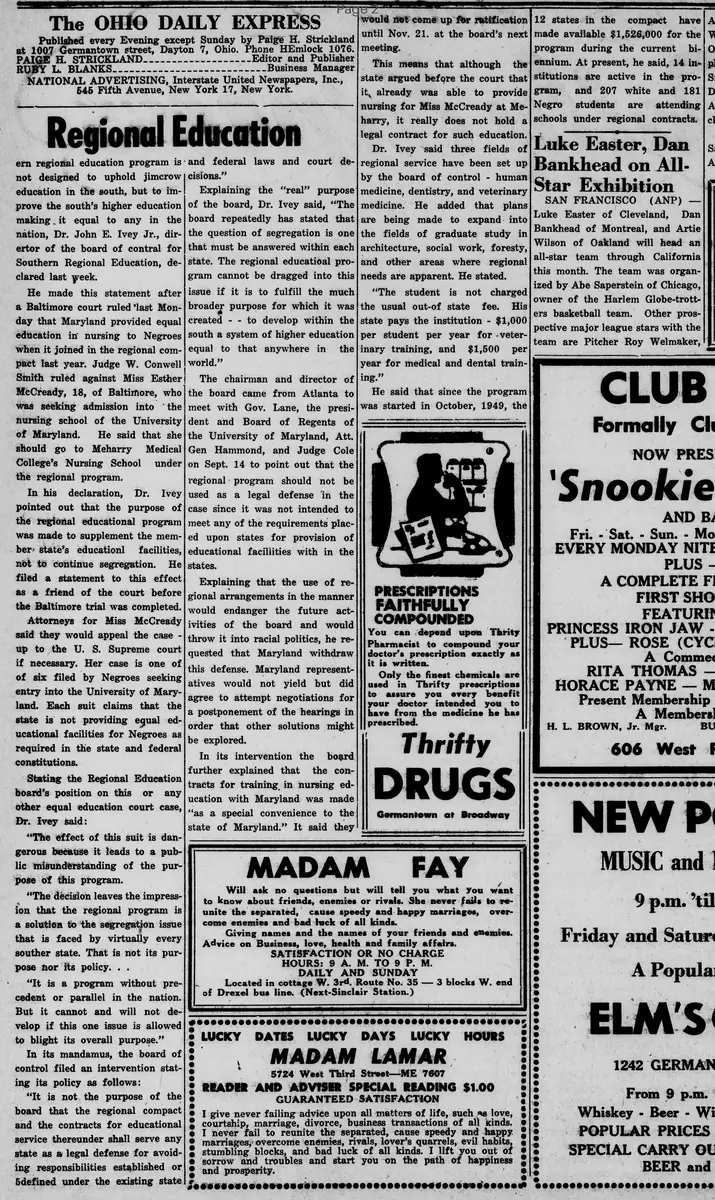
Southern regional education program is not designed to uphold Jim Crow education in the south, but to improve the south's higher education system making it equal to any in the nation, Dr. John E. Ivey Jr., director of the board of control for Southern Regional Education, declared last week.
He made this statement after a Baltimore court ruled last Monday that Maryland provided equal education in nursing to Negroes when it joined in the regional compact last year. Judge W. Conwell Smith ruled against Miss Esther McCready, 18, of Baltimore, who was seeking admission into the nursing school of the University of Maryland. He said that she should go to Meharry Medical College's Nursing School under the regional program.
In his declaration, Dr. Ivey pointed out that the purpose of the regional educational program was made to supplement the member state's educational facilities, not to continue segregation. He filed a statement to this effect as a friend of the court before the Baltimore trial was completed.
Attorneys for Miss McCready said they would appeal the case up to the U. S. Supreme court if necessary. Her case is one of six filed by Negroes seeking entry into the University of Maryland. Each suit claims that the state is not providing equal educational facilities for Negroes as required in the state and federal constitutions.
Stating the Regional Education board's position on this or any other equal education court case, Dr. Ivey said:
"The effect of this suit is dangerous because it leads to a public misunderstanding of the purpose of this program.
"The decision leaves the impression that the regional program is a solution to the segregation issue that is faced by virtually every southern state. That is not its purpose nor its policy...
"It is a program without precedent or parallel in the nation. But it cannot and will not develop if this one issue is allowed to blight its overall purpose."
In its mandamus, the board of control filed an intervention stating its policy as follows:
"It is not the purpose of the board that the regional compact and the contracts for educational service thereunder shall serve any state as a legal defense for avoiding responsibilities established or defined under the existing state and federal laws and court decisions."
Explaining the "real" purpose of the board, Dr. Ivey said, "The board repeatedly has stated that the question of segregation is one that must be answered within each state. The regional educational program cannot be dragged into this issue if it is to fulfill the much broader purpose for which it was created - to develop within the south a system of higher education equal to that anywhere in the world."
The chairman and director of the board came from Atlanta to meet with Gov. Lane, the president and Board of Regents of the University of Maryland, Att. Gen Hammond, and Judge Cole on Sept. 14 to point out that the regional program should not be used as a legal defense in the case since it was not intended to meet any of the requirements placed upon states for provision of educational facilities within the states.
Explaining that the use of regional arrangements in the manner would endanger the future activities of the board and would throw it into racial politics, he requested that Maryland withdraw this defense. Maryland representatives would not yield but did agree to attempt negotiations for a postponement of the hearings in order that other solutions might be explored.
In its intervention the board further explained that the contracts for training in nursing education with Maryland was made "as a special convenience to the state of Maryland." It said they would not come up for ratification until Nov. 21 at the board's next meeting.
This means that although the state argued before the court that it already was able to provide nursing for Miss McCready at Meharry, it really does not hold a legal contract for such education.
Dr. Ivey said three fields of regional service have been set up by the board of control - human medicine, dentistry, and veterinary medicine. He added that plans are being made to expand into the fields of graduate study in architecture, social work, forestry, and other areas where regional needs are apparent. He stated,
"The student is not charged the usual out-of-state fee. His state pays the institution - $1,000 per student per year for veterinary training, and $1,500 per year for medical and dental training."
He said that since the program was started in October, 1949, the 12 states in the compact have made available $1,526,000 for the program during the current biennium. At present, he said, 14 institutions are active in the program, and 207 white and 181 Negro students are attending schools under regional contracts.
What sub-type of article is it?
What themes does it cover?
What keywords are associated?
What entities or persons were involved?
Where did it happen?
Story Details
Key Persons
Location
Baltimore, Maryland
Event Date
Last Week; Last Monday; Sept. 14; October 1949
Story Details
Dr. Ivey declares the Southern Regional Education program aims to equalize higher education in the South, not perpetuate segregation, after a Baltimore court rules Maryland provides equal nursing education to Negroes via the program, denying Esther McCready admission to University of Maryland and directing her to Meharry; attorneys plan appeal to U.S. Supreme Court; board intervenes clarifying purpose.