Thank you for visiting SNEWPapers!
Sign up free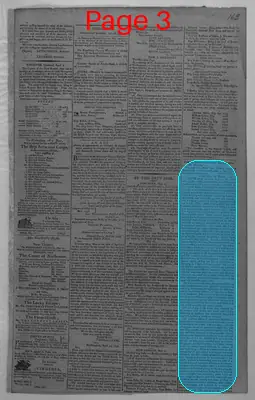
Letter to Editor
May 18, 1796
Gazette Of The United States
Philadelphia, Philadelphia County, Pennsylvania
What is this article about?
A forwarded letter from Demey Burges in Philadelphia, dated March 2, 1796, opposes the U.S. treaty with Britain, viewing it as injurious and disarming America. It criticizes government policies on debt, taxes, and executive control, eroding the writer's confidence in the administration.
Clipping
OCR Quality
92%
Excellent
Full Text
From the STATE Gazette of North-Carolina.
Mr. Wills,
The copy of a letter from Demey Burges is handed you, which you will please so insert for information in your paper.
Philadelphia, 2d March, 1796.
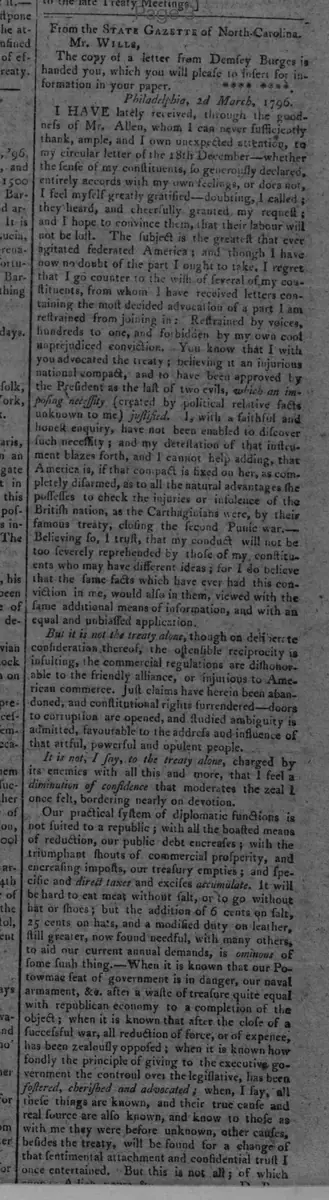
I HAVE lately received, through the goodness of Mr. Allen, whom I can never sufficiently thank, ample, and I own unexpected attention, to my circular letter of the 18th December-whether the sense of my constituents, so generously declared, entirely accords with my own feelings, or does not, I feel myself greatly gratified--doubting, I called; they heard, and cheerfully granted my request; and I hope to convince them, that their labour will not be lost. The subject is the greatest that ever agitated federated America; and though I have now no doubt of the part I ought to take, I regret that I go counter to the wish of several of my constituents, from whom I have received letters containing the most decided advocation of a part I am restrained from joining in: Restrained by voices, hundreds to one, and forbidden by my own cool unprejudiced conviction. You know that I wish you advocated the treaty; believing it an injurious national compact, and to have been approved by the President as the last of two evils, which an imposing necessity (created by political relative facts unknown to me) justified. I, with a faithful and honest enquiry, have not been enabled to discover such necessity; and my detestation of that instrument blazes forth, and I cannot help adding, that America is, if that compact is fixed on her, as completely disarmed, as to all the natural advantages she possesses to check the injuries or insolence of the British nation, as the Carthaginians were, by their famous treaty, closing the second Punic war.--Believing so, I trust, that my conduct will not be too severely reprehended by those of my constituents who may have different ideas; for I do believe that the same facts which have ever had this conviction in me, would also in them, viewed with the same additional means of information, and with an equal and unbiased application.
But it is not the treaty alone, though on deliberate consideration thereof, the ostensible reciprocity is insulting, the commercial regulations are dishonorable to the friendly alliance, or injurious to American commerce. Just claims have herein been abandoned, and constitutional rights surrendered doors to corruption are opened, and studied ambiguity is admitted, favourable to the address and influence of that artful, powerful and opulent people.
It is not, I say, to the treaty alone, charged by its enemies with all this and more, that I feel a diminution of confidence that moderates the zeal I once felt, bordering nearly on devotion.
Our practical system of diplomatic functions is not suited to a republic; with all the boasted means of reduction, our public debt increases; with the triumphant shouts of commercial prosperity, and increasing imports, our treasury empties; and specific and direct taxes and excises accumulate. It will be hard to eat meat without salt, or so go without hat or shoes; but the addition of 6 cents on salt, 25 cents on hats, and a modified duty on leather, still greater, now found needful, with many others, to aid our current annual demands, is ominous of some unhappy thing.--When it is known that our Post-masters general of government is in danger, our naval armament, &c. after a waste of treasure quite equal with republican economy to a completion of the object; when it is known that after the close of a successful war, all reduction of force, or of expense, has been zealously opposed; when it is known how fondly the principle of giving to the executive government the controul over the legislative, has been fostered, cherished and advocated; when, I say, all these things are known, and their true cause and real source are also known, and known to those as with me they were before unknown, other causes, besides the treaty, will be found for a change of that sentimental attachment and confidential trust I once entertained. But this is not all; of which
Mr. Wills,
The copy of a letter from Demey Burges is handed you, which you will please so insert for information in your paper.
Philadelphia, 2d March, 1796.
I HAVE lately received, through the goodness of Mr. Allen, whom I can never sufficiently thank, ample, and I own unexpected attention, to my circular letter of the 18th December-whether the sense of my constituents, so generously declared, entirely accords with my own feelings, or does not, I feel myself greatly gratified--doubting, I called; they heard, and cheerfully granted my request; and I hope to convince them, that their labour will not be lost. The subject is the greatest that ever agitated federated America; and though I have now no doubt of the part I ought to take, I regret that I go counter to the wish of several of my constituents, from whom I have received letters containing the most decided advocation of a part I am restrained from joining in: Restrained by voices, hundreds to one, and forbidden by my own cool unprejudiced conviction. You know that I wish you advocated the treaty; believing it an injurious national compact, and to have been approved by the President as the last of two evils, which an imposing necessity (created by political relative facts unknown to me) justified. I, with a faithful and honest enquiry, have not been enabled to discover such necessity; and my detestation of that instrument blazes forth, and I cannot help adding, that America is, if that compact is fixed on her, as completely disarmed, as to all the natural advantages she possesses to check the injuries or insolence of the British nation, as the Carthaginians were, by their famous treaty, closing the second Punic war.--Believing so, I trust, that my conduct will not be too severely reprehended by those of my constituents who may have different ideas; for I do believe that the same facts which have ever had this conviction in me, would also in them, viewed with the same additional means of information, and with an equal and unbiased application.
But it is not the treaty alone, though on deliberate consideration thereof, the ostensible reciprocity is insulting, the commercial regulations are dishonorable to the friendly alliance, or injurious to American commerce. Just claims have herein been abandoned, and constitutional rights surrendered doors to corruption are opened, and studied ambiguity is admitted, favourable to the address and influence of that artful, powerful and opulent people.
It is not, I say, to the treaty alone, charged by its enemies with all this and more, that I feel a diminution of confidence that moderates the zeal I once felt, bordering nearly on devotion.
Our practical system of diplomatic functions is not suited to a republic; with all the boasted means of reduction, our public debt increases; with the triumphant shouts of commercial prosperity, and increasing imports, our treasury empties; and specific and direct taxes and excises accumulate. It will be hard to eat meat without salt, or so go without hat or shoes; but the addition of 6 cents on salt, 25 cents on hats, and a modified duty on leather, still greater, now found needful, with many others, to aid our current annual demands, is ominous of some unhappy thing.--When it is known that our Post-masters general of government is in danger, our naval armament, &c. after a waste of treasure quite equal with republican economy to a completion of the object; when it is known that after the close of a successful war, all reduction of force, or of expense, has been zealously opposed; when it is known how fondly the principle of giving to the executive government the controul over the legislative, has been fostered, cherished and advocated; when, I say, all these things are known, and their true cause and real source are also known, and known to those as with me they were before unknown, other causes, besides the treaty, will be found for a change of that sentimental attachment and confidential trust I once entertained. But this is not all; of which
What sub-type of article is it?
Political
Persuasive
Reflective
What themes does it cover?
Politics
Economic Policy
Constitutional Rights
What keywords are associated?
Jay Treaty
British Compact
Public Debt
Taxes Excises
Executive Control
Constitutional Rights
American Commerce
What entities or persons were involved?
Demey Burges
Mr. Wills
Letter to Editor Details
Author
Demey Burges
Recipient
Mr. Wills
Main Argument
the author opposes the treaty with britain as an injurious compact that disarms america and surrenders rights, while broader government failures in debt, taxes, and executive overreach erode confidence in the administration.
Notable Details
References Carthaginian Treaty After Second Punic War
Criticizes Taxes: 6 Cents On Salt, 25 Cents On Hats, Duties On Leather
Mentions President's Approval As Lesser Evil Due To Unknown Necessity