Thank you for visiting SNEWPapers!
Sign up free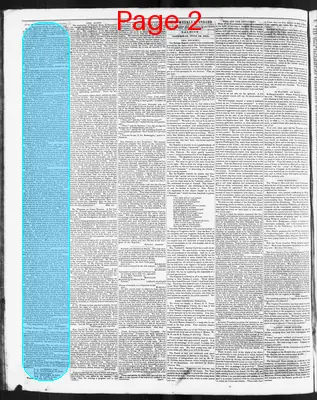
North Carolina Standard
Raleigh, Wake County, North Carolina
What is this article about?
In 1851, S. A. Andrews defends the 1832 anti-nullification and anti-secession resolutions of the Wayne County State Guard against criticism from the Telegraph editor, contextualizing them amid nullification excitement and affirming secession as a potential constitutional remedy against Northern aggression while critiquing Whig inconsistencies.
Clipping

OCR Quality
Full Text
GOLDSBOROUGH, N. C., June 30th, 1851.
Messrs. Robinson and Gulick: The last Telegraph contains some remarks by the very dignified editor, introductory and following Resolutions adopted by the Light Artillery Company, which I had the honor to command in 1832.
I am somewhat apprehensive that any strictures on his course may be offensive to the very peculiar ideas of dignity that gentleman and some of his particular friends seem to entertain, viz: that they have the right to assail private citizens, while a reply is peculiarly undignified. Indeed I feel rather a sense of loss of dignity in paying any attention to the paper, and am only induced to do it in justice to the motives of honest and patriotic men who acted with me at that time, many of whom have left this stage of action and are in the legion of a happier world, to none of whom would apply, the Register's very learned and terse quotation "doubly dying, unwept, un-honored."
&c., for a nobler troop never were mounted than the "State Guard of Wayne County."
They were pure, honest yeomen, devoted to their country.
There was much excitement, as is well known, in 1832 on the subject of nullification, and, in many and various parts of North Carolina, meetings were called and held, and resolutions adopted, probably as strong as those passed by the Wayne Troop. Whether we were ahead of the excitement so much as to be the only one, who included "secession" with nullification, is more than I can say, but as nullification was the subject most under discussion at that time, it is highly probable few if any were found so ignorant of States rights as to destroy this only safe citadel of retreat for the weak minority when oppressed by the strong majority.
The resolutions were written by myself at the suggestion of many citizens, and I am responsible for the language. They were read and adopted by the unanimous vote of a pretty full muster. (The Company had on its rolls about 65 men.) The probability is that the resolutions expressed the sentiments of 50 men as regards nullification, attachment to the Union, respect for the Constitution and the President, and the determination to support Constitutional Government. As politics was not the subject of our association and many of the Troop had ever paid much attention to the merits of the question of secession, or its important bearing on the safety of the minority States. I feel no mortification in acknowledging that at that time my attachment to the Union was such that I should hardly have examined any argument which might intimate a dissolution as possible. True there had been aggression; but the precedence in the compromise was general; another compromise was on foot, and it was hoped the agitating question of the unequal tariff would be honorably settled.
Under such circumstances I wrote the resolutions, and they were adopted by fifty as gallant true hearted Americans as ever formed a Militia Company-the yeomanry of Wayne County.
"This little ray of light upon my past history" shows to the Editor of the Telegraph clearly the weakness of poor human nature. It mortifies our pride, bids us not rejoice in the strength of our intellects, and warns us not to cling with tenacity to our opinions, since those intellects can be so easily overshadowed by the clouds of prejudice, and those opinions, though honestly entertained, so warped by the force of surrounding circumstances."
I have extracted entire the above sentence to give your readers an opportunity of judging of the logic, rhetoric, and erudition, as well as the dignity of the very learned Editor of the Telegraph.
The intimation, that a change of opinion on an abstract question of Constitutional law in a man making no pretension to be a lawyer, or even a politician, "shows the weakness of poor human nature," comes with a very bad grace from a young man recently allied to a party, which, … by force of surrounding circumstances," has been compelled in less than half the time it has taken, according to Mr. Strong, to effect a change in my opinion on secession, to change their positions and opinions on every political question of the age, and even to change their name.
He will for personal security, probably, plead non-age to any charge of change against himself, but he comes forward as a violent champion of whiggery, and in adopting that party is undoubtedly prepared to adopt their history also. For my own part, I should feel most excessively mortified if a close observation of the history of the past 20 years led only to a certainty that we had no escape from Northern aggression, and that we must sit down submissively, and hold our hands to receive their shackles. Democracy I have always understood to be progressive, and in general we glory in the progress we make. If it is important to the world to know my present opinions on the question of secession, I do not hesitate to say, it is the only practical security we have for our rights, and it is undoubtedly the true remedy against aggression. I would not be understood as advocating secession at the present time or under existing circumstances. But it is certainly important that we have, and the world should know that we have, a remedy to which, when forbearance ceases to be a virtue, we may resort. And I pray God will so far restrain the fanaticism of Northern aggressions on our Constitutional rights, that we may never be driven to resort to the remedy. It is the subservient submissionist, who argues against this right, who is aiding factionists to our destruction. Were it not well known to such men as Seward, Winthrop, et id omne genus, that a large party at the South are denying that we have any Constitutional remedy, the agitation at the North would be put down in a month.
It is the Southern support," aid and comfort," those men receive which sustains them and encourages this persistence in driving us to the wall.
I do not wish to be understood as making any complaint at the course the editor sees fit to pursue in the management of his paper; but it appears to me that his closing paragraph possesses one quality which to say the least would not in old time, have been considered gentlemanly, and that is, a perversion of language to convey a false idea. The sentence reads thus!" And this Company was the only one in North Carolina that volunteered its service to march against South Carolina, to coerce and crush her.'"
The italics and capitals are his, and so is the quotation. Let him reconcile it with truth if he can. If he says he copies from the Register, he only shows his subserviency, and that he is willing to retail small malice although he knows its falsehood.
I have extended this letter farther than I ever intended, and owe an apology for asking its publication. My own apology is that the Great Whig Organ at Raleigh, having thought my opinions 20 years ago of sufficient importance to publish them, and the little organs, as in duty bound, finding it consistent with their peculiar notions of dignity to open on the trail at his bidding-gives me the right to a little attention. I am a private citizen not obtruding my opinion on the public; but I cannot forbear to recommend to certain editors the importance of examining their own positions and the history of their party. Let them reflect that they have been driven by " force of surrounding circumstances" from every party position they have taken either since or before they changed their name from Federalists to Whigs, and this should give them some little sympathy—some fellow feeling for "Poor human nature."
Will you do me the favor to publish the Resolutions with the Preamble in connexion with this, to enable your readers to judge how far I am culpable?
Very Respectfully, your ob't. serv't.
S. A. ANDREWS.
Late Capt. Wayne County, State Guard, Light Art.
" The State's Guard, of Wayne County, taking into consideration the alarming situation to which the agitations of South Carolina are bringing our beloved Country, feel themselves bound to express their abhorrence of the doctrines of Nullification AND Secession, as adopted by the convention of South Carolina; and
Resolved, unanimously, That we will, in our corporate and individual capacities, support the Constitution of the United States—hold the Union sacred —obey and enforce the laws our Constitutional Federal Government has or may enact.
Resolved, That the President of the United States is worthy of our full respect and confidence, and shall command our support and services, if the exigencies of our country require it.
Resolved, That these Resolutions be signed by the Commissioned officers of the Troop, and copies sent to papers in Raleigh, Newbern, and Fayetteville for publication.
S. A. Andrews, Capt.
L. B. Whitfield, 1st Lieut:
2d Lieutenant absent.
J. C. SLOCUMB, 3d Lieut.
WM. K. LANE, Cornet.
Waynesboro', Dec. 29th, 1832.
What sub-type of article is it?
What themes does it cover?
What keywords are associated?
What entities or persons were involved?
Letter to Editor Details
Author
S. A. Andrews. Late Capt. Wayne County, State Guard, Light Art.
Recipient
Messrs. Robinson And Gulick
Main Argument
andrews defends the 1832 resolutions of the wayne county state guard as reflective of the nullification-era context and union loyalty, critiques the telegraph editor's attacks and whig inconsistencies, and affirms secession as a constitutional remedy against northern aggression without advocating it currently.
Notable Details