Thank you for visiting SNEWPapers!
Sign up free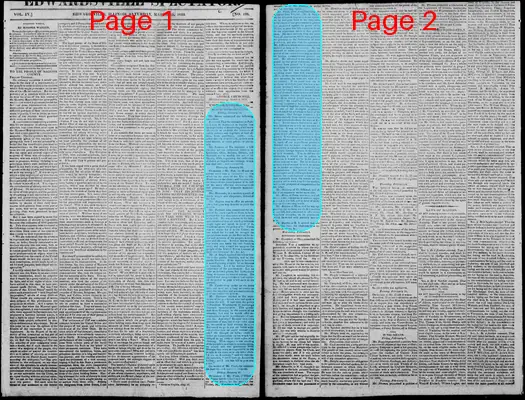
Edwardsville Spectator
Edwardsville, Madison County, Illinois
What is this article about?
U.S. House of Representatives proceedings from January 24 to 31: Mr. Moore's resolution to prohibit land office officials from buying public land; Mr. Newton's bill on collection districts in several states; extended debates on a bill to encourage and protect domestic manufactures, with speeches by Messrs. Holcombe, Baylies, Tattnall, A. Smyth, Cambreleng, Burrorus, Cook, Mallary, Rhea, and Durfee supporting or opposing it on policy and constitutional grounds.
Merged-components note: Direct textual continuation of congressional proceedings on the bill for domestic manufactures across pages.
Clippings

1 of 2
OCR Quality
Full Text
HOUSE OF REPRESENTATIVES.
Friday, January 24,
Mr. Moore submitted the following resolution:
Resolved, That the committee on Public Lands be instructed to inquire into the expediency of introducing a bill more effectually to prohibit the receivers of public moneys and registers of land offices, from purchasing public land, either directly or indirectly, in their own land district, at either private or public sale.
Mr. Newton, of Va. reported a bill creating certain collection districts in Kentucky, Ohio, Indiana, Illinois, and Missouri, and to modify the act of 2d March, 1799, regulating the collection of duties on imports and tonnage, which was read twice, and committed.
Thursday January 30.
On motion of Mr. Tod, the House resolved itself into a committee of the whole on the state of the Union, Mr. Tomlinson in the chair: and the committee resumed the consideration of the bill for the more effectual encouragement and protection of domestic manufactures.
Mr. Holcombe, in a maiden speech of much length and eloquence, defended the bill.
Mr. Baylies rose to offer an amendment, but gave way in order to yield the floor to Mr. Tattnall, who considered the object of the gentleman from Mass. to be to prevent the free discussion of the merits of the bill. He was adverse to the bill: and considered that all which gentlemen might right and speak in favor of it, would not prove the policy of it. There was no desire for it in the Union; no one asked for it; and he thought the speculations made on the floor on the labor and industry of the people, is intrusive and officious. It was a trite maxim, that every one knew his own business best; and why should we suppose the people of the United States ignorant of their own interests? &c. &c. &c.
Mr. A. Smyth opposed the bill as hostile to the public interests, and to the public liberties. If we were to become a manufacturing people, let us become so naturally. Let it be without the interference of the government. Let us raise no hot-bed plants, but leave every thing to pursue its natural course. He insisted that the government had received no power to pass a bill such as the present.
Mr. Cambreleng spoke on the same side, and went into a long argument to show the impolicy and unconstitutionality of the restrictive system.
Mr. Burrorus replied to the arguments of the gentlemen who had spoken against the bill. It had been the policy of President Washington to encourage domestic manufactures. The gentleman from Georgia, in the course of his remarks, had said he would offer encouragement to the manufacture of cannon, &c. And why? Because they were munitions of war, and if war come upon us, we could not fight without them. But could we go to war any better without clothes than we could without cannon? He thought no nation could be called an independent nation which was obliged to go 3000 or 4000 miles after clothing. With respect to the standing of the people concerned in manufactures, he would tell the gentleman from Georgia they were as respectable as the people in his state, or in any other state. "I am an American," said the honorable member, "and I have an American feeling; and I wish this bill to pass into a law."
On motion of Mr. Cook, the committee then rose and reported progress.
Friday, January 31.
On motion of Mr. Cook, of Illinois, the House resolved itself into a committee of the whole, on the state of the Union, Mr. Tomlinson in the chair, on amendment of Mr. Tattnall, to strike out the enacting clause.
Mr. Cook, after complimenting the member from Virginia, (Mr. A. Smyth) on the research displayed in his speech, as he had gone back to the very commencement of our government to ground his argument against the power of the House to pass this bill, replied in detail, to the objections taken by that gentleman. He read extracts from the manifesto of grievances, which were published previous to the declaration of independence, and also from the opinions of Mr. Jefferson, whose merited fame would endure as long as the country. He had assisted to emancipate--to uphold the power of the country--to impose duties on foreign commerce--to protect our own. He adverted to the embargo imposed by that great statesman, and the several laws passed by Congress, recognizing the principle of restriction, on which, this bill was founded. After speaking some time with considerable effect, on the constitutionality of the present measure, he went into view of its expediency. If we could turn the 80 millions of dollars (and this was a moderate average) which is annually exported for foreign produce into our channels of domestic manufactures and trade, who is there that can doubt the beneficial effects which would result to our country? By establishing a system of internal commerce we bind the Union more closely together; and this, perhaps, was one of the strongest arguments which could be advanced in favor of the measure. Our foreign commerce has arisen entirely from casual causes altogether unnatural--from the wars of Europe. These causes had ceased, and it now becomes us to rely on our own resources. It was not his object, neither did it come within the power of Congress to cut off foreign commerce altogether. It was always expedient to keep up that intercourse which would suffice to carry off our superfluous products. Neither did he desire to make this so completely a manufacturing country, as to supply foreign markets to the extent of their demands. This he did not desire--this, it would not be politic to do--this, it would not be in the power of the country to do. But he desired to protect manufactures to such an extent as to render us independent of foreign manufactures. He wished that such encouragement would be given as should induce the manufacturer to extract the raw materials from the bowels of the country and to work it up for the market, with a fair prospect of compensation for his labor.
Mr. Mallary, of Vt. followed, and offered an argument on the same side.
Mr. Rhea, of Tenn. rose next, and addressed the committee in zealous opposition to the bill, and in favor of striking out the enacting words.
Mr. Baylies of Mass. said he was opposed to the striking out the first section of the bill, and proceeded to offer some desultory remarks, on its provisions, which he stated only partially met his idea.
Mr. Durfee, of R. I. moved that the committee rise; the chairman then reported progress, &c.
What sub-type of article is it?
What keywords are associated?
What entities or persons were involved?
Domestic News Details
Event Date
Friday, January 24; Thursday, January 30; Friday, January 31
Key Persons
Outcome
committees formed; bills read and committed; debates held with progress reported; no final outcomes.
Event Details
Proceedings in the House of Representatives included submission of a resolution by Mr. Moore to prohibit land office officials from purchasing public land in their districts; reporting of a bill by Mr. Newton creating collection districts in several states; and multi-day debates in committee of the whole on a bill to encourage domestic manufactures, featuring speeches defending or opposing the bill on constitutional, policy, and economic grounds, with arguments referencing Washington, Jefferson, and historical precedents.