Thank you for visiting SNEWPapers!
Sign up free
Poem
October 10, 1857
Weekly Trinity Journal
Weaverville, Trinity County, California
What is this article about?
A heartbroken poetic effusion by 'F.' addressed to Miss Less, lamenting unrequited love, trustful affection turned to sorrow after parting. Includes editorial note suggesting the author was mistreated. From Ridgeville, September 25, 1857.
Clipping
OCR Quality
95%
Excellent
Full Text
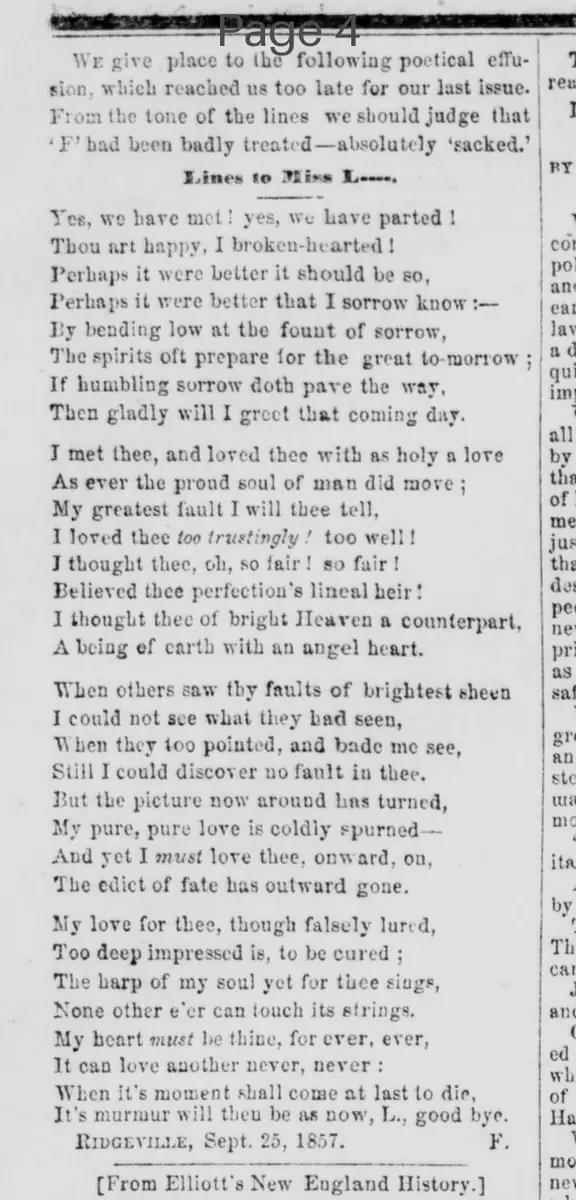
We give place to the following poetical effusion, which reached us too late for our last issue. From the tone of the lines we should judge that 'F' had been badly treated—absolutely 'sacked.'
Lines to Miss Less—
Yes, we have met; yes, we have parted
Thou art happy, I broken-hearted
Perhaps it were better it should be so,
Perhaps it were better that I sorrow know:-
By bending low at the fount of sorrow,
The spirits oft prepare for the great to-morrow;
If humbling sorrow doth pave the way.
Then gladly will I greet that coming day.
I met thee, and loved thee with as holy a love
As ever the proud soul of man did move;
My greatest fault I will thee tell.
I loved thee too trustingly! too well!
I thought thee, oh, so fair! so fair!
Believed thee perfection's lineal heir:
I thought thee of bright Heaven a counterpart.
A being of earth with an angel heart.
When others saw thy faults of brightest sheen
I could not see what they had seen,
When they too pointed, and bade me see,
Still I could discover no fault in thee.
But the picture now around has turned.
My pure, pure love is coldly spurned-
And yet I must love thee, onward, on.
The edict of fate has outward gone.
My love for thee, though falsely lured.
Too deep impressed is, to be cured:
The harp of my soul yet for thee sings,
None other e'er can touch its strings.
My heart must be thine, for ever, ever.
It can love another never, never:
When its moment shall come at last to die.
Its murmur will then be as now, L., good bye.
RIDGEVILLE, Sept. 25, 1857.
F.
Lines to Miss Less—
Yes, we have met; yes, we have parted
Thou art happy, I broken-hearted
Perhaps it were better it should be so,
Perhaps it were better that I sorrow know:-
By bending low at the fount of sorrow,
The spirits oft prepare for the great to-morrow;
If humbling sorrow doth pave the way.
Then gladly will I greet that coming day.
I met thee, and loved thee with as holy a love
As ever the proud soul of man did move;
My greatest fault I will thee tell.
I loved thee too trustingly! too well!
I thought thee, oh, so fair! so fair!
Believed thee perfection's lineal heir:
I thought thee of bright Heaven a counterpart.
A being of earth with an angel heart.
When others saw thy faults of brightest sheen
I could not see what they had seen,
When they too pointed, and bade me see,
Still I could discover no fault in thee.
But the picture now around has turned.
My pure, pure love is coldly spurned-
And yet I must love thee, onward, on.
The edict of fate has outward gone.
My love for thee, though falsely lured.
Too deep impressed is, to be cured:
The harp of my soul yet for thee sings,
None other e'er can touch its strings.
My heart must be thine, for ever, ever.
It can love another never, never:
When its moment shall come at last to die.
Its murmur will then be as now, L., good bye.
RIDGEVILLE, Sept. 25, 1857.
F.
What sub-type of article is it?
Ode
What themes does it cover?
Love Courtship
What keywords are associated?
Unrequited Love
Heartbreak
Miss Less
Romantic Sorrow
Eternal Affection
What entities or persons were involved?
F.
Poem Details
Title
Lines To Miss Less—
Author
F.
Subject
Parting From Miss Less
Form / Style
Rhymed Quatrains
Key Lines
Yes, We Have Met; Yes, We Have Parted
Thou Art Happy, I Broken Hearted
I Loved Thee Too Trustingly! Too Well!
My Heart Must Be Thine, For Ever, Ever.
It Can Love Another Never, Never:
Its Murmur Will Then Be As Now, L., Good Bye.