Thank you for visiting SNEWPapers!
Sign up free
Story
February 26, 1893
The Roanoke Times
Roanoke, Virginia
What is this article about?
Article explains how animals perceive sounds inaudible to humans, citing examples like cat-pleasing noises, African frog piping heard by one but not another, and Galton's whistle; references Profs. Lloyd-Morgan and Barrett's 1877 demonstration with sensitive flame.
Clipping
OCR Quality
95%
Excellent
Full Text
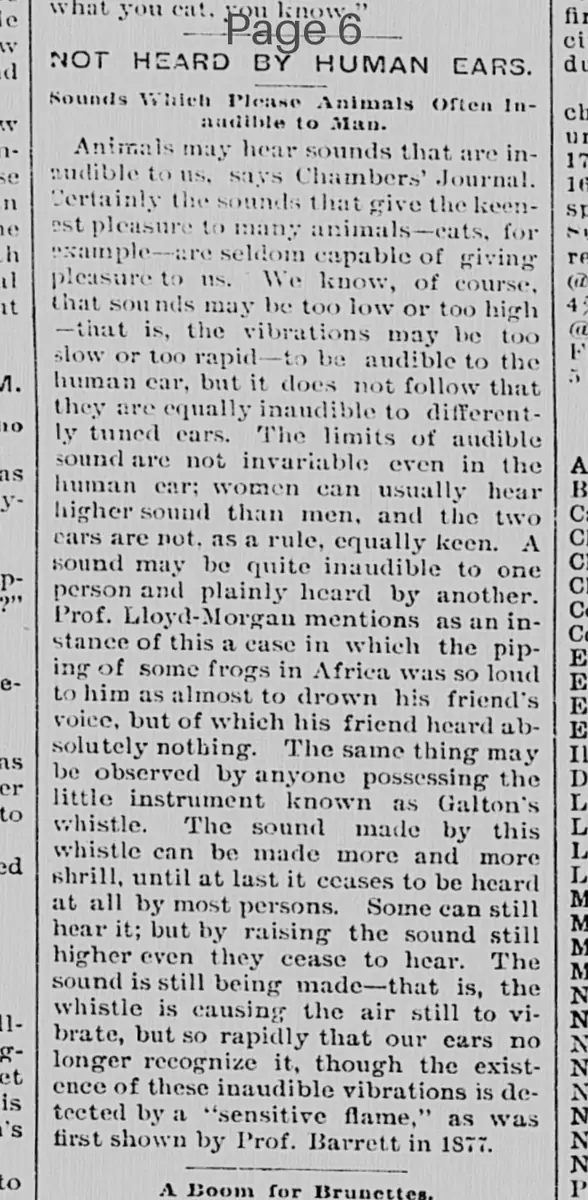
NOT HEARD BY HUMAN EARS.
Sounds Which Please Animals Often Inaudible to Man.
Animals may hear sounds that are inaudible to us, says Chambers' Journal. Certainly the sounds that give the keenest pleasure to many animals—cats, for example—are seldom capable of giving pleasure to us. We know, of course, that sounds may be too low or too high—that is, the vibrations may be too slow or too rapid—to be audible to the human ear, but it does not follow that they are equally inaudible to differently tuned ears. The limits of audible sound are not invariable even in the human ear; women can usually hear higher sound than men, and the two ears are not, as a rule, equally keen. A sound may be quite inaudible to one person and plainly heard by another.
Prof. Lloyd-Morgan mentions as an instance of this a case in which the piping of some frogs in Africa was so loud to him as almost to drown his friend's voice, but of which his friend heard absolutely nothing. The same thing may be observed by anyone possessing the little instrument known as Galton's whistle. The sound made by this whistle can be made more and more shrill, until at last it ceases to be heard at all by most persons. Some can still hear it; but by raising the sound still higher even they cease to hear. The sound is still being made—that is, the whistle is causing the air still to vibrate, but so rapidly that our ears no longer recognize it, though the existence of these inaudible vibrations is detected by a "sensitive flame," as was first shown by Prof. Barrett in 1877.
Sounds Which Please Animals Often Inaudible to Man.
Animals may hear sounds that are inaudible to us, says Chambers' Journal. Certainly the sounds that give the keenest pleasure to many animals—cats, for example—are seldom capable of giving pleasure to us. We know, of course, that sounds may be too low or too high—that is, the vibrations may be too slow or too rapid—to be audible to the human ear, but it does not follow that they are equally inaudible to differently tuned ears. The limits of audible sound are not invariable even in the human ear; women can usually hear higher sound than men, and the two ears are not, as a rule, equally keen. A sound may be quite inaudible to one person and plainly heard by another.
Prof. Lloyd-Morgan mentions as an instance of this a case in which the piping of some frogs in Africa was so loud to him as almost to drown his friend's voice, but of which his friend heard absolutely nothing. The same thing may be observed by anyone possessing the little instrument known as Galton's whistle. The sound made by this whistle can be made more and more shrill, until at last it ceases to be heard at all by most persons. Some can still hear it; but by raising the sound still higher even they cease to hear. The sound is still being made—that is, the whistle is causing the air still to vibrate, but so rapidly that our ears no longer recognize it, though the existence of these inaudible vibrations is detected by a "sensitive flame," as was first shown by Prof. Barrett in 1877.
What sub-type of article is it?
Curiosity
What themes does it cover?
Nature
What keywords are associated?
Animal Hearing
Inaudible Sounds
Galton's Whistle
Frog Piping
Sensitive Flame
What entities or persons were involved?
Prof. Lloyd Morgan
Prof. Barrett
Where did it happen?
Africa
Story Details
Key Persons
Prof. Lloyd Morgan
Prof. Barrett
Location
Africa
Event Date
1877
Story Details
Animals hear sounds inaudible to humans, such as those pleasing cats or high-pitched frog piping in Africa noted by Prof. Lloyd-Morgan. Galton's whistle demonstrates varying audibility, with inaudible vibrations detected by a sensitive flame as shown by Prof. Barrett.