Thank you for visiting SNEWPapers!
Sign up free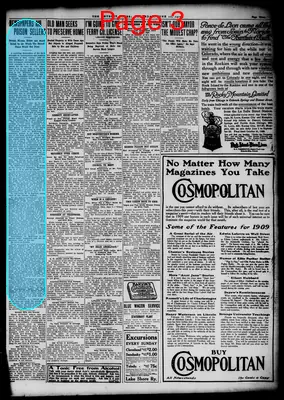
Story
June 10, 1909
The Detroit Times
Detroit, Wayne County, Michigan
What is this article about?
A Detroit woman suffers severe effects from a fake 'morphine cure' bought via newspaper ad from Chicago's St. Paul Association. Dr. George McElveen reports it to Washington authorities, highlighting dangers and pushing for legislation against such fraudulent products and ads.
Clipping

OCR Quality
98%
Excellent
Full Text
NEWSPAPERS AID POISON SELLERS
Detroit Woman Bilked and Nearly Killed by Ad Which The Detroit Times Would Not Print.
A startling illustration of the harm wrought by unscrupulous and grasping purveyors of fake "cures," with the able assistance of equally unscrupulous newspaper publishers who permit their columns to be defiled by these fakers for the sake of the money there is in it, has come to the attention of Dr. George McElveen, with offices in the Whitney opera house building. In this instance it was a so-called "morphine cure" sent out by a Chicago concern styling itself the St. Paul association.
A Detroit woman, attracted by the concern's alluring advertisements in a newspaper, tried the "cure," paying $10 for six four-ounce bottles. When she called on Dr. McElveen for treatment her condition, physically and mentally, was so pitiable that he at once took the case up with the public health department at Washington in the hope of preventing the sale of the baneful concoction.
The information came as no surprise to the authorities. Other complaints of a like nature had preceded Dr. McElveen's, and legislation is now pending in congress looking toward the regulation of the sale of such products, he was informed. The authorities also were hopeful that a law would ultimately be passed prohibiting the advertising of such products.
The "morphine cure" in question, according to the label, contains 1 1-3 grains of morphine to the ounce and four grains of dionin to the ounce, diluted with 12 per cent of alcohol.
"Dionin," says Dr. McElveen, "is morphine poison in its worst form, one of the most powerful of the morphine compounds, in fact. Once a person starts using the stuff he must keep on using it. Deprived of it, he goes all to pieces so the 'cure' is nothing more than a continuation of the morphine habit in an aggravated form."
And yet, some newspapers will further such a diabolical scheme to extract money from unfortunate and unsuspecting human beings by selling advertising space to the promoters.
The woman I attended told me she used four bottles of the stuff in two weeks. When she discontinued its use she actually became demented.
Dr. McElveen's letter to Prof. Wiley, of the bureau of chemistry, Washington, D. C., is in part as follows:
I am sending you herewith label detached from a bottle of medicine supplied to a patient now under my care by the St. Paul Association of Chicago, also a letter from the association to the patient explaining the effects of the drug, which was supposed to take the place of, or cure, the morphine habit. The medicine is advertised in Chicago newspapers, and I would be glad to know if steps could not be taken to prevent the advertising of drugs of this nature so that they get into the hands of people who do not understand the effects of same.
To this letter, W. D. Bigelow, acting chief of the bureau, replied:
We are well acquainted with the St. Paul Association of Chicago and its method of doing business. Several purchases of the goods supplied to possible habitues are in our possession. We thank you for the information you submit and regret to be compelled to advise you that at present there is no way or means by which it is possible to prevent the advertising of products of this nature in newspapers or otherwise. This is a matter which should receive careful consideration by all thinking medical men, and it is hoped that a law will ultimately be passed prohibiting the advertising of such products, and also forbid their shipment into interstate commerce, except by personal medical supervision.
We are inclosing a copy of the Mann bill, which was intended to cover transactions represented by the St. Paul Association, and I would ask that you return the bill at your earliest convenience with such criticism and suggestions as may appear from a medical practitioner's point of view.
Accordingly, Dr. McElveen, in his second letter, suggested that the authorities "start at the top."
He wrote as follows:
There are a few so-called physicians that are engaged in the practice of medicine that are drug fiends of the most abominable type. To my knowledge there are people suffering the worst form of slavery as a result of irresponsible physicians having administered at times of suffering opium or other narcotics. There are instances where the subject has not been aware of the danger until the habit has been formed.
There are drug stores in our city where the drug clerk prescribes and hands out to the customers any kind of preparation, no matter what the contents are.
The Mann bill cannot be enacted into law too soon by congress. It would fill a long-felt and neglected want. In our hurry we lost sight of some of the things most beneficial to our unfortunate fellow beings, and allow them to be imposed upon from a source where there is only one consideration--money.
The interest manifested in legislation of this nature will meet with the sharpest practice possible in the way of obstruction, as the proposed legislation would cut off the revenue a great many papers thrive upon. There are signs of improvement visible, as one of our metropolitan dailies has right along cut out all such matter from its columns, and there are others that will follow as soon as the people awake to the great injury being done and demand a change for the good cause of clean advertising.
In his reference to a Detroit paper which does not assist the quacks and the sharks, Dr. McElveen meant The Detroit Times, the only newspaper in this city which protects the readers of its advertisements.
Detroit Woman Bilked and Nearly Killed by Ad Which The Detroit Times Would Not Print.
A startling illustration of the harm wrought by unscrupulous and grasping purveyors of fake "cures," with the able assistance of equally unscrupulous newspaper publishers who permit their columns to be defiled by these fakers for the sake of the money there is in it, has come to the attention of Dr. George McElveen, with offices in the Whitney opera house building. In this instance it was a so-called "morphine cure" sent out by a Chicago concern styling itself the St. Paul association.
A Detroit woman, attracted by the concern's alluring advertisements in a newspaper, tried the "cure," paying $10 for six four-ounce bottles. When she called on Dr. McElveen for treatment her condition, physically and mentally, was so pitiable that he at once took the case up with the public health department at Washington in the hope of preventing the sale of the baneful concoction.
The information came as no surprise to the authorities. Other complaints of a like nature had preceded Dr. McElveen's, and legislation is now pending in congress looking toward the regulation of the sale of such products, he was informed. The authorities also were hopeful that a law would ultimately be passed prohibiting the advertising of such products.
The "morphine cure" in question, according to the label, contains 1 1-3 grains of morphine to the ounce and four grains of dionin to the ounce, diluted with 12 per cent of alcohol.
"Dionin," says Dr. McElveen, "is morphine poison in its worst form, one of the most powerful of the morphine compounds, in fact. Once a person starts using the stuff he must keep on using it. Deprived of it, he goes all to pieces so the 'cure' is nothing more than a continuation of the morphine habit in an aggravated form."
And yet, some newspapers will further such a diabolical scheme to extract money from unfortunate and unsuspecting human beings by selling advertising space to the promoters.
The woman I attended told me she used four bottles of the stuff in two weeks. When she discontinued its use she actually became demented.
Dr. McElveen's letter to Prof. Wiley, of the bureau of chemistry, Washington, D. C., is in part as follows:
I am sending you herewith label detached from a bottle of medicine supplied to a patient now under my care by the St. Paul Association of Chicago, also a letter from the association to the patient explaining the effects of the drug, which was supposed to take the place of, or cure, the morphine habit. The medicine is advertised in Chicago newspapers, and I would be glad to know if steps could not be taken to prevent the advertising of drugs of this nature so that they get into the hands of people who do not understand the effects of same.
To this letter, W. D. Bigelow, acting chief of the bureau, replied:
We are well acquainted with the St. Paul Association of Chicago and its method of doing business. Several purchases of the goods supplied to possible habitues are in our possession. We thank you for the information you submit and regret to be compelled to advise you that at present there is no way or means by which it is possible to prevent the advertising of products of this nature in newspapers or otherwise. This is a matter which should receive careful consideration by all thinking medical men, and it is hoped that a law will ultimately be passed prohibiting the advertising of such products, and also forbid their shipment into interstate commerce, except by personal medical supervision.
We are inclosing a copy of the Mann bill, which was intended to cover transactions represented by the St. Paul Association, and I would ask that you return the bill at your earliest convenience with such criticism and suggestions as may appear from a medical practitioner's point of view.
Accordingly, Dr. McElveen, in his second letter, suggested that the authorities "start at the top."
He wrote as follows:
There are a few so-called physicians that are engaged in the practice of medicine that are drug fiends of the most abominable type. To my knowledge there are people suffering the worst form of slavery as a result of irresponsible physicians having administered at times of suffering opium or other narcotics. There are instances where the subject has not been aware of the danger until the habit has been formed.
There are drug stores in our city where the drug clerk prescribes and hands out to the customers any kind of preparation, no matter what the contents are.
The Mann bill cannot be enacted into law too soon by congress. It would fill a long-felt and neglected want. In our hurry we lost sight of some of the things most beneficial to our unfortunate fellow beings, and allow them to be imposed upon from a source where there is only one consideration--money.
The interest manifested in legislation of this nature will meet with the sharpest practice possible in the way of obstruction, as the proposed legislation would cut off the revenue a great many papers thrive upon. There are signs of improvement visible, as one of our metropolitan dailies has right along cut out all such matter from its columns, and there are others that will follow as soon as the people awake to the great injury being done and demand a change for the good cause of clean advertising.
In his reference to a Detroit paper which does not assist the quacks and the sharks, Dr. McElveen meant The Detroit Times, the only newspaper in this city which protects the readers of its advertisements.
What sub-type of article is it?
Deception Fraud
Medical Curiosity
Crime Story
What themes does it cover?
Deception
Misfortune
Justice
What keywords are associated?
Fake Morphine Cure
Newspaper Advertising Fraud
Medical Deception
Drug Addiction
Legislation Against Quackery
St. Paul Association
Dr. Mcelveen
What entities or persons were involved?
Dr. George Mcelveen
Detroit Woman
St. Paul Association
Prof. Wiley
W. D. Bigelow
Where did it happen?
Detroit, Chicago, Washington D. C.
Story Details
Key Persons
Dr. George Mcelveen
Detroit Woman
St. Paul Association
Prof. Wiley
W. D. Bigelow
Location
Detroit, Chicago, Washington D. C.
Story Details
A Detroit woman buys a fake 'morphine cure' from Chicago's St. Paul Association via newspaper ad, suffers severe addiction and dementia. Dr. McElveen treats her, reports to authorities, advocates for legislation like the Mann bill to regulate sales and ads of such harmful products.