Thank you for visiting SNEWPapers!
Sign up free
Springfield Weekly Republican
Springfield, Hampden County, Massachusetts
What is this article about?
Article reviews Dr. Blanchard Fosgate's pamphlet critiquing New York prison systems at Auburn and Sing Sing, highlighting causes of crime, flaws in discipline and contract labor, excessive pardons; contrasts with efficient Albany penitentiary and costlier Massachusetts prison, advocating reform.
Clipping
OCR Quality
Full Text
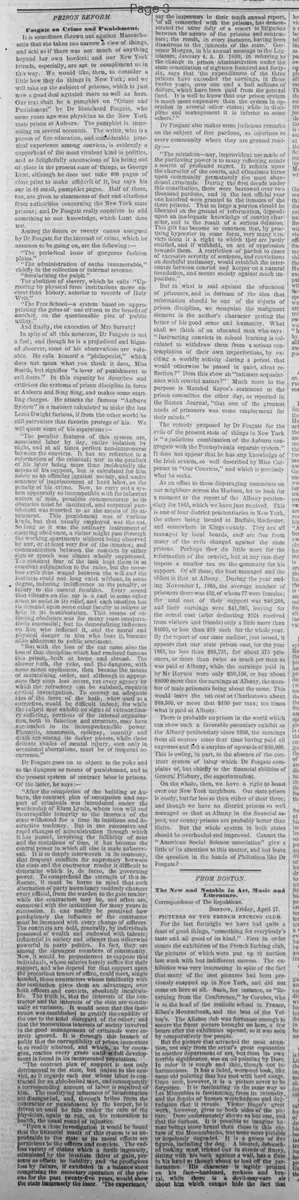
Fosgate on Crime and Punishment.
It is sometimes thrown out against Massachusetts that she takes too narrow a view of things, and acts as if there was not much of anything beyond her own borders; and our New York friends, especially, are apt to compliment us in this way. We would like, then, to consider a little how they do things in New York; and we will take up the subject of prisons, which is just now a good deal agitated there as well as here.
Our text shall be a pamphlet on "Crime and Punishment" by Dr. Blanchard Fosgate, who some years ago was physician to the New York state prison at Auburn. The pamphlet is interesting on several accounts. The writer, who is a person of fine education, and considerable practical experience among convicts, is evidently a copperhead of the most virulent kind in politics, and as delightfully unconscious of his being out of place in the present state of things, as George Lunt, although he does not take 600 pages of close print to make affidavit of it, but says his say in 48 small, pamphlet pages. Half of these, too, are given to statements of fact and citations from authorities concerning the New York state prisons; and Dr. Fosgate really contrives to add something to our knowledge, which Lunt does not.
Among the dozen or twenty causes assigned by Dr. Fosgate for the increase of crime, which he assumes to be going on, are the following:—
"The periodical issue of gorgeous fashion plates."
"The administration of oaths innumerable," chiefly in the collection of internal revenue.
"Secularizing the pulpit."
The abolition of slavery, which he calls "Uprooting by physical force institutions more ancient than history, anterior to records of Holy Writ."
"The Free School—a system based on appropriating the gains of one citizen to the benefit of another, on the questionable plea of public utility."
And finally, the execution of Mrs. Surratt!
In spite of all this nonsense, Dr. Fosgate is not a fool; and though he is a prejudiced and bigoted observer, some of his observations are valuable. He calls himself a "philopenist," which does not mean what you think it does, Miss Smith, but signifies "a lover of punishment to evil doers." In this capacity he describes and criticises the systems of prison discipline in force at Auburn and Sing Sing, and makes some startling charges. He attacks the famous "Auburn System" in a manner calculated to make the late Louis Dwight furious, if from the other world he still patronizes that favorite protege of his. We will quote some of his aspersions:-
"The peculiar features of this system are, associated labor by day, entire isolation by night, and at all times perfect non-intercourse between the convicts. It has no reference to a reformation of the criminal; nor to the product of his labor being more than incidentally the means of his support, but is calculated for him solely as an offender (against society, and under sentence of imprisonment at hard labor, as the penalty of his crime. Now, to carry out a system apparently so incompatible with the inherent nature of man, penalties commensurate to its obstacles must be instituted, and corporeal punishment was resorted to as the means of its attainment. This punishment was of various kinds, but that usually employed was the cat. So long as it was the ordinary instrument of coercing obedience, a visitor might pass through the working apartments without being observed by any, or at least very few of the inmates; and communication between the convicts by either sign or speech was almost wholly suppressed. The constant fear of the lash kept them in as constant subjugation to the rules, but the ceaseless strife thus waged between the will and the instincts could not long exist without, in some degree, inducing indifference to the penalty, or injury to the mental faculties. Every sound that vibrates on the ear is a call to some other sense to assist in its relief, and each emotion has its demand upon some other faculty to relieve or help in its manifestation. This means of enforcing obedience was for many years comparatively successful; but its demoralizing influence on him who inflicted it, and the moral and physical danger to him who bore it, became alike abhorrent to public sentiment.
"But with the loss of the cat came also the loss of that discipline which had rendered famous this prison, both at home and abroad. The shower bath, the yoke, and the dungeon, with some minor appliances, then became the means of maintaining order, and although in appearance they seem less severe, yet every agency by which the refractory can be subdued, requires critical investigation. To convey an adequate idea of the force of the bath, when used as a corrective, would be difficult indeed; for while the culprit may exhibit no signs of extraordinary suffering, portions of the internal organization, both in function and structure, may have succumbed to its incomprehensible power. Phrenitis, amaurosis, epilepsy, insanity and death are among its darker phases, while those delicate shades of mental injury, seen only in occasional aberrations, must be of frequent occurrence."
Dr. Fosgate goes on to object to the yoke and to the dungeon as means of punishment, and to the present system of contract labor in prisons. Of the latter, he says:
"After the completion of the building at Auburn, the contract plan of occupation and support of criminals was introduced under the wardenship of Elam Lynds, whose iron will and incorruptible integrity to the interests of the state withstood for a time its insidious and destructive tendency. But in the successive and rapid changes of administration through which it has passed, involving the fallibility of man and the mutations of time, it has become the central power to which all else is made subservient. It is so deeply interwoven in its economy, that frequent conflicts for supremacy between the state and the contractor render it difficult to determine which is, de facto, the governing power. To comprehend the strength of this influence, it must be borne in mind that each alternation of party ascendancy suddenly changes every official, from the warden to the gate tender; while the contractors may be, and often are, connected with the institution for many years in succession. It can readily be perceived how prodigiously the influence of the contractor must be increased with every change of officers. The contracts are held, generally, by individuals possessed of wealth and endowed with talents; influential in society and oftener than otherwise powerful in party politics. In fact, they are among the strongest members of community. Now, it would be preposterous to suppose that individuals, whose salaries barely suffice for their support, and who depend for that support upon the precarious tenure of office, could meet, single handed, those contractors whose familiarity with the institution gives them an advantage, over both officers and convicts, absolutely incalculable. The truth is, that the interests of the contractor and the interests of the state are continually at variance. It would seem that the institution was established to gratify the cupidity of the one to the total disregard of the other; and that the momentous interests of society involved in the good management of criminals were entirely ignored. It is through this branch of polity that the corruptibility of prison inspectors is so readily attained, and which, as by contagion, reaches every grade until a full development is found in its incarcerated population.
"The contract plan of support is not only detrimental to the state, but unjust to the convict, as it regards each one whose labor is contracted for an able-bodied man, and consequently a corresponding amount of labor is required of him. The modifying influences of incarceration are disregarded, and, through bribes from the contractor or punishment by the keeper, he is driven on until he falls under the care of the physician, again to run, on his restoration to health, the usual round of injustice.
"Upon a close investigation it would be found that the financial result of this system is as unprofitable to the state as its moral effects are pernicious to the officers and convicts. The endless variety of claims which a fertile ingenuity, stimulated by the insatiate thirst of gain, presents as offsets to liability; and the prodigious loss by failure, if exhibited in a balance sheet comprising the monetary operation of the prisons for the past twenty-five years, would show the state immensely the loser. The experience, say the inspectors in their tenth annual report, of all connected with the prisons, has demonstrated the utter folly of a resort to litigation between the agents of the prisons and contractors; the result, in every instance, having been disastrous to the interests of the state. Governor Morgan, in his annual message to the Legislature, January 4, A. D. 1859, in referring to the change in prison administration under the state constitution of eighteen hundred and forty-six, says that the expenditures of the three prisons have exceeded the earnings, in these twelve years, over one and a half millions of dollars, which have been paid from the general fund. It is well to know that our prison system is much more expensive than the system in operation in several other states; while in discipline and management it is inferior to some others."
Dr. Fosgate also makes some judicious remarks on the subject of free pardons, so injurious to every community where they are granted readily:-
"The mistaken—nay, improvident use made of the pardoning power is to many reflecting minds a source of profound regret. It reflects upon the character of the courts, and oftentimes turns upon community prematurely the most abandoned criminals. During the first decade under this constitution, there were bestowed over two thousand pardons, and in the last official year one hundred were granted to the inmates of the three prisons. That so large a portion should be liberated on the ground of reformation, depends upon an inadequate knowledge of convict character, and is the result of a serious delusion. This gift has become so common that, by practising hypocrisy in some form, very many convicts deem it a right to which they are justly entitled, and if withheld, an act of oppression towards them. A restriction of pardon to cases of excessive severity of sentence, and convictions on doubtful testimony, would establish the intercourse between convict and keeper on a natural foundation, and secure society against much imposition."
But in what is said against the education of prisoners, and in derision of the idea that reformation should be one of the objects of prison discipline, we recognize the malignant element in the author's character getting the better of his good sense and humanity. What shall we think of an educated man who says:
"Instructing convicts in school learning is calculated to withdraw them from a serious contemplation of their own imperfections, by exciting a worldly activity during a period that would otherwise be passed in quiet, silent reflection?" Does this show an "intimate acquaintance with convict nature?" Much more to the purpose is Marshal Keyes's statement to the prison committee the other day, as reported in the Boston Journal, "that one of the greatest needs of prisoners was some employment for their minds."
The remedy proposed by Dr. Fosgate for the evils of the present state of things in New York is "a judicious combination of the Auburn congregate with the Pennsylvania separate system." It does not appear that he has any knowledge of the Irish system, so well described by Miss Carpenter in "Our Convicts," and which is precisely what he seeks.
As an offset to these disparaging comments on our neighbors across the Hudson, let us look for a moment at the report of the Albany penitentiary for 1865, which we have just received. This is one of four district penitentiaries in New York, the others being located at Buffalo, Rochester, and somewhere in Kings county. They are all managed by local boards, and are free from many of the evils charged against the state prisons. Perhaps they do little more for the reformation of the convict, but at any rate they impose a smaller tax on the community for his support. Of all these, the best managed and the oldest is that at Albany. During the year ending November 1, 1865, the average number of prisoners there was 452, of whom 77 were females; the total cost of their support was $46,268, and their earnings were $41,565, leaving for the actual cost (after deducting $524 received from visitors and friends) only a little more than $4000, or less than $10 each for the whole year. By the report of our state auditor, just issued, it appears that our state prison cost, for the year 1865, no less than $88,751, for about 375 prisoners, or more than twice as much per man as was paid at Albany, while the earnings paid in by Mr. Haynes were only $50,106, or but about $5000 more than the earnings at Albany, the number of male prisoners being about the same. This would leave the net cost at Charlestown about $88,500, or more than $100 per man; ten times what is paid at Albany.
There is probably no prison in the world which can show such a favorable pecuniary exhibit as the Albany penitentiary since 1850, the earnings from all sources since that time having paid all expenses and left a surplus of upwards of $50,000. This is owing, in part, to the absence of the contract system of labor which Dr. Fosgate complains of, but chiefly to the financial abilities of General Pillsbury, the superintendent.
On the whole, then, we have a right to boast over our New York neighbors. Our state prison is costly, but far less so than either of their three; and though we have no district prisons so well managed as that at Albany in the financial aspect, our county prisons are probably better than theirs. But the whole system in both states should be overhauled and improved. Cannot the "American Social Science association" give a little of its attention to this matter, and not leave the question in the hands of Philistines like Dr. Fosgate?
What sub-type of article is it?
What themes does it cover?
What keywords are associated?
What entities or persons were involved?
Where did it happen?
Story Details
Key Persons
Location
New York State Prisons (Auburn, Sing Sing), Albany Penitentiary, Massachusetts (Charlestown)
Event Date
1865
Story Details
Review of Dr. Fosgate's pamphlet critiques Auburn System's punishments and contract labor in NY prisons, lists odd causes of crime, opposes education and pardons; praises Albany penitentiary's finances over MA's Charlestown prison, calls for reform.